
CHE-470 · Lesson 1 of 12 · 21 min
The refining industry and refinery configurations
In January, Kingfisher Bioenergy lent Theo Laurent to its largest customer. For three years the ethanol plant has sold most of its fuel ethanol to St. Clair Refining, which blends it into gasoline at the St. Clair refinery in Sarnia. The two companies have agreed to study whether more of the refinery's light streams could be sent to the ethanol site, and whether the ethanol plant's carbon dioxide and steam could help the refinery cut its emissions. Theo, now an engineer-in-training, is seconded to the refinery's process engineering group for eighteen months. His new mentor is Roz Meyer, the refinery's technical manager, who has spent twenty-five years in crude units, crackers and hydrotreaters. On his first morning she gives him a hard hat, a radio and a plot plan, and says: before you can improve a refinery, you have to understand why it is built the way it is.
This course follows Theo through that secondment. It covers what a refinery does, how crude oil is characterized, the main conversion and treating units, gasoline and diesel blending, how bitumen from the oil sands is upgraded, the petrochemical plants that sit beside refineries, and the hydrogen, energy and emissions questions that now shape every investment. It ends with a refinery planning problem: choosing crudes and products to make the most money within the limits of the units. The course builds on reaction engineering in CHE-345, separations in CHE-350 and the safety methods in CHE-380.
What a refinery does
Crude oil is a mixture of many thousands of hydrocarbons, from methane to molecules with more than a hundred carbon atoms, together with sulfur, nitrogen, oxygen, metals and salt. Almost none of it can be used as it comes out of the ground. A refinery separates crude into fractions by boiling range, converts heavy fractions into lighter and more valuable ones, removes sulfur and nitrogen, rearranges molecules to improve fuel quality, and blends the results into products that meet specifications. The main products are gasoline, diesel, jet fuel, heating oil, liquefied petroleum gas (LPG), asphalt, petroleum coke and feedstocks for petrochemical plants. A typical North American refinery turns more than 90 % of each barrel into fuels and other light products.
the St. Clair refinery is typical of an inland North American refinery. It processes about 120,000 barrels of crude per day (b/d), roughly 19,000 m³/d, which arrives by pipeline from Western Canada through the Enbridge system, as a mix of light synthetic crude from the oil sands upgraders, diluted bitumen and conventional light crude. It sits in Sarnia's Chemical Valley, where several refineries and petrochemical plants line the St. Clair River across from Michigan. Its products go out by pipeline, truck and rail to markets within a few hundred kilometres. It has a crude unit, a vacuum unit, a delayed coker, a fluid catalytic cracker, a catalytic reformer, hydrotreaters for naphtha, kerosene and diesel, an alkylation unit, an isomerization unit, a sulfur recovery plant and a hydrogen plant. Each of these units is a lesson in this course.
The industry in numbers
Refining is a large, mature and highly integrated industry. According to the US Energy Information Administration, the United States had 132 operable refineries with a combined crude capacity of about 18.4 million barrels per calendar day at the start of 2025, almost unchanged from a year earlier, and several large refineries announced closures or conversions to renewable diesel around that time. The Canada Energy Regulator reports that Canada has 16 crude oil refineries with an operating capacity of up to about 1.9 million b/d, which ran at roughly 90 % of capacity in 2025. Ontario has four refineries, three of them around Sarnia and one at Nanticoke. Canada exports much of its crude to US refineries, especially in the Midwest, and imports some refined products and crude in the east. The two refining systems are closely linked by pipelines.
Refineries are capital-intensive and long-lived. Many in operation today were built in the 1950s to 1970s and have been expanded and upgraded many times since. New grassroots refineries are rare in North America; most investment goes into adding conversion units, meeting fuel quality rules, improving energy efficiency and, now, reducing emissions. Margins are thin and volatile, and a refinery competes by running reliably, choosing crudes well and squeezing value out of every barrel.
Refinery configurations
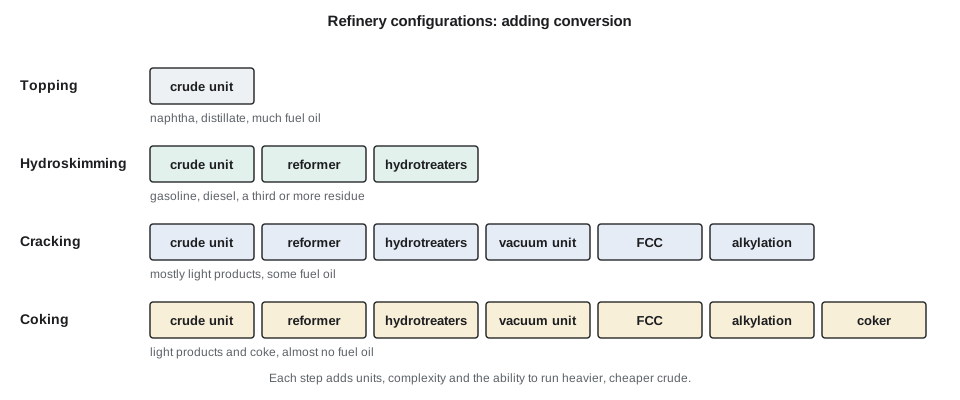
Refineries are often grouped by how much conversion capacity they have. A topping refinery has only a crude unit and makes naphtha, distillates and a large amount of heavy fuel oil; few remain in North America. A hydroskimming refinery adds a catalytic reformer and hydrotreaters, so it can make gasoline and low-sulfur diesel, but it still leaves a third or more of the crude as residue. A cracking refinery adds a vacuum unit and a fluid catalytic cracker or hydrocracker to convert vacuum gas oil into gasoline and distillate. A coking or full-conversion refinery adds a coker or residue hydrocracker so that even the heaviest part of the crude is turned into light products and coke. the St. Clair refinery is a coking refinery, which is why it can run heavy, cheaper crudes such as diluted bitumen.
The choice of configuration follows the crude and the market. Light, sweet crude can be run profitably in a simple refinery because most of it is already in the gasoline and diesel range. Heavy, sour crude needs a lot of conversion and sulfur removal, but it is cheaper. The difference in price between heavy and light crude, the heavy-light differential, is what pays for cokers and hydrocrackers. When the differential is wide, complex refineries earn far more than simple ones; when it narrows, the advantage shrinks.
The Nelson complexity index
A widely used measure of how much processing a refinery has is the Nelson complexity index, developed by W. L. Nelson in the 1960s. Each unit is given a factor that reflects its cost relative to crude distillation, which is assigned a factor of 1. The factor is multiplied by the unit's capacity as a fraction of crude capacity, and the products are summed. A simple hydroskimming refinery scores around 2 to 5; a complex coking refinery scores 10 or more. The index is a rough guide to replacement cost and to how much value a refinery can add, and it is used in valuations and comparisons. The factors in the code below are rounded typical values, labelled illustrative; published tables differ in detail.
# Nelson complexity index of the partner refinery (unit factors are typical published values, rounded)
units = [  # (unit, capacity in b/d, complexity factor)
    ("crude distillation", 120000, 1.0),
    ("vacuum distillation", 52000, 2.0),
    ("delayed coker", 26000, 6.0),
    ("fluid catalytic cracker", 38000, 6.0),
    ("catalytic reformer", 22000, 5.0),
    ("naphtha hydrotreater", 26000, 2.0),
    ("distillate hydrotreater", 40000, 2.5),
    ("alkylation", 9000, 10.0),
    ("isomerization", 7000, 3.0),
    ("sulfur recovery (t/d)", 140, 240.0),
]
cdu = units[0][1]
total = 0.0
print(f"{'unit':40s} {'b/d':>8s} {'factor':>7s} {'points':>7s}")
for name, cap, f in units:
    pts = f * cap / cdu
    total += pts
    print(f"{name:40s} {cap:8d} {f:7.1f} {pts:7.2f}")
print(f"Nelson complexity index: {total:.1f}")
# Simple product slate check: fraction of crude converted to light products
light = {"gasoline pool": 60000, "jet and diesel": 48000, "LPG": 7000}
heavy = {"coke (oil equivalent)": 5000, "asphalt and fuel oil": 6000}
gain = sum(light.values()) + sum(heavy.values()) - cdu
print(f"light products {sum(light.values())} b/d = {100*sum(light.values())/cdu:.0f} % of crude; volume gain {gain} b/d ({100*gain/cdu:.1f} %)")unit b/d factor points crude distillation 120000 1.0 1.00 vacuum distillation 52000 2.0 0.87 delayed coker 26000 6.0 1.30 fluid catalytic cracker 38000 6.0 1.90 catalytic reformer 22000 5.0 0.92 naphtha hydrotreater 26000 2.0 0.43 distillate hydrotreater 40000 2.5 0.83 alkylation 9000 10.0 0.75 isomerization 7000 3.0 0.17 sulfur recovery (t/d) 140 240.0 0.28 Nelson complexity index: 8.5 light products 115000 b/d = 96 % of crude; volume gain 6000 b/d (5.0 %)
The result, about 8.5, places the St. Clair refinery in the middle of the range for North American coking refineries. Roz points out two things the index hides. It says nothing about how well the units are run, and it treats a large old unit and a small modern one alike if their capacities are the same. A refinery with a high index can still lose money if its units are unreliable or its energy use is poor.
Worked problem
Complexity contribution of a new unit
the St. Clair refinery considers adding a 12,000 b/d hydrocracker, a unit with a Nelson factor of about 6. By how much would the complexity index rise?
Show solution
- The contribution is the factor times capacity as a fraction of crude capacity.
- \(6 \times 12\,000 / 120\,000 = 0.6\).
- The index would rise from about 8.5 to about 9.1.
Answer: About 0.6 points, to about 9.1.
Volume gain and the refinery balance
A refinery's products occupy more volume than the crude it runs, even though mass is conserved. Cracking and hydrogen addition turn dense heavy molecules into lighter ones with lower density, so a barrel of crude can yield 1.05 barrels or more of products. This volume gain is worth real money because products are sold by volume. The code above shows a gain of about 5 % for the St. Clair refinery. A refinery engineer always checks both a mass balance, which must close, and a volume balance, which shows the gain.
| Configuration | Main units added | Typical complexity | Residue left |
|---|---|---|---|
| Topping | Crude unit only | about 1 | High |
| Hydroskimming | Reformer, hydrotreaters | 2 to 5 | 30 % or more |
| Cracking | Vacuum unit, FCC or hydrocracker | 6 to 9 | 10 to 20 % |
| Coking (full conversion) | Coker or residue hydrocracker | 9 to 14 | Little (coke instead) |
Products and specifications
Fuels must meet specifications for their properties, set by standards organizations and regulators. Gasoline has limits on octane, vapour pressure, distillation range, sulfur, benzene and other aromatics. In Canada sulfur in gasoline is governed by the federal Sulphur in Gasoline Regulations, which have held gasoline to an average of 10 mg/kg of sulfur since 2020, and benzene by the federal Benzene in Gasoline Regulations. Diesel has limits on cetane number, sulfur, density, flash point, cold flow properties and lubricity; on-road diesel is limited by the federal Sulphur in Diesel Fuel Regulations, which cap on-road diesel at 15 mg/kg. Jet fuel has strict limits on freezing point, flash point, thermal stability and cleanliness, because an aircraft cannot afford a fuel problem. Every product leaving the refinery is tested and certified against its specification.
These specifications shape the refinery as much as the crude does. The move to ultra-low sulfur fuels in the 2000s and 2010s led to large investments in hydrotreating and hydrogen production. Limits on benzene drove changes in reforming and isomerization. Renewable fuel rules made ethanol blending standard in gasoline, which is why Kingfisher Bioenergy's product is part of almost every litre of gasoline that leaves the St. Clair refinery.
Safety and the refinery workforce
Refineries handle large inventories of flammable and toxic materials at high temperature and pressure. They are covered by CSA Z767 process safety management and by occupational health and safety law under Ontario's Occupational Health and Safety Act, and they hold environmental approvals for air emissions and water discharges through an Environmental Compliance Approval from the Ontario Ministry of the Environment, Conservation and Parks, with Ontario's air standards for benzene and sulfur dioxide among the limits. Major refinery accidents, including the 2005 explosion at an isomerization unit in Texas City that killed 15 people, have shaped modern process safety; CHE-380 studied the lessons. Theo's first week includes a site orientation, permit-to-work training and a walk of every unit with an operator. Roz's view is that an engineer who cannot find the isolation valves on a unit has no business changing its operation.
The professional responsibility is the same as at the ethanol plant. Changes to a refinery process go through management of change, the design is checked and approved by a P.Eng. registered with Professional Engineers Ontario, and the operating and maintenance staff are consulted before any change is made. Theo's project work will be reviewed in exactly that way.
Common mistakes
MistakeJudging a refinery only by its complexity index.
InsteadComplexity measures equipment, not how well it is run or how well its crude and market match.
MistakeAssuming product barrels equal crude barrels.
InsteadCracking and hydrogen addition give a volume gain; check both mass and volume balances.
MistakeThinking heavy crude is always uneconomic.
InsteadHeavy crude is cheaper; with enough conversion capacity the discount pays for the extra processing.
MistakeTreating specifications as fixed forever.
InsteadFuel rules on sulfur, benzene, renewable content and carbon intensity have changed many times and keep changing.
Summary and key terms
- A refinery separates crude oil by boiling range, converts heavy fractions to light ones, removes contaminants and blends products to specification.
- Configurations range from topping and hydroskimming to cracking and full-conversion coking refineries.
- The Nelson complexity index sums unit factors weighted by capacity; the St. Clair refinery scores about 8.5.
- Refineries gain volume because light products are less dense than crude.
- Product specifications for sulfur, benzene, octane, cetane and renewable content drive much of refinery investment.
- Hydroskimming refinery
- A refinery with distillation, reforming and hydrotreating but no heavy-oil conversion.
- Coking refinery
- A full-conversion refinery that turns vacuum residue into lighter products and coke.
- Nelson complexity index
- A measure of refinery processing capability based on unit cost factors and capacities.
- Heavy-light differential
- The price difference between light and heavy crude oils.
- Volume gain
- The increase in product volume over crude volume due to lower product densities.
- Barrels per day (b/d)
- The standard unit of refinery capacity; one barrel is about 0.159 m³.
Practice problems
Work each problem on paper first, then reveal the answer to check.
What does a hydroskimming refinery lack compared with a cracking refinery?
Show answer
Conversion units such as a vacuum unit and a catalytic cracker or hydrocracker.
Why can a coking refinery pay more for heavy crude than a simple one?
Show answer
It can convert the residue into light products; the heavy crude discount pays for that processing.
A 10,000 b/d alkylation unit with factor 10 is added to a 100,000 b/d refinery. How much does the complexity index rise?
Show answer
\(10 \times 0.1 = 1.0\) point.
Why do refineries report a volume gain?
Show answer
Products are lighter than crude, so the same mass fills more volume.
Name three gasoline specifications.
Show answer
Octane, vapour pressure and sulfur (also benzene, distillation range, aromatics).
What drove large investment in hydrotreating since 2000?
Show answer
Ultra-low sulfur gasoline and diesel rules.
Lesson quiz · 5 questions
Score 60% or more to complete this lesson.
Create a free account to save your progress, take quizzes and earn a certificate.