
CHE-470 · Lesson 4 of 12 · 21 min
Hydrotreating and sulfur recovery
Malik calls Theo from the Kingfisher plant with a question about the renewable diesel unit they are planning: will its hydrotreater behave like a refinery diesel hydrotreater? Theo does not know, so he asks Roz, who walks him over to the diesel hydrotreater at the St. Clair refinery. Hydrotreating, she says, is the refinery's most widespread process. Nearly every product stream passes through one before it can be sold, because fuel specifications on sulfur are now so tight. In Canada, the federal Sulphur in Gasoline Regulations, which have held gasoline to an average of 10 mg/kg of sulfur since 2020 and the federal Sulphur in Diesel Fuel Regulations, which cap on-road diesel at 15 mg/kg set the limits. Removing the sulfur is only half the job; the refinery must also turn the hydrogen sulfide it produces into elemental sulfur, which is the work of the sulfur plant.
What hydrotreating does
A hydrotreater reacts an oil fraction with hydrogen over a catalyst at 300 to 400 °C and 30 to 150 bar. The main reactions are hydrodesulfurization, in which sulfur compounds react with hydrogen to form hydrocarbons and hydrogen sulfide; hydrodenitrogenation, which removes nitrogen as ammonia; olefin and aromatic saturation; and removal of oxygen, metals and silicon. A typical desulfurization reaction for a thiophene is:
The catalysts are cobalt-molybdenum or nickel-molybdenum sulfides on alumina. Cobalt-molybdenum is preferred for desulfurization at moderate pressure; nickel-molybdenum is better for nitrogen removal and aromatic saturation and is used for cracked stocks and hydrocracker pretreatment. The catalyst is loaded in its oxide form and sulfided in place before use.
Why the last sulfur is hardest
Sulfur compounds differ widely in reactivity. Mercaptans and sulfides react easily. Thiophenes and benzothiophenes are slower. The hardest are dibenzothiophenes with methyl groups next to the sulfur atom, such as 4,6-dimethyldibenzothiophene, which shield the sulfur from the catalyst surface. At the 10 to 15 ppm levels now required, almost all the sulfur left in the product is in these hindered molecules, so the last few hundred ppm need much more catalyst, higher pressure or higher temperature than the first few thousand.
Engineers often fit hydrotreater performance with an apparent nth-order rate law in sulfur concentration, with an order between 1.5 and 2 that reflects the spread of reactivities. For an ideal plug-flow reactor, the product sulfur \(S\) from a feed sulfur \(S_{0}\) at a liquid hourly space velocity LHSV follows:
LHSV is the volume flow of liquid feed per hour divided by the catalyst volume. A low LHSV means more catalyst per barrel and more severe treatment.
# Hydrotreating: first-order sulfur removal vs space velocity, hydrogen use and Claus sulfur recovery
import math
S_in = 1.30        # wt % sulfur in the diesel feed
k = 110.0          # apparent rate constant at reactor temperature (illustrative, lumped order 1.6)
n = 1.6
def s_out(lhsv):
    # nth-order plug flow: S^(1-n) - S0^(1-n) = (n-1) k / LHSV
    val = S_in ** (1 - n) + (n - 1) * k / lhsv
    return val ** (1 / (1 - n))
for lhsv in (3.0, 2.0, 1.5, 1.0, 0.7):
    print(f"LHSV {lhsv:3.1f} 1/h -> product sulfur {s_out(lhsv)*1e4:8.1f} ppm")
target = 10.0e-4   # 10 ppm, inside the 15 ppm ultra-low sulfur diesel limit
lo, hi = 0.2, 5.0
for _ in range(60):
    mid = (lo + hi) / 2
    lo, hi = (mid, hi) if s_out(mid) < target else (lo, mid)  # lower LHSV means more catalyst
print(f"LHSV for 10 ppm: {lo:.2f} 1/h")
# Hydrogen consumption: sulfur removal plus aromatics saturation
feed = 40000  # b/d
scf_per_bbl = 350
print(f"hydrogen demand {feed*scf_per_bbl/1e6:.1f} million scf/d ({feed*scf_per_bbl*0.0283/1e3:.0f} thousand Nm3/d approx.)")
# Sulfur recovery: H2S in amine acid gas -> elemental sulfur
crude, S_crude, sg = 120000, 1.2, 0.87     # b/d, wt %, specific gravity
t_crude = crude * 0.159 * sg               # t/d
s_tpd = t_crude * S_crude / 100
to_srU = 0.62    # fraction that ends up as H2S in amine and sour water gas
print(f"crude sulfur {s_tpd:.0f} t/d; about {s_tpd*to_srU:.0f} t/d reaches the sulfur plant")
for stages, rec in ((2, 0.955), (3, 0.97), ("3 + tail gas unit", 0.999)):
print(f"Claus {stages}: recovery {rec*100:.1f} %, sulfur to incinerator {s_tpd*to_srU*(1-rec):.2f} t/d")LHSV 3.0 1/h -> product sulfur 54.3 ppm LHSV 2.0 1/h -> product sulfur 28.2 ppm LHSV 1.5 1/h -> product sulfur 17.7 ppm LHSV 1.0 1/h -> product sulfur 9.1 ppm LHSV 0.7 1/h -> product sulfur 5.0 ppm LHSV for 10 ppm: 1.06 1/h hydrogen demand 14.0 million scf/d (396 thousand Nm3/d approx.) crude sulfur 199 t/d; about 124 t/d reaches the sulfur plant Claus 2: recovery 95.5 %, sulfur to incinerator 5.56 t/d Claus 3: recovery 97.0 %, sulfur to incinerator 3.71 t/d Claus 3 + tail gas unit: recovery 99.9 %, sulfur to incinerator 0.12 t/d
The code shows how steep the curve becomes. At an LHSV of 3 per hour the product carries about 54 ppm, but reaching 10 ppm needs an LHSV near 1.1, nearly three times as much catalyst. When ultra-low sulfur diesel rules came in, many refineries added a second reactor or replaced the whole unit with a larger, higher-pressure one rather than simply raising temperature, because higher temperature shortens catalyst life and, at the end of the run, aromatic saturation becomes limited by equilibrium.
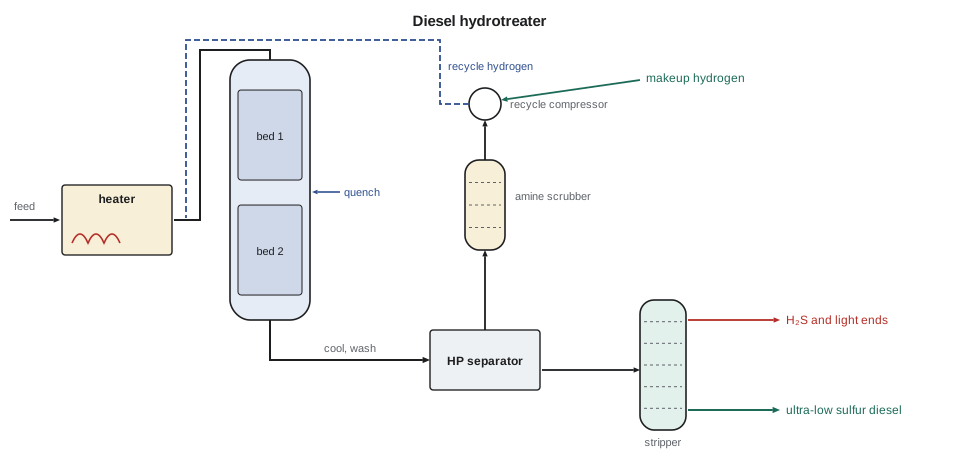
The hydrotreater flow scheme
In a typical unit, the feed is mixed with hydrogen-rich recycle gas, heated against the reactor effluent and then in a furnace, and passed down through one or more fixed catalyst beds. The reactions are exothermic, so cold hydrogen is injected between the beds as a quench to hold the temperature. The effluent is cooled, washed with water to dissolve ammonium salts that would otherwise deposit in the cooler, and separated at high pressure. The gas is scrubbed with an amine solution to remove hydrogen sulfide, compressed and recycled, with makeup hydrogen added to replace what was consumed. The liquid goes to a stripper that removes dissolved hydrogen sulfide and light ends.
Hydrogen consumption depends on the feed. A straight-run naphtha consumes very little; a diesel from the crude unit consumes perhaps 50 to 100 scf per barrel (9 to 18 Nm³/m³); a cracked light cycle oil from the cracker, rich in aromatics, can consume several hundred. The code estimates a demand of about 14 million scf per day for a 40,000 b/d diesel hydrotreater, a large share of the refinery's hydrogen balance in lesson 11.
Catalyst activity falls over the run as coke and metals deposit. The operators compensate by raising the reactor temperature, typically by 1 to 3 °C per month. When the weighted average bed temperature reaches the limit set by the metallurgy, product colour or equilibrium, the unit shuts down for a catalyst change. A run of two to four years is common for diesel units.
Amine treating
Hydrogen sulfide removed in the hydrotreaters, the cracker, the coker and elsewhere ends up in fuel gas, recycle gas and sour water. Amine units absorb it from the gas streams into an aqueous solution of an alkanolamine such as methyldiethanolamine (MDEA) or diethanolamine. The rich amine is regenerated by heating in a stripper, which releases a concentrated acid gas of hydrogen sulfide and some carbon dioxide. The sour water stripper does the same for the water streams, also releasing ammonia. Both acid gases go to the sulfur recovery unit.
The Claus process
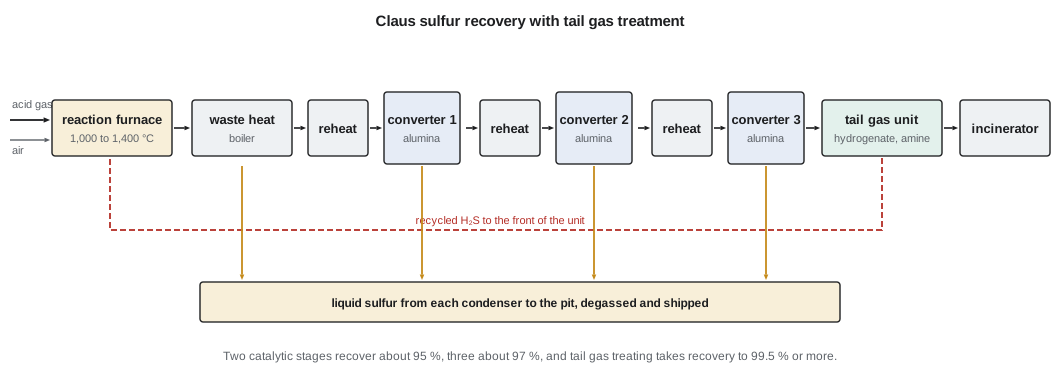
The Claus process converts hydrogen sulfide into elemental sulfur in two steps. In the thermal stage, about a third of the hydrogen sulfide is burned with air in a furnace at 1,000 to 1,400 °C to form sulfur dioxide. The remaining hydrogen sulfide then reacts with the sulfur dioxide:
Much of the conversion happens in the furnace. The gas is cooled in a waste heat boiler that raises steam, and sulfur is condensed and drained. The gas is then reheated and passed through two or three catalytic converters filled with activated alumina, each followed by a condenser, where the Claus reaction continues at 200 to 350 °C. Because the reaction is limited by equilibrium, which favours lower temperature but must stay above the sulfur dew point, each stage recovers less than the one before. Two catalytic stages typically give about 95 to 96 % overall recovery, three stages about 97 to 98 %.
The air-to-acid-gas ratio is critical. Burning too much hydrogen sulfide leaves excess sulfur dioxide; too little leaves excess hydrogen sulfide. Either way the 2:1 ratio needed for the Claus reaction is lost and recovery falls. A tail gas analyzer measures the ratio continuously and trims the air flow.
Tail gas treating
To reach the 99.5 to 99.9 % recovery that modern permits require, the Claus tail gas goes to a tail gas treating unit. The most common type hydrogenates all the remaining sulfur compounds back to hydrogen sulfide over a cobalt-molybdenum catalyst, quenches the gas, absorbs the hydrogen sulfide in a selective amine, and recycles it to the front of the Claus unit. What is left is incinerated, converting traces of hydrogen sulfide to sulfur dioxide before release. The code shows that at the St. Clair refinery, the tail gas unit cuts the sulfur sent to the incinerator from about 3.7 to about 0.1 tonnes per day.
Sulfur is stored as a liquid at about 140 °C, degassed to remove dissolved hydrogen sulfide, and shipped as liquid or formed into solid pellets. Most refinery sulfur is sold to make sulfuric acid, much of it for fertilizer.
| Configuration | Typical recovery | Sulfur emitted per 100 t/d feed |
|---|---|---|
| Two Claus catalytic stages | 95 to 96 % | 4 to 5 t/d |
| Three Claus catalytic stages | 97 to 98 % | 2 to 3 t/d |
| Claus plus tail gas treating | 99.5 to 99.9 % | 0.1 to 0.5 t/d |
Safety around hydrogen sulfide
Hydrogen sulfide is acutely toxic. At low concentrations it smells of rotten eggs, but at higher concentrations it deadens the sense of smell, so odour is no guide to safety. The amine units, sour water stripper, sulfur plant and sulfur pit are the places in a refinery where people are most likely to meet it. Refineries use fixed detectors, personal monitors, permit-to-work procedures and rescue plans for these areas, as covered in CHE-380. Sulfur pits also accumulate hydrogen sulfide in their vapour space, so they are swept with air and the vapour is routed to the incinerator.
From refinery to renewable diesel
Theo's answer to Malik turns out to be partly yes. Renewable diesel units use the same kind of hydrotreater, with nickel-molybdenum or similar catalyst, to remove oxygen from vegetable oils, used cooking oil and animal fats. But the oxygen removal is highly exothermic and consumes much more hydrogen, often 300 to 400 Nm³ per m³ of feed, and it makes water, carbon monoxide and carbon dioxide as well as propane. The reactors need more quench and recycle to control the heat, and the feeds need pretreatment to remove phosphorus, metals and chlorides that would poison the catalyst. Malik will need a much larger hydrogen supply than a diesel hydrotreater of the same size.
Theo also learns why refiners care so much about hydrogen partial pressure. Desulfurization of the hindered molecules proceeds partly through a route in which an aromatic ring is first saturated, which removes the steric shielding of the sulfur. That route depends strongly on hydrogen pressure. Raising the purity of the recycle gas, by purging more light hydrocarbons or by scrubbing more hydrogen sulfide out of it, raises the hydrogen partial pressure without changing the total pressure, and is one of the cheapest ways to get more desulfurization from an existing reactor.
Worked problem
Catalyst for ultra-low sulfur
A hydrotreater with 100 m³ of catalyst treats 6,000 m³/d of diesel to 50 ppm sulfur. How much catalyst would be needed to reach 10 ppm, if 10 ppm needs an LHSV of 1.06 per hour?
Show solution
- Feed rate: \(6\,000/24 = 250\) m³/h, so the current LHSV is \(250/100 = 2.5\) per hour.
- Catalyst volume for 10 ppm: \(250/1.06 = 236\) m³.
Answer: About 236 m³, more than double the current inventory.
Common mistakes
MistakeAssuming product sulfur falls linearly with catalyst volume.
InsteadThe last ppm are in hindered molecules; the curve is steep at low sulfur.
MistakeRaising temperature without limit to meet specification.
InsteadIt shortens catalyst life and aromatic saturation becomes equilibrium-limited.
MistakeRunning the Claus air ratio by feed-forward only.
InsteadUse the tail gas analyzer to hold the 2:1 hydrogen sulfide to sulfur dioxide ratio.
MistakeTrusting smell to detect hydrogen sulfide.
InsteadIt deadens the sense of smell; use detectors.
Summary and key terms
- Hydrotreating removes sulfur, nitrogen and metals with hydrogen over cobalt-molybdenum or nickel-molybdenum catalysts.
- The last ppm of sulfur sit in hindered dibenzothiophenes, so ultra-low sulfur needs much more catalyst.
- Amine units and sour water strippers concentrate hydrogen sulfide into acid gas.
- The Claus process burns a third of the hydrogen sulfide and reacts the rest with sulfur dioxide to make sulfur.
- Tail gas treating raises recovery to 99.5 % or more.
- Hydrodesulfurization
- Removal of sulfur from oil as hydrogen sulfide by reaction with hydrogen over a catalyst.
- LHSV
- Liquid hourly space velocity: liquid feed volume per hour divided by catalyst volume.
- Quench
- Cold hydrogen injected between catalyst beds to control temperature.
- Amine unit
- A unit that absorbs hydrogen sulfide from gas in an alkanolamine solution.
- Claus process
- Conversion of hydrogen sulfide to elemental sulfur by partial combustion and catalytic reaction.
- Tail gas treating
- Hydrogenation and amine absorption of the residual sulfur in Claus tail gas.
Practice problems
Work each problem on paper first, then reveal the answer to check.
Why is nickel-molybdenum preferred for cracked stocks?
Show answer
It is more active for nitrogen removal and aromatic saturation.
What is LHSV?
Show answer
Liquid feed volume per hour divided by catalyst volume.
Why is quench added between beds?
Show answer
The reactions are exothermic; quench holds the temperature.
What fraction of hydrogen sulfide is burned in the Claus furnace?
Show answer
About one third, to give a 2:1 ratio of hydrogen sulfide to sulfur dioxide.
Why does each Claus stage recover less than the one before?
Show answer
The reaction approaches equilibrium and less reactant remains.
Why are sulfur pits swept with air?
Show answer
To remove hydrogen sulfide released from the liquid sulfur.
Lesson quiz · 5 questions
Score 60% or more to complete this lesson.
Create a free account to save your progress, take quizzes and earn a certificate.