
CHE-470 · Lesson 11 of 12 · 22 min
Refinery hydrogen, energy and emissions
Ingrid's question from lesson 7, why a refinery with a reformer still needs a hydrogen plant, has become Theo's main project. Roz asks him to prepare the hydrogen balance for the St. Clair refinery, to estimate the carbon dioxide from the hydrogen plant, and to set out the options the refinery has for cutting emissions over the next decade. It is a topic every refinery now studies, because hydrogen production is one of the largest sources of carbon dioxide on a refinery site, and because in Canada the refinery's emissions and its fuels both face policy pressure: Ontario's Emissions Performance Standards program for large industrial emitters, which prices emissions above a sector benchmark in line with the federal floor price, and the federal Clean Fuel Regulations, which require gasoline and diesel suppliers to cut the life-cycle carbon intensity of their fuels in steps to 2030, with credits earned for low-carbon blending, process changes at the refinery and fuel switching.
The hydrogen balance
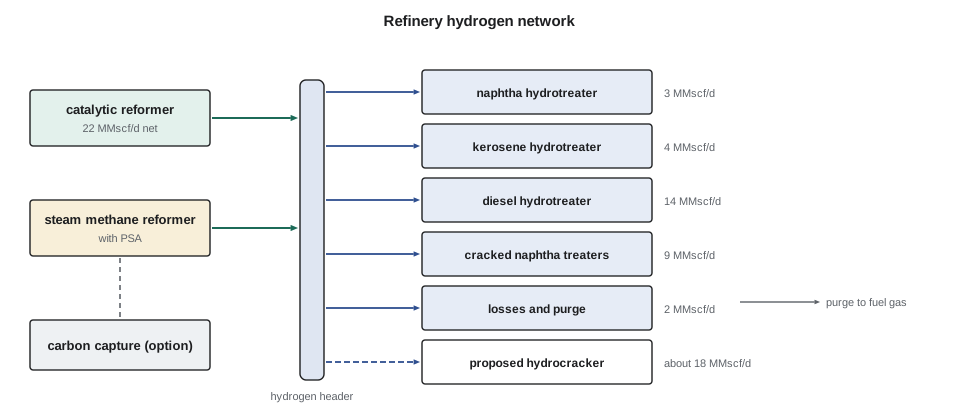
A refinery's hydrogen network links the units that make hydrogen to those that consume it. The catalytic reformer is the main internal source. The consumers are the hydrotreaters for naphtha, kerosene, diesel and cracked streams, plus the hydrocracker if there is one, the isomerization unit and small users. Some hydrogen is lost in purge streams, which are bled from hydrotreater recycle loops to keep light hydrocarbons from building up, and in hydrogen dissolved in liquid products. Whatever the reformer cannot supply must come from a steam methane reformer (SMR), either the refinery's own or one owned by an industrial gas company on or near the site.
# Refinery hydrogen balance and emissions from steam methane reforming
supply = {"catalytic reformer": 22.0}            # million scf/d, net of reformer recycle
demand = {"diesel hydrotreater": 14.0, "naphtha hydrotreater": 3.0, "cracked naphtha and FCC gasoline treaters": 9.0, "kerosene hydrotreater": 4.0, "losses and purge": 2.0}
gap = sum(demand.values()) - sum(supply.values())
print(f"hydrogen demand {sum(demand.values()):.0f} MMscf/d, reformer supplies {supply['catalytic reformer']:.0f}; SMR must make {gap:.0f} MMscf/d")
# SMR: CH4 + 2 H2O -> CO2 + 4 H2 overall (reforming plus shift); fuel adds more CO2
kmol_h2 = gap * 1e6 / 35.3 / 22.4   # kmol/d at standard conditions (approx.)
co2_process = kmol_h2 / 4 * 44 / 1000   # t/d from feed carbon
co2_fuel = co2_process * 0.6            # firing the reformer furnace (illustrative ratio)
tot = co2_process + co2_fuel
print(f"hydrogen {kmol_h2*2.016/1000:.1f} t/d; CO2 {co2_process:.0f} t/d process + {co2_fuel:.0f} t/d fuel = {tot:.0f} t/d")
print(f"about {tot/(kmol_h2*2.016/1000):.1f} t CO2 per t hydrogen")
for capture in (0.0, 0.6, 0.9):
    print(f"capture {capture*100:.0f} % of process CO2: emissions {tot - co2_process*capture:.0f} t/d")
# Carbon intensity of the gasoline pool with ethanol (gCO2e/MJ, illustrative)
ci_gas, ci_eth = 93.0, 55.0
for e in (0.0, 0.10, 0.15):
    eshare = e * 21.2 / (e * 21.2 + (1 - e) * 32.2)   # energy share (MJ/L)
    print(f"E{int(e*100):<2d}: pool CI {ci_gas*(1-eshare)+ci_eth*eshare:.1f} g/MJ")
# Proposed 12,000 b/d hydrocracker at about 1,500 scf/bbl
hcu = 12000 * 1516 / 1e6
print(f"with the proposed hydrocracker: demand {sum(demand.values()) + hcu:.0f} MMscf/d; SMR must make {gap + hcu:.0f} MMscf/d")hydrogen demand 32 MMscf/d, reformer supplies 22; SMR must make 10 MMscf/d hydrogen 25.5 t/d; CO2 139 t/d process + 83 t/d fuel = 223 t/d about 8.7 t CO2 per t hydrogen capture 0 % of process CO2: emissions 223 t/d capture 60 % of process CO2: emissions 139 t/d capture 90 % of process CO2: emissions 97 t/d E0 : pool CI 93.0 g/MJ E10: pool CI 90.4 g/MJ E15: pool CI 89.0 g/MJ with the proposed hydrocracker: demand 50 MMscf/d; SMR must make 28 MMscf/d
The code puts the current demand at the St. Clair refinery at about 32 million scf per day and the reformer's net supply at about 22 million, slightly less than the 24 million it produces in lesson 7 because some is used in the reformer's own recycle loop and some leaves with fuel gas. The SMR must make the difference, about 10 million scf per day or about 25 t/d of hydrogen. Adding the 12,000 b/d hydrocracker from lesson 6 would raise demand to about 50 million scf per day and the SMR's share to about 28 million, nearly three times as much. That one investment would make the hydrogen plant the deciding factor in the refinery's emissions.
Steam methane reforming
Steam methane reforming is the dominant way to make hydrogen in industry. Natural gas is desulfurized, mixed with steam and passed through nickel-catalyst tubes in a furnace at about 800 to 900 °C and 20 to 30 bar. Methane reacts with steam to form carbon monoxide and hydrogen. The gas then passes through shift reactors, where carbon monoxide reacts with more steam to form carbon dioxide and more hydrogen:
The overall result is four molecules of hydrogen per molecule of methane, with one molecule of carbon dioxide. The first reaction is strongly endothermic, so the reformer tubes sit in a large furnace that burns more natural gas and the purge gas from the purification step. Modern plants purify the hydrogen by pressure swing adsorption (PSA), in which beds of adsorbent take up everything except hydrogen at high pressure and release it at low pressure, giving 99.9 % or purer hydrogen. The PSA tail gas, containing carbon dioxide, methane and carbon monoxide, is burned in the reformer furnace.
An SMR therefore emits carbon dioxide from two sources: the process carbon dioxide that comes from the feed methane through the shift reaction, which is concentrated in the process gas before the PSA, and the combustion carbon dioxide from the furnace flue gas, which is dilute. The code estimates about 139 t/d of process carbon dioxide and about 83 t/d from firing, about 223 t/d in total, or roughly 9 tonnes of carbon dioxide per tonne of hydrogen. Published values for modern SMRs are typically 9 to 10 tonnes per tonne including the furnace.
Energy use in the refinery
Hydrogen is only part of the refinery's energy picture. Refineries use roughly 5 to 8 % of the energy in the crude they process, more for complex refineries running heavy crude. The largest users are the fired heaters of the crude and vacuum units, the reformer, the hydrotreaters and the coker, the FCC regenerator, which burns coke, and the steam system, which supplies stripping steam, turbines and tracing. The refinery burns its own fuel gas, a mixture of methane, ethane, hydrogen and some heavier gases from the processing units, topped up with purchased natural gas. Electricity is bought from the grid or made in cogeneration units that produce both steam and power.
Energy efficiency has improved steadily through better heat integration, as in the crude preheat train of lesson 3, more efficient furnaces with air preheat, power recovery from the FCC flue gas, and advanced process control that holds units closer to their optimum. Benchmarking studies compare refineries using indices that account for their configuration, so that a complex refinery is not penalized simply for having more units. Most refineries that have studied the question find that the cheapest emission reductions come first from energy efficiency, before any new technology.
| Source | Share of refinery CO2 (typical) | Concentration in flue or process gas | Capture difficulty |
|---|---|---|---|
| Fired heaters and boilers | 40 to 60 % | 3 to 10 % CO2 | Hard: dilute and spread across many stacks |
| FCC regenerator | 20 to 30 % | 10 to 20 % CO2 | Moderate: one large stack, but with dust and sulfur oxides |
| SMR process gas | 5 to 20 % | 15 to 20 % CO2 at pressure | Easiest: concentrated and at pressure |
| SMR furnace and other sources | 5 to 15 % | Dilute | Hard |
Options for lower-carbon hydrogen
The cheapest carbon dioxide to capture in a refinery is the process carbon dioxide from the SMR, because it is concentrated and at pressure. Amine or other solvents can remove most of it from the shifted gas before the PSA. That gives what is often called blue hydrogen. The code shows that capturing 90 % of the process carbon dioxide would cut the SMR's emissions from about 223 to about 97 t/d. Capturing the furnace carbon dioxide too would need a larger post-combustion unit on the flue gas, at a higher cost per tonne. Newer autothermal reforming designs, which supply the reforming heat by partial combustion inside the reactor with oxygen, put nearly all the carbon dioxide in the process gas and can capture more than 90 % overall.
Capture is only useful if the carbon dioxide can be stored or used. That requires a pipeline and a suitable geological formation, a deep saline aquifer or a depleted oil and gas reservoir, with the permits and monitoring to show the carbon dioxide stays put. Projects such as Quest at the Scotford upgrader, in lesson 9, show that it can be done at a scale of about a million tonnes a year. the St. Clair refinery's options depend on whether a carbon dioxide pipeline and storage site become available within reach.
Electrolytic hydrogen, made by splitting water with electricity, has no direct process emissions, and its carbon intensity depends on the electricity used. A refinery with access to low-carbon power can install electrolyzers to supply part of its hydrogen. The barriers are cost, since electrolytic hydrogen has usually been several times more expensive than SMR hydrogen, and scale: replacing the 25 t/d of SMR hydrogen at the St. Clair refinery would need an electrolyzer of roughly 50 to 60 MW running continuously. Several refineries have built electrolyzers of a few to a few tens of megawatts, partly to earn credits for lower-carbon fuels.
Carbon intensity of fuels
Fuel policies increasingly measure the carbon intensity (CI) of fuels in grams of carbon dioxide equivalent per megajoule, over the life cycle from extraction to combustion. In Canada, the federal Clean Fuel Regulations, which require gasoline and diesel suppliers to cut the life-cycle carbon intensity of their fuels in steps to 2030, with credits earned for low-carbon blending, process changes at the refinery and fuel switching. A refinery can lower the CI of its fuels by blending renewable content, such as ethanol in gasoline and biodiesel or renewable diesel in diesel, by reducing emissions at the refinery itself, for example through capture at the SMR, or by co-processing renewable feeds such as vegetable oil in its existing hydrotreaters or FCC.
The code shows the effect of ethanol on the gasoline pool. Ethanol has lower energy density than gasoline, so 10 % ethanol by volume is only about 7 % by energy, and the pool CI falls from about 93 to about 90 g/MJ with E10 and to about 89 with E15, if the ethanol's own CI is about 55 g/MJ. In Canada, E10 is the usual blend and some provinces require more renewable content than the federal minimum. Ethanol with lower CI, from plants with carbon capture on their fermentation carbon dioxide or using low-carbon energy, reduces the pool CI further. Kingfisher's ethanol plant, which Malik has been working to decarbonize, is exactly the kind of supplier the refinery's fuel marketing team wants to talk to.
Co-processing and renewable diesel
A refinery can also make renewable fuels directly. Co-processing feeds a few percent of vegetable oil, tallow or bio-oil into an existing hydrotreater or FCC alongside fossil feed, producing a fuel with a renewable share that can be tracked and credited. Higher shares need more hydrogen, cause more heat release and may damage catalysts, so co-processing is usually limited to about 5 % in diesel hydrotreaters. Some refineries have gone further and converted whole units, or the entire site, to renewable diesel production, using the hydrotreating chemistry seen in lesson 4. Those conversions need large new hydrogen supplies and feed pretreatment, and they compete with each other for a limited supply of fats and oils.
The plan Theo presents
Theo's draft emissions roadmap for the St. Clair refinery has four steps. First, energy efficiency: cleaning and upgrading the crude preheat train, adding air preheat to two furnaces and optimizing the steam system. Second, the SMR: preparing for capture of its process carbon dioxide, starting with a study of storage options and a pipeline route. Third, fuels: increasing ethanol supply from low-CI producers and testing co-processing of a few percent of renewable feed in the diesel hydrotreater. Fourth, the hydrocracker decision: if it goes ahead, its hydrogen should come from a new low-carbon source rather than a conventional SMR. Roz tells him the order is right but warns that each step will be judged on its cost per tonne of carbon dioxide avoided and, where a carbon price applies, on the carbon cost it saves; the planners will put both into the model in lesson 12.
Worked problem
Carbon dioxide from an SMR
An SMR makes 40 t/d of hydrogen. Using 4 mol of hydrogen per mole of carbon dioxide from the feed, and assuming the furnace adds 60 % more on top, estimate the total carbon dioxide.
Show solution
- Hydrogen: \(40\,000/2.016 = 19\,840\) kmol/d.
- Process carbon dioxide: \(19\,840/4 \times 44 = 218\,000\) kg/d \(= 218\) t/d.
- Total: \(218 \times 1.6 = 349\) t/d.
Answer: About 350 t/d, or about 8.7 t of carbon dioxide per tonne of hydrogen.
Common mistakes
MistakeAssuming the reformer covers all hydrogen needs.
InsteadIts supply varies with gasoline operations; most refineries need an SMR.
MistakeCounting only process carbon dioxide from the SMR.
InsteadThe furnace adds a large dilute share.
MistakeTreating volume ethanol share as energy share.
InsteadEthanol has about two thirds the energy density of gasoline.
MistakePlanning capture without a storage route.
InsteadCapture is only useful with a pipeline and permitted storage.
Summary and key terms
- The hydrogen balance links the reformer and SMR to hydrotreaters, the hydrocracker and purge losses.
- SMR makes hydrogen and carbon dioxide from methane and steam, about 9 to 10 t of carbon dioxide per tonne of hydrogen.
- Fired heaters, the FCC regenerator and the SMR are the main carbon dioxide sources.
- SMR process carbon dioxide is the cheapest to capture; storage is the key enabler.
- Fuel carbon intensity falls with renewable blending, co-processing and lower refinery emissions.
- Steam methane reforming
- Production of hydrogen from methane and steam over nickel catalyst, followed by shift.
- Pressure swing adsorption
- Purification of hydrogen by adsorbing impurities at high pressure and releasing them at low pressure.
- Blue hydrogen
- Hydrogen from natural gas with its carbon dioxide captured and stored.
- Electrolytic hydrogen
- Hydrogen made by splitting water with electricity.
- Carbon intensity
- Life-cycle greenhouse gas emissions per unit of fuel energy, in g CO2e/MJ.
- Co-processing
- Processing renewable feeds together with fossil feeds in existing refinery units.
Practice problems
Work each problem on paper first, then reveal the answer to check.
Why does a refinery hydrotreater loop purge gas?
Show answer
To keep light hydrocarbons from building up and diluting the hydrogen.
How many molecules of hydrogen does SMR with shift make per methane?
Show answer
Four.
Why is SMR process carbon dioxide easier to capture than furnace carbon dioxide?
Show answer
It is concentrated and at pressure.
What is the main barrier to electrolytic hydrogen in refineries?
Show answer
Cost relative to SMR hydrogen, and the scale of power needed.
Why does E10 cut pool carbon intensity by less than 10 %?
Show answer
Ethanol is only about 7 % of the energy, and it has its own CI.
What limits co-processing shares?
Show answer
Hydrogen demand, heat release and catalyst effects.
Lesson quiz · 5 questions
Score 60% or more to complete this lesson.
Create a free account to save your progress, take quizzes and earn a certificate.