
BLR-120 · Lesson 9 of 12 · 20 min
Chain falls, come-alongs and rigging inside boilers
Inside a boiler there is no crane. When the Riverbend crew replaced six boiler bank tubes in the spring, every tube, every scaffold board and every tool went in through a door or a roof opening and was moved by hand rigging: beam clamps on the structural steel, chain falls hung from them, lever hoists to pull pieces sideways, and a great deal of planning about where each load would hang at each moment. This fall, Ironbridge is back at Riverbend on the same contract to replace a section of waterwall in the Unit 2 furnace, and at Tamarack Pulp to replace floor tubes in the recovery boiler. Both jobs are hand rigging in a confined, crowded space, and they are where boilermakers do their most characteristic rigging work. This lesson covers chain falls, lever hoists and wire rope pullers, rigging points inside boilers, angled pulls, and transferring a load from one hoist to another.
Hand-operated hoists
Three kinds of hand-operated hoist do most of the work inside boilers. A chain fall, or manual chain hoist, lifts a load on a load chain when the operator pulls a hand chain; the gearing gives a large mechanical advantage, so one person can lift a tonne or more slowly. A lever hoist, often called a come-along, does the same with a ratchet lever and can pull in any direction, which makes it the tool for pulling a load sideways, tensioning a sling or fine-tuning a position. A wire rope puller, sometimes known by a maker's trade name, pulls a wire rope through jaws in a lever-operated housing and can pull long distances, because the rope is not wound on a drum. Electric and air-powered chain hoists are used where many lifts are needed or the hoist hangs out of reach.
Each hoist has a rated capacity marked on it and a load chain or rope matched to it. Hand hoists are designed so that one person pulling at a normal force will lift the rated load; if the hand chain or lever takes more than one person to pull, the hoist is overloaded or damaged, and extending the lever with a pipe, a cheater, is forbidden. Hoists are inspected before use and periodically under ASME B30.16 for chain hoists and B30.21 for lever hoists, and the Alberta Code's rigging rules apply to all of them.
| Hoist | Best use inside a boiler | Watch for |
|---|---|---|
| Chain fall | Vertical lifts from a beam clamp or trolley | Twisted chain, damaged hook latch, load brake slipping |
| Lever hoist | Sideways pulls, tensioning, positioning | Pulling at an angle over an edge, using a cheater bar |
| Wire rope puller | Long pulls, dragging tube panels along a floor | Rope damage, anchor strength, people in the line of the rope |
| Powered chain hoist | Repeated lifts, hoists out of reach | Electrical or air supply in a wet or hot space, control pendant care |
Rigging points inside a boiler
The first question in boiler rigging is what to hang the hoist from. The boiler's tubes are not rigging points. They are thin, pressure-retaining and often weakened by erosion or corrosion, and a load hung from a tube can kink it, crack a weld or start a leak that appears only when the boiler is back in service. Approved rigging points are the boiler's structural steel, the buckstays that tie the furnace walls together where the owner has approved them, purpose-built lifting lugs or rails installed during construction, and temporary beams and lugs designed for the job. On Riverbend Unit 2, the original builder left lifting beams in the penthouse above the superheater headers, and Peg Lindqvist, the owner's inspector, keeps a drawing marked with every approved rigging point and its capacity.
Beam clamps attach to the flange of a structural beam and provide a lifting eye; they are rated for a load in a particular direction, usually straight down, and some are rated for limited angles. A beam clamp is fitted to a flange width within its range, tightened as the maker requires and checked that it sits square on the flange. Slings choked around beams are also used, with softeners on the sharp flange edges. Where no approved point exists, the lift engineer designs a temporary one, and it is installed and inspected before use.
Riverbend's rule, which Kiera hears from Dale and from Peg, is simple: every rigging point used inside the boiler is on the approved drawing or has an engineer's design, and if it is not, it is not used.
Moving a tube panel
The new waterwall section for Unit 2 is a tube panel, a set of tubes welded together side by side with membrane bars, about 2.4 m wide and 6 m long, weighing 1,850 kg. It is brought into the furnace in sections through a temporary opening cut in the roof, lowered with chain falls on the penthouse beams, and then moved sideways to the wall where it will be fitted. That sideways move is where the rigging gets interesting. The panel is hung from two chain falls on two different beams, and by paying out one and taking in the other, the crew can swing it across without anyone pushing it by hand.
When a load hangs from two hoists that are not directly above it, each hoist's chain runs at an angle, and the chain tensions are larger than the shares of the weight. The calculation is the same as for slings at an angle, but in the boiler the angles are often steep and unequal, and the tension in one chain can be close to the whole weight of the panel or even more. The crew must check both chain falls for the tension they will actually carry at each position along the move, not just the panel's weight divided by two.
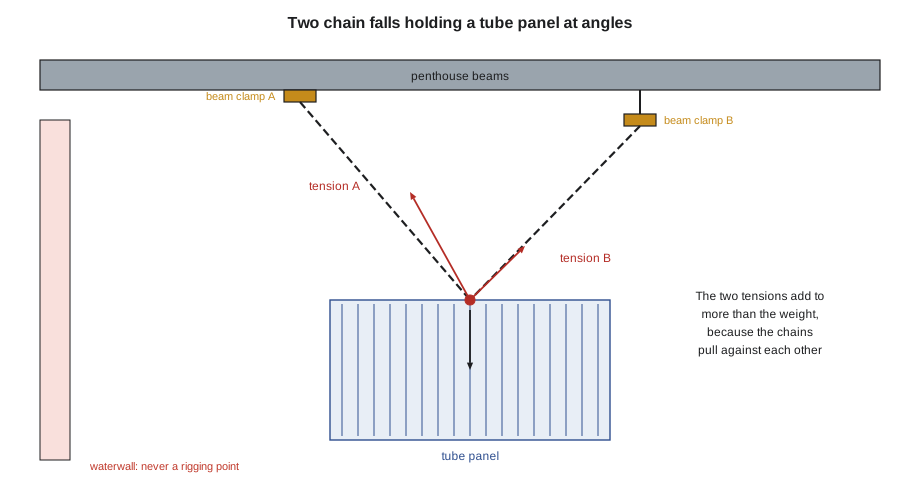
At one stage of the move, the panel's lifting lug hangs 1.8 m to the right of beam clamp A and 3.2 m below it, and 1.2 m to the left of beam clamp B and 2.6 m below it. Dale has Kiera calculate the tensions.
# Two chain falls holding a tube panel inside the boiler (metric)
import math
W = 1_850                      # panel weight (kg)
# beam clamp positions and the panel lug, measured in the vertical plane (m)
A = (-1.8, 3.2); B = (1.2, 2.6); P = (0.0, 0.0)
def unit(a, b):
    dx, dy = b[0] - a[0], b[1] - a[1]; L = math.hypot(dx, dy); return dx / L, dy / L, L
ax, ay, La = unit(P, A); bx, by, Lb = unit(P, B)
# solve Ta*a + Tb*b = (0, W) for the two chain tensions
det = ax * by - ay * bx
Ta = (0 * by - W * bx) / det; Tb = (ax * W - ay * 0) / det
print(f"chain fall A: {La:4.2f} m of chain, angle {math.degrees(math.atan2(ay, ax)):5.1f} deg, tension {Ta:6,.0f} kg")
print(f"chain fall B: {Lb:4.2f} m of chain, angle {math.degrees(math.atan2(by, bx)):5.1f} deg, tension {Tb:6,.0f} kg")
print(f"sum of tensions {Ta + Tb:,.0f} kg for a {W:,} kg panel")
for cap in (1_000, 2_000, 3_000):
    ok = "OK" if max(Ta, Tb) <= cap else "too small"
print(f" {cap:,} kg chain falls: {ok}")chain fall A: 3.67 m of chain, angle 119.4 deg, tension 957 kg chain fall B: 2.86 m of chain, angle 65.2 deg, tension 1,119 kg sum of tensions 2,076 kg for a 1,850 kg panel 1,000 kg chain falls: too small 2,000 kg chain falls: OK 3,000 kg chain falls: OK
The two tensions add to 2,076 kg for an 1,850 kg panel, because the chains pull partly sideways against each other. Chain fall B, the steeper one at this position, carries 1,119 kg, more than 60 percent of the panel's weight. Rated 1,000 kg chain falls, which would have looked adequate for half the weight, would be overloaded. The crew uses 2,000 kg chain falls, and Kiera checks the beam clamps' ratings for the chain angles at the most extreme position of the move as well.
Transferring a load between hoists
Long moves inside a boiler are made in stages, with the load passed from one set of hoists to the next. A transfer is a controlled change of who holds the load. The next hoist is rigged and its chain taken up until it begins to carry load, then the first hoist is slowly paid out while the second takes in, until the second carries all the load and the first goes slack. During the transfer, both hoists share the load at angles, and the tension in each must stay within its rating at every point. The worst case is usually partway through, when the chains are at their widest angles.
Transfers fail when the crew hurries, when two people pull hand chains at once without coordinating, or when a hoist is unhooked before it is completely slack. The rule is one move at a time, called out by one person, with the load watched continuously. Nobody stands under the load, and nobody puts hands between the load and the tubes it is moving past.
Pulling at an angle and the effect of sheaves
A lever hoist or wire rope puller pulling a load across a floor or up a slope needs an anchor that can take the pull, and the anchor load can be much larger than the pull if the line runs around a snatch block. A line passing around a block and turning back on itself puts nearly twice the line pull on the block's anchor; a line turning through 90 degrees puts about 1.4 times the line pull. Riggers check the angle at every block and size the block and its anchor for the resultant, not for the line pull.
| Angle between the lines at the block | Load on the block's anchor |
|---|---|
| 0 degrees (line doubles back) | 2.0 × line pull |
| 60 degrees | 1.73 × line pull |
| 90 degrees | 1.41 × line pull |
| 120 degrees | 1.0 × line pull |
| 150 degrees | 0.52 × line pull |
Rigging in a recovery boiler
At Tamarack Pulp, the recovery boiler's floor tubes are being replaced, a job done every few years because the floor sits under the smelt bed and corrodes. The space under the furnace is low and full of smelt spouts and their cooling water lines; above, the furnace is tall and dark. The crew lowers the floor tube panels through the furnace from a roof opening, with chain falls on lifting beams installed for the job and a powered hoist at the top for the long drop. Because the recovery boiler is a confined space with its own hazards, including the smelt-water explosion hazard covered in the first course, every rigging plan is part of the confined space entry plan, and all water lines in the area are isolated before work begins.
The rigging inside the recovery boiler also has to work around the scaffold. A tall scaffold fills much of the furnace, and the panels must be lowered past it through a planned opening in the scaffold's decks. The scaffold builder and the rigging crew agree on the opening before the scaffold goes up, and the panels' drop zone is barricaded at every scaffold level while a panel is moving.
Good practice with hand hoists
- Check the hoist's tag, capacity and inspection date, and inspect the hook latches, chain and brake before use.
- Hang the hoist from an approved rigging point, with the hook seated fully and the latch closed.
- Keep the load chain straight and untwisted; a twisted chain does not run properly over the sheave and can jump.
- Never wrap the load chain around the load as a sling; use a proper sling.
- One person pulls each hand chain, at normal force; if it takes more, stop and find out why.
- Never stand under a load hanging from a hand hoist; hand hoists can slip if their brakes are worn or contaminated.
- Do not leave a load hanging on a hand hoist unattended; land it or secure it with a second support.
Worked problem
Load on a snatch block anchor
A wire rope puller drags a tube bundle along the floor with a line pull of 1,200 kg. The rope runs around a snatch block anchored to the boiler's steel, turning through 90 degrees. What load does the block's anchor carry?
Show solution
- The angle between the incoming and outgoing lines is 90 degrees.
- From the table, the anchor load is 1.41 times the line pull.
- Anchor load: 1.41 × 1,200 = 1,690 kg.
Answer: The block and its anchor must be rated for about 1,700 kg, not the 1,200 kg line pull.
Common mistakes
MistakeHanging a chain fall from a boiler tube.
InsteadUse the approved rigging points: structural steel, approved lugs and beams, or engineered temporary points.
MistakeChoosing chain falls for half the load weight when the chains will be at angles.
InsteadCalculate the tension in each chain at the worst position of the move.
MistakeUsing a cheater bar on a lever hoist.
InsteadIf one person cannot pull it at normal force, the hoist is overloaded or damaged.
MistakeUnhooking a hoist before the load is fully transferred.
InsteadPay out slowly until the first hoist is completely slack, then unhook.
MistakeSizing a snatch block for the line pull.
InsteadSize it for the resultant at its angle, up to twice the line pull.
Summary and key terms
- Chain falls lift vertically, lever hoists pull in any direction and wire rope pullers make long pulls.
- Boiler tubes are never rigging points; use structural steel, approved lugs and beams, or engineered temporary points.
- When a load hangs from two hoists at angles, each chain's tension exceeds its share of the weight and can approach the whole weight.
- Transfers between hoists are made one move at a time, with the tensions checked at the worst point.
- A snatch block's anchor carries up to twice the line pull, depending on the angle.
- Hand hoists are inspected, hung correctly, pulled by one person and never left holding a load unattended.
- Chain fall
- A hand-operated chain hoist that lifts a load chain by pulling a hand chain.
- Lever hoist
- A ratchet-lever hoist, often called a come-along, that can pull in any direction.
- Wire rope puller
- A lever-operated device that pulls wire rope through gripping jaws.
- Beam clamp
- A clamp that attaches to a beam flange and provides a lifting eye.
- Snatch block
- A pulley block that opens at the side so a rope can be inserted without threading the end.
- Load transfer
- Passing a load from one hoist or set of rigging to another in a controlled way.
Practice problems
Work each problem on paper first, then reveal the answer to check.
A 1,000 kg load hangs from two chain falls, each at 45 degrees from vertical and symmetrical. What is the tension in each?
Show answer
500 / cos 45° = 707 kg.
Why is a boiler tube not a rigging point?
Show answer
It is thin, pressure-retaining and may be weakened; loading it can damage it and cause a later leak.
A line turns 180 degrees around a block (doubles back) with a pull of 800 kg. What does the anchor carry?
Show answer
About 1,600 kg.
What should you do if a chain fall takes more than one person to pull?
Show answer
Stop; the hoist is overloaded or damaged.
Lesson quiz · 5 questions
Score 60% or more to complete this lesson.
Create a free account to save your progress, take quizzes and earn a certificate.