
BLR-120 · Lesson 6 of 12 · 19 min
Ground bearing, outriggers and crane mats
A crane is only as stable as the ground under it. Every load chart assumes the crane sits level on ground firm enough to carry its outrigger or track loads without settling, and the notes on the chart say so. Yet ground failure is one of the most common causes of crane overturns: an outrigger punches through a crust of asphalt into soft fill, a track settles into a backfilled trench, or a float sits over a buried culvert that collapses. Industrial sites are full of these traps. Under the gravel of a plant road there may be sewers, cable ducts, firewater mains, old foundations, and excavations filled in during earlier turnarounds. This lesson covers how outrigger and track loads are estimated, how mats spread them, and how the ground is assessed before a crane sets up.
Outrigger loads
When a crane on outriggers lifts, its weight and the load are carried by the four outrigger floats, but not equally. With the load over one corner, most of the combined weight shifts to the float nearest the load, and the float on the opposite corner may carry very little. The exact outrigger loads depend on the crane's geometry, the slew angle, the counterweight and the load, and most crane makers publish them, either in tables or through software that gives the maximum outrigger load for any configuration. The lift plan uses the maker's figures.
For a first check, before the maker's figures are available, riggers often use a quick rule: the worst outrigger can carry up to about three-quarters of the crane's total weight plus the load. The rule is conservative for most cranes and lifts, but it is only a screening tool; the maker's figure is what the mats are designed for.
The pressure under a float is the outrigger load divided by the float's contact area. Outrigger floats are small, often 0.5 to 0.8 m², so the pressure under a bare float is very high, far more than most ground can carry. The answer is to spread the load over a larger area with mats or pads.
Ground bearing capacity
Every soil and surface has a limit to the pressure it can carry without excessive settlement or failure, called its allowable bearing pressure. The limit depends on the soil type, its compaction, its moisture, any frost and the size of the loaded area. Typical allowable values range from very low for soft clay or loose fill to high for dense gravel and rock. A plant's roads and laydown areas are usually built on compacted gravel over native soil, and their allowable bearing depends as much on the soil below the gravel as on the gravel itself.
| Ground | Typical allowable bearing | Notes |
|---|---|---|
| Soft clay, loose fill, wet ground | under 75 kPa | Needs engineered pads or piling |
| Firm clay, compacted sand | 100 to 200 kPa | Varies with moisture |
| Compacted gravel over firm ground | 200 to 400 kPa | Common for plant roads and pads |
| Dense gravel, hard clay | 300 to 600 kPa | Check for voids and buried services |
| Sound rock, thick reinforced concrete | over 1,000 kPa | Concrete slabs need a structural check |
Concrete slabs, pavements and paved roads are not ground in the usual sense. A slab may carry an outrigger well if it is thick and reinforced and the soil below is sound, or it may crack and fail if it is thin, if it spans a void, or if the load is near its edge. Where a crane must set up on concrete, the owner's civil engineer checks the slab.
For the reboiler lift, Northgate's civil group has given the lift team an allowable bearing of 250 kPa for the compacted gravel pad where the crane will set up, based on soil tests done when the pad was built. They have also marked a firewater main and a cable duct that run under one corner of the pad.
Crane mats
Crane mats spread the outrigger or track load over a larger area of ground. Timber mats, made of hardwood timbers bolted together, are the most common; steel mats and composite mats are used where loads are high or the mats are reused often. For outriggers, a single large pad under each float may be enough; for heavier loads, two or more mats are laid side by side or in layers, with the upper layer crossing the lower to spread the load further. For crawlers, mats are laid under the full length of the tracks.
A mat does not spread the load evenly over its whole area. Under a small float on a large mat, the pressure is highest under the float and falls off toward the mat's edges, because the mat bends. A thick, stiff mat spreads load farther than a thin, flexible one. Mat makers and crane companies use methods that account for this, but a simple, conservative check is to treat only part of the mat's area as effective. The example below uses 70 percent; the real figure depends on the mat's stiffness and the float size, and the crane company's mat design governs.
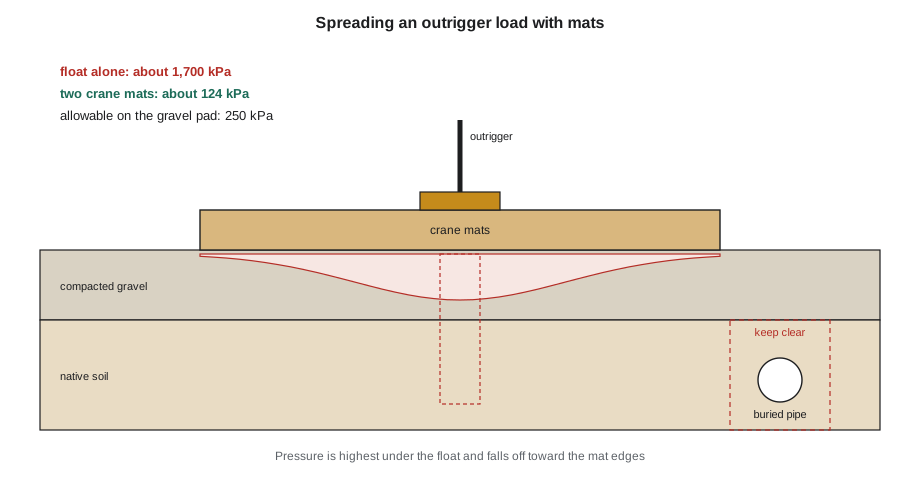
The all-terrain crane for the reboiler weighs 96 t with its counterweight, and the load with its rigging is 45.8 t. The outrigger float has an area of 0.60 m². Wade has Kiera check three mat options against the 250 kPa allowable.
# Outrigger load and mat pressure (metric; quick check, the crane maker's figures govern)
crane = 96.0                 # crane weight with counterweight (t)
load = 45.8                  # load plus rigging (t)
# quick rule used for a first check: worst outrigger takes up to 75 % of crane plus load
P = 0.75 * (crane + load)
print(f"worst-case outrigger load (quick rule): {P:,.0f} t")
float_area = 0.60            # outrigger float area (m2)
print(f"pressure under the float alone: {P * 9.81 / float_area:,.0f} kPa")
mats = [("timber mat 1.2 x 1.2 m", 1.2, 1.2), ("steel pad 1.8 x 1.8 m", 1.8, 1.8), ("two crane mats 1.2 x 5 m", 2.4, 5.0)]                # mat options: (name, length, width)
allow = 250              # allowable bearing for the compacted gravel pad (kPa)
for name, l, w in mats:
    eff = l * w * 0.7                     # only part of a mat spreads load well
    p = P * 9.81 / eff
    flag = "OK" if p <= allow else "TOO HIGH"
print(f"{name:<24} effective {eff:5.1f} m2 -> {p:6,.0f} kPa ({flag}, allowable {allow:,})")worst-case outrigger load (quick rule): 106 t pressure under the float alone: 1,739 kPa timber mat 1.2 x 1.2 m effective 1.0 m2 -> 1,035 kPa (TOO HIGH, allowable 250) steel pad 1.8 x 1.8 m effective 2.3 m2 -> 460 kPa (TOO HIGH, allowable 250) two crane mats 1.2 x 5 m effective 8.4 m2 -> 124 kPa (OK, allowable 250)
The bare float would put about 1,700 kPa on the gravel, nearly seven times the allowable. A single timber mat brings it down to about 1,000 kPa, still four times too high, and a steel pad to about 460 kPa. Two large crane mats side by side bring it to about 124 kPa, half the allowable, and that is what the plan specifies, under all four outriggers. The crane company's own outrigger software later gives a maximum float load of 89 t for the worst slew angle, a little below the quick rule's 106 t, confirming that the mats are adequate.
Crawler track pressure
A crawler's tracks spread its weight over a long area, and when the crane is not lifting, the average track pressure is modest. When it lifts over the front, the weight shifts forward, and the pressure under the front of the tracks can be several times the average, while the rear of the tracks carries little. The crane maker publishes track pressure diagrams for each configuration, typically as a trapezoid or a triangle of pressure along the track. For heavy lifts, the mats under the tracks are designed to spread this peak pressure, and the ground under them is often improved: excavated and replaced with compacted gravel, or, for the largest lifts, supported on an engineered pad.
The Northgate coker drum lift needs exactly that. The main crawler will set up in a cleared area beside the coker structure, and the civil group has designed a pad of compacted crushed gravel over geotextile, with two layers of crane mats on top. Underground, the site's records show a sewer line crossing the area; it has been located by daylighting, excavating with a vacuum truck to expose it, and the crane's position adjusted so that the tracks stay well clear of it.
Finding what is underground
Before any crane sets up on a plant site, the lift team finds out what lies under the setup area. The plant's drawings show many buried services, but not all, and old drawings may be wrong. Northgate's procedure requires a ground disturbance permit for any excavation and a buried services check for every crane setup area, using the plant's records, a locate by the utility owners, and, where there is any doubt, daylighting to expose the service. In Alberta, Utility Safety Partners, the province's one-call notification service, is contacted before ground is disturbed, and many owners apply its locate rules to crane setups as well.
The things to look for are the same everywhere: buried pipes and ducts, which can collapse or be crushed; recent excavations filled in without proper compaction; sumps, manholes and catch basins; old foundations, which can create hard spots that tilt a mat; and voids where soil has washed into a broken sewer. Ground can also change during the job: rain softens it, frost heaves it and then thaws it, and a leak from a nearby line can wash out the fill. The lift plan sets inspection points: the mats are checked before every heavy lift and after any rain or thaw.
Level and settlement
A crane that settles during a lift goes out of level, the load swings outward on the low side, and the radius grows; the effect on capacity can be severe. Before a heavy lift, the operator levels the crane and records the level. During the lift, a rigger is assigned to watch the outrigger floats and the mats, and on the largest lifts a surveyor monitors the crane's level with an instrument. Any settlement during the trial lift is a reason to set the load back down and find out why.
Worked problem
Checking mats for an outrigger
A crane weighing 60 t lifts a load of 20 t including rigging. The allowable ground bearing is 200 kPa. Using the quick rule and treating 70 percent of the mat area as effective, what mat area is needed under the worst outrigger?
Show solution
- Worst outrigger load: 0.75 × (60 + 20) = 60 t, or about 589 kN.
- Effective area needed: 589 / 200 = 2.9 m².
- Mat area needed with 70 percent effective: 2.9 / 0.7 = 4.2 m².
- A pair of 1.2 × 2.4 m mats gives 5.8 m², which is enough.
Answer: About 4.2 m² of mat under the worst outrigger, before the crane maker's actual outrigger load is checked.
Mats in use
Mats are equipment, and they are inspected like any other. Timber mats are checked for crushed or split timbers, rot, missing or loose bolts and warping; a mat with a broken timber under a float can fail suddenly. Mats are laid on a prepared surface, levelled and fully bearing, with no gaps or rocks under them, because a mat that rocks or bridges over a hollow does not spread the load. Under outriggers, the float is centred on the mat, never near its edge or corner. Mats laid in two layers have the top layer crossing the bottom one, and both are tied or pinned so that they cannot shift.
Moving mats is itself a lift. Large timber mats weigh 1 to 2 t each, and they are handled with a forklift, a loader or the crane, with the riggers clear of the mat as it is set down. Kiera's crew spends a full shift laying the mats for the coker drum's main crane, with the civil group's surveyor checking the level of each layer before the next goes down.
Common mistakes
MistakeSetting outriggers on a bare float on gravel or asphalt.
InsteadUse mats sized for the outrigger load and the allowable bearing.
MistakeAssuming the drawings show every buried service.
InsteadCheck records, get locates and daylight services near the setup.
MistakeTreating a concrete slab as solid ground.
InsteadHave the slab checked by an engineer; slabs can crack or span voids.
MistakeIgnoring rain or thaw after the mats are laid.
InsteadInspect the mats and ground before each heavy lift and after weather changes.
MistakeUsing the average track pressure for a crawler lifting over the front.
InsteadUse the maker's track pressure diagram, which shows the peak at the front.
Summary and key terms
- Ground failure is a leading cause of crane overturns; charts assume firm, level ground.
- Outrigger loads shift toward the load; the maker's figures govern, and a quick rule of 75 percent of crane plus load is used for screening.
- Allowable bearing depends on the soil and its condition; concrete needs a structural check.
- Mats spread the load, but not evenly; only part of a mat's area is effective.
- Crawler track pressure peaks at the front when lifting over the front.
- Locate buried services, recent excavations and voids before setting up, and monitor level and settlement during the lift.
- Allowable bearing pressure
- The pressure the ground can carry without excessive settlement or failure.
- Outrigger float
- The pad at the end of an outrigger that rests on the ground or mat.
- Crane mat
- A timber, steel or composite pad that spreads outrigger or track load over the ground.
- Daylighting
- Exposing a buried service by careful excavation, often with a vacuum truck.
- Track pressure diagram
- The crane maker's chart of ground pressure along a crawler's tracks.
- Settlement
- Downward movement of a mat or float as the ground compresses.
Practice problems
Work each problem on paper first, then reveal the answer to check.
An outrigger load of 50 t (about 490 kN) is spread by a mat with 4 m² effective area. What is the ground pressure?
Show answer
490 / 4 = 123 kPa.
Why is the pressure under a bare float so high?
Show answer
The float's area is small, so the load is concentrated.
What does daylighting mean?
Show answer
Exposing a buried service by careful excavation to confirm its position.
When should mats be inspected?
Show answer
Before each heavy lift and after rain, thaw or other changes.
Lesson quiz · 5 questions
Score 60% or more to complete this lesson.
Create a free account to save your progress, take quizzes and earn a certificate.