
BLR-120 · Lesson 5 of 12 · 20 min
Crawler cranes, tower cranes and hydraulic gantries
Two kinds of lift on the Northgate turnaround cannot be done with an all-terrain crane. The coker drum is too heavy and too tall: lifting nearly 300 t to a height of more than 60 m at the radius the coker structure allows needs a large lattice crawler crane, assembled on site over a week. At the other extreme, a new exchanger has to go into a bay under a pipe rack, where no crane boom can reach at all, and there the crew will use a hydraulic gantry on its own track. This lesson covers the heavy lifting equipment boilermakers work with beyond the hydraulic mobile crane: crawler cranes and their heavy-lift attachments, tower cranes on construction projects, hydraulic gantries, and a brief look at strand jacks and other systems used for the very largest loads.
Lattice crawler cranes
A crawler crane sits on two long tracks instead of outriggers and carries a lattice boom built from steel sections pinned or bolted together. The lattice boom is light for its strength, so a crawler can carry heavy loads at long radius and great height. Crawlers can travel with a load on the hook, slowly and on prepared ground, which is useful for walking a vessel from a laydown area to its foundation. They are delivered in pieces on many trucks and assembled on site using an assist crane, a process that can take days for the largest and requires a cleared assembly area as long as the boom.
Large crawlers have options for heavy lifting. A luffing jib on the end of the main boom gives reach over obstructions. A heavy-lift attachment, known by different names from different makers, adds a mast behind the main boom and a separate counterweight, carried on a tray or a wheeled carrier at a long radius behind the crane, connected to the mast by pendants or a pull rod. The added counterweight at a long arm greatly increases the crane's resisting moment. Some attachments require the extra counterweight to be suspended clear of the ground throughout the lift, and others allow it to rest on the ground until the load is lifted; either way, the crane cannot simply set the load down at any point, and the lift sequence must be planned so that the counterweight and the load are balanced at every stage.
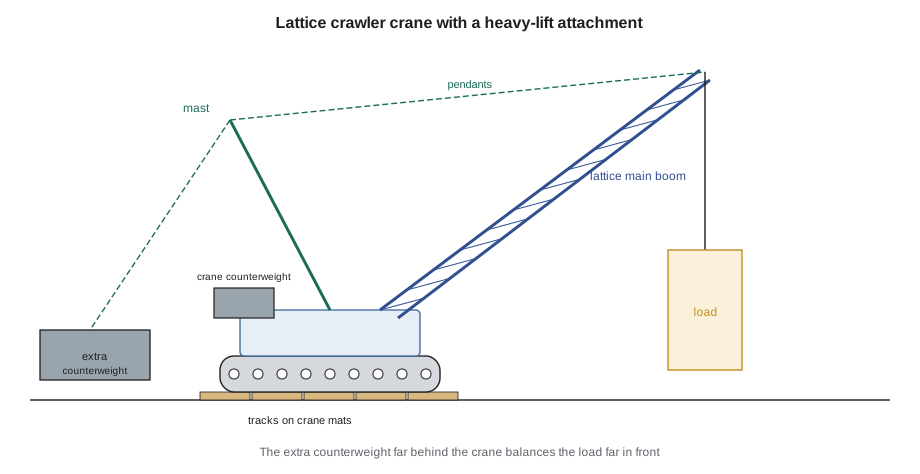
Crawler load charts are organized like other charts, by boom length, jib, counterweight and radius, with additional pages for each heavy-lift configuration and for travelling with a load. Ground pressure under the tracks is much higher at the front of the tracks than at the back when the crane is lifting over the front, and the ground preparation and mats for a crawler are a major part of the lift plan. Lesson 6 covers them.
For the coker drum, Prairie Heavy Lift, the crane company, will bring a large crawler with a heavy-lift attachment. Its chart, for the configuration Sunita has chosen, gives a gross capacity of 420 t at the radius needed to set the drum on its foundation in the coker structure. A smaller crawler of about a third the size will act as the tail crane. The main crane alone arrives on more than thirty trucks.
Assembly and disassembly
Assembling and dismantling a lattice boom crane is one of the most dangerous phases of crane work. Workers have been killed when boom sections fell as pins were removed, because the section was not supported or the boom was not blocked. The crane maker's assembly instructions set the sequence, and an assembly director, a qualified person, supervises the work. The boilermakers on the heavy-lift crew often help assemble the rigging for the lift, but the boom assembly belongs to the crane crew.
Kiera watches part of the crawler's assembly from outside the barricades. The assist crane sets each boom section on cribbing, the crane crew pins it to the next, and the pendant lines are laid out along the ground. The rule she hears repeated is never to stand under or inside a boom section when a pin is being driven or removed, and to know which pins are holding which part of the boom before touching any of them.
Tower cranes
Tower cranes are rarely used on turnarounds, but boilermakers meet them on new construction: power boiler erection, large process plants and mining facilities, where a fixed crane stands for months beside the structure. A tower crane has a vertical mast, often climbing with the structure, a horizontal jib with a trolley that runs out along it, and a counterjib with counterweight. Its capacity falls with the trolley's distance out on the jib, and its chart is a simple table of capacity against radius. Tower cranes are sensitive to wind because of the large area of the jib and load, and they are left free to weathervane when out of service. Operators of tower cranes need their own certification.
On a boiler erection project, the tower crane sets steel, drums and pressure parts into the structure from above. The steam drum of a new utility boiler, which can weigh more than a coker drum, is often lifted into the top of the structure by strand jacks rather than by any crane.
Hydraulic gantries
A hydraulic gantry is a lifting frame made of four telescoping hydraulic legs, usually two at each side, joined by header beams that span between them. The load hangs from the header beams by lifting links and slings. Each pair of legs sits on a track, and the gantry can roll along the tracks with the load raised, carrying it horizontally under a pipe rack or into a building where no crane can reach. The legs extend in stages, and each stage has its own capacity: the higher the legs extend, the lower the capacity per leg, because a longer, thinner stage is weaker against buckling and side loads.
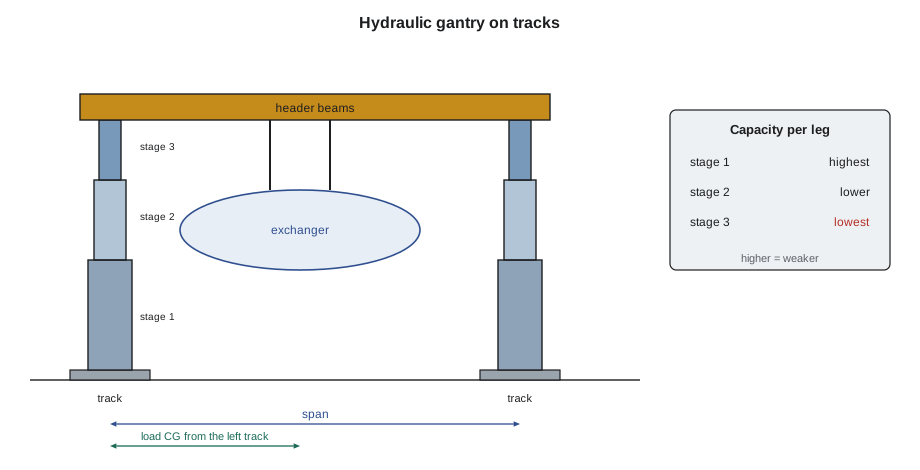
The gantry's load shares between its two sides by the same moment rule as an off-centre sling: if the load hangs closer to one track, the legs on that side carry more. The rigging and header beams add their own weight, shared equally. The lift plan checks the worst leg against the capacity for the stage that the lift height requires, and the gantry maker's chart gives those capacities.
The new exchanger for the Northgate bay weighs 36 t and has to be lifted 5.0 m to clear its foundation and the pipes under the rack. The header beams, links and slings weigh 3 t. The tracks are 6.0 m apart, and because of the pipes the exchanger hangs 2.4 m from the left track. The gantry's leg stages are illustrative.
# Hydraulic gantry leg loads with the load off centre on the header beams (metric, illustrative)
W = 36_000                      # exchanger weight (kg)
rig = 3_000                   # header beams, lifting links and slings (kg)
span = 6.0                # distance between the two gantry tracks (m)
x = 2.4                      # load CG measured from the left track (m)
legs_per_side = 2
stages = [(3.5, 25_000), (5.5, 18_500), (7.5, 12_000)]            # leg stage: (top of stage height, capacity per leg)
left = (W * (span - x) / span + rig / 2) / legs_per_side
right = (W * x / span + rig / 2) / legs_per_side
print(f"load per leg: left {left:,.0f} kg, right {right:,.0f} kg")
need = 5.0                # lift height needed (m)
for top, cap in stages:
    if need <= top:
        worst = max(left, right)
        print(f"lift height {need} m is in the stage rated {cap:,} kg per leg; worst leg at {100 * worst / cap:.0f} %")
breakload per leg: left 11,550 kg, right 7,950 kg lift height 5.0 m is in the stage rated 18,500 kg per leg; worst leg at 62 %
The left legs carry 11.6 t each, the right legs 8.0 t. The lift height falls in the second stage, rated 18.5 t per leg, so the worst leg is at 62 percent. If the pipes had forced the exchanger closer to the left track, the left legs would take more, and the plan sets a limit on how far off centre the load may hang.
Gantry tracks must be level and supported along their length, with the track joints over solid supports, because a leg that settles throws load onto the others and can side load the legs. The gantry is raised and lowered with all legs synchronized by its control system, and the crew watches the leg stroke readings continuously. Rolling the gantry with a load is slow, with a person at each leg watching the track and the clearances, and the load is lowered to the lowest stage practical before the gantry travels.
Jacking towers, strand jacks and transporters
For the very largest loads, there are systems beyond cranes. Strand jacks pull a bundle of steel strands through hydraulic cylinders in short strokes, gripping and releasing the strands alternately; a set of strand jacks on a temporary structure can lift loads of thousands of tonnes slowly and precisely, and they are used for boiler drums, bridge spans and modules. Jacking towers lift a load in steps by raising it on hydraulic cylinders and building cribbing or tower sections beneath it. Self-propelled modular transporters, rows of computer-controlled wheeled axles, carry modules weighing thousands of tonnes across a site and can position them within millimetres. Boilermakers on major projects work alongside the specialty contractors who run these systems.
| System | How it lifts or moves | Typical use |
|---|---|---|
| Lattice crawler with heavy-lift attachment | Boom and extra counterweight at long arm | Vessels and drums to hundreds of tonnes |
| Tower crane | Trolley on a fixed jib | Construction of boilers and large plants |
| Hydraulic gantry | Four telescoping legs on tracks | Setting loads under racks or in buildings |
| Strand jacks | Cylinders gripping strands in steps | Boiler drums, very heavy lifts from a structure |
| Jacking tower | Cylinders and cribbing raised in steps | Raising loads where no overhead support exists |
| Self-propelled modular transporter | Computer-steered wheeled axles | Moving modules and vessels across a site |
Choosing the method
Wade explains to Kiera that the first decision on any heavy lift is the method, and it is often not obvious. The coker drum could, in principle, have been set by strand jacks from the coker structure, but the structure was not designed for that load. A larger crawler could have reached the exchanger bay from the far side of the rack, but at a radius that would have needed a crane far bigger than the job justified, and the boom would have passed over a live unit. The method is chosen by weighing the load, the reach, the obstructions, the ground, the schedule and the cost, and the result is written into the lift plan before any equipment is ordered.
Worked problem
Leg loads on a gantry
A gantry with tracks 5.0 m apart carries a 24 t load hanging 1.5 m from the left track. The header beams and rigging weigh 2 t. There are two legs on each side. Find the load on each left leg.
Show solution
- Load share on the left side: 24 × (5.0 − 1.5) / 5.0 = 16.8 t.
- Add half the rigging: 16.8 + 1.0 = 17.8 t.
- Divide between the two left legs: 8.9 t each.
Answer: Each left leg carries 8.9 t. The right legs carry 4.1 t each. The left legs are checked against the stage capacity.
Travelling with a load
A crawler crane can travel with a load on the hook, but its chart for travelling is lower than for lifting in place, and the travel path must be prepared like a setup area: level, firm and matted where needed. The load is carried low, close to the ground, with the boom positioned as the chart requires, usually in line with the tracks, and with taglines controlling it. The crane moves slowly, with a spotter walking ahead to watch the ground and the clearances, and stops if the mats or ground show any movement. On the coker drum lift, the main crane does not travel with the drum; the tail crane travels in short steps during the upending, each step checked against the plan.
Common mistakes
MistakeStanding under a boom section while pins are removed.
InsteadFollow the maker's assembly sequence and stay clear of sections being pinned or unpinned.
MistakeAssuming a crawler can set the load down anywhere during a heavy-lift attachment lift.
InsteadThe lift sequence balances the load and extra counterweight at each stage.
MistakeReading a gantry's top-stage capacity for a lift that needs a higher stage.
InsteadCapacity falls with extension; use the stage the lift height requires.
MistakeIgnoring an off-centre load on a gantry.
InsteadThe legs nearer the load carry more; check the worst leg.
MistakeRolling a gantry on an unsupported or unlevel track.
InsteadTracks are level and supported at joints, and the load is lowered before travelling.
Summary and key terms
- Lattice crawler cranes carry heavy loads at long radius and can travel with a load on prepared ground.
- Heavy-lift attachments add a mast and extra counterweight at a long arm; the lift sequence must keep the crane balanced.
- Crane assembly and disassembly is high risk and is supervised by a qualified assembly director.
- Tower cranes serve construction projects; their capacity falls with trolley radius and they are wind sensitive.
- Hydraulic gantries lift on four telescoping legs whose capacity falls with each stage; off-centre loads load one side more.
- Strand jacks, jacking towers and modular transporters handle the very largest loads.
- Crawler crane
- A crane mounted on tracks, usually with a lattice boom.
- Heavy-lift attachment
- A mast and additional counterweight behind a crawler crane that increase its capacity.
- Assist crane
- A smaller crane used to assemble or dismantle a larger one.
- Hydraulic gantry
- A lifting frame of telescoping hydraulic legs and header beams that can travel on tracks.
- Stage
- One section of a gantry leg's telescoping extension, with its own capacity.
- Strand jack
- A hydraulic jack that lifts by gripping and pulling a bundle of steel strands in steps.
Practice problems
Work each problem on paper first, then reveal the answer to check.
A gantry load of 30 t hangs at mid-span. The rigging weighs 2 t. What does each of the four legs carry?
Show answer
(30 + 2) / 4 = 8 t.
Why does capacity fall as a gantry leg extends?
Show answer
A longer leg is more slender and weaker against buckling and side loads.
What does a heavy-lift attachment add to a crawler crane?
Show answer
A mast and extra counterweight at a long distance behind the crane.
Name a system used to lift a boiler steam drum into a new structure.
Show answer
Strand jacks on the structure.
Lesson quiz · 5 questions
Score 60% or more to complete this lesson.
Create a free account to save your progress, take quizzes and earn a certificate.