
BLR-120 · Lesson 12 of 12 · 18 min
Capstone: setting a coker drum
On the nineteenth day of the Northgate turnaround, the old coker drum is out, lying on cribbing in the laydown yard, and the new one is ready on its trailer beside the coker structure. The main crawler is assembled and has passed its inspection; the tail crane is set up on its own mats; the forecast for the next morning is light wind and clear sky. Wade calls the last planning session before the lift and asks Kiera to walk the team through the lift plan summary she has helped prepare. This capstone follows that plan, and every part of it draws on a lesson in this course: the weight and centre of gravity from lesson 2, the trunnions and lifting beam from lesson 3, the cranes and charts from lessons 4 and 5, the ground from lesson 6, the upending from lesson 7, the signals and wind from lesson 10 and the plan from lesson 11.
The load
The new drum weighs 291 t according to the fabricator's weighed shipping record, against Kiera's build-up of 288.4 t. The plan uses the build-up plus 3 percent, which is slightly above the fabricator's figure, for every crane and rigging check. The centre of gravity is 23.0 m above the skirt base. The drum is lifted at the top by two trunnions on its axis, 36.5 m above the base, through the crane company's lifting beam, and tailed by a single tail lug on the skirt's base ring.
| Item | Value in the plan | Source |
|---|---|---|
| Drum weight | 288.4 t, plus 3 percent = 297 t | Build-up checked against the fabricator's weight |
| Centre of gravity | 23.0 m above the skirt base | Build-up, lesson 2 |
| Main crane rigging | 12.5 t: lifting beam, grommets, shackles, block | Crane company's rigging list |
| Tail crane rigging | 4.0 t: slings, shackles, block | Ironbridge rigging list |
| Trunnion design load | 164 t each, rated 175 t | Vessel drawings and lug calculation |
The cranes
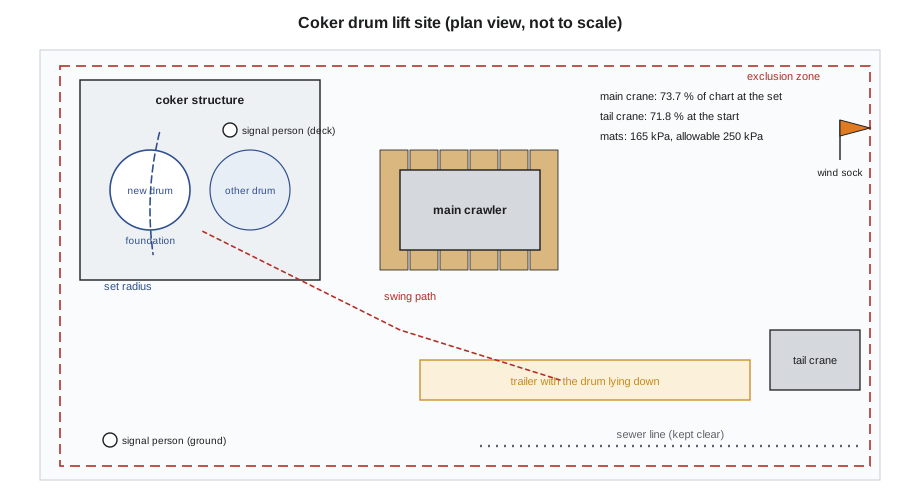
The main crane is a large lattice crawler with a heavy-lift attachment, set up on two layers of crane mats on the engineered gravel pad beside the coker structure. At the set radius over the foundation, its chart gives 420 t gross for the configuration. The tail crane is a smaller crawler, set up on mats near the trailer, with a chart value of 160 t at the radius where it picks up the tail lug. Northgate's tandem limits are 85 percent of chart for the main crane and 75 percent for the tail crane.
Kiera checks that the main crane is checked at the right point. During the upending, the main crane carries only part of the drum; at the set, it carries all of it, plus the lifting beam and rigging, at the longest radius of the lift. That is the point that governs. For the tail crane, the governing point is the start of the upending, when its share is largest.
The upending and the shares
From lesson 7, the tail crane carries about 37 percent of the drum's weight at the start of upending, falling to nothing at vertical. With the contingency, that is about 111 t on the tail hook, plus 4 t of rigging. The main crane starts at about 186 t plus its rigging and rises to the full 297 t plus 12.5 t at vertical. The upending table from Sunita gives both cranes' loads, radii and boom angles at every 15 degrees, and the tail crane travels toward the main crane in steps between them to keep its line vertical.
Ground, trunnions, wind and clearances
The civil group's design for the main crane pad gives an allowable bearing of 250 kPa on the gravel. The crane company's track pressure diagram for the set, the worst case, gives a peak pressure on the mats' underside of 165 kPa. The sewer line found by daylighting is more than 3 m outside the mats. The trunnions were designed for the full drum weight with the contingency and a dynamic allowance; their design load is 164 t each against a rating of 175 t. The wind forecast for the lift window is 6 m/s at the boom tip, against the plan's stop at 9 m/s, and the drum, at the set, clears the coker structure's nearest steel by 1.2 m against a minimum of 0.6 m in the plan.
The summary check
Kiera writes the summary as a short script that checks each part of the plan against its limit and prints one line per check, so that the whole team sees the same numbers at the meeting.
# Coker drum set: one summary of the lift plan checks (metric, values from the plan, illustrative)
plan_ok = True
def check(name, ok, detail):
    global plan_ok
    plan_ok = plan_ok and ok
    print(f"[{'OK' if ok else 'FIX'}] {name:<22} {detail}")
W = 288.4 * 1.03                                 # drum weight with 3 % contingency
rig_main, rig_tail = 12.5, 4.0                 # rigging below each hook
tail_share = 0.373                               # tail crane share at the start of upending
gross_main, gross_tail = 420, 160             # chart gross at the set radius and the tail radius
pm = 100 * (W + rig_main) / gross_main
pt = 100 * (W * tail_share + rig_tail) / gross_tail
check("main crane", pm <= 85, f"{pm:.1f} % of chart at the set radius (site limit 85 % for tandem)")
check("tail crane", pt <= 75, f"{pt:.1f} % of chart at the start of upending")
mat_p, allow = 165, 250
check("ground", mat_p <= allow, f"track pressure on mats {mat_p:,} kPa, allowable {allow:,} kPa")
lug_cap, lug_load = 175, 164
check("trunnions", lug_load <= lug_cap, f"design load per trunnion {lug_load:,} t, rated {lug_cap:,} t")
wind, limit = 6, 9
check("wind", wind <= limit, f"forecast {wind} m/s at boom tip, stop at {limit} m/s")
clear = 1.2
check("structure clearance", clear >= 0.6, f"{clear} m between the drum and the coker structure at the set")
print("plan ready for the pre-lift meeting" if plan_ok else "plan needs work before the pre-lift meeting")[OK] main crane 73.7 % of chart at the set radius (site limit 85 % for tandem) [OK] tail crane 71.8 % of chart at the start of upending [OK] ground track pressure on mats 165 kPa, allowable 250 kPa [OK] trunnions design load per trunnion 164 t, rated 175 t [OK] wind forecast 6 m/s at boom tip, stop at 9 m/s [OK] structure clearance 1.2 m between the drum and the coker structure at the set plan ready for the pre-lift meeting
Every check passes, with margins that match the plan's intent: the main crane at 73.7 percent of chart against an 85 percent limit, the tail crane at 71.8 percent against 75, the ground at two-thirds of its allowable, the trunnions at 94 percent of their rating, the wind forecast two-thirds of the stop speed, and the clearance twice the minimum. The tail crane's margin is the smallest, and Wade notes it at the meeting: if the trial lift shows the tail load more than 4 percent above the table, the lift stops for review.
The sequence and hold points
The plan's sequence is the part the team will follow on the day, step by step. Kiera's summary at the meeting reads it aloud.
| Step | Action | Hold point checks |
|---|---|---|
| 1 | Rig the lifting beam to the trunnions and the tail sling to the tail lug; remove the trailer's tie-downs | Rigging inspected, pins and cotters, lift director's walk-down |
| 2 | Trial lift: both cranes take up and lift the drum level, a short distance clear of the trailer | Load cells against the table, level, settlement, tail share |
| 3 | Trailer pulled clear; drum lowered to a working height | Exclusion zone, radios |
| 4 | Upend in steps of 15 degrees, tail crane travelling to keep its line vertical | Loads and radii at each step; hold at 45 degrees |
| 5 | Drum vertical; main crane carries the full load; tail rigging released and lowered | Main crane indicator confirms full load before release |
| 6 | Main crane hoists the drum above the structure and swings to the set radius | Wind, radius, clearance, handover to the deck signal person |
| 7 | Lower the drum onto the foundation, guide the skirt over the anchor bolts | Bolt alignment, clearance to steel, deck signal person |
| 8 | Land the drum, install nuts, release the lifting beam | Load off the crane before the rigging is released |
At step 7, the boilermakers on the coker deck become the most important people on the lift. They guide the drum's skirt over the anchor bolts with taglines and push-pull bars, never with hands between the skirt and the foundation, and they tell the deck signal person when the bolts are aligned. Kiera will be on the deck as a tagline hand with Dale. Her job is to watch the bolts on her quarter of the base ring and call out when they enter their holes.
The meeting and the lift
The pre-lift meeting is held at the main crane at six the next morning, with thirty-two people present: the lift director, both operators, both signal persons, the riggers, the tagline hands, the spotters, the crane company's engineer and technician, Corinne for the owner, and Imran for safety. Wade goes through the plan, the hold points and the stop conditions. Each team member states their role. The radios are tested on all three channels. The wind at the boom tip reads 4 m/s.
The trial lift reads 1.5 percent above the table on the main crane and 2.0 percent on the tail, inside the 3 percent contingency. The drum hangs level. The upending takes two hours, with the tail crane travelling in nine steps and the riggers calling out the line angles at each. At 45 degrees the lift holds while the lift director checks every reading. At vertical, the main crane's indicator confirms the full load, the tail sling goes slack, and the tail crane's rigging is released. The main crane hoists, swings and lowers, and an hour later the drum's skirt slides over the last anchor bolt, guided by four tagline crews on the deck, and comes to rest on its foundation.
The debrief is short. The tail crane's track pressure was checked after each travel step, and one mat had settled slightly at the third step; the riggers had seen it and called a hold, the mat was packed, and the lift went on. Wade adds that to the lessons for the next drum, two years from now.
What the capstone shows
The coker drum lift went smoothly because almost nothing about it was left to the day. Its weight was built up and checked against a measured figure. Its centre of gravity was calculated, and the upending table was built from it. The cranes were chosen for the worst point of the lift, the ground was designed for the worst track pressure, the trunnions were designed for the full load, and the wind and clearances were checked against limits. Everyone on the team knew their role, the signals and the stop conditions. Each of those pieces is a lesson in this course, and each is something a boilermaker on a heavy-lift crew is expected to understand, check and question.
Worked problem
Checking the main crane at the set
The drum's weight with contingency is 297 t and the main crane's rigging is 12.5 t. The chart at the set radius is 420 t. If the set radius had to grow by enough to reduce the chart to 380 t, would the lift still be within the 85 percent tandem limit?
Show solution
- Total on the main crane at the set: 297 + 12.5 = 309.5 t.
- Percentage at the planned radius: 309.5 / 420 = 73.7 percent.
- Percentage at the longer radius: 309.5 / 380 = 81.4 percent.
- Both are under 85 percent, but the longer radius uses most of the remaining margin.
Answer: Yes, at about 81 percent, but the plan would be revised and re-approved for the new radius; changes after approval always go back through review.
Common mistakes
MistakeChecking the main crane at the start of the upending only.
InsteadCheck it at the set, where it carries the full weight at the longest radius.
MistakeReleasing the tail rigging as soon as the drum looks vertical.
InsteadRelease only when the main crane's indicator confirms the full load.
MistakeGuiding the skirt onto the bolts by hand.
InsteadUse taglines and push-pull bars; keep hands out from between the skirt and foundation.
MistakeIgnoring a small mat settlement because the lift is going well.
InsteadCall a hold, check and correct it before going on.
MistakeSkipping the debrief after a successful lift.
InsteadRecord what happened so the next lift is better planned.
Summary and key terms
- The capstone lift combines every topic in the course: weight and centre of gravity, rigging, cranes and charts, ground, tandem upending, signals, wind and the critical lift plan.
- The main crane is checked at the set, where it carries the full load; the tail crane at the start of upending, where its share is largest.
- The summary check compares each part of the plan with its limit and shows where the margins are smallest.
- Hold points and stop conditions are planned in advance and used on the day.
- The deck crew guides the drum onto its bolts with taglines and bars, never by hand.
- A debrief records the lessons for the next lift.
- Set radius
- The radius at which the crane places the load on its final support.
- Governing point
- The point in a lift where a crane or component is closest to its limit.
- Anchor bolts
- Bolts cast into a foundation that pass through a vessel's base ring to hold it down.
- Push-pull bar
- A bar used to guide a suspended load without placing hands near pinch points.
- Walk-down
- An inspection of the whole lift setup by the lift director before the lift.
Practice problems
Work each problem on paper first, then reveal the answer to check.
The tail crane's share at the start of upending is 37 percent of a 297 t drum, with 4 t of rigging. Its chart is 160 t. What percentage of chart is it?
Show answer
(0.37 × 297 + 4) / 160 = 71 percent.
Where is the main crane's governing point in this lift?
Show answer
At the set, where it carries the full drum at the longest radius.
The trial lift reads 2 percent above the table and the contingency is 3 percent. Should the lift continue?
Show answer
Yes, it is inside the contingency, provided the drum hangs level and nothing else is out of plan.
Why is the debrief important?
Show answer
It records lessons for the next lift.
Lesson quiz · 5 questions
Score 60% or more to complete this lesson.
Create a free account to save your progress, take quizzes and earn a certificate.