
BLR-120 · Lesson 8 of 12 · 20 min
Jacking, skidding and rolling heavy loads
Not every heavy load is moved by a crane. At the Prairie Junction terminal, Tank 14 needs a new floor, and the usual way to replace a large tank floor is to lift the whole tank shell and roof a short distance on hydraulic jacks spaced around its base, cut out the old floor and build the new one underneath. At Northgate, a replacement reboiler has to be moved from the end of an access road into its bay along a track, because the bay is surrounded by pipe and structure. And on almost every job, heavy items are raised, lowered and shifted a few centimetres at a time with jacks and cribbing. This lesson covers hydraulic jacks and cribbing, skidding on tracks, rolling on rollers, and the friction and stability that govern them.
Hydraulic jacks
Hydraulic jacks lift by pumping oil into a cylinder under a ram. Boilermakers use several types: bottle jacks and low-height pancake jacks for small lifts, long-stroke cylinders for jacking tanks and vessels, and toe jacks with a lifting toe that reaches under a load close to the ground. Jacks are rated by capacity and stroke, and the capacity marked on a jack is its maximum; good practice is to use jacks at no more than about 80 percent of their rating, so they are never at their limit if the load is shared unevenly. Jacks are powered by hand pumps or by power units, and a set of jacks on one load is usually connected through a manifold so that they lift together.
The most important rule with jacks is that a jack is a lifting device, not a support. A load on a jack can drop if a hose bursts, a seal fails, a valve is opened or the jack slips. Every jacked load is supported by cribbing that follows it up, so that at every stage the load can settle no more than a short distance if a jack fails. Locking collars on the ram, where the jack has them, give a second line of defence, but they are not a substitute for cribbing.
Jacks also need a firm, level base and a firm, level contact with the load. A jack set on soft ground, on a slope or on an uneven surface can kick out sideways under load. A jack pushing on a curved surface or a thin plate can punch through or slip. Steel plates, spreader beams or purpose-made jacking brackets distribute the load into the ground and into the structure being lifted.
Cribbing
Cribbing is a stack of timbers laid in alternating layers, each layer at right angles to the one below, like a log cabin. A crib carries the load in compression through the timbers and spreads it into the ground. Cribbing is built as the load rises, with each new layer added under the load as the jack extends, and removed layer by layer as it comes down. Its strength depends on the timber species and condition, the size of the timbers, the number of contact points between layers and the ratio of height to width; a tall, narrow crib is unstable. A common rule is to keep the crib's height no more than about twice the width of its base, unless an engineer has designed it otherwise.
Kiera learns to build cribbing at the yard before the tank job. Dale's rules are short: lay the timbers square and tight, never put hands under the load to place a timber, use the tool, keep the gap between the crib and the load small, and stop if the crib starts to lean.
Jacking a tank shell
To replace a tank floor, the tank's shell and roof are lifted together by jacks placed around the base of the shell, usually on brackets welded to the shell's outside. The shell is cut free of the floor first, then all the jacks are raised together in small steps, so that the shell rises evenly and does not distort. As it rises, cribbing or steel stands are placed under the brackets. With the shell held a short distance above its foundation, the old floor is removed and the new one is laid and welded underneath, and the shell is lowered onto it and welded to it.
The jacks share the weight of the shell, roof and attachments, but not perfectly evenly, because the shell is not perfectly round or stiff and the jacks do not all extend at exactly the same rate. Tank contractors therefore choose jacks with a margin over the average load per jack. Tank 14 is 60 m in diameter; its shell, roof, rafters, wind girder and attachments weigh about 440 t, and the contractor's procedure spaces the jacks about 3 m apart around the shell.
# Jacking a tank shell and skidding a vessel (metric, illustrative)
# 1 Tank 14 shell lift for floor replacement: jacks spaced around the shell
import math
D = 60                      # tank diameter (m)
shell_roof = 440_000            # shell, roof, wind girder and attachments (kg)
spacing = 3.0               # jack spacing around the circumference (m)
n = math.ceil(math.pi * D / spacing)
per_jack = shell_roof / n
print(f"{n} jacks at about {math.pi * D / n:.1f} m spacing, {per_jack:,.0f} kg each")
print(f"with a 1.25 uneven-lift allowance: choose jacks rated at least {per_jack * 1.25:,.0f} kg")
# 2 skidding the new reboiler on greased skid track
W = 41_000                      # reboiler weight (kg)
for track, mu in (("steel on steel, dry", 0.30), ("greased steel", 0.15), ("PTFE pads on stainless", 0.08)):
    for slope in (0.0, 1.0):
        F = W * 0.00981 * (mu * math.cos(math.radians(slope)) + math.sin(math.radians(slope)))
print(f"{track:<24} slope {slope:3.1f} deg: pull {F:8,.0f} kN")63 jacks at about 3.0 m spacing, 6,984 kg each with a 1.25 uneven-lift allowance: choose jacks rated at least 8,730 kg steel on steel, dry slope 0.0 deg: pull 121 kN steel on steel, dry slope 1.0 deg: pull 128 kN greased steel slope 0.0 deg: pull 60 kN greased steel slope 1.0 deg: pull 67 kN PTFE pads on stainless slope 0.0 deg: pull 32 kN PTFE pads on stainless slope 1.0 deg: pull 39 kN
The tank needs 63 jacks, each carrying about 7.0 t on average, and with the contractor's 1.25 allowance for uneven sharing the jacks must be rated at least 8.7 t. The contractor uses 10 t jacks, connected in groups to a central control so that the whole ring rises at once. The brackets are welded to the shell by Ironbridge welders to the contractor's design, and each weld is inspected before jacking begins.
Skidding
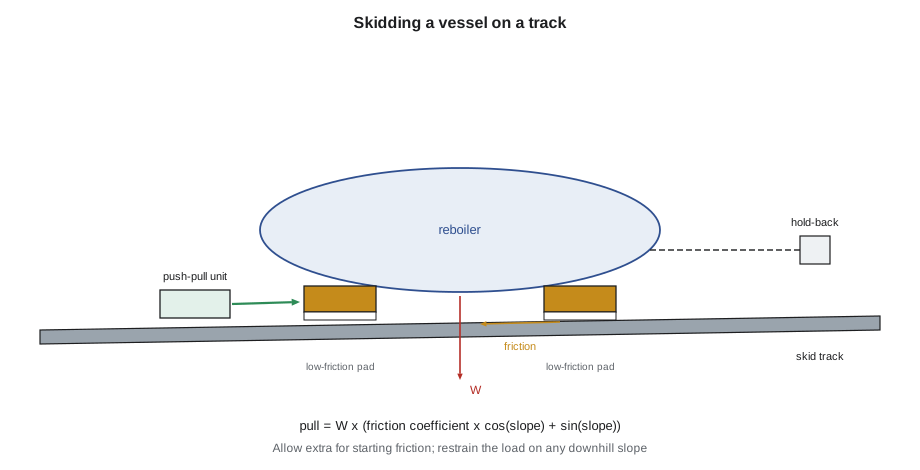
Skidding moves a load horizontally by sliding it along a track. The load sits on skid shoes or a frame on steel skid beams, and it is pushed or pulled along by hydraulic push-pull units, which grip the track and push in short strokes, or by a winch or chain fall. The force needed is the load's weight multiplied by the coefficient of friction between the sliding surfaces, plus, if the track slopes uphill, the component of the weight along the slope. Friction depends strongly on the surfaces: dry steel on steel can need nearly a third of the load's weight to start it moving, grease cuts that in half, and low-friction pads, such as PTFE on polished stainless steel, cut it to a small fraction.
The force to start the load moving is higher than the force to keep it moving, because static friction is higher than sliding friction, and skid tracks must be clean, straight, level across and properly supported so that the load does not jam. If the track slopes downhill, the load can run away once it starts, so a skidded load always has a restraint, such as a hold-back chain fall or a second push-pull unit, on the downhill side.
The new reboiler for the Northgate bay weighs 41 t and will be skidded about 18 m along a skid track laid on the bay's foundation and a temporary steel support. Kiera checks the pull needed for three track surfaces, level and at a 1 degree slope.
The pull ranges from about one-twelfth of the load's weight for PTFE pads to nearly a third for dry steel, and a 1 degree slope adds about a fifth to the pull on the low-friction track, because the slope's component is large compared with such low friction. The plan uses PTFE pads on stainless track, a push-pull unit rated for twice the calculated force to allow for starting friction, and a hold-back chain fall at the rear.
Rolling
Rolling moves a load on rollers: steel pipes laid under a load in the old way, or, more often today, purpose-made machinery rollers or skates, which have rows of small rollers in a frame and can carry loads of many tonnes. Rolling needs less force than skidding, often a few percent of the load's weight on a smooth, hard floor, but it needs a smooth, level and strong surface, because the rollers concentrate the load on small contact areas. The load must be stable on its rollers, with the rollers placed under its strong points and the centre of gravity well inside them; a tall, narrow load on rollers can tip if it stops suddenly or a roller hits an obstruction.
Self-propelled modular transporters, introduced in lesson 5, are the heavy-duty form of rolling, with computer-controlled hydraulic suspension that keeps the load level as the ground changes. Boilermakers rarely run them, but they often prepare the load for them, setting it on transport frames and securing it.
Stability during moves
Any load being jacked, skidded or rolled must be stable at every stage. The checks are the same whatever the method. The centre of gravity must stay well inside the supports; a load on four points can tip if one point is lowered faster than the others. The supports and the track must carry their share of the load without settling. The load must be restrained against sliding off or tipping if it is struck, if the wind catches it or if a support moves. And everyone must be kept clear of the pinch points between the load and its supports, and out of the line of a load that could slide or tip.
| Method | Force needed | Key hazards | Key controls |
|---|---|---|---|
| Jacking | Equal to the load share on each jack | Jack failure, kick-out, uneven lift | Cribbing follows the load, firm level bases, synchronized jacks |
| Skidding | Weight times friction, plus slope | Jamming, runaway on slopes, track failure | Clean level track, low-friction pads, hold-back restraint |
| Rolling | A few percent of the weight on a hard floor | Roller failure, tipping, uneven floor | Smooth strong surface, rollers under strong points, slow moves |
Worked problem
Skidding force on a slope
A 25 t load is skidded on greased steel, coefficient of friction 0.15, up a 0.5 degree slope. What pull is needed, and what pull would be needed on the level?
Show solution
- Weight as a force: 25 × 9.81 = 245 kN.
- On the slope: 245 × (0.15 × cos 0.5° + sin 0.5°) = 245 × (0.150 + 0.0087) = 38.9 kN.
- On the level: 245 × 0.15 = 36.8 kN.
- Allowing twice the force for starting friction, the push-pull unit should be rated at least 78 kN.
Answer: About 39 kN to keep it moving on the slope; choose equipment with a margin for starting friction and plan a hold-back.
Synchronized jacking
When many jacks lift one load, they must move together. If one group of jacks rises faster than the others, the load tilts, the jacks under the high side lose load and those under the low side take more, and the structure being lifted is twisted. On a tank shell, uneven jacking can buckle the bottom of the shell or tear a bracket off. Modern jacking systems use a computer-controlled power unit that meters oil to each jack or group of jacks and measures each one's stroke, stopping the lift if any jack gets ahead or behind by more than a set amount. With hand pumps, the crew lifts in small, equal steps, with a person at each jack calling the stroke and the foreman checking the level of the load after each step.
Tank 14's shell is raised about 600 mm in steps of 25 mm, with the contractor's system checking every jack's stroke after each step and the shell's level checked by a surveyor at eight points around the circumference.
Common mistakes
MistakeLeaving a load on jacks without cribbing.
InsteadCribbing follows the load at every stage; jacks lift, cribbing supports.
MistakePutting a hand under a load to place a timber.
InsteadUse a tool; keep hands out from under the load.
MistakeBuilding a tall, narrow crib.
InsteadKeep the crib's height no more than about twice its base width unless engineered.
MistakeSkidding downhill without a restraint.
InsteadAlways use a hold-back on the downhill side.
MistakeUsing the sliding friction value to size the pulling equipment.
InsteadAllow for the higher starting friction.
Summary and key terms
- Hydraulic jacks lift; cribbing supports. Jacks are used at no more than about 80 percent of their rating.
- Cribbing is built in alternating layers, follows the load up and down, and is kept squat and tight.
- Tank shells are lifted on jacks spaced around the base, with a margin for uneven sharing.
- Skidding force is the weight times the friction coefficient plus any slope component; low-friction pads reduce it greatly.
- Rolling needs less force but a smooth, strong surface and a stable load.
- Every move keeps the centre of gravity inside the supports and the crew out of pinch points and the line of fire.
- Cribbing
- Timbers stacked in alternating layers to support a load.
- Toe jack
- A jack with a lifting toe near its base for lifting loads close to the ground.
- Skidding
- Moving a load by sliding it along a track.
- Push-pull unit
- A hydraulic unit that grips a skid track and pushes or pulls the load in strokes.
- Coefficient of friction
- The ratio of the force needed to slide a load to the load pressing the surfaces together.
- Machinery skate
- A frame of small rollers used to roll heavy loads on a hard surface.
Practice problems
Work each problem on paper first, then reveal the answer to check.
A 12 t load is skidded on dry steel with a friction coefficient of 0.3. What pull is needed on the level, in kilonewtons?
Show answer
12 × 9.81 × 0.3 = 35.3 kN.
A tank shell weighing 200 t is lifted on 40 jacks. What is the average load per jack, and what rating is needed with a 1.25 allowance?
Show answer
5 t average; at least 6.25 t.
Why must cribbing follow the load up?
Show answer
So that if a jack fails, the load can drop only a short distance.
Why is starting friction important when choosing a pulling unit?
Show answer
It is higher than sliding friction, so more force is needed to start the load.
Lesson quiz · 5 questions
Score 60% or more to complete this lesson.
Create a free account to save your progress, take quizzes and earn a certificate.