
BIOL-208 · Lesson 7 of 12 · 25 min
Competition
Whenever two organisms need the same limited resource, each reduces what is available to the other. Competition is this mutually negative interaction. It happens between members of the same species, which need exactly the same things, and between different species whose needs overlap. Competition shaped the beaks of Darwin's finches, keeps some plants out of the shade of others, and decides which invasive species take over. This lesson covers the forms competition takes, the classic Lotka–Volterra model of competition between two species and its graphical analysis, the principle of competitive exclusion, the niche concept, and the evidence from experiments and nature that competition structures communities, along with the debate about how important it really is.
Kinds of competition
Intraspecific competition occurs between members of the same species; it is the main source of the density dependence studied in lesson 4. Interspecific competition occurs between different species. Both can take two forms. In exploitation competition, organisms compete indirectly by using up a shared resource: two species of diatom in a lake both draw down silica, and whichever reduces it fastest leaves less for the other. In interference competition, organisms interact directly to deny one another access: a red squirrel defends its cone cache against other squirrels, ants attack workers of other colonies, and some plants release chemicals from their roots that inhibit neighbours, a process called allelopathy. Spotted knapweed, an invasive plant on western rangelands in Canada and the United States, has been studied as a possible allelopathic competitor, although the strength of the effect in the field is debated.
Competition is usually asymmetric: one competitor suffers much more than the other. A large tree shades a seedling severely, while the seedling barely affects the tree. Asymmetry is common in plants competing for light and in animals of different sizes.
The Lotka–Volterra competition model
In the 1920s, Alfred Lotka and Vito Volterra independently extended the logistic model to two competing species. Each species' growth is reduced by its own density and by the density of the other, weighted by a competition coefficient:
The coefficient \( \alpha_{12} \) measures the effect of one individual of species 2 on species 1, in units of species 1 individuals. If \( \alpha_{12} = 0.5 \), each individual of species 2 uses as much of species 1's resources as half an individual of species 1. If the two species were identical in their resource use, both coefficients would be 1.
Isoclines and the four outcomes
The model is best understood graphically. On a graph with \( N_1 \) on one axis and \( N_2 \) on the other, each species has a zero-growth isocline: the line of combinations at which its population neither grows nor shrinks. For species 1, setting \( dN_1/dt = 0 \) gives the straight line \( N_1 = K_1 - \alpha_{12} N_2 \), which meets the \( N_1 \) axis at \( K_1 \) and the \( N_2 \) axis at \( K_1/\alpha_{12} \). Below its isocline, species 1 grows; above it, species 1 declines. Species 2's isocline is constructed the same way.
How the two isoclines lie relative to each other determines the outcome. If species 1's isocline lies entirely outside species 2's, species 1 always wins. If species 2's lies outside, species 2 wins. If the isoclines cross, there are two possibilities. When each species limits itself more than it limits the other, the crossing point is a stable equilibrium and the two coexist. When each limits the other more than itself, the crossing point is unstable, and whichever species gets ahead first wins: the outcome depends on starting numbers.
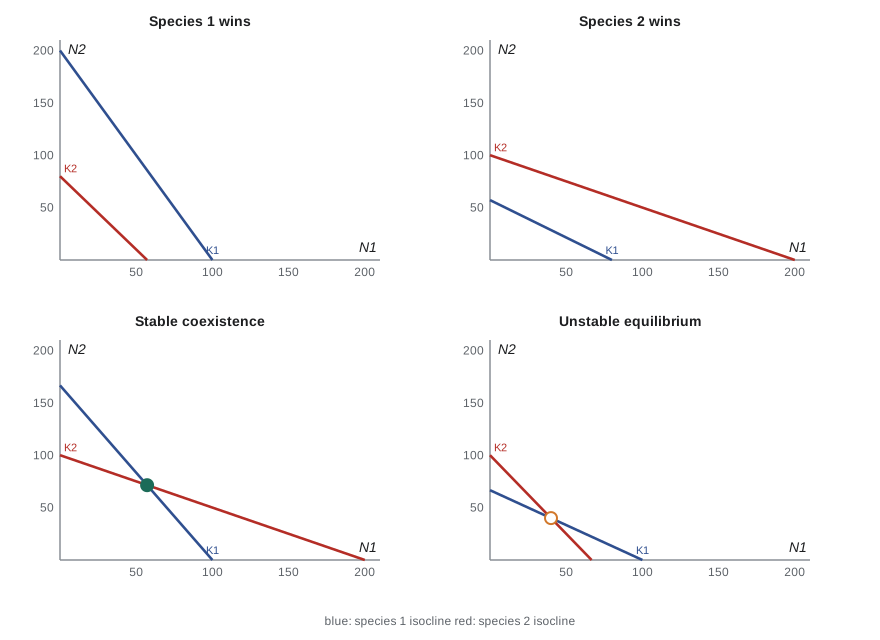
| Condition | Outcome |
|---|---|
| K₁ > K₂/α₂₁ and K₂ < K₁/α₁₂ | Species 1 excludes species 2 |
| K₂ > K₁/α₁₂ and K₁ < K₂/α₂₁ | Species 2 excludes species 1 |
| K₁ < K₂/α₂₁ and K₂ < K₁/α₁₂ | Stable coexistence: each species limits itself more than the other |
| K₁ > K₂/α₂₁ and K₂ > K₁/α₁₂ | Unstable equilibrium: the winner depends on starting numbers |
import numpy as np
from scipy.integrate import solve_ivp

def lv(t, N, r1, r2, K1, K2, a12, a21):
    N1, N2 = N
    return [r1 * N1 * (K1 - N1 - a12 * N2) / K1,
            r2 * N2 * (K2 - N2 - a21 * N1) / K2]

cases = {
    "species 1 wins":     (100, 80, 0.5, 1.4),
    "species 2 wins":     (80, 100, 1.4, 0.5),
    "stable coexistence": (100, 100, 0.6, 0.5),
    "unstable (start 1)": (100, 100, 1.5, 1.5),
}
for name, (K1, K2, a12, a21) in cases.items():
    start = [60, 40] if "unstable" in name else [10, 10]
    sol = solve_ivp(lv, (0, 300), start, args=(0.5, 0.5, K1, K2, a12, a21), rtol=1e-8)
    N1, N2 = sol.y[:, -1]
    print(f"{name:20s} K1={K1} K2={K2} a12={a12} a21={a21} -> N1 = {N1:6.1f}, N2 = {N2:6.1f}")
sol = solve_ivp(lv, (0, 300), [40, 60], args=(0.5, 0.5, 100, 100, 1.5, 1.5), rtol=1e-8)
print(f"{'unstable (start 2)':20s} same parameters, start N1=40, N2=60 -> N1 = {sol.y[0,-1]:6.1f}, N2 = {sol.y[1,-1]:6.1f}")species 1 wins K1=100 K2=80 a12=0.5 a21=1.4 -> N1 = 100.0, N2 = 0.0 species 2 wins K1=80 K2=100 a12=1.4 a21=0.5 -> N1 = 0.0, N2 = 100.0 stable coexistence K1=100 K2=100 a12=0.6 a21=0.5 -> N1 = 57.1, N2 = 71.4 unstable (start 1) K1=100 K2=100 a12=1.5 a21=1.5 -> N1 = 100.0, N2 = 0.0 unstable (start 2) same parameters, start N1=40, N2=60 -> N1 = 0.0, N2 = 100.0
The equilibrium for coexistence can be found by solving the two isocline equations together:
Worked problem
Equilibrium densities of two competitors
Two plant species have K₁ = 100, K₂ = 100, α₁₂ = 0.6 and α₂₁ = 0.5. Find the equilibrium and check whether it is stable.
Show solution
- Denominator: 1 − 0.6 × 0.5 = 0.7.
- N₁* = (100 − 0.6 × 100)/0.7 = 40/0.7 ≈ 57.1.
- N₂* = (100 − 0.5 × 100)/0.7 = 50/0.7 ≈ 71.4.
- Stability: K₁ = 100 < K₂/α₂₁ = 200 and K₂ = 100 < K₁/α₁₂ ≈ 167, so each species limits itself more than the other.
Answer: The species coexist stably at about 57 and 71 individuals, matching the simulation above. Each is held below its carrying capacity by the other.
Competitive exclusion and the niche
In the 1930s, the Russian biologist Georgy Gause grew two species of Paramecium together in test tubes with bacteria as food. Paramecium aurelia consistently drove Paramecium caudatum to extinction, although each grew well alone. But when he paired P. caudatum with P. bursaria, which fed in a different part of the tube, the two coexisted. These experiments led to the competitive exclusion principle: two species that compete for exactly the same limiting resources cannot coexist indefinitely; one will eventually exclude the other. Coexistence requires that the species differ in how they use resources.
That leads to the niche, one of ecology's central concepts. G. Evelyn Hutchinson defined a species' fundamental niche as the full range of environmental conditions and resources in which it could persist, imagined as a space with many dimensions, one for each factor. The realized niche is the narrower part it actually occupies when competitors, predators and other species are present. Joseph Connell's experiments on barnacles on the Scottish coast in 1961 demonstrated the difference. The barnacle Chthamalus lived high on the shore, above Balanus. When Connell removed Balanus from rocks lower down, Chthamalus thrived there too: its fundamental niche extended lower, but competition from the faster-growing Balanus confined it to the upper shore, where Balanus could not tolerate drying out.
Resource partitioning and character displacement
If competing species cannot share identical niches, we expect coexisting species to divide resources among themselves. Robert MacArthur's study of five species of wood warblers in the spruce forests of Maine and Vermont, published in 1958, is a famous example. All the warblers ate insects in the same trees, but each foraged mainly in a different part of the tree: the tips of upper branches, the inner trunk, the lower branches and so on. This resource partitioning reduces overlap and allows coexistence.
Competition can also drive evolution. Character displacement is the evolution of greater differences between species where they live together than where they live apart. Threespine sticklebacks in a few small lakes on islands in the Strait of Georgia, British Columbia, provide a well-studied case. In lakes with only one stickleback species, fish are generalists. In the few lakes with two species, one is a large, bottom-feeding benthic form and the other a small, open-water limnetic form that eats plankton. Dolph Schluter and colleagues at the University of British Columbia showed experimentally that competition favours individuals that differ from the other species, supporting character displacement. Sadly, one of these species pairs collapsed in the 1990s and 2000s into a single hybrid population after an invasive crayfish altered the lake, a reminder that coexistence depends on habitat.
Resource competition theory
David Tilman extended competition theory by modelling the resources directly. For a single limiting resource, each species has an R*: the resource level at which its population just replaces itself. The species with the lowest R* can reduce the resource below the level the others need, and it wins. Tilman tested this with diatoms competing for silica and phosphate, and with prairie grasses competing for nitrogen at Cedar Creek in Minnesota, where the grass species that drew soil nitrate down lowest eventually dominated. When two resources limit growth, two species can coexist if each is limited more by a different resource.
# R* for a resource-limited consumer: growth = mu_max * R / (Ks + R); death rate d
# At equilibrium mu_max * R / (Ks + R) = d  =>  R* = d * Ks / (mu_max - d)
species = {"grass A": (1.0, 4.0, 0.2), "grass B": (0.8, 1.5, 0.2), "grass C": (1.2, 6.0, 0.25)}
rstars = {}
for name, (mu, Ks, d) in species.items():
    rstars[name] = d * Ks / (mu - d)
    print(f"{name}: mu_max={mu}, Ks={Ks}, death={d}  -> R* = {rstars[name]:.2f} units of soil nitrogen")
print("predicted winner (lowest R*):", min(rstars, key=rstars.get))grass A: mu_max=1.0, Ks=4.0, death=0.2 -> R* = 1.00 units of soil nitrogen grass B: mu_max=0.8, Ks=1.5, death=0.2 -> R* = 0.50 units of soil nitrogen grass C: mu_max=1.2, Ks=6.0, death=0.25 -> R* = 1.58 units of soil nitrogen predicted winner (lowest R*): grass B
How important is competition?
For decades ecologists debated how strongly competition structures natural communities. Some patterns that look like competition, such as species differing in body size, can arise by chance, and statistical tests with null models are needed to tell them apart. Reviews of field experiments in the 1980s, by Thomas Schoener and by Connell, found evidence for interspecific competition in a majority of studies, but its strength varied widely: competition was common among plants and among animals that defend territories or share a limited food supply, and less important among herbivorous insects, whose populations are often held down by predators and parasitoids. Competition can also be hidden: two prey species that share a predator can harm each other indirectly, because more of one supports more predators, which then eat more of the other. This apparent competition is now recognized as important, for example where moose and deer populations support more wolves that also prey on endangered woodland caribou.
Common mistakes
MistakeCompetition always involves direct fighting.
InsteadExploitation competition happens indirectly through a shared resource; interference involves direct interaction.
MistakeTwo species can share exactly the same niche if resources are abundant.
InsteadIf resources are truly limiting and use is identical, one species eventually excludes the other.
MistakeThe realized niche is larger than the fundamental niche.
InsteadThe realized niche is the part of the fundamental niche actually occupied when other species are present, so it is usually smaller.
MistakeIn the Lotka–Volterra model, crossing isoclines always mean coexistence.
InsteadIf each species limits the other more than itself, the crossing point is unstable and one species wins.
MistakeSimilar species living together proves that competition shaped them.
InsteadPatterns can arise by chance; null models and experiments are needed to test competition.
Summary and key terms
- Competition is a mutually negative interaction over limited resources, within or between species, by exploitation or interference.
- The Lotka–Volterra model adds competition coefficients (α) to logistic growth.
- Zero-growth isoclines give four outcomes: either species wins, stable coexistence, or an unstable equilibrium.
- Stable coexistence requires each species to limit itself more than it limits the other.
- Gause's experiments led to the competitive exclusion principle; Hutchinson defined fundamental and realized niches.
- Resource partitioning (MacArthur's warblers) and character displacement (BC sticklebacks) reduce competition.
- Tilman's R* predicts the winner for a single resource; apparent competition acts through shared predators.
- interspecific competition
- Competition between individuals of different species.
- exploitation competition
- Indirect competition through the depletion of a shared resource.
- interference competition
- Direct interaction that prevents a competitor from using a resource.
- competition coefficient (α)
- The effect of one individual of a species on another species, in units of the latter.
- zero-growth isocline
- The set of population combinations at which a species neither grows nor shrinks.
- competitive exclusion principle
- Species competing for identical limiting resources cannot coexist indefinitely.
- fundamental niche
- The full range of conditions and resources in which a species could persist.
- realized niche
- The part of the fundamental niche actually occupied in the presence of other species.
- character displacement
- Greater divergence between species where they coexist than where they live apart.
- apparent competition
- Indirect negative effects between prey species mediated by a shared predator.
Practice problems
Work each problem on paper first, then reveal the answer to check.
Give an example of interference competition.
Show answer
Red squirrels defending cone caches; ants attacking rival colonies.
In the Lotka–Volterra model, what does α₁₂ = 2 mean?
Show answer
Each individual of species 2 has the competitive effect of two individuals of species 1 on species 1.
Where does species 1's isocline meet the N₂ axis?
Show answer
At K₁/α₁₂.
K₁ = 80, K₂ = 120, α₁₂ = 0.5, α₂₁ = 0.4. Find N₁* and N₂*.
Show answer
Denominator 0.8. N₁* = (80 − 60)/0.8 = 25. N₂* = (120 − 32)/0.8 = 110.
Are the species in the previous question likely to coexist stably?
Show answer
Yes: K₁ = 80 < K₂/α₂₁ = 300 and K₂ = 120 < K₁/α₁₂ = 160.
What did Connell's barnacle experiment show?
Show answer
Chthamalus could live lower on the shore, but competition from Balanus restricted its realized niche.
How did MacArthur's warblers coexist?
Show answer
They foraged in different parts of the same trees, partitioning the resource.
Define character displacement and give an example.
Show answer
Divergence where species coexist; benthic and limnetic sticklebacks in BC lakes.
Species A has R* = 1.2 and species B has R* = 0.7 for nitrogen. Which wins?
Show answer
Species B, which can draw nitrogen lower.
How can moose harm woodland caribou without competing for food?
Show answer
Through apparent competition: more moose support more wolves, which also kill caribou.
Lesson quiz · 5 questions
Score 60% or more to complete this lesson.
Create a free account to save your progress, take quizzes and earn a certificate.