
BIOL-208 · Lesson 3 of 12 · 26 min
Organisms and the physical environment
Every organism lives inside a physical envelope set by temperature, water, light, oxygen and chemistry. Within that envelope it can grow and reproduce; at the edges it merely survives; beyond them it dies. Physiological ecology studies how organisms cope with their physical environment, and it explains much about where species occur. A wood frog can freeze solid in an Ontario winter and thaw in spring; a desert kangaroo rat may never drink water; an Arctic willow grows only a few centimetres tall but survives temperatures far below −40 °C. This lesson looks at the principles behind these feats: tolerance ranges and limiting factors, the effect of temperature on biological rates, how organisms gain and lose heat, how they manage water, and how body size and shape follow climate.
Tolerance ranges and limiting factors
In the early twentieth century, the American ecologist Victor Shelford proposed that each species has a range of tolerance for each environmental factor, with an optimum in the middle and limits at either end. Near the optimum, individuals grow and reproduce well; toward the limits, they are stressed; beyond the limits, they cannot survive. A species' geographic range often reflects where all the important factors fall within its tolerance at once.
An older idea, from the nineteenth-century chemist Justus von Liebig, is the law of the minimum: growth is limited by the resource in shortest supply relative to need, not by the total of all resources. Adding more nitrogen to a crop does nothing if phosphorus is limiting. In lakes, as lesson 11 shows, phosphorus is usually the limiting nutrient, which is why it controls algal blooms. In practice, organisms are often co-limited by several factors at once, but Liebig's principle remains a useful starting point.
Temperature and the rate of life
Almost every biological process, from enzyme reactions to growth and movement, speeds up with temperature over the range that an organism normally experiences, until high temperatures begin to damage proteins and membranes. Ecologists describe the sensitivity of a rate to temperature with the temperature coefficient, Q10: the factor by which a rate increases for a 10 °C rise.
Here \( R_1 \) and \( R_2 \) are rates measured at temperatures \( T_1 \) and \( T_2 \). Most biological processes have Q10 values between about 2 and 3, meaning they double or triple with each 10 °C increase. This is why a cold-blooded animal is sluggish on a cool morning and why decomposition of leaf litter is so slow in the boreal forest: at 5 °C, a process with a Q10 of 2.5 runs at only about 40 per cent of its rate at 15 °C.
def q10(r1, r2, t1, t2):
    return (r2 / r1) ** (10 / (t2 - t1))

def rate_at(r_ref, t_ref, t, q):
    return r_ref * q ** ((t - t_ref) / 10)

# Invented respiration data for a soil sample (micrograms CO2 per gram per hour)
print("Q10 from 6 C -> 16 C:", round(q10(1.8, 4.6, 6, 16), 2))
print("Q10 from 12 C -> 20 C:", round(q10(3.1, 6.2, 12, 20), 2))
for t in (0, 5, 10, 15, 20, 25):
print(f"{t:3d} C predicted rate {rate_at(3.0, 10, t, 2.5):5.2f}")Q10 from 6 C -> 16 C: 2.56 Q10 from 12 C -> 20 C: 2.38 0 C predicted rate 1.20 5 C predicted rate 1.90 10 C predicted rate 3.00 15 C predicted rate 4.74 20 C predicted rate 7.50 25 C predicted rate 11.86
The rise in rate with temperature cannot continue indefinitely. Plotting an organism's performance, such as sprint speed, growth rate or feeding rate, against body temperature gives a thermal performance curve. It rises slowly from a critical thermal minimum (CTmin), peaks at an optimum temperature (Topt), then falls steeply to a critical thermal maximum (CTmax). The curve is asymmetric: performance drops much faster above the optimum than below it. This asymmetry matters for climate change, because a few degrees of warming can push an organism already living near its optimum onto the steep falling side of its curve.
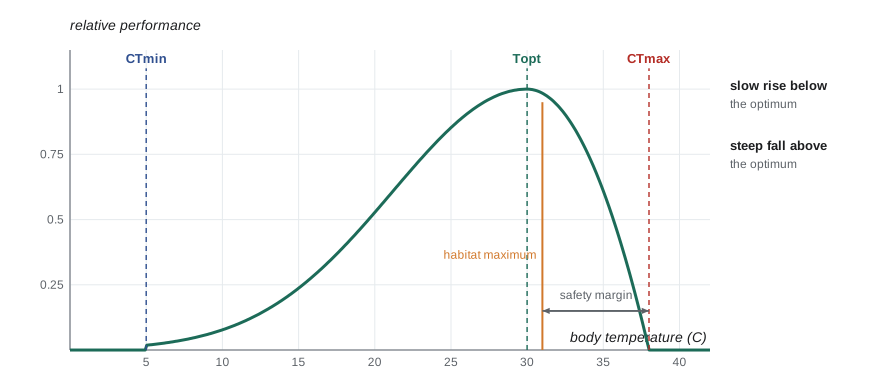
import numpy as np

def performance(T, ctmin=5.0, topt=30.0, ctmax=38.0):
    """A simple asymmetric curve: Gaussian rise, quadratic fall (illustrative)."""
    T = np.asarray(T, dtype=float)
    rise = np.exp(-((T - topt) / ((topt - ctmin) / 2.0)) ** 2)
    fall = 1 - ((T - topt) / (ctmax - topt)) ** 2
    p = np.where(T <= topt, rise, fall)
    return np.clip(p, 0, None)

temps = np.array([10, 20, 26, 30, 33, 36, 38])
for t, p in zip(temps, performance(temps)):
    print(f"{t:3d} C  relative performance {p:.2f}")
habitat_max = 31.0
print("thermal safety margin (CTmax - habitat max):", 38.0 - habitat_max, "C")10 C relative performance 0.08 20 C relative performance 0.53 26 C relative performance 0.90 30 C relative performance 1.00 33 C relative performance 0.86 36 C relative performance 0.44 38 C relative performance 0.00 thermal safety margin (CTmax - habitat max): 7.0 C
Ectotherms and endotherms
Organisms differ in where their body heat comes from. Ectotherms, which include most invertebrates, fish, amphibians and reptiles, gain heat mainly from their surroundings. Their body temperature tracks the environment unless they regulate it by behaviour, such as basking in the sun, seeking shade or burrowing. Endotherms, mainly birds and mammals, generate most of their heat by metabolism and keep their body temperature nearly constant. Endothermy allows activity in the cold but is expensive: a mammal needs several times more food than a reptile of the same mass.
Heat balance for any organism can be summarized as a budget: heat gained from metabolism and absorbed radiation must equal heat lost by radiation, convection, conduction and evaporation, otherwise the body warms or cools. Animals adjust each term. Arctic foxes and caribou have thick insulating fur that cuts convective and conductive loss; many birds tuck in their legs and fluff their feathers; beavers and ducks use countercurrent heat exchange in their legs and tails, where warm arterial blood flowing out passes heat to cool venous blood flowing back, so the extremities stay cold and little heat is lost.
In winter, many small animals escape the cold rather than resist it. Hibernating mammals such as the little brown bat and the Richardson's ground squirrel drop their body temperature close to freezing and cut their metabolic rate by more than 90 per cent. Others overwinter beneath the snow in the subnivean space, where temperatures stay near 0 °C even when the air above is −30 °C. The wood frog, found as far north as the Arctic treeline, freezes solid: up to about two-thirds of its body water turns to ice, while glucose produced by the liver protects its cells, and it thaws and hops away in spring.
Body size, shape and climate
Heat is produced in proportion to body volume but lost through the body surface. As an animal gets larger, its volume grows with the cube of its length but its surface area only with the square, so larger animals have less surface per unit of volume and lose heat more slowly. In 1847, Carl Bergmann observed that within groups of related endotherms, populations and species in colder climates tend to be larger. Joel Allen later noted that extremities such as ears, tails and limbs tend to be shorter in colder climates. The Arctic hare's short ears, compared with the long ears of desert jackrabbits, are a textbook example. These rules are tendencies, not laws, and many exceptions exist, but they illustrate how climate shapes form.
import numpy as np

rng = np.random.default_rng(208)
# Invented data: mean body mass (kg) of white-tailed deer populations by latitude
lat = np.array([28, 32, 35, 38, 41, 44, 47, 50, 53])
mass = 45 + 1.6 * (lat - 28) + rng.normal(0, 4, lat.size)
slope, intercept = np.polyfit(lat, mass, 1)
r = np.corrcoef(lat, mass)[0, 1]
for a, m in zip(lat, mass):
    print(f"lat {a:2d} N  mass {m:5.1f} kg")
print(f"fitted slope: {slope:.2f} kg per degree, r = {r:.2f}")

# Surface-area-to-volume ratio of spheres of increasing size
for radius_cm in (2, 10, 40):
    sa = 4 * np.pi * radius_cm**2
    vol = 4 / 3 * np.pi * radius_cm**3
print(f"radius {radius_cm:3d} cm SA/V = {sa / vol:.3f} per cm")lat 28 N mass 43.9 kg lat 32 N mass 45.4 kg lat 35 N mass 50.7 kg lat 38 N mass 64.0 kg lat 41 N mass 63.4 kg lat 44 N mass 68.3 kg lat 47 N mass 78.4 kg lat 50 N mass 73.5 kg lat 53 N mass 85.9 kg fitted slope: 1.69 kg per degree, r = 0.97 radius 2 cm SA/V = 1.500 per cm radius 10 cm SA/V = 0.300 per cm radius 40 cm SA/V = 0.075 per cm
Worked problem
Why a shrew must eat constantly
A masked shrew weighs about 5 g and a moose about 400 kg. Treating each as a sphere of similar density, by what factor is the shrew's surface-area-to-volume ratio larger?
Show solution
- For a sphere, SA/V = 3/r, so SA/V is inversely proportional to radius.
- Radius scales with the cube root of mass. Mass ratio: 400,000 g / 5 g = 80,000.
- Cube root of 80,000 ≈ 43.1.
- The shrew's radius is about 43 times smaller, so its SA/V is about 43 times larger.
Answer: About 43 times. Per gram, the shrew loses heat far faster and must eat roughly its own body mass in food each day, while the moose can survive on low-quality browse.
Water balance
Life evolved in water, and every terrestrial organism must keep its internal water within narrow limits while living in air that constantly pulls water away. Animals gain water by drinking, in food, and from metabolism (oxidizing food produces water), and lose it in urine, faeces, breath and through the skin. Desert animals such as the kangaroo rat survive almost entirely on metabolic water, producing extremely concentrated urine and staying in cool, humid burrows by day. Freshwater fish face the opposite problem: water floods in by osmosis, so they excrete large volumes of dilute urine, while marine fish lose water and drink seawater, excreting salt through their gills.
Plants face a fundamental trade-off. To take in carbon dioxide for photosynthesis, they must open the stomata on their leaves, but open stomata let water vapour escape. Transpiration pulls water from the soil through the roots and up the stem. Plants in dry environments limit water loss with thick waxy cuticles, small or hairy leaves, sunken stomata, deep roots, or alternative photosynthetic pathways. CAM plants such as cacti open their stomata only at night, storing carbon dioxide as organic acids and using it by day with stomata closed. C₄ grasses, common on warm prairies, concentrate carbon dioxide inside the leaf and so can photosynthesize with stomata partly closed.
Light, oxygen and chemistry
Light varies with latitude, season, canopy cover and depth in water. On a forest floor in summer, only a few per cent of full sunlight may reach the ground, and shade-tolerant plants such as sugar maple seedlings can survive there for years, waiting for a gap. In lakes, light declines exponentially with depth, limiting photosynthesis to the upper zone. Oxygen is plentiful in air but scarce in water, especially warm or still water, where oxygen dissolves poorly, and it can disappear entirely in the deep water of nutrient-rich lakes. Soil and water chemistry, including pH and salinity, also limit where species can live; acid rain lowered the pH of thousands of lakes on the Canadian Shield and in the northeastern United States in the late twentieth century, eliminating acid-sensitive fish and invertebrates. BIOL-460 covers aquatic environments in detail.
| Factor | Example adaptation | Organism |
|---|---|---|
| Extreme cold | Freeze tolerance using glucose as a cryoprotectant | Wood frog |
| Cold, endotherm | Thick fur and countercurrent heat exchange | Arctic fox, beaver |
| Drought, animal | Metabolic water and concentrated urine | Kangaroo rat |
| Drought, plant | CAM photosynthesis; stomata open at night | Prickly pear cactus |
| Heat | Behavioural thermoregulation: shade, burrows, nocturnal activity | Desert lizards |
| Low light | Shade tolerance; low respiration rates | Sugar maple seedlings |
| Low oxygen | Large gills, low metabolic rate | Fish of warm ponds |
Common mistakes
MistakeCold-blooded animals have cold blood.
InsteadEctotherms take heat from the environment; a basking lizard can be warmer than a mammal.
MistakeBiological rates keep rising as temperature rises.
InsteadRates rise toward an optimum and then fall steeply as heat damages proteins and membranes.
MistakeBergmann's rule says all cold-climate animals are large.
InsteadIt is a tendency within groups of related endotherms, with many exceptions.
MistakePlants open their stomata only to release oxygen.
InsteadStomata let carbon dioxide in for photosynthesis, at the cost of water vapour escaping.
MistakeLiebig's law means total nutrients determine growth.
InsteadGrowth is limited by the scarcest essential resource relative to need.
Summary and key terms
- Each species has a tolerance range for each environmental factor, with an optimum and limits; growth is limited by the scarcest essential resource.
- Biological rates typically increase 2 to 3 times per 10 °C rise (Q10), up to an optimum.
- Thermal performance curves rise slowly to an optimum and fall steeply to CTmax, so warming near the optimum can be harmful.
- Ectotherms gain heat mainly from the environment; endotherms generate it metabolically at a high energy cost.
- Insulation, countercurrent exchange, hibernation, the subnivean space and freeze tolerance help animals survive cold.
- Larger bodies have less surface per volume and lose heat more slowly, underlying Bergmann's and Allen's rules.
- Water balance shapes animal physiology and plant structure, including CAM and C₄ photosynthesis.
- tolerance range
- The span of an environmental factor within which a species can survive.
- law of the minimum
- Growth is limited by the scarcest essential resource relative to need.
- Q10
- The factor by which a rate increases for a 10 °C rise in temperature.
- thermal performance curve
- A graph of an organism's performance against body temperature.
- ectotherm
- An organism that gains body heat mainly from its environment.
- endotherm
- An organism that generates most of its body heat by metabolism.
- countercurrent exchange
- Heat or substance transfer between fluids flowing in opposite directions.
- subnivean space
- The sheltered layer beneath the snowpack, near 0 °C.
- Bergmann's rule
- Endotherms in colder climates tend to be larger than related ones in warmer climates.
- CAM photosynthesis
- A pathway in which stomata open at night and carbon dioxide is stored for use by day.
Practice problems
Work each problem on paper first, then reveal the answer to check.
A rate is 2.0 at 10 °C and 5.0 at 20 °C. Calculate Q10.
Show answer
Q10 = 5.0/2.0 = 2.5.
With Q10 = 2, how much faster is a rate at 25 °C than at 5 °C?
Show answer
2^(20/10) = 4 times.
Why is the falling side of a thermal performance curve steeper than the rising side?
Show answer
Above the optimum, heat rapidly damages proteins and membranes, so performance collapses.
Give two ways an endotherm reduces heat loss in winter.
Show answer
Thicker insulation (fur, feathers) and countercurrent heat exchange in extremities; also huddling or hibernation.
How does the wood frog survive freezing?
Show answer
Glucose acts as a cryoprotectant while ice forms outside the cells; it thaws in spring.
Explain why larger animals lose heat more slowly per unit mass.
Show answer
Surface area grows with length squared but volume with length cubed, so SA/V falls with size.
State Allen's rule with an example.
Show answer
Extremities are shorter in colder climates; the Arctic hare has shorter ears than desert jackrabbits.
How does a kangaroo rat get water?
Show answer
Mainly from metabolic water produced by oxidizing food, with very concentrated urine.
Why do CAM plants open their stomata at night?
Show answer
Cooler, more humid air at night reduces water loss while they take in carbon dioxide.
A crop has plenty of nitrogen but stops growing. Which principle helps explain this?
Show answer
Liebig's law of the minimum: another resource, such as phosphorus, is limiting.
Lesson quiz · 5 questions
Score 60% or more to complete this lesson.
Create a free account to save your progress, take quizzes and earn a certificate.