
AWS-101 · Lesson 8 of 12 · 18 min
The AWS Cloud Adoption Framework
▶ Video coming soon A video version of this lesson is on the way.
At the end of October Andre Leclerc, the operations manager for the eleven clinics, asks a question that has nothing to do with servers. "When this goes live, my receptionists will log in differently, the reports will look different and the clinic managers will want to know who to call. Who is planning that?" Gwen is delighted. Most cloud migrations that struggle, she explains, struggle because of people, processes and decisions, not technology. AWS's guide to the whole organizational journey is the AWS Cloud Adoption Framework (AWS CAF), and the CLF-C02 exam asks candidates to describe its components and the outcomes it supports.
The CAF collects AWS's experience from many organizations' cloud transformations into a structure that helps a business plan its own. Where the Well-Architected Framework reviews a workload, the CAF looks at the organization: its skills, governance, operations and ways of making decisions. It groups the capabilities an organization needs into six perspectives, each with its own stakeholders.
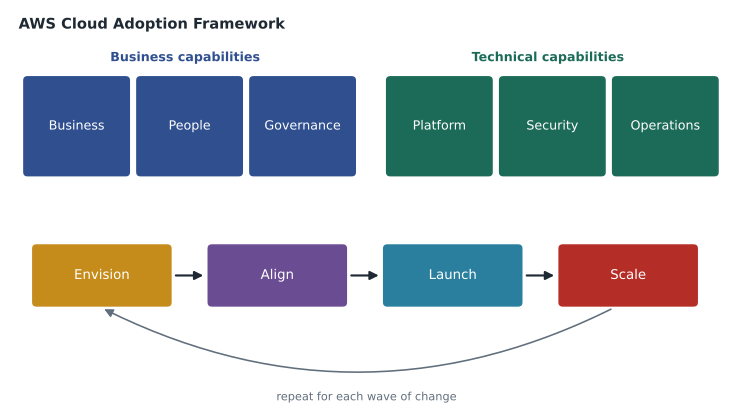
The six perspectives
The first three perspectives concern business capabilities; the last three concern technical capabilities. Gwen maps each to the person at Cascade Ridge who owns it, because a perspective without an owner tends to be forgotten.
| Perspective | Focus | Typical stakeholders | Cascade Ridge owner |
|---|---|---|---|
| Business | Making sure cloud investments accelerate business outcomes | Chief executive, finance, strategy | The board and Lorraine |
| People | Culture, skills, roles and change management | Human resources, team leaders | Hannah (HR systems) and Andre |
| Governance | Orchestrating initiatives to maximize benefits and minimize risk | Finance, risk, program management | Lorraine and Gwen |
| Platform | Building a scalable cloud platform and modernizing workloads | Architects, engineers | Gwen and Kwame |
| Security | Protecting the confidentiality, integrity and availability of data and workloads | Security and compliance leads | Hannah |
| Operations | Delivering cloud services at the level the business needs | IT operations, support | Mateo |
Business perspective
The business perspective makes sure the cloud investment serves the business strategy rather than becoming a technology project for its own sake. Its capabilities include strategy management, portfolio management, innovation, product management and data monetization. For Cascade Ridge, the business goals are concrete: no more outages at the emergency hospital, faster access to images for vets, an online booking system that copes with spring, and lower spending on hardware. Every later decision should trace back to one of these.
People perspective
The people perspective addresses the human side: culture, leadership, skills and how roles change. Its capabilities include culture evolution, transformational leadership, cloud fluency, workforce transformation, change acceleration and organization design. This is where Andre's question belongs. The receptionists need short training on any changed sign-in steps; clinic managers need a new support contact; and Mateo's own role changes from fixing hardware to managing cloud services, which is why he is studying for the exam.
Governance perspective
The governance perspective keeps the program on track and its risks under control. Its capabilities include program and project management, benefits management, risk management, cloud financial management, application portfolio management, data governance and data curation. Lorraine's interest in tags and budgets is governance, and so is the decision record Gwen keeps for each major choice. A monthly steering meeting with Lorraine, Dr. Kaur, Hannah, Andre and Gwen will review progress, spending and risks.
Platform perspective
The platform perspective is about building the technical foundation: a well-designed, scalable cloud environment and the patterns for running workloads on it. Its capabilities include platform architecture, data architecture, platform engineering, data engineering, provisioning and orchestration, modern application development and continuous integration and delivery. The multi-account structure, the network design and the templates that build servers all belong here.
Security perspective
The security perspective protects data and workloads. Its capabilities include security governance, security assurance, identity and access management, threat detection, vulnerability management, infrastructure protection, data protection, application security and incident response. Hannah's policy work, drawn from the Well-Architected security pillar, forms the core. AWS-102 covers the services that support it.
Operations perspective
The operations perspective makes sure cloud services run at the level the business needs, day after day. Its capabilities include observability, event management, incident and problem management, change and release management, performance and capacity management, configuration management, patch management and availability and continuity management. This is Mateo's new home: monitoring, alerts, patching, backups and the runbook that tells the clinics what to do if something goes wrong.
Business outcomes
The CAF links a cloud transformation to four kinds of business outcome. The exam guide names them, and Gwen asks Mateo to give a Cascade Ridge example for each.
- Reduced business risk: improved reliability, security and recovery. The Multi-AZ design and the second Region reduce the risk of another July.
- Improved environmental, social and governance (ESG) performance: for example, lower energy use from efficient shared infrastructure, and better governance through clear controls and audit trails.
- Increased revenue: new or better products and services. A BookVet that never falls over in spring should capture bookings that today are lost to frustrated clients.
- Increased operational efficiency: lower costs and less manual work. No tape runs, no hardware repairs, and reports that run without someone exporting spreadsheets.
Transformation domains
AWS describes the change as running through four transformation domains that build on each other. Technology transformation means migrating and modernizing infrastructure, applications and data. Process transformation means digitizing and automating business operations, often using data and analytics. Organization transformation means reshaping how teams work, for example around products and value streams. Product transformation means rethinking the business model with new products, services and revenue. Cascade Ridge is mostly in the technology domain this year, with a first step into process when booking reminders become automatic.
Four phases of the journey
The CAF describes an iterative journey in four phases. Gwen draws them as a loop rather than a line, because organizations repeat them for each wave of change.
| Phase | What happens | At Cascade Ridge |
|---|---|---|
| Envision | Identify how the cloud will accelerate business outcomes and prioritize opportunities | September: the board sets four goals and approves the move |
| Align | Find capability gaps across the six perspectives and agree a plan to close them | October: owners named, training planned, risks listed |
| Launch | Deliver pilots or first workloads in production and show value | December: the BookVet pilot, as planned |
| Scale | Expand the proven approach across the business | Spring 2027: VetLedger and the image archive, as planned |
Help with the journey
Organizations rarely make the move alone. AWS offers several kinds of support that the exam may mention in connection with migration. AWS Professional Services is AWS's own consulting team. The AWS Partner Network includes thousands of consulting and technology partners who help with planning and migration; Gwen herself works with a partner on large projects. AWS Training and Certification offers courses, many free on AWS Skill Builder, and the certification path Mateo is following. AWS also runs migration programs and tools, such as AWS Migration Hub for tracking migrations, which lesson 9 mentions alongside the migration strategies.
# Track readiness across the six CAF perspectives (illustrative self-assessment, 1 to 5).
scores = {"business": 4, "people": 2, "governance": 3, "platform": 3, "security": 3, "operations": 2}
gaps = sorted((s, p) for p, s in scores.items() if s < 3)
print("Average readiness:", round(sum(scores.values()) / len(scores), 1))
print("Perspectives below 3 that need a plan before launch:", [p for s, p in gaps])Average readiness: 2.8 Perspectives below 3 that need a plan before launch: ['operations', 'people']
What this code does
It records a self-assessment score from 1 to 5 for each of the six AWS Cloud Adoption Framework perspectives. It prints the average score and lists the perspectives scoring below 3. In this example people and operations are flagged as needing a plan before launch.
The self-assessment confirms what Andre suspected: the technology plan is ahead of the people and operations plans. Gwen adds two actions to the steering meeting agenda: a training schedule for clinic staff and a support model for after cutover.
Common mistakes
MistakeThinking the CAF is a technical architecture.
InsteadIt is an organizational framework covering business, people, governance, platform, security and operations.
MistakeConfusing the CAF with the Well-Architected Framework.
InsteadThe CAF guides the organization's adoption journey; Well-Architected reviews individual workloads.
MistakeLeaving the people perspective until after go-live.
InsteadTraining, roles and support must be ready before users are affected.
MistakeListing 'cost' as one of the six perspectives.
InsteadCost sits within the governance perspective as cloud financial management.
Common pitfalls the CAF helps avoid
Gwen has seen enough migrations to list the ways they go wrong, and almost every item maps to a perspective that was neglected. A migration that moves servers successfully but leaves staff confused about how to log in has neglected the people perspective. One that runs over budget because nobody tracked spending has neglected governance. One that leaves an open storage bucket on the internet has neglected security. One that goes live without anyone watching the alarms at night has neglected operations. And one that delivers working systems nobody asked for has neglected the business perspective.
The value of the framework, in her view, is less in its long lists of capabilities than in the discipline of asking, for each perspective, who owns it and what must be true before the next phase begins. Cascade Ridge's steering group now opens each monthly meeting with a two-minute status for each of the six perspectives, given by its owner.
Skills and roles
The people perspective includes cloud fluency: the level of cloud understanding each role needs. Gwen sketches a simple plan for Cascade Ridge. Mateo will reach a professional level of operational skill and take the Cloud Practitioner exam first, followed later by an associate-level certification. Kwame will learn serverless development for phase 2. Hannah will study security and identity on AWS. Lorraine and Andre need enough fluency to read cost reports and understand the service changes their teams will see. Clinic staff need only short, task-based training on the sign-in steps and the new support contact.
| Role | Cloud fluency needed | How |
|---|---|---|
| Practice systems coordinator (Mateo) | Operate and troubleshoot AWS services | Cloud Practitioner, then an associate-level path |
| Developer (Kwame) | Build serverless applications | Developer training on AWS Skill Builder |
| Privacy and security lead (Hannah) | Identity, logging, encryption, compliance | Security-focused courses |
| CFO and operations manager | Read cost and service reports | Short briefings with Gwen |
| Clinic staff | Use the changed sign-in and support process | Fifteen-minute sessions before each cutover |
Measuring progress
The governance perspective's benefits management capability asks how the organization will know the transformation is working. Lorraine wants numbers, so the steering group agrees four measures linked to the four business goals: minutes of VetLedger downtime per quarter, time for a vet to open a prior radiograph, BookVet bookings completed during the spring rush compared with the year before, and money not spent on hardware. Each has a baseline from 2026 and a target for 2027.
Gwen warns that the first months after a cutover can look worse on some measures, as staff adjust and the team tunes the new systems. The steering group agrees to judge the measures over a full quarter rather than week by week, and to treat an early dip as a prompt for action rather than a reason to reverse course.
The measures go into the steering group's monthly report alongside the six perspective updates, so that progress on people and process is discussed as seriously as progress on servers.
Worked problem
Assigning a concern to a perspective
Four concerns come up at the steering meeting: receptionists need training on the new sign-in; the monthly bill must be split by clinic; client records must be encrypted; and someone must be paged if VetLedger stops at night. Which CAF perspective owns each?
Show solution
- Training receptionists is the people perspective.
- Splitting the bill by clinic is cloud financial management, in the governance perspective.
- Encrypting client records is the security perspective.
- Paging someone when VetLedger stops is event and incident management, in the operations perspective.
Answer: People, governance, security and operations. Each concern now has an owner on the steering group.
Andre leaves the meeting with a training plan and a seat at the monthly steering meeting. Mateo leaves with a list of operations capabilities he must build before spring. Lesson 9 turns to how each system will actually move.
Summary and key terms
- The AWS Cloud Adoption Framework guides an organization's cloud transformation.
- Its six perspectives are business, people and governance (business capabilities) and platform, security and operations (technical capabilities).
- It links transformation to four outcomes: reduced business risk, improved ESG performance, increased revenue and increased operational efficiency.
- Change runs through the technology, process, organization and product domains.
- The journey has four iterative phases: envision, align, launch and scale.
- AWS Professional Services, AWS Partners, AWS Training and Certification and tools such as AWS Migration Hub support it.
- AWS CAF
- AWS Cloud Adoption Framework: guidance for an organization's cloud transformation.
- Perspective
- One of six groups of capabilities in the CAF.
- Business perspective
- Ensures cloud investments accelerate business outcomes.
- People perspective
- Culture, skills, leadership and change.
- Governance perspective
- Program management, risk and cloud financial management.
- Platform perspective
- The technical foundation and modern workload patterns.
- Security perspective
- Confidentiality, integrity and availability of data and workloads.
- Operations perspective
- Running cloud services at the level the business needs.
- Envision, align, launch, scale
- The four phases of a cloud transformation in the CAF.
Practice problems
Work each problem on paper first, then reveal the answer to check.
Which three CAF perspectives cover technical capabilities?
Show answer
Platform, security and operations.
Which CAF perspective includes training staff and managing organizational change?
Show answer
The people perspective.
Name the four business outcomes the CAF links to cloud transformation.
Show answer
Reduced business risk, improved ESG performance, increased revenue and increased operational efficiency.
Lesson quiz · 5 questions
Score 60% or more to complete this lesson.
Create a free account to save your progress, take quizzes and earn a certificate.