
AWS-101 · Lesson 2 of 12 · 18 min
The six advantages of cloud computing
▶ Video coming soon A video version of this lesson is on the way.
On the second Monday, Lorraine invites Gwen to explain the move to the board's finance committee. Gwen brings one slide with six lines on it. The lines come from an AWS whitepaper, Overview of Amazon Web Services, and they appear in some form on almost every AWS introduction. Mateo watches the committee members react to each one and realizes that each line answers a different worry. That afternoon Gwen asks him to rewrite the slide in Cascade Ridge's own words, with a real example beside every advantage.
The CLF-C02 exam guide asks candidates to explain the value proposition of the AWS Cloud, including the benefits of the global infrastructure, high availability, elasticity and agility. The six advantages are the most compact way to remember that value, and exam questions often describe a situation and ask which advantage it shows.
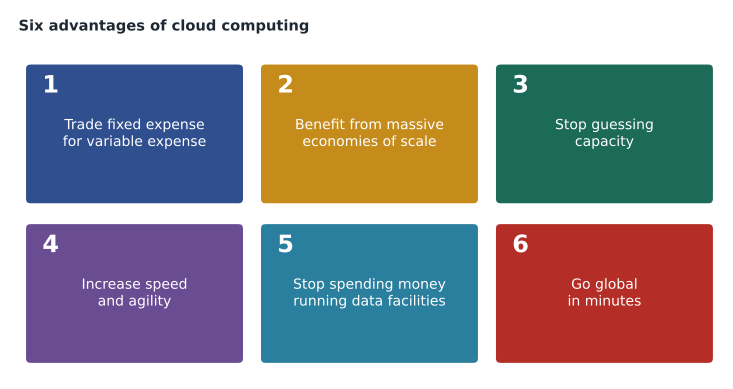
1. Trade fixed expense for variable expense
Instead of investing heavily in servers and facilities before knowing how they will be used, an organization pays only when it consumes computing resources, and only for how much it consumes. For Cascade Ridge, this means the next storage array never has to be bought. Today Mateo would have to buy enough disk for five more years of radiographs, about 30 terabytes beyond what is used now, and pay for all of it up front. In the cloud, storage is billed for what is actually stored each month, so the bill grows as the archive grows.
Lorraine's question to the committee is the right one: does variable always mean lower? No. Variable means proportional. If the clinics took twice as many images next year, the storage bill would roughly double too. The benefit is that spending follows activity, which usually follows revenue, and that no money is locked into equipment that might turn out to be the wrong size.
2. Benefit from massive economies of scale
A provider that runs computing for millions of customers buys hardware, power and network capacity in quantities no single company can match, and it automates operations that a small team would do by hand. Those savings are partly passed on as lower prices, and AWS has reduced prices on many services many times since it began. Economies of scale is the term the exam uses for this: the cost per unit falls as total volume rises.
Mateo puts it in clinic terms. Cascade Ridge buys vaccines through a purchasing group with other practices because a single clinic ordering a few boxes pays more per dose. AWS is the purchasing group for computing, at a scale of countries rather than clinics. The exam also links economies of scale to sustainability, since a large, efficient provider can often run the same workload with less energy than many small server rooms, a theme of the Well-Architected Framework's sustainability pillar in lesson 6.
3. Stop guessing capacity
When organizations buy their own hardware, they must decide capacity in advance. Guess too low and users suffer; guess too high and expensive equipment sits idle. In the cloud, capacity can be added or removed in minutes, so the guess becomes far less important. This is elasticity: the ability to acquire resources as demand rises and release them as it falls, ideally automatically.
BookVet is Cascade Ridge's best example. Every spring, when vaccination reminders go out, bookings jump to about four times the normal level for three weeks. The rented virtual server struggled each year, and Kwame spent nights restarting it. In AWS, an Auto Scaling group can add servers when load rises and remove them when it falls, and a load balancer spreads requests across whatever servers are running. Lesson 7 shows how this works and why it also improves availability.
# How many servers would BookVet need each week of the year?
# Illustrative weekly peak bookings per hour; one server handles 400.
import math
weekly_peak = [300]*10 + [1200, 1250, 1180] + [350]*12 + [280]*15 + [500, 520] + [300]*10
per_server = 400
needed = [max(2, math.ceil(b / per_server)) for b in weekly_peak]  # keep at least two
print("Weeks:", len(needed))
print("Servers if sized for the peak all year:", max(needed) * len(needed), "server-weeks")
print("Servers if sized week by week: ", sum(needed), "server-weeks")Weeks: 52 Servers if sized for the peak all year: 208 server-weeks Servers if sized week by week: 108 server-weeks
What this code does
It lists the busiest hour's bookings for each of the 52 weeks of the year, where one server handles 400 bookings an hour and at least two servers always run. For each week it works out the servers needed by dividing bookings by 400 and rounding up. It then compares sizing for the peak all year with sizing week by week, and the week-by-week approach uses about half the server-weeks.
The calculation keeps at least two servers at all times so that one failure does not take the app down, a design choice explained in lesson 7. Even with that floor, sizing week by week needs far fewer server-weeks than sizing for the spring peak all year.
4. Increase speed and agility
In a traditional environment, getting new resources to developers takes weeks: approvals, purchasing, delivery, installation. In the cloud, new resources are a click or an API call away, so the time it takes to try an idea drops from weeks to minutes. Agility in AWS's language means being able to experiment quickly, at low cost, and to throw away what does not work.
Kwame has wanted for two years to test sending appointment reminders by text message instead of email. On the old setup that meant buying and configuring a messaging gateway. In AWS he can try a managed messaging service in an afternoon, send a few hundred reminders to staff volunteers, measure the response, and delete the whole experiment if it disappoints. The cost of being wrong becomes small, so the team can afford to try more things.
5. Stop spending money running and maintaining data centres
Running servers means running the room they live in: power, cooling, physical security, fire suppression, racks, cabling, hardware replacement. None of that work makes Cascade Ridge a better veterinary group. AWS's advice is to focus on projects that differentiate the business, not on the undifferentiated heavy lifting of racking, stacking and powering servers.
Mateo counts his own hours. Last year he spent about two working weeks on hardware alone: replacing failed disks, updating firmware, chasing the air-conditioning contractor and driving backup tapes to Lorraine's house every Friday. After the move, Gwen expects that time to go into things the clinics actually ask for, such as better reporting for Andre, the operations manager, and faster access to images for the vets.
6. Go global in minutes
Because AWS operates Regions on several continents, an organization can deploy an application in another part of the world with a few clicks, giving users there lower latency at minimal cost. This is the advantage the exam guide calls global reach.
Cascade Ridge is not about to open clinics overseas, so Mateo is tempted to skip this one. Gwen points out that the same idea matters at home. AWS has two Regions in Canada, one in the Montréal area and one in Calgary, so Cascade Ridge can keep a recovery copy of its systems a few thousand kilometres from the primary copy without leaving the country. Lessons 4 and 5 explain how Regions work and how to choose them.
| Advantage | The worry it answers | Cascade Ridge example |
|---|---|---|
| Trade fixed for variable expense | Large purchases before demand is known | No new storage array; pay for images as they are stored |
| Economies of scale | High unit costs for a small buyer | Provider prices reflect purchasing at enormous volume |
| Stop guessing capacity | Over-buying or under-buying servers | BookVet grows for the spring rush and shrinks after |
| Speed and agility | Weeks to get resources for an idea | Kwame tests text reminders in an afternoon |
| Stop running data centres | Time and money spent on facilities | No more server room repairs or Friday tape runs |
| Go global in minutes | Distance from users or from a backup site | A recovery copy in a second Region far away |
Related terms the exam uses
Exam questions mix the six advantages with several related terms. Gwen makes Mateo define each in one sentence, because confusing them is a common way to lose points.
- Scalability is the ability of a system to handle more load by adding resources. Elasticity adds the idea of adding and removing resources automatically as demand changes. A system can be scalable without being elastic if someone must add capacity by hand.
- High availability means a system keeps working when parts of it fail, usually by running copies in more than one place. Lesson 7 shows how Availability Zones make this practical.
- Fault tolerance goes further: the system continues with no interruption at all when a component fails, typically because a full spare is always running.
- Agility is the speed at which an organization can experiment and deliver change.
- Reliability is a system's ability to perform its intended function correctly and consistently, and to recover from failures; it is also one of the six Well-Architected pillars.
Common mistakes
MistakeTreating 'pay as you go' as a promise of lower bills.
InsteadIt promises proportional bills. Savings come from matching capacity to demand and turning off what is not used.
MistakeConfusing scalability with elasticity.
InsteadScalability is the ability to grow; elasticity is growing and shrinking automatically with demand.
MistakeSkipping 'go global in minutes' for local businesses.
InsteadThe same Regions that serve distant users also provide distant recovery sites within one country.
MistakeListing 'security' as one of the six advantages.
InsteadSecurity matters greatly, but it is not one of the six; it is a Well-Architected pillar and the subject of AWS-102.
Advantages are not guarantees
Gwen ends the session with a caution that Lorraine appreciates. Each advantage describes what the cloud makes possible, not what happens automatically. Variable expense only helps if unused resources are switched off. Economies of scale only reach the customer through prices, which still have to be compared. Elasticity only works if the application is built to run on more than one server. Agility only pays off if the team has time to experiment. Going global only helps if someone sets up and tests the second Region.
For that reason, the board pack pairs every advantage with an owner and a measure. Lorraine owns variable expense and will watch the monthly bill against the estimate. Kwame owns elasticity and will report how many servers BookVet ran during the spring rush. Mateo owns the end of server room work and will log the hours he no longer spends on hardware. Dr. Kaur owns the recovery Region in the sense that matters most to her: she will attend the test that proves it works. The exam does not ask about owners and measures, but Gwen says real projects succeed or fail on them.
Worked problem
Naming the advantage
Dr. Simone Kaur, the medical director, asks why the board believes the move will make the emergency hospital more reliable when the old servers were reliable for years at a time. Which advantages should Mateo mention, and how?
Show solution
- Stop spending money running and maintaining data centres: the overheating server room was the cause of the July outage, and AWS facilities are built and staffed to prevent it.
- Go global in minutes: Cascade Ridge can keep a recovery copy in a second, distant Region, which the old single server room could never offer.
- Stop guessing capacity: VetLedger can be given more resources quickly if the hospital grows, instead of waiting weeks for hardware.
- He should also mention high availability, which comes from running copies across Availability Zones (lesson 7), even though it is not one of the six by name.
Answer: Mateo connects the July outage to facilities, distance and capacity, and promises Dr. Kaur a clear plan for availability in lesson 7.
Mateo's rewritten slide goes to the board pack the following week with six lines and six real examples. Lorraine adds one note in the margin: tag everything so we can see the cost of each. Gwen smiles; that note belongs in AWS-104, but it is the right instinct.
Summary and key terms
- AWS describes six advantages of cloud computing.
- Trade fixed expense for variable expense: pay only for what is consumed.
- Benefit from massive economies of scale: a huge provider buys and operates more cheaply per unit.
- Stop guessing capacity: add and remove resources as demand changes.
- Increase speed and agility: get resources in minutes and experiment cheaply.
- Stop spending money running and maintaining data centres: focus on what differentiates the business.
- Go global in minutes: deploy in Regions around the world.
- Elasticity, scalability, high availability, fault tolerance and agility are related terms the exam uses precisely.
- Economies of scale
- Lower cost per unit as the total volume of production or purchasing rises.
- Elasticity
- Acquiring and releasing resources automatically as demand rises and falls.
- Scalability
- The ability to handle more load by adding resources.
- Agility
- The speed and low cost with which an organization can experiment and deliver change.
- High availability
- Continuing to work when components fail, usually by running copies in separate places.
- Fault tolerance
- Continuing with no interruption when a component fails.
- Undifferentiated heavy lifting
- Infrastructure work that does not make a business distinctive, such as racking and powering servers.
- Global reach
- The ability to deploy close to users or recovery sites anywhere AWS operates.
Practice problems
Work each problem on paper first, then reveal the answer to check.
A start-up launches without buying any servers and pays monthly for what it uses. Which advantage is this?
Show answer
Trade fixed expense for variable expense.
What separates elasticity from scalability?
Show answer
Elasticity grows and shrinks capacity automatically with demand; scalability is only the ability to grow.
Which advantage explains why a team can test an idea in an afternoon and delete it if it fails?
Show answer
Increase speed and agility.
Lesson quiz · 5 questions
Score 60% or more to complete this lesson.
Create a free account to save your progress, take quizzes and earn a certificate.