
AWS-101 · Lesson 7 of 12 · 18 min
Designing for failure and elasticity
▶ Video coming soon A video version of this lesson is on the way.
Werner Vogels, Amazon's chief technology officer, is often quoted as saying that everything fails, all the time. Gwen writes the line on the whiteboard at the start of the reliability session, under the four high-risk findings from the Well-Architected review. "In the server room," she says, "you tried to make one machine never fail. In the cloud, you assume machines will fail and design so that nobody notices." This lesson follows how she redesigns VetLedger and BookVet around that idea, and how the same design lets BookVet grow and shrink with demand.
Single points of failure
A single point of failure is any component whose failure stops the whole system. Cascade Ridge's current setup has several: one server room, one storage array, one database server, one internet connection at head office, one person who knows how everything works. The July outage happened because one component, the air conditioner, failed and nothing else could take over.
The cure is redundancy: running more than one copy of each critical component, in places that do not fail together, with a way to switch between them. AWS makes the expensive part of redundancy, separate buildings with separate power and cooling, available to every customer through Availability Zones. The customer's job is to use them.
Spreading across Availability Zones
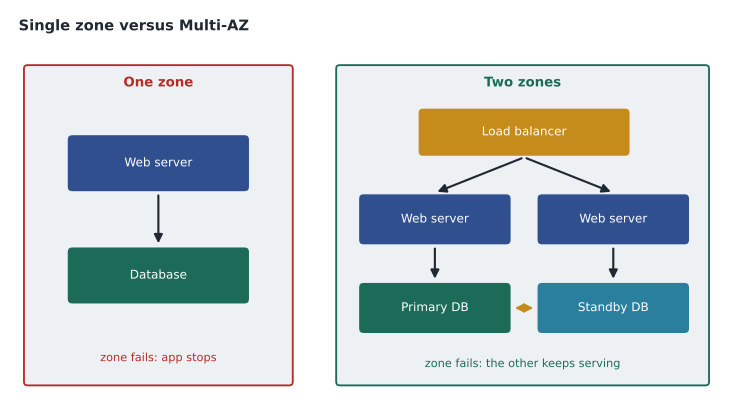
Gwen's VetLedger design spreads every layer across two Availability Zones in the primary Region. Two application servers run on EC2, one in each zone. An Elastic Load Balancing load balancer sits in front of them, checks their health every few seconds and sends each request only to healthy servers. The SQL Server database runs on Amazon RDS in a Multi-AZ deployment: RDS keeps a standby copy in the second zone, copies every change to it synchronously, and if the primary fails it switches to the standby automatically, usually within a minute or two.
Images go into Amazon S3, which already stores every object redundantly across several Availability Zones in the Region, so no extra design is needed for that layer. AWS states that S3 Standard is designed for very high durability, often quoted as eleven nines, meaning the chance of losing a stored object in a year is extraordinarily small. The exam uses the phrase durability for not losing data and availability for being able to reach it when needed; the two are different.
| Layer | Before (server room) | After (AWS, primary Region) |
|---|---|---|
| Application servers | One Windows server | Two EC2 instances in two Availability Zones behind a load balancer |
| Database | One SQL Server machine | Amazon RDS for SQL Server, Multi-AZ with automatic failover |
| Image storage | One storage array | Amazon S3, stored redundantly across zones |
| Backups | Nightly tape, carried off site weekly | AWS Backup with copies to the recovery Region |
| Facilities | One room, one air conditioner | Several AWS data centres in separate zones |
Recovering from a Regional problem
Multi-AZ protects against the failure of a zone, which is the most common large-scale event. A failure of a whole Region is far rarer but not impossible. For that, the design keeps a recovery copy in the second Region chosen in lesson 5: database backups and S3 images are copied there automatically, and templates can rebuild the servers there if needed. Recovering in the second Region would take hours rather than minutes, which Dr. Kaur accepts for a once-in-many-years event.
Two measures express how much protection a design gives. The recovery time objective (RTO) is the longest acceptable time to restore service after a disruption. The recovery point objective (RPO) is the largest acceptable amount of data loss, measured in time: an RPO of fifteen minutes means losing at most the last fifteen minutes of changes. The business sets these objectives, and they drive the design and its cost. Gwen agrees an RTO of five minutes and an RPO of near zero for a zone failure, and an RTO of four hours and an RPO of one hour for a Regional disaster.
# Check a design against recovery objectives (all times in minutes; illustrative).
objectives = {"zone failure": {"rto": 5, "rpo": 1}, "region failure": {"rto": 240, "rpo": 60}}
design = {
    "zone failure":   {"recovery_time": 2,   "data_loss": 0},    # RDS Multi-AZ failover
    "region failure": {"recovery_time": 180, "data_loss": 30},   # rebuild from copies every 30 min
}
for event, goal in objectives.items():
    d = design[event]
    ok = d["recovery_time"] <= goal["rto"] and d["data_loss"] <= goal["rpo"]
    print(f"{event:15} recovers in {d['recovery_time']:3} min, loses {d['data_loss']:2} min of data ->",
"meets objectives" if ok else "does NOT meet objectives")zone failure recovers in 2 min, loses 0 min of data -> meets objectives region failure recovers in 180 min, loses 30 min of data -> meets objectives
What this code does
It sets recovery-time and data-loss limits for a zone failure and a region failure, and the expected recovery time and data loss for the current design. For each event it checks that both values are within the limits. The printout shows the design meets the objectives in both cases.
Loose coupling
Components that depend tightly on each other fail together. Loose coupling means components interact through well-defined interfaces and can keep working, or at least fail gracefully, when another component is slow or missing. A common technique is to put a queue between parts of a system. Kwame plans to use Amazon SQS (Simple Queue Service) so that when BookVet takes a booking it places a message in a queue, and a separate process sends the confirmation email. If the email service is slow for ten minutes, bookings keep working and the emails catch up afterwards.
Elasticity and Auto Scaling
The same redundancy that protects against failure also makes elasticity easy. If BookVet runs on several identical servers behind a load balancer, adding or removing servers changes capacity without changing the design. Amazon EC2 Auto Scaling manages a group of instances and keeps its size between a minimum and a maximum that the team sets. A scaling policy adds instances when a measure such as average processor use rises above a target and removes them when it falls.
Kwame sets BookVet's group to a minimum of two instances, one per zone, so that one failure never leaves the app without a server. The maximum is eight, enough for the spring vaccination rush with room to spare. A target-tracking policy aims to keep average processor use around a set level. When reminders go out in March, the group grows within minutes; in summer it sits at two.
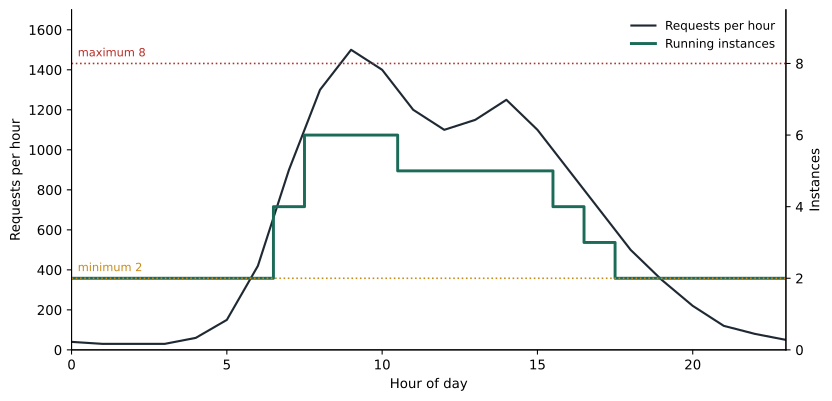
# Simulate a target-tracking Auto Scaling group through a busy day.
import math
hourly_requests = [40, 30, 30, 30, 60, 150, 420, 900, 1300, 1500, 1400, 1200,
                   1100, 1150, 1250, 1100, 900, 700, 500, 350, 220, 120, 80, 50]
per_instance = 250           # requests per hour one instance handles at the target load
minimum, maximum = 2, 8
running = []
for r in hourly_requests:
    want = math.ceil(r / per_instance)
    running.append(min(maximum, max(minimum, want)))
print("Instances by hour:", running)
print("Instance-hours used:", sum(running), "versus", maximum * 24, "if sized for the peak all day")Instances by hour: [2, 2, 2, 2, 2, 2, 2, 4, 6, 6, 6, 5, 5, 5, 5, 5, 4, 3, 2, 2, 2, 2, 2, 2] Instance-hours used: 80 versus 192 if sized for the peak all day
What this code does
It simulates an Auto Scaling group through a day using illustrative hourly request counts, where one instance handles 250 requests an hour and the group must keep between 2 and 8 instances. Each hour it divides requests by 250, rounds up and keeps the result inside those limits. It prints the instances running each hour and the total instance-hours, which is well under half of what keeping 8 running all day would use.
Scaling up and scaling out
There are two ways to add capacity. Vertical scaling, or scaling up, means moving to a bigger server with more processors or memory. It is simple, but it has limits, usually needs a restart and leaves a single point of failure. Horizontal scaling, or scaling out, means adding more servers of the same size. It needs an application that can run on several servers at once, but it has no practical ceiling and adds redundancy at the same time. The reliability pillar's principle of scaling horizontally to increase aggregate availability says exactly this.
VetLedger's database will scale vertically, because SQL Server is a single primary database; RDS makes changing the instance size a few clicks and a short maintenance window. VetLedger's application servers and BookVet scale horizontally. Gwen notes that many cloud designs mix both, as this one does.
Testing failure on purpose
A redundant design that has never been tested is a hope, not a plan. The reliability pillar asks teams to test recovery procedures, and the general principles recommend game days. Before the spring cutover, Gwen schedules a game day: during a quiet evening, the team will reboot the primary database with failover to force RDS to switch zones, stop one application server, and restore a backup in the recovery Region, timing each step against the RTO and RPO. AWS Fault Injection Service can run controlled experiments like these, but for a first game day Gwen prefers simple, scripted steps.
Common mistakes
MistakeBelieving AWS makes every application highly available automatically.
InsteadAWS provides zones and managed features; the customer must design the application to use more than one zone.
MistakeConfusing durability with availability.
InsteadDurability is not losing data; availability is being able to reach the system when needed.
MistakeSetting an Auto Scaling minimum of one for an important app.
InsteadWith one instance, a single failure takes the app down; a minimum of two across zones avoids that.
MistakeNever testing failover.
InsteadRecovery that has not been rehearsed often fails when needed; game days find the problems first.
Health checks and self-healing
Redundancy works only if failed components are noticed and replaced. The load balancer's health checks send a small request to each server every few seconds; a server that stops answering is taken out of service. An Auto Scaling group can use the same health checks: when an instance is marked unhealthy, the group terminates it and launches a replacement from the same template. The system heals itself without anyone logging in, which is the reliability pillar's principle of recovering automatically from failure.
Self-healing changes how Mateo thinks about servers. In the server room, each machine had a name and a history, and he nursed it back to health when it misbehaved. In an Auto Scaling group, instances are interchangeable and disposable; any one of them can be replaced at any time. That only works if no important data lives on an instance's own disk, so BookVet will store everything that matters in the database or in S3, and the instances will hold nothing that cannot be rebuilt.
Gwen adds that health checks should test what users actually need. A check that only confirms the server is switched on can pass while the application is broken. BookVet's check therefore loads a small page that reads from the database, so that a server with a broken database connection is taken out of service too, and Kwame can see in the logs which check failed and why.
Worked problem
Explaining the design to Dr. Kaur
Dr. Kaur asks what happens at 3 a.m. if the Availability Zone running the primary VetLedger database loses power.
Show solution
- RDS detects that the primary is unreachable and promotes the standby in the second zone, usually within a minute or two.
- The database's endpoint name stays the same, so the application servers reconnect without any change in configuration.
- The load balancer stops sending requests to the application server in the affected zone, and the one in the healthy zone keeps serving staff.
- Images in S3 are unaffected because S3 stores them across several zones.
- Staff may see a short pause or need to retry one screen; no data that was saved should be lost.
Answer: A brief pause instead of a three-hour outage, which is the purpose of a Multi-AZ design.
Dr. Kaur asks to be invited to the game day. Mateo adds her to the calendar and writes RTO and RPO at the top of a new page. Lesson 8 steps back from technology to the organizational side of the move.
Summary and key terms
- Everything fails eventually, so cloud designs remove single points of failure through redundancy across Availability Zones.
- Elastic Load Balancing spreads traffic across healthy instances; Amazon RDS Multi-AZ keeps a synchronous standby in another zone; Amazon S3 stores objects across zones.
- A second Region protects against rare Regional events.
- RTO is the longest acceptable time to restore service; RPO is the largest acceptable data loss in time.
- Loose coupling with queues such as Amazon SQS keeps failures from spreading.
- EC2 Auto Scaling adds and removes instances between a minimum and maximum.
- Horizontal scaling adds servers; vertical scaling makes one server larger.
- Recovery must be tested.
- Single point of failure
- A component whose failure stops the whole system.
- Redundancy
- Running more than one copy of a component so another can take over.
- Elastic Load Balancing
- Distributes incoming traffic across healthy targets in one or more zones.
- Multi-AZ
- A deployment with resources in more than one Availability Zone, such as an RDS standby.
- Durability
- Protection against losing stored data.
- RTO
- Recovery time objective: the longest acceptable time to restore service.
- RPO
- Recovery point objective: the largest acceptable data loss, measured in time.
- Loose coupling
- Components that interact through interfaces and do not fail together.
- Amazon EC2 Auto Scaling
- Adds and removes EC2 instances automatically between set limits.
- Horizontal scaling
- Adding more servers; also called scaling out.
- Vertical scaling
- Moving to a larger server; also called scaling up.
Practice problems
Work each problem on paper first, then reveal the answer to check.
What does an RPO of one hour mean?
Show answer
At most one hour of data changes may be lost after a disruption.
Why set an Auto Scaling minimum of two instances in two zones?
Show answer
So that one instance or zone failing never leaves the application with no servers.
Which is usually simpler but has a ceiling and leaves a single point of failure: scaling up or scaling out?
Show answer
Scaling up (vertical scaling).
Lesson quiz · 5 questions
Score 60% or more to complete this lesson.
Create a free account to save your progress, take quizzes and earn a certificate.