
AWS-101 · Lesson 6 of 12 · 18 min
The AWS Well-Architected Framework
▶ Video coming soon A video version of this lesson is on the way.
By the middle of October Gwen has a first design for Cascade Ridge on a single page: VetLedger on EC2 and RDS, images in S3, BookVet behind a load balancer, backups in a second Region. Before anyone builds it, she wants to review it. "A design that works on day one is easy," she tells Mateo. "A design that is still secure, reliable and affordable in year three is the hard part." Her review tool is the AWS Well-Architected Framework, and the CLF-C02 exam guide asks candidates to describe its pillars and tell them apart.
The framework is a set of design principles, questions and best practices that AWS has collected from reviewing thousands of customer workloads. It does not prescribe one correct architecture. Instead it asks structured questions, such as how a team detects a failure or how it controls who can change production, and it helps the team see where its design is strong and where it carries risk. A workload in the framework's language is a set of resources and code that delivers business value together, such as VetLedger or BookVet.
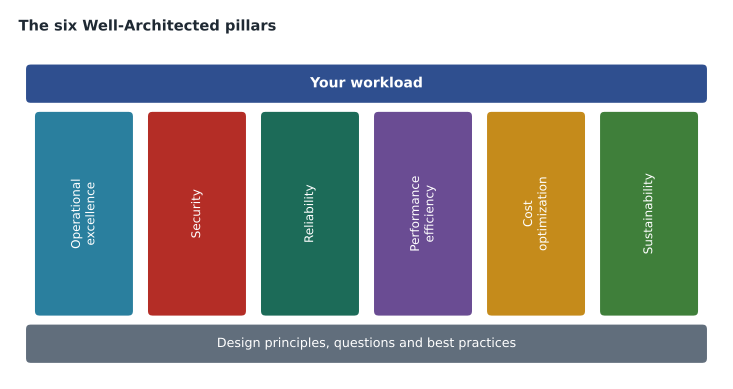
The six pillars
The framework is organized into six pillars. Each has a short definition, a set of design principles and a list of questions. Gwen gives Mateo a one-line version of each and a Cascade Ridge example, then makes him say them back from memory the next morning.
| Pillar | Focus | Cascade Ridge example |
|---|---|---|
| Operational excellence | Running and monitoring systems and continually improving processes | Changes to VetLedger servers are scripted, reviewed and reversible |
| Security | Protecting data, systems and assets | Client records are encrypted, and staff get only the access their role needs |
| Reliability | Performing correctly and recovering quickly from failures | The database fails over to another zone automatically |
| Performance efficiency | Using resources efficiently as demand and technology change | BookVet uses the right instance size and adds servers only when needed |
| Cost optimization | Delivering value at the lowest price | Old images move to cheaper storage; idle test servers shut down at night |
| Sustainability | Reducing the environmental impact of workloads | Right-sized servers and efficient storage use less energy |
Operational excellence
The operational excellence pillar is about how a team runs its systems: how it makes changes, how it responds to events and how it learns. Its design principles include performing operations as code, making frequent, small, reversible changes, refining procedures often, anticipating failure and learning from every operational event. The core idea is that operations should be engineered like software rather than improvised.
For Mateo, this is the biggest change in habit. Today he logs into a server and fixes things by hand, and the knowledge lives in his head. In AWS he will describe infrastructure in templates, keep runbooks for common tasks and review each incident afterwards to find the cause rather than the culprit.
Security
The security pillar covers protecting information, systems and assets. Its design principles include implementing a strong identity foundation with least privilege, enabling traceability so that every action is logged, applying security at all layers, automating security best practices, protecting data in transit and at rest, keeping people away from data where possible, and preparing for security events. Hannah adopts the list almost word for word as the outline of Cascade Ridge's new cloud security policy. AWS-102 covers these topics in depth.
Reliability
The reliability pillar is about a workload performing its intended function correctly and consistently, and recovering quickly when something fails. Its design principles include recovering automatically from failure, testing recovery procedures, scaling horizontally to increase aggregate availability, stopping guessing capacity, and managing change through automation. Lesson 7 is largely about this pillar, because Dr. Kaur's July outage was a reliability failure.
Performance efficiency
The performance efficiency pillar asks whether resources are used efficiently to meet requirements, and whether that efficiency holds as demand changes and technology evolves. Its design principles include using advanced technologies as managed services, going global in minutes, using serverless architectures, experimenting more often and considering how data is accessed. For Kwame, it means measuring BookVet's real load and choosing instance types and services that fit it, then revisiting the choice as AWS releases new options.
Cost optimization
The cost optimization pillar is about running systems to deliver business value at the lowest price point. Its design principles include implementing cloud financial management, adopting a consumption model, measuring overall efficiency, stopping spending on undifferentiated heavy lifting and analysing and attributing expenditure. Lorraine's note about tagging every resource belongs here: without knowing what each system costs, no one can optimize it. Lesson 10 and AWS-104 develop this pillar.
Sustainability
The sustainability pillar, the newest of the six, focuses on reducing the environmental impact of running cloud workloads. Its design principles include understanding the workload's impact, setting sustainability goals, maximizing utilization, adopting more efficient hardware and software, using managed services and reducing the downstream impact of the workload. AWS describes a shared responsibility for sustainability: AWS makes its infrastructure efficient, and customers make their use of it efficient.
Mateo notices that many sustainability actions are also cost actions. A server running at a tenth of its capacity wastes both money and energy. Moving rarely viewed radiographs to an archive storage class uses less energy-intensive storage and costs less. Gwen agrees, and adds that the pillars often reinforce each other, but sometimes they pull in different directions, which is exactly why the framework asks teams to make trade-offs deliberately.
General design principles
Alongside the pillar-specific principles, the framework lists general principles that apply to every cloud design. Gwen considers them the quickest summary of how cloud thinking differs from server-room thinking.
- Stop guessing your capacity needs. Scale with demand instead of buying for the peak.
- Test systems at production scale. Create a full-size test environment when needed and delete it afterwards, paying only while it runs.
- Automate with architectural experimentation in mind. Automation makes it cheap to try and to reproduce designs.
- Consider evolutionary architectures. Designs can change as requirements change, rather than being fixed at the start.
- Drive architectures using data. Measure how the workload behaves and let facts guide changes.
- Improve through game days. Rehearse failures and events on a schedule so the team is practised when real ones happen.
Trade-offs between pillars
The pillars are not a checklist to maximize all at once. Running a second copy of every system in another Region improves reliability but doubles some costs. Encrypting everything adds a little processing. The framework's guidance is to make trade-offs consciously, based on business needs, and to write down why. For Cascade Ridge the emergency hospital's systems justify spending on reliability; the old intranet wiki does not.
# A simple Well-Architected review tally: questions answered, and how many risks each pillar shows.
# H = high risk, M = medium risk, OK = no risk found. Illustrative answers for VetLedger.
answers = {
    "operational excellence": ["H", "M", "OK", "OK", "M"],
    "security":               ["OK", "M", "OK", "H", "OK"],
    "reliability":            ["H", "H", "OK", "M", "OK"],
    "performance efficiency": ["OK", "OK", "M", "OK"],
    "cost optimization":      ["M", "OK", "M", "OK"],
    "sustainability":         ["OK", "M", "OK"],
}
for pillar, a in answers.items():
    print(f"{pillar:24} high {a.count('H')}  medium {a.count('M')}  of {len(a)} questions")
worst = max(answers, key=lambda p: (answers[p].count("H"), answers[p].count("M")))
print("Start improvement work with:", worst)operational excellence high 1 medium 2 of 5 questions security high 1 medium 1 of 5 questions reliability high 2 medium 1 of 5 questions performance efficiency high 0 medium 1 of 4 questions cost optimization high 0 medium 2 of 4 questions sustainability high 0 medium 1 of 3 questions Start improvement work with: reliability
What this code does
It records the answers to a Well-Architected review, marked high risk, medium risk or fine, for each of the six pillars. It counts the high and medium risks per pillar and picks out the pillar with the most serious findings. The printout lists the counts and shows reliability has the most high risks, so it is the first area to fix.
The AWS Well-Architected Tool and lenses
AWS provides the AWS Well-Architected Tool in the console at no extra charge. A team defines a workload, answers the framework's questions, and the tool records high-risk and medium-risk issues, links to guidance for each, and tracks progress over time as improvements are made. Reviews can be repeated at milestones, such as before launch and every year after.
Lenses extend the framework for particular technologies or industries, such as a serverless lens, a SaaS lens or a lens for a regulated industry. They add questions specific to that context. AWS Partners can also run formal Well-Architected reviews for customers. Gwen will run the first review for VetLedger herself, with Mateo, Hannah and Kwame answering the questions in a two-hour session, and she will schedule a second one after the spring cutover.
Common mistakes
MistakeListing five pillars.
InsteadThere are six; sustainability was added to the original five.
MistakeTreating the framework as a fixed architecture to copy.
InsteadIt is a set of questions and principles; the right design depends on the workload.
MistakeConfusing reliability with performance efficiency.
InsteadReliability is about functioning correctly and recovering from failure; performance efficiency is about using resources efficiently to meet demand.
MistakeExpecting to maximize every pillar at once.
InsteadThe framework asks for deliberate trade-offs based on business needs.
How a review session runs
Gwen describes how she will run the two-hour review so that Mateo can run the next one himself. Before the session she defines the workload in the Well-Architected Tool: its name, its Regions, its business owner and a short description. During the session she reads each question aloud and asks the person who knows the answer, not the most senior person, to respond. Answers are recorded honestly; the purpose is to find risk, not to score well. Questions that do not apply are marked as such with a reason.
After the session the tool produces a list of high-risk and medium-risk issues with links to guidance. Gwen turns each issue into an improvement item with an owner and a target date, and sets a milestone in the tool so that the next review can be compared with this one. Over several reviews the number of high risks should fall, and the milestones show the progress to the steering group.
| Step | Who | Output |
|---|---|---|
| Define the workload | Architect | Workload entry in the tool |
| Answer the questions | People who build and run it | Recorded answers and notes |
| Review the risks | Whole team | High and medium risk list |
| Plan improvements | Architect and owners | Improvement items with dates |
| Save a milestone | Architect | A baseline for the next review |
The pillars and the exam
Exam questions about the framework usually describe a goal and ask which pillar it belongs to. A question about recovering from failure points to reliability; one about least privilege or encryption points to security; one about running operations as code or learning from incidents points to operational excellence; one about choosing efficient resource types or using serverless points to performance efficiency; one about paying only for what is needed points to cost optimization; one about reducing energy or maximizing utilization points to sustainability. Mateo makes a set of flash cards with a design principle on the front and the pillar on the back, and works through them on the bus.
Two pillars cause most confusion. Reliability and performance efficiency both mention scaling, but for different reasons: reliability scales horizontally so that the failure of one server matters less, while performance efficiency chooses the right resources so that the work is done efficiently. Cost optimization and sustainability also overlap, because waste costs both money and energy; the clue is whether the question is about price or about environmental impact.
Worked problem
Sorting findings into pillars
During the first review the team lists four findings: the database backup has never been restored as a test; three staff share one administrator login; test servers run all weekend; and nobody is alerted when disk space runs low. Which pillar does each finding belong to?
Show solution
- An untested backup is a reliability issue: the design principle is to test recovery procedures.
- A shared administrator login is a security issue: it breaks least privilege and traceability.
- Test servers idle all weekend are a cost optimization issue, and also a sustainability one.
- No alert on low disk space is an operational excellence issue: the team cannot respond to events it does not see.
Answer: Reliability, security, cost optimization (and sustainability), and operational excellence. Each finding becomes an improvement item with an owner.
Mateo leaves the review with fourteen improvement items, four of them marked high risk. Gwen is pleased; finding risks before launch is the whole point. Lesson 7 tackles the reliability findings first.
Summary and key terms
- The AWS Well-Architected Framework is a set of design principles, questions and best practices for reviewing workloads.
- Its six pillars are operational excellence, security, reliability, performance efficiency, cost optimization and sustainability.
- General principles include stopping guessing capacity, testing at production scale, automating, evolving architectures, driving decisions with data and running game days.
- The pillars can conflict, so trade-offs should be deliberate.
- The AWS Well-Architected Tool records reviews and risks at no extra charge, and lenses add questions for specific technologies or industries.
- Well-Architected Framework
- AWS guidance for designing and reviewing secure, reliable, efficient, cost-effective and sustainable workloads.
- Pillar
- One of six areas of the framework, each with design principles and questions.
- Operational excellence
- Running and monitoring systems and continually improving operations.
- Reliability
- Performing correctly and consistently and recovering quickly from failure.
- Performance efficiency
- Using computing resources efficiently as demand and technology change.
- Cost optimization
- Delivering business value at the lowest price point.
- Sustainability
- Minimizing the environmental impact of workloads.
- Well-Architected Tool
- A console tool for running and tracking framework reviews.
- Lens
- An extension of the framework for a technology or industry.
Practice problems
Work each problem on paper first, then reveal the answer to check.
Name the six pillars.
Show answer
Operational excellence, security, reliability, performance efficiency, cost optimization and sustainability.
Which pillar includes the principle of testing recovery procedures?
Show answer
Reliability.
What does the AWS Well-Architected Tool do?
Show answer
It guides a team through the framework questions for a workload and records risks and improvements over time.
Lesson quiz · 5 questions
Score 60% or more to complete this lesson.
Create a free account to save your progress, take quizzes and earn a certificate.