
AUTO-430 · Lesson 4 of 12 · 24 min
Engine review
For the engine session Marty brought a cylinder head from the scrap bin, a set of feeler gauges and a compression gauge with a cracked lens, and put them on the table next to the coffee. "Most engine questions are three questions in a trench coat," he said. "What does the test show, what does that mean is wrong inside, and what do you check next." Kiran had rebuilt the Lindqvists' timing chain in her second year and had diagnosed Gord's lifter by compression, leak-down and vacuum, so she expected to do well. Her first practice set on engines said otherwise: she missed four of fifteen, all on lubrication and cooling.
Engine and engine support systems, major work activity B, is worth 22 questions on the Red Seal exam, more than any single block except electrical and steering, suspension and braking. It covers the engine's mechanical systems, lubrication, cooling, the intake and exhaust, and the fuel and ignition support systems that keep it running. Fuel, ignition and emissions get their own review in lesson 9; this lesson covers the mechanical engine, lubrication and cooling.
The review follows AUTO-120 (Engine Fundamentals). AUTO-330 extended the diagnosis with relative compression and in-cylinder pressure.
The four-stroke cycle and engine numbers
Every exam has a question on the four strokes: intake, with the intake valve open and the piston moving down; compression, with both valves closed and the piston moving up; power, with combustion pushing the piston down; and exhaust, with the exhaust valve open and the piston moving up. Valve overlap, when both valves are briefly open near top dead centre between exhaust and intake, helps scavenge the cylinder. Four strokes take two crankshaft revolutions, so the camshaft turns at half crankshaft speed.
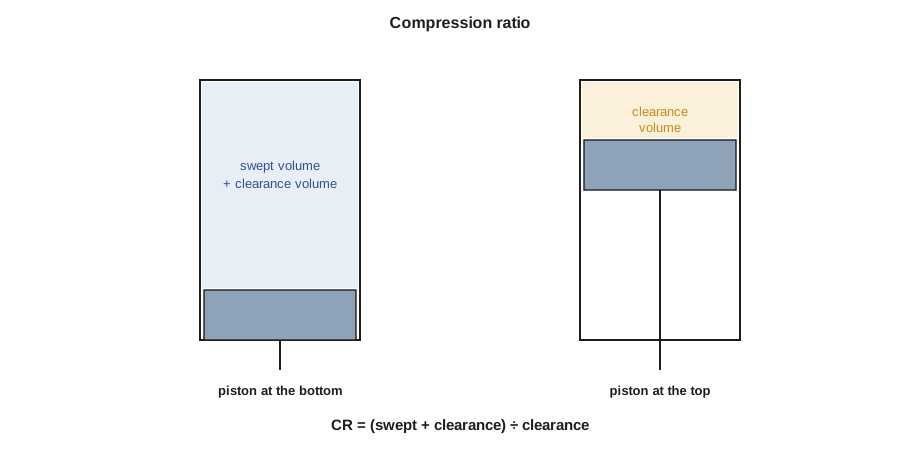
Displacement is the swept volume of all cylinders: the area of the bore times the stroke times the number of cylinders. Compression ratio is the total volume with the piston at bottom dead centre divided by the volume at top dead centre, which equals the swept volume plus the clearance volume, divided by the clearance volume. Both appear as calculations, and both appear as reasoning questions: raising the compression ratio increases efficiency and the risk of detonation, and a thinner head gasket or a milled head raises it.
# Displacement and compression ratio
import math
bore, stroke, cyl = 9.6, 9.2, 8
swept = math.pi / 4 * bore ** 2 * stroke          # one cylinder
clear = 65.0                                      # clearance volume, one cylinder
print(f"swept volume per cylinder: {swept:.0f} cc")
print(f"engine displacement: {swept * cyl / 1000:.2f} L")
print(f"compression ratio: {(swept + clear) / clear:.1f}:1")
clear2 = clear * 0.95
print(f"head milled to cut clearance 5%: {(swept + clear2) / clear2:.1f}:1")swept volume per cylinder: 666 cc engine displacement: 5.33 L compression ratio: 11.2:1 head milled to cut clearance 5%: 11.8:1
Mechanical diagnosis: compression, leak-down and vacuum
AUTO-120 lesson 10 set the order. A compression test shows whether each cylinder seals; readings are compared with each other and with the specification, and most makers expect all cylinders within about 10 to 15 per cent of the highest. A wet test, with a small amount of oil added, separates rings from valves: if compression rises markedly, the rings or cylinder walls are worn; if it does not, suspect valves or the head gasket. Two adjacent cylinders both low points to a head gasket failure between them. A leak-down test pressurizes a cylinder at top dead centre and measures the percentage lost, and listening tells you where it goes: the intake for an intake valve, the tailpipe for an exhaust valve, the oil filler for rings, and bubbles in the coolant or a neighbouring cylinder for a head gasket.
A vacuum gauge at idle on a healthy engine reads steady, typically 17 to 21 inHg at sea level, lower at altitude: about one inch of mercury less for every thousand feet. A steady low reading suggests late valve or ignition timing or an intake leak; a needle that drops regularly suggests a burnt or sticking valve; a reading that falls slowly at steady high speed suggests a restricted exhaust. Ridgeline's altitude means the shop's good engines read lower than the textbook, which is the kind of detail that appears in a reasoning question.
| Result | Most likely cause |
|---|---|
| One cylinder low, rises with oil | Worn rings or cylinder |
| One cylinder low, no change with oil | Valve not sealing or head gasket |
| Two adjacent cylinders low | Head gasket between them |
| Leak-down air at the tailpipe | Exhaust valve |
| Leak-down air at the oil filler | Rings |
| Bubbles in the coolant | Head gasket or cracked head |
| Vacuum needle drops regularly | Burnt or sticking valve |
| Vacuum falls slowly at steady high speed | Restricted exhaust |
# Compression test analysis: variation from the highest cylinder
readings = {1: 1190, 2: 1210, 3: 1180, 4: 960, 5: 1200, 6: 1170}
hi = max(readings.values())
for cyl, p in readings.items():
    drop = (hi - p) / hi * 100
    flag = "check" if drop > 15 else "ok"
    print(f"cylinder {cyl}: {p:5} kPa  {drop:4.1f}% below highest  {flag}")
print("wet test next on any cylinder flagged")cylinder 1: 1190 kPa 1.7% below highest ok cylinder 2: 1210 kPa 0.0% below highest ok cylinder 3: 1180 kPa 2.5% below highest ok cylinder 4: 960 kPa 20.7% below highest check cylinder 5: 1200 kPa 0.8% below highest ok cylinder 6: 1170 kPa 3.3% below highest ok wet test next on any cylinder flagged
Valve train and timing
Questions on cylinder heads cover valve guides, seats, springs and clearances. Valve lash that is too tight holds the valve slightly open, burning it and lowering compression; lash that is too loose makes noise and reduces lift. Hydraulic lifters take up lash automatically and depend on clean oil at the right pressure; a collapsed or stuck lifter ticks. Cylinder deactivation lifters, which AUTO-120 lesson 6 covered on Gord's pickup, add a locking pin and an oil control solenoid, and a stuck pin causes a misfire on a deactivated cylinder.
Timing belts and chains keep the camshafts in step with the crankshaft. Belts are replaced at the maker's interval and, on an interference engine, a broken belt lets the pistons hit the valves. Chains wear and stretch over time, so cam and crank correlation codes, or a rattle at start-up from a weak tensioner, point to the chain. Variable valve timing uses oil pressure through solenoids to rotate cam phasers; sludge, low oil level or the wrong viscosity can make a phaser respond slowly and set a code, which is why AUTO-330's camshaft case turned out to be oil, not the phaser.
Lubrication
Kiran's four wrong answers were here and in cooling, and both are well covered by AUTO-120 lessons 8 and 9. The oil pump creates flow, and the resistance of the bearings and passages creates pressure; worn bearings let oil escape easily and lower the pressure, especially when hot and at idle. A pressure relief valve limits the maximum. Low oil pressure with the warning light on at idle when hot points first to oil level, viscosity and the sending unit, then to worn bearings, a worn pump or a blocked pickup screen. High oil consumption points to rings, valve stem seals or a crankcase ventilation fault, which AUTO-230 linked to fuel trims. Oil specifications appear as viscosity grades from the SAE J300 standard and as approvals such as API and ILSAC categories and maker specifications, and the correct oil is the one the maker specifies.
Worked problem
A low oil pressure question
A high-mileage engine's oil warning light flickers at hot idle but goes out above 1,500 rpm. Oil level is correct. A mechanical gauge reads 70 kPa (10 psi) at hot idle against a specification of 100 kPa (15 psi) minimum. What is most likely?
Show solution
- The level is correct, so a low level is ruled out.
- The gauge confirms the light: pressure is really low, so a faulty sender is unlikely.
- Pressure is low only when hot and at low speed, the classic pattern of oil escaping through worn bearing clearances.
- A blocked pickup screen usually starves the pump at high speed too.
Answer: Worn crankshaft or camshaft bearings. Confirm the oil grade first, because a too-thin oil gives the same pattern.
Cooling
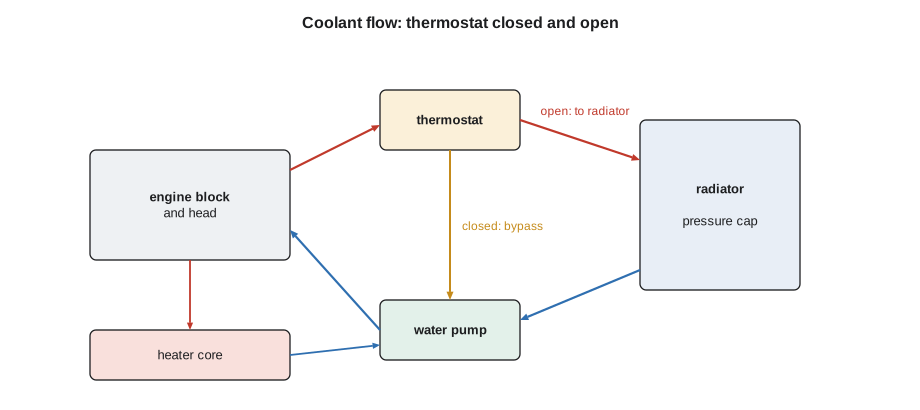
The cooling system keeps the engine at its operating temperature, not as cold as possible. The thermostat stays closed until the engine is warm, then opens to regulate. A thermostat stuck open causes slow warm-up, poor heater output and, on modern engines, a code for the coolant temperature taking too long to rise; one stuck closed causes overheating. The pressure cap raises the boiling point, roughly by 2.4 °C for every 10 kPa of pressure, so a weak cap can let coolant boil at normal temperatures. A cooling system pressure tester finds leaks, and a combustion leak tester, which detects exhaust gas in the coolant, finds head gasket leaks. Coolant must be the maker's type, mixed in the right proportion; a 50/50 mix is typical.
Altitude lowers the boiling point of coolant in an open container, about 1 °C for every 300 m (1 °F for every 500 ft), so a system at Ridgeline that loses pressure boils sooner than the same system at sea level. AUTO-120 lesson 9 used that to explain why a van with a weak cap overheated on a mountain pass but not in town.
Traps in this area
Engine questions punish candidates who jump from a symptom to a part. A misfire is not a coil until you test it, and low compression is not rings until you do the wet test. Watch also for questions that change one condition, hot rather than cold, idle rather than cruise, wet rather than dry, because that condition is usually the clue. And remember Kiran's lesson: the support systems, lubrication and cooling, are as much a part of the engine block as pistons and valves.
More practice in this area
Worked problem
A cooling question
An engine overheats only in slow traffic on hot days and is fine on the highway. The coolant is full and the thermostat tests good. What is most likely?
Show solution
- On the highway, ram air through the radiator cools the engine without the fan.
- In slow traffic, the cooling fan provides the airflow.
- A fault that appears only at low road speed points to the fan: the motor, relay, control module command or, on belt-driven fans, a slipping fan clutch.
Answer: A cooling fan fault. A clogged radiator or a weak water pump would usually also show at highway speed under load.
Worked problem
A valve train question
Technician A says excessive valve lash causes a ticking noise and reduced valve lift. Technician B says insufficient lash can hold a valve open and burn it. Who is right?
Show solution
- Too much lash makes the rocker or follower tap the valve and opens it less: A is right.
- Too little lash can keep the valve from closing fully as parts expand with heat, letting hot gas escape past the seat and burn the valve: B is right.
Answer: Both. Lash questions are popular because both errors have clear, opposite symptoms.
Timing questions often turn on interference. If a timing belt breaks on an interference engine, the valves that were open when the camshaft stopped can be struck by the pistons, and a compression or leak-down test confirms bent valves before the engine is reassembled with a new belt. On a free-running engine, a new belt usually restores operation. Lesson 12 of AUTO-120 added chain stretch: a cam-crank correlation code, rattle on start-up and the maker's stretch measurement through the scan tool.
The study group also spent time on the formulas that support engine questions, because a calculation question that you can do in a minute is a gift. Displacement, compression ratio, piston speed and engine power all appeared in practice sets. The trick is to keep the units straight: bore and stroke in centimetres give cubic centimetres; in inches they give cubic inches, and one litre is about 61 cubic inches.
Kiran's lubrication and cooling errors from her first practice set had all come from the same habit: answering from what she had seen most at Ridgeline rather than what the stem described. The cure was to underline the conditions in the stem, hot or cold, idle or load, and check her answer against each one.
Common mistakes
MistakeCalling low compression rings without a wet test.
InsteadAdd oil and retest: a rise means rings, no change means valves or gasket.
MistakeIgnoring altitude on vacuum and boiling-point questions.
InsteadAbout 1 inHg less vacuum per 1,000 ft; coolant boils sooner at altitude.
MistakeCondemning the oil pump for low hot-idle pressure.
InsteadWorn bearings are the usual cause; check level, grade and sender first.
MistakeReplacing a phaser for a cam timing code.
InsteadCheck oil level, grade and the solenoid screen first.
MistakeTreating a stuck-open thermostat as harmless.
InsteadIt causes slow warm-up, poor heat, codes and fuel economy loss.
Summary and key terms
- The four strokes take two crankshaft turns; the camshaft turns at half speed.
- Displacement is bore area times stroke times cylinders; compression ratio is total volume over clearance volume.
- Compression, wet compression, leak-down and vacuum tests locate mechanical faults in a logical order.
- Valve lash, hydraulic lifters, timing chains and phasers all depend on correct oil and pressure.
- Low hot-idle oil pressure usually means worn bearings; check level, grade and sender first.
- The thermostat regulates temperature, the cap raises the boiling point, and altitude lowers it.
- Clearance volume
- The volume above the piston at top dead centre.
- Wet compression test
- A compression test repeated with oil in the cylinder to separate rings from valves.
- Leak-down test
- A test that pressurizes a cylinder and measures the percentage of leakage.
- Interference engine
- An engine in which pistons and open valves can collide if the timing is lost.
- Cam phaser
- A hydraulic device that rotates a camshaft relative to its sprocket to vary valve timing.
Practice problems
Work each problem on paper first, then reveal the answer to check.
An engine has 90 mm bore and 90 mm stroke (3.54 in bore and 3.54 in stroke) and four cylinders. What is its displacement?
Show answer
0.785 × 9² × 9 × 4 = about 2,290 cc, or 2.3 L.
Technician A says two adjacent low cylinders suggest a head gasket. Technician B says a leak at the oil filler during leak-down points to an exhaust valve. Who is right?
Show answer
Technician A only; the oil filler points to rings.
A vacuum gauge needle drops sharply and regularly at idle. What is likely?
Show answer
A burnt or sticking valve.
Why does a weak radiator cap cause overheating?
Show answer
It lowers the system pressure and therefore the coolant's boiling point.
Lesson quiz · 5 questions
Score 60% or more to complete this lesson.
Create a free account to save your progress, take quizzes and earn a certificate.