
AUTO-430 · Lesson 10 of 12 · 25 min
Climate control review
In late April the shop's air conditioning season began early, with a warm spell and three no-cool complaints in a week, so the climate session had real cases. Theo had recovered refrigerant from a crossover that morning and asked why the machine's gauges showed a different static pressure from the one on the P-T chart taped to the wall. Kiran pointed at the window: the chart was for sea level, the gauges read pressure above the local atmosphere, and Ridgeline is more than a kilometre up. It was the same altitude lesson the group kept relearning, and it is the kind of detail an exam question can turn on.
Climate control is part of major work activity E, electrical and comfort control systems, worth 23 questions shared with the electrical material in lesson 8. Expect questions on the refrigeration cycle, refrigerants and their handling, components, heating and air distribution, automatic climate control and electric compressors.
The review follows AUTO-320 (Climate Control Systems).
The refrigeration cycle
The cycle moves heat from the cabin to the outside air. The compressor raises the pressure and temperature of refrigerant vapour. In the condenser, the hot vapour gives up heat to the outside air and condenses to a high-pressure liquid. The expansion device, an orifice tube or a thermal expansion valve, drops the pressure, and the liquid boils in the evaporator, absorbing heat from the cabin air. The low-pressure vapour returns to the compressor. Systems with an orifice tube use an accumulator on the low side to protect the compressor from liquid; systems with an expansion valve use a receiver-drier on the high side.
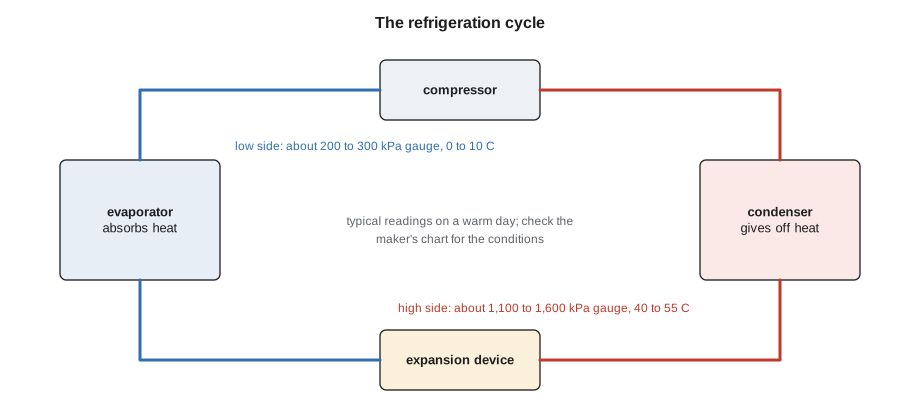
Two words appear in many questions. Superheat is how much warmer the vapour leaving the evaporator is than the refrigerant's boiling point at that pressure; it shows whether the evaporator is getting enough refrigerant. High superheat means the evaporator is starved: low charge or a restriction. Very low superheat means it is flooded: overcharge or an expansion valve stuck open. Subcooling is how much cooler the liquid leaving the condenser is than its condensing temperature; it shows whether the condenser has enough liquid. Low subcooling suggests low charge; high subcooling suggests overcharge or a restriction after the condenser.
# Superheat and subcooling from gauge readings (rounded R-1234yf saturation data)
pt = {316: 0, 369: 5, 439: 10, 1018: 40, 1150: 45, 1301: 50, 1465: 55, 1641: 60}                  # saturation temperature against absolute pressure
atm = 89                # local atmospheric pressure
def sat(p_abs):
    pts = sorted(pt.items())
    for (p1, t1), (p2, t2) in zip(pts, pts[1:]):
        if p1 <= p_abs <= p2:
            return t1 + (t2 - t1) * (p_abs - p1) / (p2 - p1)
low_g, suction_t = 260, 14
high_g, liquid_t = 1150, 41
sh = suction_t - sat(low_g + atm)
sc = sat(high_g + atm) - liquid_t
print(f"low side {low_g} kPa gauge -> saturates at {sat(low_g + atm):.1f} C, suction line {suction_t} C, superheat {sh:.1f} C")
print(f"high side {high_g} kPa gauge -> condenses at {sat(high_g + atm):.1f} C, liquid line {liquid_t} C, subcooling {sc:.1f} C")low side 260 kPa gauge -> saturates at 3.1 C, suction line 14 C, superheat 10.9 C high side 1150 kPa gauge -> condenses at 47.9 C, liquid line 41 C, subcooling 6.9 C
Refrigerants and their rules
R-134a was the standard refrigerant for decades. R-1234yf, which has a global warming potential below 1 against R-134a's 1,430, has replaced it on new light vehicles; it is mildly flammable, classed A2L, so it has its own service fittings, equipment and labels. A few vehicles use R-744, carbon dioxide, which runs at very high pressures. The exam expects you to identify the refrigerant from the label and fittings before connecting, to use a refrigerant identifier before recovery so that a contaminated system does not ruin the shop's machine and supply, and never to mix refrigerants or use substitutes. Harold's system contaminated with hydrocarbon from a do-it-yourself can, in AUTO-320, was the example.
Refrigerant handling is governed by the federal halocarbon regulations and by provincial rules. In Alberta, releasing refrigerants is prohibited and servicing must use recovery equipment; technicians complete approved environmental training, and shops keep the certificates and service records. Venting refrigerant is never acceptable. Recovery cylinders are filled to no more than 80 per cent of their capacity by weight.
Oils matter too. R-134a and R-1234yf mechanical compressors use PAG oil of the viscosity the maker specifies. Electric compressors on hybrids and electric vehicles need an oil with high electrical insulation, usually a POE oil; adding PAG oil to an electric compressor lowers the insulation resistance of the high-voltage system and can set an isolation fault, which was Ines's capstone fault in AUTO-410.
Components and diagnosis
Diagnosis starts with a performance test: engine at a set speed, doors open or closed as the maker specifies, blower on high, recirculation on, and vent temperature compared with a chart for the ambient temperature and humidity. Gauge readings then sort the faults. Low on both sides, with warm vents, suggests low charge. High on both sides suggests overcharge, a blocked condenser or a condenser fan fault, which was van 3's seized fan in AUTO-320's capstone. Low high side and high low side suggest a weak compressor. A very low low side with a normal or high high side suggests a restriction, such as a blocked orifice tube or expansion valve; frost at the restriction is a clue.
| Low side | High side | Most likely cause |
|---|---|---|
| Low | Low | Low refrigerant charge |
| High | High | Overcharge, condenser airflow blocked, fan fault |
| High | Low | Weak compressor or variable displacement valve fault |
| Very low | Normal or high | Restriction at the expansion device or in the high side |
| Normal | Normal, poor cooling | Air distribution or blend door fault, not refrigerant |
Variable displacement compressors, now common, change output with a control valve instead of cycling a clutch, so the low side may sit steady rather than cycling. Leak detection uses an electronic detector, dye with an ultraviolet light, or nitrogen pressure testing; refrigerant is not used to pressure test. After repairs, the system is evacuated to a deep vacuum, held to check for leaks, and recharged by weight to the specification, because the charge on modern systems is small and gauge pressures alone are not accurate enough.
Heating, airflow and automatic control
Heater output depends on the cooling system: low coolant, air in the system, a thermostat stuck open or a restricted heater core all reduce heat. A heater core restriction shows as a small temperature difference between the inlet and outlet hoses with poor heat, the opposite of what most people expect; a good core shows a clear drop. Gord's air pocket in AUTO-320's capstone, from a leaking quick-connect, showed as heat that came and went with engine speed. Air distribution uses doors for mode, recirculation and blend, moved by actuators. A blend door actuator reports its position by a feedback voltage, and a stripped actuator, like the Lindqvists', clicks while the door stays still. Automatic climate control uses in-car, ambient, sun load and evaporator temperature sensors; a blocked in-car sensor aspirator, like Harold's, makes the system misjudge the cabin temperature.
Worked problem
A heater complaint
A minivan's heater blows lukewarm at idle and gets hotter on the highway. Coolant is full and the engine reaches normal temperature. The heater inlet hose is hot and the outlet hose is almost as hot. What is most likely?
Show solution
- Coolant level and engine temperature are correct.
- Both hoses are hot with little difference, so coolant flows through the core freely.
- Heat that improves with engine speed often points to low flow or air at idle, but a small temperature difference with good flow points elsewhere.
- With the coolant side good, check the blend door and its actuator, which control how much air passes through the core.
Answer: An air distribution problem, most likely the blend door not reaching full heat. If the outlet hose were much cooler than the inlet, a restricted core would be more likely.
Electric compressors and heat pumps
Hybrids and electric vehicles use high-voltage electric compressors, and many electric vehicles use heat pumps, which run the cycle in reverse to heat the cabin efficiently. Service follows the high-voltage safety rules reviewed in lesson 11, with the system de-energized by the maker's procedure before opening refrigerant lines, and the correct insulating oil. Heat pumps lose efficiency in deep cold, which is why Dr. Singh's EV used a resistive heater on the coldest mornings.
More practice in this area
Worked problem
A restriction question
An A/C system with an orifice tube has a very low low-side pressure, a normal high-side pressure, frost on the liquid line just before the evaporator and warm vents. What is most likely?
Show solution
- The low side is pulled very low because little refrigerant reaches the evaporator.
- Frost forms where the pressure drops sharply, which is at a restriction.
- With the high side normal, the charge is probably present but blocked.
Answer: A restricted orifice tube. Recover, replace the tube and the accumulator, flush as specified, evacuate and charge by weight.
Worked problem
A cycling question
On a system with a cycling clutch and an orifice tube, the compressor clutch cycles on and off every few seconds and cooling is poor. What is likely?
Show solution
- A clutch cycling switch or pressure sensor turns the clutch off when the low side falls to its set point.
- With low charge, the low side falls to that set point quickly, then rises quickly when the clutch is off.
- Rapid cycling with poor cooling is the classic low-charge sign on these systems.
Answer: Low refrigerant charge. Find the leak with an electronic detector or dye before recharging.
Worked problem
An automatic climate control question
An automatic climate control system keeps blowing cold air at full fan speed after the cabin is comfortable. The in-car temperature sensor reads 4 degrees above the actual cabin temperature. What should be checked?
Show solution
- The system believes the cabin is warmer than it is, so it keeps cooling.
- The in-car sensor is usually aspirated by a small fan or a hose to the duct, which draws cabin air across it.
- A blocked or disconnected aspirator lets the sensor read warm air trapped behind the dash.
Answer: The sensor's aspirator hose or fan, as on Harold's SUV in AUTO-320. If the aspirator is working, test the sensor against a thermometer.
Leak testing questions often ask what gas may be used to pressure test a system. The answer is dry nitrogen, at a pressure within the maker's limits, sometimes with a trace gas added for an electronic detector. Refrigerant is not used to pressure test, and compressed air is never used because it brings in moisture. After the system is opened, a deep vacuum held for the specified time removes moisture and proves the system is tight before the charge goes in.
Heat pump questions are new on both exams and are mostly about understanding: a heat pump moves heat rather than making it, so it uses less energy than a resistive heater; it needs valves to reverse or redirect the flow; and its capacity falls as the outside air gets colder, which is why most systems keep a resistive heater for the coldest days.
Compressor questions also cover the clutch. An air gap that is too wide makes the clutch slip or fail to engage, especially when hot; a measured gap within the specification and a clutch coil with the correct resistance and a good feed and ground clear the clutch and point elsewhere. Theo's slipping clutch in AUTO-320 had an air gap well over the limit after years of wear, and shimming it back into range fixed it. A compressor that engages but makes no pressure difference has failed internally.
Kiran's climate errors were knowledge gaps on refrigerant handling details and two misreads on gauge questions that asked for the least likely cause. Her fix for the handling details was a single page of rules, written from AUTO-320 lesson 4 and reviewed on her cards: identify first, recover with certified equipment, never vent, never mix, fill cylinders no more than 80 per cent, record the work.
One more trap appears often: a performance test done with the wrong conditions. Vent temperatures depend on the outside temperature, the humidity, the engine speed, the blower speed and whether recirculation is on, so a reading that looks poor on a humid day may be within the maker's chart. Always compare with the chart for the actual conditions before deciding there is a fault.
Common mistakes
MistakeConnecting the recovery machine before identifying the refrigerant.
InsteadUse an identifier; contaminated refrigerant ruins equipment and supply.
MistakeCharging by gauge pressure alone.
InsteadEvacuate, hold vacuum, then charge by weight to the specification.
MistakeIgnoring altitude when comparing gauge readings with a P-T chart.
InsteadAdd local atmospheric pressure to the gauge reading to get absolute pressure.
MistakeUsing PAG oil in an electric compressor.
InsteadUse the specified insulating oil; PAG can cause an isolation fault.
MistakeBlaming refrigerant when pressures are normal and cooling is poor.
InsteadCheck air distribution, blend doors and actuators.
Summary and key terms
- The compressor, condenser, expansion device and evaporator move heat from the cabin outside.
- Superheat shows evaporator feed; subcooling shows condenser liquid.
- R-1234yf is A2L and has its own fittings and equipment; identify refrigerant before recovery and never vent it.
- Gauge patterns separate low charge, overcharge or airflow faults, weak compressors and restrictions.
- Heater faults are often cooling system faults; blend doors and sensors cause many comfort complaints.
- Electric compressors need insulating oil and high-voltage precautions; heat pumps lose capacity in deep cold.
- Superheat
- How much warmer the vapour leaving the evaporator is than its boiling point at that pressure.
- Subcooling
- How much cooler the liquid leaving the condenser is than its condensing temperature.
- Refrigerant identifier
- An instrument that checks a system refrigerant for purity before recovery.
- Variable displacement compressor
- A compressor that changes its output with an internal control valve.
- Blend door
- A door that mixes air through the heater core and around it to set outlet temperature.
Practice problems
Work each problem on paper first, then reveal the answer to check.
Both gauge readings are high and the condenser fan does not run. What is the likely cause?
Show answer
Lack of condenser airflow from the fan fault.
Technician A says superheat measures the liquid leaving the condenser. Technician B says high superheat suggests a starved evaporator. Who is right?
Show answer
Technician B only; Technician A is describing subcooling.
Why must refrigerant be identified before recovery?
Show answer
Contaminated refrigerant can damage the recovery machine and contaminate the shop's supply.
What is the maximum fill of a recovery cylinder?
Show answer
80 per cent of its capacity by weight.
Lesson quiz · 5 questions
Score 60% or more to complete this lesson.
Create a free account to save your progress, take quizzes and earn a certificate.