
AUTO-430 · Lesson 2 of 12 · 21 min
Study strategy and the occupational standard
The second Thursday, Marty brought a thick printout and dropped it on the lounge table. It was the Red Seal Occupational Standard for the trade, the RSOS, with every major work activity broken into tasks and every task into sub-tasks, each with the performance criteria and the knowledge a journeyperson needs. "This is the exam," he said. "Not the questions. The questions come from this. If something is in here and you can't explain it, that's what you study." Kiran had seen the standard before, in her first period, but had never read it as a study guide.
This lesson turns the published breakdown into a study plan. It covers how to use the standard as a checklist, how to divide study time by weight and weakness, how memory works and how to use spaced repetition, how to practise with questions rather than reread notes, how to keep an error log, and how to pace a long exam. The tools here are the ones Kiran used for the rest of the course.
Using the occupational standard as a checklist
The RSOS is organized in a hierarchy. Each major work activity, such as engine and engine support systems, contains tasks, such as diagnosing engine mechanical systems, and each task contains sub-tasks, such as diagnosing cylinder head components. For each, the standard lists what a journeyperson does and what they need to know: the components, the principles, the tests, the specifications and the safety requirements. The exam's 125 questions are a sample from that whole body of work, weighted by the breakdown, so a study plan that touches every sub-task, even briefly, protects you from surprise questions.
Kiran's method was simple. She went through the standard sub-task by sub-task and marked each with a number from 1 to 3: 1 for things she did every week and could explain to an apprentice, 2 for things she had done but would need to look up, 3 for things she had never done or could not explain. Module communications, airbag and restraint diagnosis and some body electrical sub-tasks came out mostly 3; brakes, suspension and maintenance mostly 1. Her 3s became the start of her study plan. Her 1s became practice-question topics only.
| Rating | Meaning | What to do |
|---|---|---|
| 1 | Do it often; can explain it | Practice questions only |
| 2 | Have done it; would look it up | Review notes and service information, then practice questions |
| 3 | Never done it, or cannot explain it | Study from the lesson, watch it done, do it if possible, then practice questions |
Dividing your time
A study plan has two inputs: how many marks an area is worth, and how much you can gain there. An area worth many questions where you are already strong gives little return on study time; an area worth fewer questions where you are weak may give more. A practical approach is to give each area time in proportion to its weight multiplied by a weakness factor, where the factor is higher for areas rated 3 and lower for areas rated 1. The code below does that arithmetic for Kiran's plan.
# Study hours by weight and weakness
weights = {'A': 9, 'B': 22, 'C': 12, 'D': 17, 'E': 23, 'F': 23, 'G': 10, 'H': 9}
weak = {'A': 1, 'B': 2, 'C': 3, 'D': 2, 'E': 2, 'F': 1, 'G': 3, 'H': 2}      # 1 = strong, 2 = average, 3 = weak (from the self-rating)
factor = {1: 0.6, 2: 1.0, 3: 1.6}
hours_total = 120
score = {k: weights[k] * factor[weak[k]] for k in weights}
s = sum(score.values())
for k in weights:
    h = hours_total * score[k] / s
    print(f"{k:<4} weight {weights[k]:>3}  rating {weak[k]}  ->  {h:5.1f} h")
print(f"total {hours_total} h over 20 weeks = {hours_total / 20:.1f} h per week")A weight 9 rating 1 -> 5.2 h B weight 22 rating 2 -> 21.1 h C weight 12 rating 3 -> 18.4 h D weight 17 rating 2 -> 16.3 h E weight 23 rating 2 -> 22.0 h F weight 23 rating 1 -> 13.2 h G weight 10 rating 3 -> 15.3 h H weight 9 rating 2 -> 8.6 h total 120 h over 20 weeks = 6.0 h per week
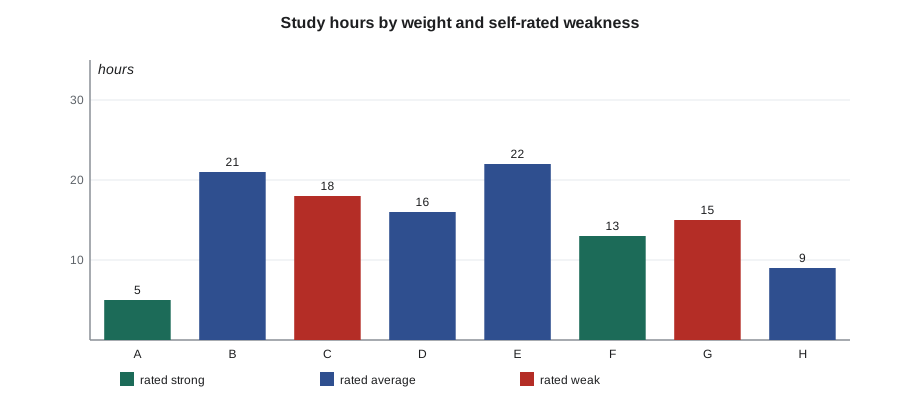
Kiran's plan came to about six hours a week for twenty weeks: two on Thursday with the group, two on Sunday morning and two spread over short sessions during the week. Twenty weeks fitted the time from January to the June exam, including her nine weeks of fourth-period technical training, when the school's classes covered much of the same ground.
How memory works, and spaced repetition
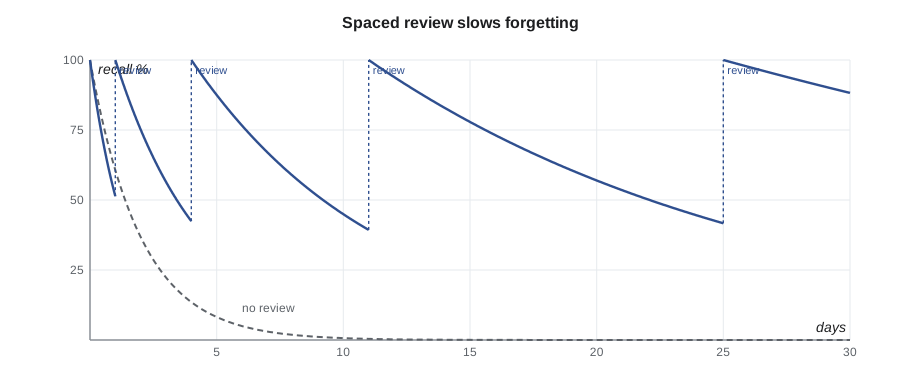
People forget quickly. Without review, much of what you learn in a study session is gone within days; each time you review it, especially when you have to work to recall it, it lasts longer before fading. Two practical rules follow. First, short sessions spread over many days beat one long session, even when the total time is the same. Second, testing yourself, by answering a question before checking the answer, builds memory far better than rereading, because the effort of recall is what strengthens it.
Spaced repetition puts both rules into a system. Each fact or question goes on a card. You review a card, and if you recall it correctly, the next review is pushed further out: one day, then three, then a week, then two weeks, then a month. If you miss it, it goes back to the start. The well-known Leitner box method does this with physical boxes; apps do it automatically. Kiran used index cards for formulas and specifications and an app for practice questions.
# Leitner-style spaced repetition: when is each card next due?
intervals = [1, 3, 7, 14, 30]   # days for boxes 1 to 5
cards = {"compression ratio formula": 1, "voltage drop limits": 3, "brake fluid boiling points": 2,
         "CAN termination resistance": 1, "superheat meaning": 4}
results = {"compression ratio formula": True, "voltage drop limits": True, "brake fluid boiling points": False,
           "CAN termination resistance": True, "superheat meaning": True}
day = 10
for card, box in cards.items():
    if results[card]:
        box = min(box + 1, 5)
    else:
        box = 1
print(f"{card:<28} box {box} next review day {day + intervals[box - 1]}")compression ratio formula box 2 next review day 13 voltage drop limits box 4 next review day 24 brake fluid boiling points box 1 next review day 11 CAN termination resistance box 2 next review day 13 superheat meaning box 5 next review day 40
Practise with questions, not just notes
Most candidates spend too long reading and too little time answering questions. Reading feels productive because the material looks familiar, but recognizing something is not the same as being able to use it. Practice questions force you to apply knowledge the way the exam does: read a situation, decide what matters, choose. They also train the exam skills of reading carefully, eliminating distractors and managing time. Kiran's rule was that every study session ended with at least ten questions, and every practice question she got wrong went into her error log.
Good practice questions match the exam's style: four options, one correct, a realistic stem, plausible distractors. Questions you write yourself are valuable too: writing a good distractor forces you to understand what a half-informed technician would get wrong. In the study group, each person wrote three questions a week on their weakest topic and the others answered them, which is how the practice questions in the following lessons were born. None are copies of real exam questions, which are confidential; they are written in the same style from the same standards.
The error log
An error log records every practice question you get wrong with three things: the topic, the right answer, and the reason you got it wrong. The reasons fall into a few groups. A knowledge gap means you did not know the fact or the principle. A misread means you knew it but missed a word such as except or first. A careless slip means you knew it and read it correctly but chose the wrong option or made an arithmetic error. A reasoning error means you knew the facts but applied them wrongly. Each kind has a different fix: knowledge gaps need study, misreads need slower reading, slips need checking, reasoning errors need more worked examples.
| Reason | Example | Fix |
|---|---|---|
| Knowledge gap | Did not know the CAN termination resistance | Study the topic; add a spaced-repetition card |
| Misread | Missed the word except | Second read for reversing words |
| Careless slip | Divided instead of multiplied | Write the formula; check units |
| Reasoning error | Chose a rare cause over a common one | More worked examples; ask what is most likely |
After her first practice exam, Kiran's log had 31 wrong answers. Fourteen were knowledge gaps, mostly in her weak areas, as expected. But nine were misreads, which surprised her, and five were reasoning errors where she had chosen a correct but unlikely cause. The misreads were the cheapest to fix: nine marks for nothing more than slowing down on the second read.
Pacing a long exam
The Red Seal exam gives about two minutes per question, which is generous for a technician who reads well. Kiran planned three passes. The first pass answers every question she is sure of in under a minute and marks the rest. The second pass works the marked questions, eliminating distractors and choosing. The third pass, with whatever time remains, rechecks marked questions and any with calculations. She also set checkpoints: question 32 by the end of the first hour, question 63 by the end of the second.
Worked problem
Planning checkpoints
The exam has 125 questions and four hours. Kiran wants to leave 40 minutes at the end for review. What pace does she need, and where should she be after each hour?
Show solution
- Working time: 240 − 40 = 200 minutes.
- Pace: 200 ÷ 125 = 1.6 minutes per question.
- Per hour: 60 ÷ 1.6 = 37.5 questions.
- Checkpoints: about question 38 after one hour, 75 after two, 113 after three.
Answer: About 1.6 minutes per question, with checkpoints near questions 38, 75 and 113.
Studying with others
The Thursday group worked because it had structure. Each session had one topic, set the week before, so everyone came having read the AUTO lesson that covered it. The first half hour was a short talk by whoever was weakest in that topic, which forced them to learn it well enough to explain. The second half hour was practice questions answered alone and then argued over. The last half hour was the error logs, read aloud. Marty's rule was that nobody was allowed to say they had just made a silly mistake; every wrong answer had a reason, and the reason went in the log.
Explaining is the strongest form of study. To explain how a planetary gearset gives reverse, or why a corroded ground shows up only with current flowing, you have to understand the parts and how they connect, not just recognize the words. Theo's explanations of tires and wheels were the best of the group, and teaching them made him notice how little he knew about the alignment angles that cause the wear he could read so well.
Worked problem
Building a weekly plan
Kiran has about six hours a week. Her plan gives module communications about 18 hours over twenty weeks and steering, suspension and braking about 15. How should a typical week look in March?
Show solution
- Thursday group, 2 hours: the week's topic, rotating through the blocks.
- Sunday, 2 hours: the weakest block of the moment, module communications, with the AUTO-220 notes and the training board.
- Two short sessions during the week, 1 hour each: spaced-repetition cards and 20 mixed practice questions.
- Every third Sunday: a timed practice set instead of new study.
Answer: A week that mixes new study, review and practice keeps every area moving, with extra time where the marks are.
Two things wreck study plans: falling behind and then trying to catch up in one long session, and dropping the plan in a busy week at work. Kiran's fix for both was to make the minimum small enough that she never skipped it: on the worst week, she still did her cards and ten questions.
Common mistakes
MistakeRereading notes and calling it study.
InsteadTest yourself with questions; recall builds memory, recognition does not.
MistakeStudying strong areas because they feel good.
InsteadDivide time by weight and weakness; weak areas give the cheapest marks.
MistakeCramming in the last week.
InsteadSpread short sessions over months; spaced review lasts.
MistakeRecording wrong answers without the reason.
InsteadLog the reason: knowledge gap, misread, slip or reasoning error.
MistakeSpending ten minutes on one hard question.
InsteadMark it, move on and come back on the second pass.
Summary and key terms
- The RSOS is the source of the exam; use it as a checklist and rate yourself on every sub-task.
- Divide study time by each area's weight and your weakness in it.
- Spaced repetition and self-testing make memory last; rereading does not.
- End every session with practice questions and log every wrong answer with its reason.
- Plan your pace with checkpoints and two or three passes.
- Spaced repetition
- Reviewing material at growing intervals, restarting when it is forgotten.
- Leitner method
- A spaced-repetition system using boxes of cards with longer review intervals for each box.
- Error log
- A record of every practice question answered wrongly, with the reason.
- Retrieval practice
- Studying by recalling answers before checking them.
- Checkpoint
- A planned question number to reach by a set time in the exam.
Practice problems
Work each problem on paper first, then reveal the answer to check.
Why is answering questions better study than rereading?
Show answer
Recall strengthens memory and applies knowledge the way the exam does; recognition only feels familiar.
What are the four reasons in the error log?
Show answer
Knowledge gap, misread, careless slip and reasoning error.
In a Leitner system, what happens to a card you miss?
Show answer
It goes back to the first box and the shortest interval.
An area is worth few questions but you are weak in it. Should you skip it?
Show answer
No; the first hours in a weak area usually gain more marks than extra hours in a strong one.
Lesson quiz · 5 questions
Score 60% or more to complete this lesson.
Create a free account to save your progress, take quizzes and earn a certificate.