
AUTO-430 · Lesson 3 of 12 · 24 min
Shop practice, safety and tools review
The first review session went where the program began, with the work that surrounds every repair: safety, lifting, tools, measurement, fasteners, service information and the repair order. Theo thought it would be the easy night. Then Marty asked him how far a frame-contact lift's arms should be from the vehicle's centre of gravity when the engine has been removed, and what changes about the lift points on a vehicle with a high-voltage battery under the floor, and the room went quiet.
These topics make up common occupational skills, major work activity A, worth 9 questions, and they also appear inside every other block, because almost every procedure question has a safety or tool step in it. This lesson also covers major work activity G, restraint systems, body components, accessories and trim, worth 10 questions, which no other lesson in this course reviews. Together that is 19 questions, about one in seven.
The review follows AUTO-110 (Shop Safety and Vehicle Systems), with references to the lessons where each topic was first taught.
Shop safety and hazardous products
The exam treats safety as the first step of every job, not a separate subject. The standard answers are the ones from AUTO-110 lesson 2: wear safety glasses at all times in the shop, wear hearing protection near impact tools and running engines in confined bays, use nitrile gloves for fluids, keep long hair and loose clothing away from rotating parts, and never use compressed air to clean yourself or brake parts. Brake dust is cleaned with a wet method or an approved brake cleaning system, never blown. Exhaust is extracted from any engine running indoors, because carbon monoxide is colourless and odourless.
Hazardous products are covered by WHMIS 2015, which follows the Globally Harmonized System. Products carry supplier labels with pictograms, signal words and hazard and precautionary statements, and each has a safety data sheet with sixteen sections. Workplace labels are needed when a product is moved into another container. Common exam points: which section of the safety data sheet gives first aid (section 4), which gives exposure controls and personal protection (section 8), and what the flame or the skull and crossbones pictogram means.
Lifting and supporting vehicles
AUTO-110 lesson 3 covered lifts, jacks and stands. The exam's favourite points are these. Use the maker's lift points from the service information, never guess. Check that all four lift pads contact firmly at equal height before raising the wheels more than a few centimetres off the ground, then shake-test the vehicle. Lower onto the locks before working underneath. Never work under a vehicle supported only by a jack; use rated stands at the maker's support points. Removing heavy components, such as an engine, transmission or rear axle, moves the centre of gravity, so the vehicle can tip on a two-post lift; use the maker's guidance, tie the vehicle down or add support stands. On hybrid and electric vehicles, the battery pack under the floor limits where lift pads may go, and some makers specify adapters.
| Situation | What the exam expects |
|---|---|
| Raising on a two-post lift | Maker's lift points, equal pad contact, raise slightly and shake-test, lower onto locks |
| Removing an engine or transmission | Account for the shift in centre of gravity; support or tie down as specified |
| Floor jack use | Lift at a jacking point, then support on rated stands before working underneath |
| Electric vehicle on a lift | Avoid the battery pack; use the maker's points and adapters |
| Vehicle on the ground | Wheel chocks, parking brake, transmission in park or gear |
Measuring tools and precision measurement
Micrometers, dial indicators, calipers, feeler gauges, telescoping gauges and plastic gauge strips appear in engine, brake and drivetrain questions, so the exam expects you to read them and to know what each measures. A metric outside micrometer reads to 0.01 mm: the sleeve shows millimetres and half-millimetres, and the thimble adds hundredths. An inch micrometer reads to 0.001 in: the sleeve shows tenths and 0.025 in steps, and the thimble adds thousandths. A dial indicator measures runout, end play and backlash by its needle's total movement as the part turns. AUTO-120 lesson 7 covered these in detail.
Worked problem
Reading a micrometer
A metric micrometer's sleeve shows 22.5 mm and the thimble mark aligned with the datum line is 18. What is the reading?
Show solution
- Sleeve: 22.5 mm (22 whole millimetres and the half-millimetre mark).
- Thimble: 18 × 0.01 = 0.18 mm.
- Add: 22.5 + 0.18 = 22.68 mm.
Answer: 22.68 mm. The common error is to forget the half-millimetre mark on the sleeve.
Fasteners and torque
AUTO-110 lesson 5 covered fasteners, torque and thread repair. Bolt strength is marked by property class on metric bolts, such as 8.8 and 10.9, and by radial lines on inch bolts, with grade 5 having three lines and grade 8 six. Torque specifications assume clean, dry or lightly oiled threads as the service information states; oiling a thread that should be dry, or using a thread locker where none is called for, changes how much clamp load a given torque produces. Torque-to-yield bolts, common on cylinder heads and some suspension parts, are tightened to a torque and then turned a specified angle, which stretches them into their yield range; they are normally replaced, not reused. Tightening sequences, usually spiralling out from the centre, prevent warping.
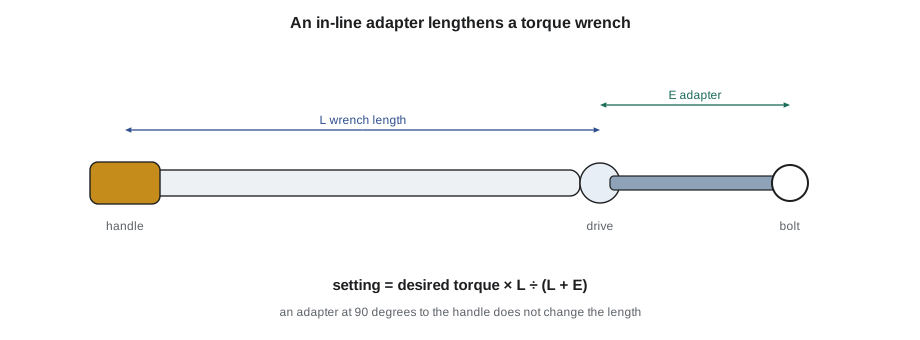
Torque wrench questions often involve an extension or adapter that lengthens the wrench. If the adapter extends the wrench in line with its handle, the torque delivered to the bolt is higher than the wrench reads, so the setting must be reduced. The relationship is: setting equals desired torque times wrench length divided by wrench length plus adapter length. An adapter at 90 degrees to the handle does not change the effective length.
# Torque wrench setting with an in-line adapter, and a unit conversion
t_bolt = 190          # desired torque at the bolt
L, E = 450, 75        # wrench length to the drive and adapter length
t_set = t_bolt * L / (L + E)
print(f"wrench length {L} mm, adapter {E} mm")
print(f"desired at bolt: {t_bolt} N m -> set the wrench to {t_set:.0f} N m")
print(f"for comparison: {t_bolt} N m = {t_bolt * 0.7376:.0f} lb ft")wrench length 450 mm, adapter 75 mm desired at bolt: 190 N m -> set the wrench to 163 N m for comparison: 190 N m = 140 lb ft
Service information and the repair order
Many questions are really about procedure: what should a technician do before starting, and how is the work documented? The exam answers come from AUTO-110 lesson 6 and AUTO-330 lesson 2. Before diagnosing, verify the complaint, check the vehicle's history, and search for technical service bulletins and recalls. Use the maker's service information for specifications and procedures, not memory. The repair order records the three Cs: the complaint in the customer's words, the cause found and the correction made. Additional work found during a repair needs the customer's authorization before it is done, and the estimate is updated. A road test after repair confirms the fix.
Restraint systems, body components and accessories
Major work activity G covers airbags and seatbelt pretensioners, the body and its components, power accessories, and trim. The safety rules are the most tested. Before working on or near an airbag module, a pretensioner or their wiring, disconnect the 12 V battery and wait the time stated in the service information, often one to ten minutes, so the reserve capacitors in the restraint control module discharge. Never measure an airbag or pretensioner circuit's resistance with an ordinary ohmmeter; use the maker's scan tool and the specified test procedure, because a meter's test current could fire a squib. Carry a live airbag module with the trim side facing away from your body and place it trim side up. Deployed modules and pretensioners are handled as the maker specifies, and many makers require the restraint control module or seatbelt pretensioners to be replaced after a deployment.
Body questions also cover power windows, locks, mirrors and seats, which are motor circuits controlled by switches or body modules; door and trunk latches; water leaks, found with a water test, smoke or an ultrasonic leak detector; and wind noise. Passenger occupancy sensors in the front seat tell the restraint module whether to enable the passenger airbag, and they often need a zero-point calibration with the seat empty after seat service. That last one catches many candidates.
| Task | Key rule |
|---|---|
| Airbag or pretensioner work | Disconnect the battery, wait the specified time, use the scan tool, not an ohmmeter |
| Handling a live airbag module | Trim side away from the body when carrying, trim side up on the bench |
| After a deployment | Replace components as specified, often including the control module |
| Front passenger seat service | Recalibrate the occupant classification sensor if specified |
| Water leak | Water test, smoke or ultrasonic detector; check drains and seals |
Traps in this area
Safety questions often offer an answer that is fast and an answer that is safe; the exam always wants the safe one. Procedure questions often offer a repair before a diagnosis; the exam wants the diagnosis first. Tool questions often hide a unit or a scale error. And restraint questions often include an ohmmeter as a distractor, because it is the tool most technicians reach for in any other circuit.
More practice in this area
Worked problem
A lifting question
A technician raises a rear-wheel-drive pickup on a two-post lift to remove the transmission. Technician A says the vehicle's centre of gravity will move forward when the transmission is removed. Technician B says tall safety stands should be placed under the vehicle at the maker's support points before the transmission is lowered. Who is right?
Show solution
- A: removing a heavy component from the middle of the vehicle moves the centre of gravity away from it. With the transmission out, the engine's weight at the front dominates, so the centre of gravity moves forward. A is right.
- B: supporting the vehicle at the maker's points with rated stands before removing heavy parts is the standard precaution. B is right.
Answer: Both. Questions like this test whether you can reason about weight, not whether you have memorized a rule.
Worked problem
A fastener question
A cylinder head's service information specifies tightening the bolts to 30 N m (22 lb ft), then 90 degrees, then another 90 degrees, in sequence, with new bolts. A technician has only a torque wrench. What should be done?
Show solution
- The specification is torque plus angle, a torque-to-yield method; torque alone cannot reach the specified clamp load.
- An angle gauge, or marks on the bolt heads and the head surface, measures the turns.
- New bolts are specified, so the old ones are not reused.
Answer: Tighten to the torque, then turn each bolt the specified angles using an angle gauge or marks, in the specified sequence, with new bolts. Substituting a higher torque value for the angle steps is a common wrong answer.
Restraint questions in major work activity G often concern what to do after a collision. Many makers require replacing the deployed airbags, the seatbelt pretensioners that fired, and in many cases the restraint control module and any impact sensors in the crush zone, then clearing codes and checking the warning lamp's self-test. A lamp that stays on after repairs points to a stored code, often an open circuit at a seat connector, a clockspring or an occupant sensor that needs calibration.
Kiran's error log in this block had only two entries, both misreads: one question asked which step should be done last, and one asked which practice was not acceptable. Basic topics invite fast reading, and fast reading is where marks go.
Service information questions also cover technical service bulletins and recalls. A bulletin is the maker's advice on a known problem and its fix, and it may apply only to certain build dates or software levels; a recall is a safety or emissions campaign the maker must complete at no charge. Checking both before diagnosing saves time and is the step the exam expects.
Common mistakes
MistakeBlowing brake dust off with compressed air.
InsteadUse a wet method or an approved enclosure; the dust is a health hazard.
MistakeSetting a torque wrench to the full specification when using an in-line adapter.
InsteadReduce the setting: desired × L ÷ (L + E).
MistakeReusing torque-to-yield bolts.
InsteadReplace them unless the maker says otherwise.
MistakeTesting an airbag circuit with an ohmmeter.
InsteadUse the scan tool and the maker's procedure; the meter can fire the squib.
MistakeDoing extra work found during a repair without asking.
InsteadGet the customer's authorization and update the estimate first.
Summary and key terms
- Safety is the first step of every job: eyes, hearing, hands, exhaust extraction and safe brake cleaning.
- Hazardous products have labels and sixteen-section safety data sheets; section 4 is first aid, section 8 is protection.
- Lift at the maker's points, check pad contact and shake-test, support with rated stands, and watch the centre of gravity.
- Read micrometers and dial indicators accurately; correct a torque wrench setting for an in-line adapter.
- Verify the complaint, check bulletins, follow service information and document the three Cs.
- Airbags and pretensioners: battery off, wait, scan tool only, careful handling, and replacement after deployment as specified.
- Safety data sheet
- A sixteen-section document describing a hazardous product, its hazards and safe handling.
- Torque-to-yield bolt
- A bolt tightened by torque plus angle into its yield range, normally not reusable.
- Occupant classification sensor
- A seat sensor that tells the restraint system whether and how to deploy the passenger airbag.
- Squib
- The electrical initiator that fires an airbag or pretensioner.
- Three Cs
- Complaint, cause and correction, recorded on the repair order.
Practice problems
Work each problem on paper first, then reveal the answer to check.
A torque wrench is 18 in long with a 3 in in-line adapter. To get 100 lb ft at the bolt, what should it be set to?
Show answer
100 × 18 ÷ 21 = about 86 lb ft (or the same ratio in metric).
Technician A says airbag circuits can be checked with a digital ohmmeter. Technician B says the battery must be disconnected and the specified time allowed before airbag work. Who is right?
Show answer
Technician B only.
Which section of a safety data sheet lists personal protective equipment?
Show answer
Section 8, exposure controls and personal protection.
Why can a vehicle tip on a two-post lift during an engine removal?
Show answer
Removing the engine moves the centre of gravity rearward, off the lift's balance point.
Lesson quiz · 5 questions
Score 60% or more to complete this lesson.
Create a free account to save your progress, take quizzes and earn a certificate.