
AUTO-430 · Lesson 1 of 12 · 23 min
How the Red Seal automotive service technician exam works
In January of her fourth year at Ridgeline Auto Service, Kiran Dhaliwal found an envelope in her locker with a photocopy of her apprenticeship record book and a note in Marty Kowalchuk's handwriting: "Fourth period starts in March. The Red Seal exam is in June. We start studying Thursday." Marty had written the same exam nineteen years earlier and still remembered the question about a parasitic draw that he had answered wrong because he read too fast. Bev Ostrowski, Ridgeline's owner, had agreed to let the study group use the customer lounge after closing on Thursdays, and Theo Banks, who was starting his own second period, asked if he could sit in.
This course is the study group. It explains how the certification exams work, how to plan and pace your study, and then reviews each part of the trade in the order you met it in this program, with worked examples, the traps exams like to set and practice questions written in the exam's style. It finishes with a full practice exam and a plan for the years after certification. This first lesson is about the exam itself: who sets it, what it covers, how it is scored and what happens on the day.
Who sets the exam and why
The Red Seal Program is the interprovincial standard of excellence for the skilled trades in Canada. For each Red Seal trade, the provinces and territories, working with industry, agree on a Red Seal Occupational Standard, known as the RSOS, that describes the work a fully qualified journeyperson does. The interprovincial exam, usually called the IP exam or the Red Seal exam, is built from that standard. An apprentice who passes it, and who has met the province's requirements for hours and technical training, receives the provincial journeyperson certificate with a Red Seal endorsement. The endorsement tells employers in every province and territory that the holder has met the national standard, which is why it matters even to technicians who never plan to move.
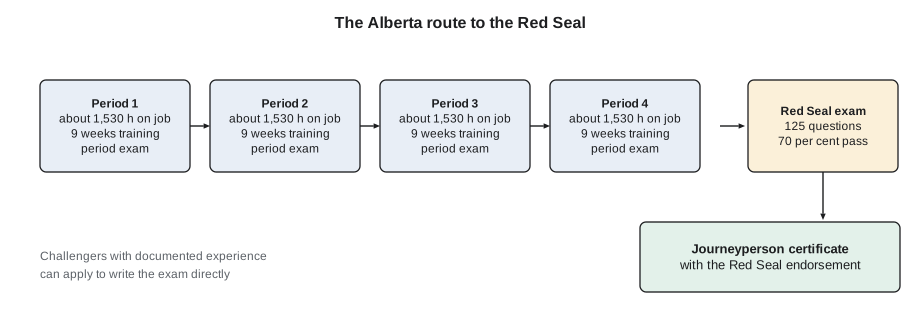
In Alberta, automotive service technician is a four-period apprenticeship. Each period combines about 1,530 hours of work on the job with about nine weeks of technical training at a college, and each period ends with an exam. At the end of the final period, the apprentice writes the Red Seal exam. Other provinces arrange the periods and hours differently, but the Red Seal exam is the same everywhere. Technicians who learned the trade without an apprenticeship can, in most provinces, apply to challenge the exam after documenting enough experience in the trade.
What the exam covers
The Red Seal automotive service technician exam has 125 multiple-choice questions, each with four options and one correct answer. The questions are spread across eight major work activities, the large blocks of the occupational standard, in proportion to how much of a journeyperson's work each one represents. The breakdown is published, which means you know in advance where the marks are.
| Major work activity | Questions | Share |
|---|---|---|
| A. Common occupational skills | 9 | 7 % |
| B. Engine and engine support systems | 22 | 18 % |
| C. Vehicle module communications systems | 12 | 10 % |
| D. Driveline systems | 17 | 14 % |
| E. Electrical and comfort control systems | 23 | 18 % |
| F. Steering, suspension, braking, control systems, tires and hubs | 23 | 18 % |
| G. Restraint systems, body components, accessories and trim | 10 | 8 % |
| H. Hybrid and electric vehicle systems | 9 | 7 % |
| Total | 125 | 100 % |
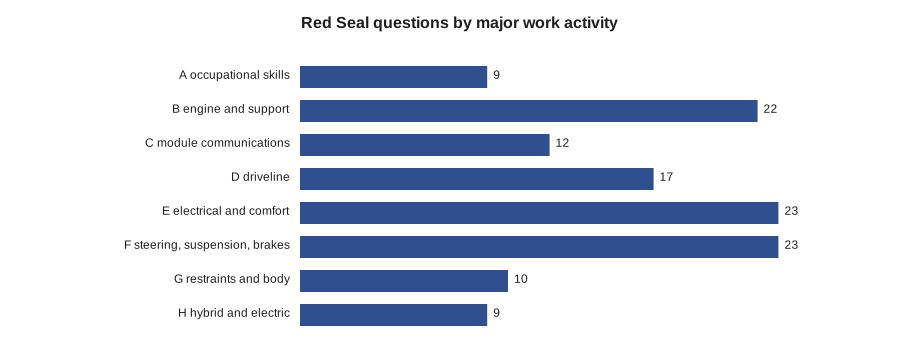
Two things stand out in that table. First, the three big blocks, engine (B), electrical and comfort (E) and steering, suspension and braking (F), together make up more than half the exam. Second, the newer blocks are not small: module communications (C) is 12 questions, nearly one in ten, and hybrid and electric vehicles (H) is 9. A candidate who studies engines and brakes and skips networks and high-voltage systems is giving away around 21 questions, which is more than the margin between passing and failing for most people.
How the questions are written
Every question has a stem, which sets up a situation or asks something, and four options. One option is correct; the other three, called distractors, are written to be plausible to someone who half knows the material. Questions are written to test what a qualified technician does on the job, so most are about diagnosis and procedure rather than definitions: what to check first, what a reading means, which part is most likely at fault, what should be done next. Some give a reading or a short scenario and ask for the most likely cause. Some ask for the exception, with wording such as which of the following is least likely or which is not a cause, and those are the ones that catch people who read too fast.
Red Seal questions are single-answer multiple choice. They avoid trick wording, but they are precise: a question about what to do first means first, not eventually, and a question about the most likely cause wants the most common or most direct cause, not a rare one that could also produce the symptom. Some questions include a diagram or a table, and the exam provides any formulas you are expected to apply but not memorize.
Worked problem
Reading a Technician A and Technician B question
Technician A says a voltage drop test must be done with current flowing in the circuit. Technician B says a voltage drop of 0.5 V across a single ground connection in a starter circuit is acceptable. Who is right?
Show solution
- Take each statement on its own and decide whether it is true.
- A: a voltage drop only appears when current flows, so a voltage drop test is done with the circuit loaded. A is right.
- B: a good single connection drops well under 0.1 V in normal use, and even in a high-current starter circuit 0.5 V across one ground connection points to a problem. B is wrong.
- Only then look at the options: A only, B only, both, neither.
Answer: Technician A only. Deciding each statement separately before reading the options is what stops the both-or-neither options from pulling you off course.
Scoring and the pass mark
The Red Seal pass mark is 70 per cent. On 125 questions that means 88 correct answers, since 87.5 rounds up. There is no penalty for a wrong answer, so you should never leave a question blank: a guess between two options you have narrowed down is right half the time, and a blank is never right. Your result report shows your score and, if you do not pass, how you did in each major work activity, which tells you where to study before you write again. In most provinces you can rewrite after a waiting period.
# What the pass mark means in questions and minutes
import math
total, minutes, pass_pct = 125, 240, 70
need = math.ceil(total * pass_pct / 100)
print(f"questions {total}, pass mark {pass_pct}%: need {need} correct, can miss {total - need}")
print(f"time available: {minutes / total:.2f} minutes per question")
for left in (40, 25, 10):
print(f"if {left} questions remain with 30 minutes left: {30 / left:.2f} minutes each")questions 125, pass mark 70%: need 88 correct, can miss 37 time available: 1.92 minutes per question if 40 questions remain with 30 minutes left: 0.75 minutes each if 25 questions remain with 30 minutes left: 1.20 minutes each if 10 questions remain with 30 minutes left: 3.00 minutes each
Exam day
The Red Seal exam is written at a provincial apprenticeship office or an approved exam centre, on paper or on a computer depending on the province, with photo identification and a booked time. You may bring a basic calculator if the province allows it; phones, notes and smart watches stay outside. You have up to four hours. Most candidates finish with time to spare, which they should spend going back to the questions they marked as uncertain, not leaving early.
Marty's advice for the day is practical. Sleep the night before and eat before you go; tired candidates misread questions. Arrive early enough to be calm. Read every stem twice, the second time looking for the words that change its meaning: first, most likely, least likely, except, not, always. Answer the ones you know, mark the ones you do not, and come back. Never change an answer without a reason; your first choice is usually better than a nervous second guess, unless you find you misread the question. And account for the clock every quarter of the way through.
What the study group agreed
At the first Thursday session, the group agreed on a plan that the next lesson builds out. Kiran would study by major work activity in proportion to the weightings, starting with her weakest areas, which her fourth-period instructor's diagnostic quiz showed were module communications and the restraint and body block. She would write a practice exam every three weeks under real time limits. And she would keep an error log: every practice question she got wrong, with the reason she got it wrong, because, as Marty put it, the reason matters more than the answer.
Worked problem
How many marks is a weak area worth?
Kiran's diagnostic quiz suggests she would answer about half of the module communications questions correctly and about 75 per cent of everything else. Would she pass, and what does lifting module communications to 75 per cent do?
Show solution
- Module communications is 12 questions; everything else is 113.
- At half on module communications: 6 + 0.75 × 113 = 6 + 84.75, about 91 correct, or 73 per cent.
- At 75 per cent on module communications: 9 + 84.75, about 94 correct, or 75 per cent.
- Three more correct answers from one weak block move her from a narrow pass to a comfortable one.
Answer: A narrow pass becomes a comfortable one. Weak areas are the cheapest marks to earn, because the first few hours of study in an area you barely know raise your score more than extra hours in an area you already know well.
Preparing for the format
Kiran wrote her first practice set two weeks into the study plan, before she had reviewed anything, so that she would know her starting point. The result, 71 per cent, told her two things. She already knew enough to pass on a good day, which took some of the fear out of the exam. And a good day was not guaranteed: two or three bad blocks would put her below 70. Marty's response was that a narrow pass is a fail you have not had yet, and that the point of studying was to make passing boring.
The group also agreed on a few rules for practice sessions that copied the real thing. Practice sets were timed. Phones stayed in the office. Answers were marked only after the whole set was done, not question by question, because checking each answer immediately trains you to need feedback that the real exam will not give. And every set ended with ten minutes on the error log while the reasoning was still fresh.
Worked problem
Eliminating distractors
Which of the following is the most likely cause of a slow crank on a vehicle with a fully charged battery that passes a load test? A: a weak battery. B: high resistance in the starter cables. C: a slipping serpentine belt. D: an open fuse in the starter relay circuit.
Show solution
- A is ruled out by the stem: the battery is charged and passes a load test.
- C does not affect cranking speed; the belt drives the alternator, not the starter.
- D would stop the starter altogether rather than slow it.
- That leaves B, and it fits: high resistance reduces the current the starter receives.
Answer: B. Even when you are unsure of the right answer, crossing out options the stem rules out turns a one-in-four guess into a likely right answer.
Elimination works because exam writers build distractors from common misunderstandings. One option often contradicts a fact in the stem; one often belongs to a different system; one is often true but does not answer the question asked. If two options remain and both seem right, reread the stem for the word that decides between them, such as first, most likely or least likely.
Common mistakes
MistakeAssuming the exam is mostly engines and brakes.
InsteadUse the published weightings: electrical, networks and hybrids are more than a third of the exam.
MistakeLeaving questions blank.
InsteadThere is no penalty for a wrong answer; narrow the options and choose.
MistakeReading the options before understanding the stem.
InsteadRead the stem twice and decide what it is really asking before looking at the options.
MistakeMissing the word except, least or not.
InsteadUnderline or mentally mark reversing words on the second read.
MistakeTreating the result report as a pass or fail only.
InsteadThe breakdown shows exactly where to study before the next attempt.
Summary and key terms
- The Red Seal exam is built from the national occupational standard and leads, with the provincial requirements, to a journeyperson certificate with the Red Seal endorsement.
- It has 125 four-option questions across eight major work activities, with a published breakdown.
- The pass mark is 70 per cent, or 88 correct; there is no penalty for wrong answers.
- Most questions test diagnosis and procedure, and the reversing words except, least and not catch fast readers.
- A score breakdown by area is the map for further study.
- Interprovincial exam
- The Red Seal exam, the same in every province and territory for a given trade.
- Occupational standard
- The national description of the tasks a qualified journeyperson performs, used to build the exam.
- Task list
- The published outline of what an ASE test covers.
- Distractor
- A plausible but incorrect option in a multiple-choice question.
- Stem
- The part of a multiple-choice question that sets up the situation or asks the question.
Practice problems
Work each problem on paper first, then reveal the answer to check.
How many questions are on the Red Seal automotive service technician exam, and how many must be correct to pass?
Show answer
125 questions; 88 correct for 70 per cent.
Which three major work activities have the most questions?
Show answer
Engine and engine support (22), electrical and comfort control (23) and steering, suspension, braking, tires and hubs (23).
Is there a penalty for a wrong answer?
Show answer
No, so every question should be answered.
Technician A says the Red Seal endorsement is recognized only in the province that issued it. Technician B says the exam is built from the national occupational standard. Who is right?
Show answer
Technician B only; the endorsement is recognized across Canada.
Lesson quiz · 5 questions
Score 60% or more to complete this lesson.
Create a free account to save your progress, take quizzes and earn a certificate.