
AUTO-410 · Lesson 9 of 12 · 19 min
Regenerative braking and drive modes
In the first week of December, Dr. Singh brings her hatchback in for its winter tire change and mentions, half apologetically, the thing she noticed last winter too. "On cold mornings the car barely slows down when I lift off the pedal. I'm used to driving with one pedal, and suddenly I have to use the brakes. By the afternoon it's back to normal. Last year Kiran said it was normal, but I'd like to understand it." Kiran, now partway through her high-voltage training, takes the question seriously. She knows the answer in a sentence; this time she wants to show Dr. Singh the numbers.
This lesson explains regenerative braking: where the energy comes from, how much of it can be recovered, what limits it, and how the vehicle blends it with friction braking. It then covers one-pedal driving, creep and the drive modes that change how an electrified vehicle behaves, and the service points that follow.
Recovering energy from a stop
A moving vehicle stores kinetic energy, half its mass times the square of its speed. A conventional vehicle turns that energy into heat in its brake rotors and pads every time it stops. An electrified vehicle can instead run its motor as a generator: the inverter commands a negative torque, the motor resists the wheels' rotation, and the electricity it generates flows back into the battery. The vehicle slows, and some of its energy is saved for the next acceleration.
Not all the energy comes back. Rolling resistance and air drag take some of it during the stop, and the motor, inverter and battery each lose a few percent converting it. A round trip from the battery to the wheels and back typically recovers 60 to 70 percent of the kinetic energy available at the wheels. In stop-and-go driving, which is most of Hal's courier routes, that recovered energy is a large part of why electrified vehicles use so much less energy than gas vehicles in town.
# Energy recovered in one stop, and over a courier van's day
mass = 3200                     # kg, van with a half load
v = 50 / 3.6                  # m/s
ek = 0.5 * mass * v ** 2 / 3.6e6          # kWh
round_trip = 0.65                          # share returned to the battery
recovered = ek * round_trip
stops = 140
print(f"kinetic energy at 50 km/h: {ek * 1000:.0f} Wh; recovered per stop about {recovered * 1000:.0f} Wh")
print(f"{stops} stops a day: about {recovered * stops:.1f} kWh recovered, roughly {recovered * stops / 0.30 * 100:.0f} km of extra driving")kinetic energy at 50 km/h: 86 Wh; recovered per stop about 56 Wh 140 stops a day: about 7.8 kWh recovered, roughly 2601 km of extra driving
What limits regeneration
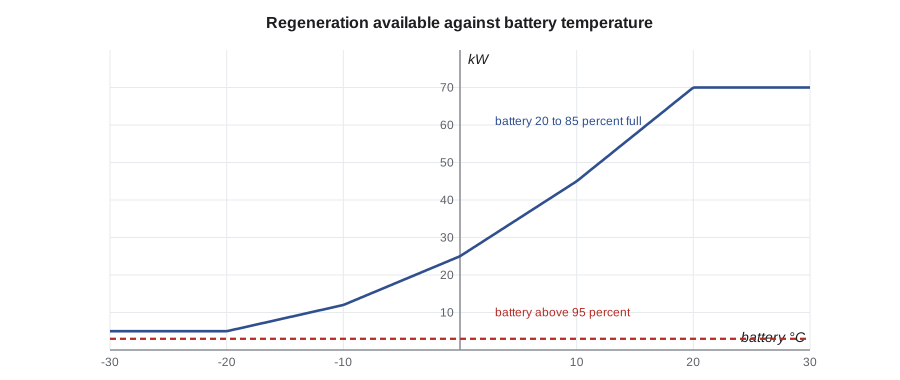
Regenerative braking is limited by the motor's torque and power, by the battery's ability to accept charge and by the tires' grip. The battery's limit is the one drivers notice. The battery management system allows the battery to accept only so much charging power at its current temperature and state of charge, as the battery lesson showed. Regeneration is charging, so when the battery is cold, the allowed charging power falls sharply, because charging cold lithium-ion cells quickly can plate lithium on the negative electrode and damage them. And when the battery is full, there is nowhere to put the energy. Either way, the vehicle reduces regeneration and the friction brakes do more of the work.
Many vehicles show the available regeneration on the dashboard as a row of dots or a shortened bar. Dr. Singh's car shows a dotted section on its power meter on cold mornings. As the battery warms from driving, or from preconditioning while plugged in, the allowed charging power rises and full regeneration returns.
# Regenerative braking available at different battery temperatures and states of charge (illustrative limits)
mass = 1850.0                 # kg, Dr. Singh's hatchback with driver
def charge_limit_kw(temp_c, soc):
    if temp_c < -20: base = 5
    elif temp_c < -10: base = 12
    elif temp_c < 0: base = 25
    elif temp_c < 10: base = 45
    else: base = 70
    if soc > 95: base = min(base, 3)
    elif soc > 85: base *= 0.6
    return base
for temp, soc in [(-15, 90), (-15, 70), (-5, 70), (5, 70), (20, 70), (20, 98)]:
    p = charge_limit_kw(temp, soc)
    v = 50 / 3.6
    decel_g = p * 1000 / (mass * v) / 9.81
print(f"battery {temp:4} C, SOC {soc:2} percent: regen up to {p:4.0f} kW, about {decel_g:.2f} g at 50 km/h")battery -15 C, SOC 90 percent: regen up to 7 kW, about 0.03 g at 50 km/h battery -15 C, SOC 70 percent: regen up to 12 kW, about 0.05 g at 50 km/h battery -5 C, SOC 70 percent: regen up to 25 kW, about 0.10 g at 50 km/h battery 5 C, SOC 70 percent: regen up to 45 kW, about 0.18 g at 50 km/h battery 20 C, SOC 70 percent: regen up to 70 kW, about 0.28 g at 50 km/h battery 20 C, SOC 98 percent: regen up to 3 kW, about 0.01 g at 50 km/h
The numbers make the point for Dr. Singh. On a −15 °C (5 °F) morning with the battery near full from her overnight charge, the car can accept only a small fraction of the regeneration it allows on a mild afternoon, so the deceleration she feels when lifting off the pedal is a fraction of normal. Two changes help: preconditioning the battery while still plugged in, which warms it with grid energy, and setting her charge limit to 80 or 90 percent for daily use, which leaves room for regeneration and is easier on the battery.
Blending regenerative and friction braking
When the driver presses the brake pedal, the vehicle must deliver the deceleration the driver asks for, whatever the battery can accept. Most electrified vehicles use a brake-by-wire system: a sensor measures the pedal's movement and force, and a brake control module decides how much of the requested deceleration the motor will provide and how much the friction brakes must add. The driver feels the same pedal either way. This is brake blending. The friction brakes take over at very low speeds, where the motor can no longer generate usefully, in hard stops beyond the motor's capacity, when the battery cannot accept charge, and when the anti-lock or stability systems intervene.
Because regenerative braking does most of the everyday stopping, electrified vehicles wear their pads and rotors slowly, often lasting several times as long as on a gas vehicle. The flip side is corrosion. In Alberta's (Colorado's) winters, with road salt and chemical de-icers, rotors that are rarely used rust and pit, and caliper slides seize, as Kiran found on Dr. Singh's rear brakes in the brakes course. Many makers include a brake cleaning routine that applies the friction brakes occasionally, and the service schedule calls for cleaning and lubricating the slides regularly.
# Brake blending: how a stop request is split between the motor and the friction brakes
mass = 1850.0
for v_kmh, decel_g, regen_kw_limit in [(80, 0.15, 70), (80, 0.40, 70), (50, 0.15, 12), (8, 0.15, 70)]:
    v = v_kmh / 3.6
    request_kw = mass * decel_g * 9.81 * v / 1000
    regen = 0 if v_kmh < 10 else min(request_kw, regen_kw_limit)
    friction = request_kw - regen
print(f"{v_kmh:3} km/h, {decel_g:.2f} g: request {request_kw:5.1f} kW -> motor {regen:5.1f} kW, friction {friction:5.1f} kW")80 km/h, 0.15 g: request 60.5 kW -> motor 60.5 kW, friction 0.0 kW 80 km/h, 0.40 g: request 161.3 kW -> motor 70.0 kW, friction 91.3 kW 50 km/h, 0.15 g: request 37.8 kW -> motor 12.0 kW, friction 25.8 kW 8 km/h, 0.15 g: request 6.0 kW -> motor 0.0 kW, friction 6.0 kW
The third case is Dr. Singh's cold morning: at 50 km/h (31 mph), the battery's limit lets the motor supply only a little, so the friction brakes supply the rest, smoothly, and she never notices except in one-pedal mode, where there is no pedal request to blend.
One-pedal driving and creep
Many electric vehicles offer one-pedal driving: lifting off the accelerator commands strong regeneration, enough to slow the vehicle to a stop in normal traffic without touching the brake pedal. Some bring the vehicle to a complete stop and hold it there with the friction brakes; others stop regenerating near walking pace and let the vehicle roll. Drivers can usually choose the regeneration strength, sometimes with paddles on the steering wheel. Because one-pedal deceleration depends on regeneration, it weakens whenever regeneration is limited, which is what Dr. Singh feels. Some vehicles use the friction brakes to keep one-pedal deceleration consistent when the battery is cold; hers does not.
Creep is the slow forward movement a conventional automatic transmission produces at idle. Electric vehicles have no idle, but most imitate creep so they behave as drivers expect in parking lots, and let the driver switch it off. An electric vehicle that is ready to drive makes no sound, which is why the safety lesson's rule matters: a ready vehicle is switched off before anyone works near it.
Drive modes
Electrified vehicles offer drive modes that change how the control modules use the motor, the battery and the climate system. An economy mode softens the accelerator's response, limits power and reduces climate control energy use. A sport mode sharpens the response and allows full power. A snow or low-traction mode reduces the torque the motor applies and the regeneration it uses, so the tires are less likely to slip on ice, a mode Dr. Singh's car offers and that Kiran recommends for Calgary's (Denver's) icy hills. Hybrids add modes that hold the battery's charge for later, force electric driving when the battery allows, or charge the battery with the engine. Plug-in hybrids often have a mode that saves electric range for the city part of a trip.
Regeneration on a slippery road needs care, because braking torque through the drive wheels can lock them as easily as friction braking can. The stability control system watches wheel speeds and reduces regeneration instantly if a driven wheel slows faster than the others. Snow mode reduces it further. A technician who hears a complaint of the vehicle feeling unstable when lifting off on ice should check the tires, the wheel speed sensors and the regeneration setting before suspecting a fault.
| Mode | Accelerator | Regeneration | Other changes |
|---|---|---|---|
| Economy | Softer, power limited | Often stronger | Reduced climate power |
| Normal | Standard | Standard | None |
| Sport | Sharper, full power | Standard or stronger | Firmer steering on some models |
| Snow or low traction | Gentler torque | Reduced | Earlier traction intervention |
| Hybrid charge hold | Standard | Standard | Engine maintains battery charge |
Service points
Regenerative braking adds a few items to the inspection Kiran does on every electrified vehicle. She checks the brakes for corrosion and seized slides, not just wear. She confirms the brake system's service mode is used before any hydraulic brake work, because the brake-by-wire system can pressurize the calipers on its own. She looks at wheel speed sensors and tone rings, because the blending and stability systems depend on them. And she reads the regeneration-related settings and any codes, so that a customer complaint can be compared with what the vehicle is set to do. On Dr. Singh's car, she finds the brakes in good condition after last year's repair, the regeneration setting at its strongest, and the charge limit at 100 percent.
She explains it with the chart from the code: the car is protecting its cold battery, the brakes will always stop it, and two settings will bring back most of the one-pedal feel on winter mornings. Dr. Singh sets her daily charge limit to 85 percent and schedules her departure time so the car preconditions the battery while plugged in. A week later, she calls to say the difference is obvious.
Worked problem
Regeneration at a red light
A 1,850 kg car slows from 60 km/h (37 mph) to a stop. How much kinetic energy did it have, and how much returns to the battery at a 65 percent round trip?
Show solution
- Speed: 60 ÷ 3.6 = 16.7 m/s.
- Kinetic energy: ½ × 1,850 × 16.7² = 257,000 J = 0.071 kWh.
- Recovered: 0.071 × 0.65 = 0.046 kWh, about 46 Wh.
Answer: About 71 Wh of kinetic energy, of which about 46 Wh returns to the battery.
Common mistakes
MistakeTreating weak regeneration on a cold morning as a fault.
InsteadCheck battery temperature and state of charge; it is usually the battery protecting itself.
MistakeDoing hydraulic brake work without the brake system's service mode.
InsteadThe brake-by-wire system can apply the calipers on its own.
MistakeInspecting electrified vehicle brakes for wear only.
InsteadLook for corrosion, pitting and seized slides.
MistakeIgnoring wheel speed sensors on a regeneration complaint.
InsteadBlending and stability control depend on them.
MistakeCharging to 100 percent every night in winter by habit.
InsteadA lower daily limit leaves room for regeneration and eases battery ageing.
Summary and key terms
- Regenerative braking runs the motor as a generator to recover the vehicle's kinetic energy.
- About 60 to 70 percent of the energy at the wheels returns to the battery in a typical stop.
- The battery's charge limit, set by temperature and state of charge, limits regeneration.
- Brake-by-wire systems blend motor and friction braking so the pedal feels the same.
- Friction brakes wear slowly but corrode, so inspection and slide service matter.
- One-pedal driving depends on regeneration and weakens when it is limited.
- Drive modes change accelerator response, regeneration, traction control and battery use.
- Regenerative braking
- Slowing the vehicle by using the motor as a generator to charge the battery.
- Brake blending
- Dividing a braking request between regeneration and the friction brakes.
- Brake-by-wire
- A brake system in which a module, not a direct hydraulic link, decides how the brakes are applied.
- One-pedal driving
- Slowing and stopping mainly by lifting off the accelerator, using strong regeneration.
- Creep
- Slow forward movement imitating an automatic transmission at idle.
- Preconditioning
- Warming or cooling the battery and cabin before driving, ideally while plugged in.
Practice problems
Work each problem on paper first, then reveal the answer to check.
Why is regeneration weak when the battery is cold?
Show answer
The battery management system limits charging power to protect cold cells.
Why is regeneration weak with the battery full?
Show answer
There is no room left to store the energy.
What decides how a brake request is shared between the motor and friction brakes?
Show answer
The brake control module in a brake-by-wire system.
What two changes helped Dr. Singh?
Show answer
A lower daily charge limit and preconditioning while plugged in.
Lesson quiz · 5 questions
Score 60% or more to complete this lesson.
Create a free account to save your progress, take quizzes and earn a certificate.