
AUTO-410 · Lesson 2 of 12 · 21 min
High-voltage safety and PPE
Kiran's high-voltage training starts on a Saturday in the shop's back bay, which Dale has turned into a classroom. On the bench lie a pair of black rubber gloves in a canvas bag, leather over-gloves, a face shield, a set of tools with orange handles, a meter with a thick probe set, a rescue hook on a fibreglass pole and a roll of orange and black barrier tape. "Every item on this bench is here because someone got hurt without it," Dale says. "By lunch you'll know what each one does, how to check it, and when it's not enough."
This lesson covers why high voltage is dangerous, the electrical safety standards that apply to vehicle work, the personal protective equipment and tools a high-voltage technician uses, how to inspect them, how to set up a safe work area, and what to do when something goes wrong. The next lesson uses all of it to de-energize a vehicle.
Why high voltage is dangerous
Electricity harms the body in three main ways. A shock drives current through the body; above a few milliamperes it hurts, above about 10 to 20 milliamperes the muscles can lock so the person cannot let go, and above about 50 milliamperes through the chest it can stop the heart. The current depends on the voltage and on the body's resistance, which falls sharply when the skin is wet, broken or pressed against metal. At 12 volts, the body's resistance keeps the current tiny. At 360 volts, the same body can carry a current many times the dangerous level.
The second hazard is the arc. A traction battery can deliver thousands of amperes into a short circuit. A dropped wrench across its terminals, or a connector pulled under load, can make an arc hot enough to melt metal, throw molten droplets and burn skin and eyes. The third hazard is the battery itself: a damaged or overheated lithium-ion battery can go into thermal runaway, a chain reaction in which cells heat, vent flammable and toxic gases and catch fire, sometimes hours or days after the damage.
# Why 360 volts is different from 12 volts: current through the body by Ohm's law (illustrative resistances)
volts = [12, 48, 202, 360, 800]
dry = 5000      # ohms, hand to hand, dry skin, light contact
wet = 1000      # ohms, wet or sweaty skin, firm grip
for v in volts:
    i_dry = v / dry * 1000
    i_wet = v / wet * 1000
    flag = "  <- can stop the heart" if i_wet > 50 else ("  <- may not let go" if i_wet > 10 else "")
print(f"{v:4} V: about {i_dry:5.1f} mA dry, {i_wet:6.1f} mA wet{flag}")12 V: about 2.4 mA dry, 12.0 mA wet <- may not let go 48 V: about 9.6 mA dry, 48.0 mA wet <- may not let go 202 V: about 40.4 mA dry, 202.0 mA wet <- can stop the heart 360 V: about 72.0 mA dry, 360.0 mA wet <- can stop the heart 800 V: about 160.0 mA dry, 800.0 mA wet <- can stop the heart
The body resistance values are typical, not exact, and a real contact could be worse. The pattern is what matters: below about 60 volts the current through dry skin stays small, while a traction battery's voltage can drive a lethal current. That is why the industry draws its line at 60 volts DC, and why every procedure assumes the system is live until it has been proven dead.
The standards that apply
In Canada, CSA Z462, Workplace electrical safety, sets out how to work safely on and near electrical equipment; its current edition is CSA Z462:24. It is based on the US standard NFPA 70E and is referenced by provincial occupational health and safety rules, including Alberta's. Z462 requires an employer to have an electrical safety program, to train workers, to assess shock and arc flash risks and to establish an electrically safe work condition before work begins wherever possible. (In the United States, NFPA 70E, Standard for Electrical Safety in the Workplace, sets out how to work safely on and near electrical equipment; its current edition is the 2024 edition. OSHA's electrical rules in 29 CFR 1910 Subpart S, including the safety-related work practices in 1910.331 to 1910.335 and the PPE rules in 1910.137, are the law, and OSHA treats NFPA 70E as the recognized way to meet them. The standard requires an electrical safety program, training, risk assessments for shock and arc flash, and an electrically safe work condition before work begins wherever possible.)
These standards were written for buildings and industrial equipment, but their principles apply to vehicles: identify the hazard, remove it by de-energizing when possible, protect the worker when it is not, and allow only qualified people to do the work. The vehicle makers' service information adds the specific steps for each model. SAE J2990 covers first responders, and the makers publish emergency response guides showing where each vehicle's high-voltage parts and cut points are.
A qualified person, in these standards, is someone trained to recognize and avoid the electrical hazards of the specific work and equipment. Kiran becomes qualified for this work by completing the training, demonstrating it, and being authorized by her employer. In the United States, many technicians also take ASE's xEV Level 1 safety awareness and Level 2 technician safety certifications, online tests valid for three years, alongside the L3 hybrid and electric vehicle specialist test. (The Red Seal standard for automotive service technicians now includes hybrid and electric vehicle tasks, and several provinces' colleges offer stand-alone high-voltage safety courses.) Until she is qualified, the standards treat her as an unqualified person, who may be near the work only under the direct supervision of a qualified one.
Approach boundaries
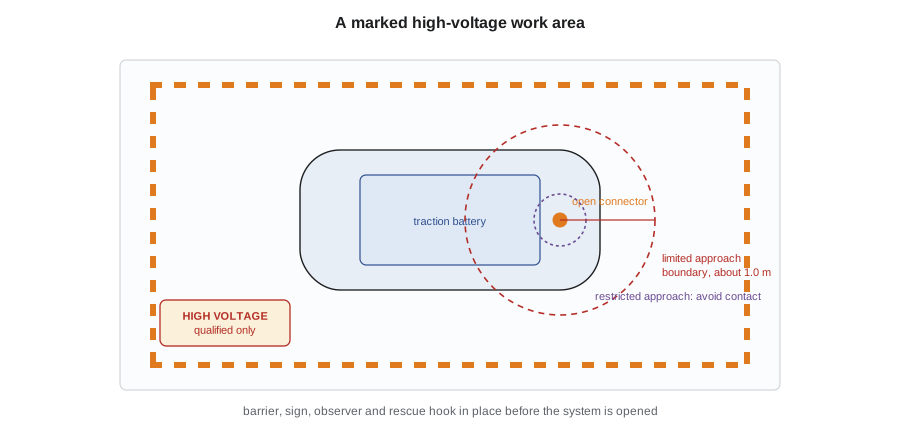
The standards define distances around exposed live parts. The limited approach boundary is the distance inside which an unqualified person may not go without being escorted by a qualified person. The restricted approach boundary is the closer distance inside which only a qualified person wearing shock protection may go, and only with a plan for the work. For the DC voltages found in vehicles, between 100 and 300 volts and up to about 750 volts, the limited approach boundary is about 1.0 m (3 ft 6 in) and the restricted approach boundary is to avoid contact. In practice, Ridgeline marks the whole bay with barrier tape and a sign while a high-voltage system is opened.
Rubber insulating gloves
The most important protection is a pair of rubber insulating gloves. They are rated by class: class 00 for up to 500 volts AC, class 0 for up to 1,000 volts AC and 1,500 volts DC, and higher classes for utility work. Vehicle work uses class 0 gloves, which are marked with a red label. The gloves are made and tested to ASTM D120 or IEC 60903, and their label shows the class, the size and the manufacturing date.
Rubber gloves are only as good as their condition. A pinhole too small to see can let current through. So the gloves are checked every time before use: inspected inside and out for cuts, cracks, swelling, embedded objects and chemical damage, then air-tested by rolling the cuff to trap air, or with an inflator, and listening and feeling for leaks. Leather protector gloves go over them to protect the rubber from cuts and punctures, and must never be worn alone for electrical protection. The gloves must also be electrically retested by a laboratory at regular intervals: Ridgeline follows the six-month interval in CSA Z462 and the glove maker's instructions (OSHA 1910.137 requires gloves to be retested at least every six months); the date of the last test is stamped on the cuff. Gloves are stored flat in their bag, away from sunlight, heat, ozone and sharp tools.
# Glove check before use: class rating, retest date and the air test
from datetime import date
today = date(2027, 2, 6)
gloves = [
    {"id": "G1", "cls": 0, "tested": date(2026, 11, 2), "air_test": "holds"},
    {"id": "G2", "cls": 0, "tested": date(2026, 7, 20), "air_test": "holds"},
    {"id": "G3", "cls": 0, "tested": date(2026, 12, 15), "air_test": "slow leak at a finger"},
    {"id": "G4", "cls": 0, "tested": date(2026, 12, 15), "air_test": "holds"},
]
system_v_dc = 360
max_dc = {0: 1500, 1: 11250}
for g in gloves:
    months = (today.year - g["tested"].year) * 12 + today.month - g["tested"].month
    problems = []
    if system_v_dc > max_dc[g["cls"]]: problems.append("class too low")
    if months >= 6: problems.append(f"retest overdue ({months} months)")
    if g["air_test"] != "holds": problems.append(g["air_test"])
print(g["id"], "OK to use" if not problems else "DO NOT USE: " + "; ".join(problems))G1 OK to use G2 DO NOT USE: retest overdue (7 months) G3 DO NOT USE: slow leak at a finger G4 OK to use
Kiran's first inspection finds two problems, both by design: one pair is past its retest date, and the other fails the air test with a slow leak at a fingertip. Dale tags them out of service. A glove that fails is destroyed or sent for testing, never patched.
Other protective equipment
Gloves protect against shock through the hands. The rest of the equipment protects against arcs, sparks and the battery's chemistry. Safety glasses are worn at all times, with a face shield rated for arc flash when the work could expose live terminals. Clothing should be non-melting natural fibre or arc-rated, because synthetic fabrics melt onto skin in an arc. Rings, watches, jewellery and metal-framed glasses come off before the work starts, because metal can bridge terminals and conduct current. Insulating mats under the technician's feet add another layer of protection where the work requires it.
Tools for high-voltage work are insulated and rated, usually to 1,000 volts AC and 1,500 volts DC, and made to IEC 60900 or ASTM F1505. They are marked with a double triangle symbol and the rating. Insulated tools are inspected before use like gloves: a cracked or worn handle is no longer insulated. The meter must be rated for the circuit, at least CAT III 1,000 volts, with probes and leads of the same rating, and it is checked on a known live source before and after each test. An insulation resistance tester, sometimes called a megohmmeter, applies a test voltage of 500 or 1,000 volts to find leaks through insulation; Kiran will use one in the diagnosis lessons.
| Item | Rating or standard | Check before use |
|---|---|---|
| Rubber insulating gloves | Class 0, ASTM D120 or IEC 60903 | Visual inspection, air test, retest date |
| Leather protectors | Sized for the rubber gloves | Cuts, punctures, contamination |
| Face shield and glasses | Arc-rated shield; impact-rated glasses | Cracks, clean lens |
| Insulated tools | 1,000 V AC / 1,500 V DC, IEC 60900 | Cracked or worn insulation |
| Meter and leads | CAT III 1,000 V or better | Live-dead-live check on a known source |
| Insulation tester | 500 and 1,000 V test ranges | Leads, calibration date |
| Rescue hook | Insulating pole | Cracks, contamination |
Setting up the work area
Before a high-voltage job begins, the work area is prepared. The vehicle is parked in the designated bay, switched off, with the key or smart key moved at least 5 m (16 ft) away or placed in a shielded box so it cannot be woken, and the parking brake applied. The bay is marked with barriers and a sign naming the qualified person in charge. A fire extinguisher suitable for electrical fires is nearby, the exit is clear, and a second trained person, the safety observer, is present whenever the system will be opened. The rescue hook hangs where the observer can reach it.
The observer's job is to watch, to keep others out of the area and to act if something goes wrong. In an emergency, the observer must not touch a person who may be in contact with a live part. Instead, the observer uses the rescue hook or a dry, non-conductive object to pull the person clear, then calls for emergency help, starts first aid and CPR if trained, and uses an automated external defibrillator if available. Anyone who receives a high-voltage shock should be checked by a doctor, even if they feel fine, because heart rhythm problems can appear later.
Damaged and overheating batteries
A traction battery that has been in a collision, flooded or overheated must be treated as hazardous. Signs include smoke or steam from the pack, popping or hissing, a sweet or chemical smell, swelling, leaking fluid, a warning message about the battery and a pack temperature that keeps rising with the vehicle switched off. A battery with any of these signs is not worked on. The vehicle is moved outside, away from buildings and other vehicles, if it can be done safely; otherwise the shop is evacuated and the fire department called. Lithium-ion battery fires need very large amounts of water to cool the cells and can reignite long after they appear to be out, so firefighters may monitor a vehicle for many hours.
Ridgeline's procedure also covers vehicles that arrive after a collision. Before anyone works on a damaged electrified vehicle, Dale checks the maker's guidance, inspects the battery area for damage, and parks the vehicle at the quarantine spot at the far end of the lot, at least 15 m (at least 50 ft) from the building. Shops that repair collision damage often keep a damaged electric vehicle outdoors for days before working on it.
Worked problem
Choosing glove protection
A technician will work on a hybrid whose traction battery is 202 volts DC. What glove class is needed, and what must be checked before use?
Show solution
- 202 volts DC is above the 60 volt threshold, so shock protection is needed.
- Class 0 gloves are rated for up to 1,500 volts DC, which covers the system.
- Before use: a visual inspection inside and out, an air test, and a retest date less than six months ago, with leather protectors over the rubber.
Answer: Class 0 rubber insulating gloves with leather protectors, inspected, air-tested and within their retest date.
Common mistakes
MistakeWearing leather gloves alone for electrical protection.
InsteadLeather protectors go over rubber insulating gloves; they do not insulate by themselves.
MistakeSkipping the air test because the gloves look fine.
InsteadPinholes are invisible; air-test every time.
MistakeUsing an ordinary meter on a traction battery.
InsteadUse a CAT III 1,000 V meter and leads, checked live-dead-live.
MistakeGrabbing a person who is being shocked.
InsteadUse the rescue hook or a dry non-conductive object, then call for help.
MistakeWorking alone on an opened high-voltage system.
InsteadA trained safety observer must be present.
Summary and key terms
- High voltage can drive lethal current through the body, cause severe arcs and, in a damaged battery, start thermal runaway.
- CSA Z462:24 and the maker's procedures govern high-voltage work in Canada.
- Only qualified people work on high-voltage systems; others stay outside the limited approach boundary unless escorted.
- Class 0 rubber insulating gloves with leather protectors are inspected, air-tested and retested every six months.
- Insulated tools, a CAT III meter, arc-rated face protection and non-melting clothing complete the kit.
- A marked work area, a safety observer and a rescue hook are in place before the system is opened.
- A damaged or overheating battery is not worked on: move it outside if safe, otherwise evacuate and call the fire department.
- Qualified person
- Someone trained and authorized to recognize and avoid the electrical hazards of specific work.
- Limited approach boundary
- The distance from live parts inside which unqualified people must be escorted.
- Class 0 gloves
- Rubber insulating gloves rated for up to 1,000 V AC and 1,500 V DC.
- Air test
- A check of rubber gloves for leaks by trapping air inside them.
- Insulated tool
- A tool with insulation rated and tested for work near live parts.
- Safety observer
- A trained person who watches high-voltage work and acts in an emergency.
- Thermal runaway
- A self-heating chain reaction in a battery cell that can spread to others and cause fire.
Practice problems
Work each problem on paper first, then reveal the answer to check.
Which glove class is used for vehicle high-voltage work?
Show answer
Class 0.
How often must rubber insulating gloves be electrically retested?
Show answer
At least every six months.
What should the observer use to free a person in contact with a live part?
Show answer
A rescue hook or a dry non-conductive object.
Name three signs of a dangerous traction battery.
Show answer
Smoke, hissing or popping, swelling, a chemical smell, leaking fluid or rising temperature.
Lesson quiz · 5 questions
Score 60% or more to complete this lesson.
Create a free account to save your progress, take quizzes and earn a certificate.