
AUTO-410 · Lesson 7 of 12 · 19 min
Electric motors: permanent-magnet and induction
Hal's trial van has been on its courier route for three weeks when Marcus Bell, who drives it, brings it back with a complaint. Between about 55 and 65 km/h (35 and 40 mph), he hears a high whine that rises and falls with speed, louder when he accelerates and almost gone when he coasts. "The old van had noises too," he says, "but they were engine noises. I don't know what this one is telling me." Marty smiles. "Electric drive units are quiet, so every small noise stands out. Before we decide whether this one is a problem, Kiran is going to learn how the motor works."
This lesson explains how electric traction motors make torque, the two main types, permanent-magnet synchronous motors and induction motors, how motors behave across their speed range, the sensors that tell the inverter where the rotor is, how motors are cooled, and how a technician separates normal drive unit sounds from faults.
How a motor makes torque
Every electric motor works by the force between magnetic fields. The stator, the stationary outer part, holds copper windings arranged in three phases. When the inverter sends three-phase alternating current through them, the windings make a magnetic field that rotates around the stator. The rotor, the turning part inside, has a magnetic field of its own, and it is pulled around by the rotating stator field. The strength of the pull, the torque, depends on the strength of the two fields and the angle between them; the inverter controls both by controlling the current in each phase.
Running the same machine in reverse makes it a generator. When the vehicle's momentum drives the rotor faster than the stator field, the machine converts mechanical energy into electrical energy, and the inverter sends it back to the battery. That is regenerative braking, the subject of a later lesson. In an electrified vehicle, "motor" and "motor-generator" mean the same machine.
The first equation links power, torque and speed: power in watts equals torque in newton-metres times angular speed in radians per second. The second gives the electrical frequency the inverter must produce, in hertz, for a motor with p poles turning at n revolutions per minute.
Permanent-magnet synchronous motors
Most electric vehicles and hybrids use a permanent-magnet synchronous motor, often shortened to PMSM. Its rotor carries strong rare-earth magnets, usually neodymium-iron-boron, set inside slots in a laminated steel core. Because the rotor's field comes from the magnets, the stator's current does not have to create it, which makes the motor very efficient, often above 95 percent over much of its range, and compact for its power. The rotor turns at exactly the speed of the stator's rotating field, in step with it, which is what synchronous means.
The magnets bring two consequences that matter to technicians. First, whenever the rotor turns, its magnets generate a voltage in the stator windings, called back electromotive force. A towed electric vehicle with its drive wheels on the ground can generate high voltage in its motor, which is why makers specify flatbed towing or wheel dollies, and why a disconnected motor cable can still be live if the wheels turn. Second, the magnets' field is always present, so at high speed the inverter must weaken it with an opposing current, called field weakening, to keep the back voltage below the battery voltage.
Some makers use a variation with less magnet material, or with none: a wound-rotor synchronous motor, also called an externally excited motor, makes its rotor field with a winding fed through brushes or a contactless transformer, avoiding rare-earth magnets at some cost in efficiency.
Induction motors
An induction motor's rotor has no magnets and no connections. It is a cage of aluminium or copper bars joined by rings at each end, set in a laminated core. The stator's rotating field induces currents in the bars, and those currents make the rotor's field. Because induction needs relative movement, the rotor always turns slightly slower than the field; the difference, called slip, is a few percent. Induction motors are rugged, cheap and contain no rare-earth metals, and they make no back voltage when the inverter is off, so they drag less when coasting. They are a little less efficient than permanent-magnet motors at light loads. Some dual-motor vehicles use a permanent-magnet motor on one axle for efficient cruising and an induction motor on the other for extra power when needed.
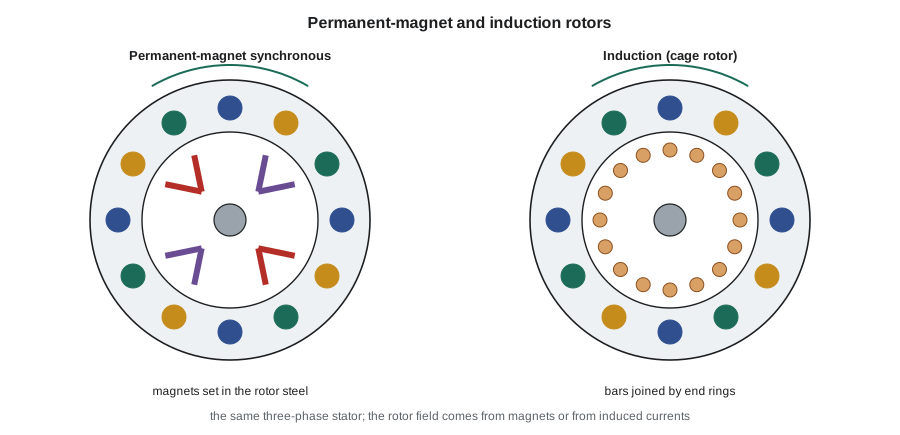
| Feature | Permanent-magnet synchronous | Induction |
|---|---|---|
| Rotor field from | Rare-earth magnets | Currents induced in the rotor bars |
| Rotor speed | Exactly the field speed | Slightly slower (slip) |
| Efficiency | Highest, especially at light load | Slightly lower at light load |
| Voltage when turned with the inverter off | Yes: back voltage | No |
| Rare-earth metals | Yes | No |
| Typical use | Most electric vehicles and hybrids | Some dual-motor vehicles, older designs |
Torque and power across the speed range
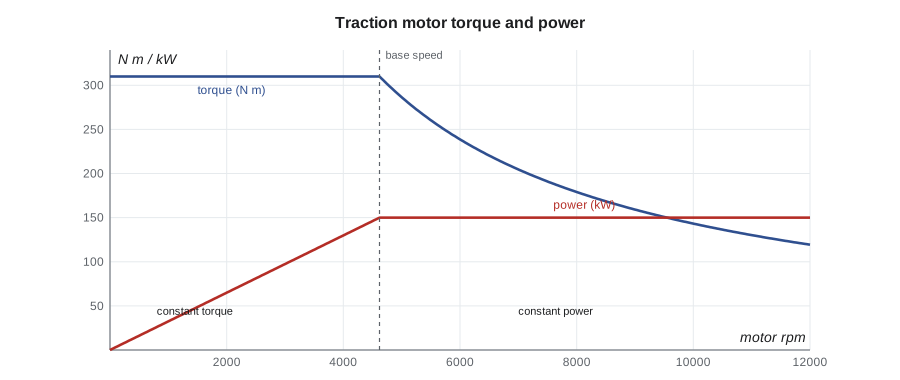
An electric motor can deliver its maximum torque from standstill, which is why electric vehicles accelerate so briskly from a stop. Torque stays at its maximum up to the base speed, where the motor's back voltage reaches the limit the inverter can supply. Above base speed, the motor runs in its constant-power region: torque falls as speed rises, so that power stays roughly constant until the top speed. Because a motor makes useful torque across such a wide range, most electric vehicles need only a single fixed reduction gear, as Kiran saw in Dr. Singh's drive unit in the drivetrain course.
# Torque, power and speed: a traction motor's curve, and the wheel torque through the reduction gear
import math
t_max = 310.0          # newton-metres, available up to base speed
p_max = 150.0          # kilowatts
base = p_max * 1000 * 60 / (2 * math.pi * t_max)
ratio = 9.0            # single reduction gear
tire_m = 0.335         # loaded tire radius, metres
print(f"base speed: {base:,.0f} rpm")
for n in (1000, 3000, base, 6000, 9000, 12000):
    torque = t_max if n <= base else p_max * 1000 * 60 / (2 * math.pi * n)
    power = 2 * math.pi * torque * n / 60 / 1000
    road = n / ratio * 2 * math.pi * tire_m * 60 / 1000
print(f"{n:6,.0f} rpm: {torque:5.0f} N m, {power:5.1f} kW, wheel torque {torque * ratio * 0.97:5.0f} N m, road speed {road:5.0f} km/h")base speed: 4,621 rpm 1,000 rpm: 310 N m, 32.5 kW, wheel torque 2706 N m, road speed 14 km/h 3,000 rpm: 310 N m, 97.4 kW, wheel torque 2706 N m, road speed 42 km/h 4,621 rpm: 310 N m, 150.0 kW, wheel torque 2706 N m, road speed 65 km/h 6,000 rpm: 239 N m, 150.0 kW, wheel torque 2084 N m, road speed 84 km/h 9,000 rpm: 159 N m, 150.0 kW, wheel torque 1389 N m, road speed 126 km/h 12,000 rpm: 119 N m, 150.0 kW, wheel torque 1042 N m, road speed 168 km/h
Rotor position sensors
To control the current in each phase, the inverter must know exactly where the rotor is, many thousands of times a second. Most traction motors use a resolver, a small rotary transformer on the motor shaft. The inverter feeds its primary winding with an excitation signal, typically a sine wave of several kilohertz, and two secondary windings, set at 90 degrees to each other, return sine and cosine signals whose amplitudes vary with the shaft angle. Resolvers are rugged and tolerate heat and vibration. Some motors use Hall-effect or inductive position sensors instead. After a motor, resolver or inverter is replaced, many systems need an offset learn, a scan tool procedure that teaches the inverter the exact angle between the resolver and the rotor's magnets; skipping it can cause rough operation or a no-ready condition.
A resolver fault usually sets a code and puts the vehicle into a reduced-power mode or prevents it from moving. A technician checks the resolver's windings for resistance and for shorts to the motor housing with the system de-energized, following the maker's procedure, and inspects the connector for coolant or water, which is a common cause.
Cooling the motor
A motor that is 95 percent efficient still turns 5 percent of its power into heat in its windings, its steel and its magnets. At 150 kilowatts, that is 7.5 kilowatts. Motors are cooled by coolant through a jacket around the stator, by oil sprayed directly on the windings and rotor, or by both, and the heat is usually shared with the inverter's cooling loop and sometimes used to warm the battery or the cabin. Magnets lose strength if they overheat, so the inverter limits power when the motor temperature climbs, much as the BMS limits the battery. Low coolant or a failed pump shows first as reduced power on long climbs, such as the highway west of Calgary (Denver) into the mountains.
Marcus's whine
Kiran and Marty drive the van with the scan tool recording motor speed and a vibration app on a tablet recording the sound. The whine peaks at about 60 km/h (37 mph). They compare its frequency with the drive unit's possible sources: the motor's electrical frequency and its harmonics, and the gear mesh frequencies of the two-stage reduction gear, which Kiran calculates from the tooth counts in the service information.
# Which part of the drive unit is whining? Compare the noise frequency with motor and gear frequencies
motor_rpm = 4500
poles = 8
z_input, z_inter1 = 19, 59         # first gear stage tooth counts
z_inter2, z_output = 21, 64        # second gear stage
noise_hz = 1425
motor_hz = motor_rpm / 60
electrical = poles * motor_rpm / 120
stage1 = motor_hz * z_input
inter_hz = motor_hz * z_input / z_inter1
stage2 = inter_hz * z_inter2
sources = {"motor shaft": motor_hz, "electrical frequency": electrical, "electrical x6 (slot harmonic)": electrical * 6,
           "stage 1 gear mesh": stage1, "stage 2 gear mesh": stage2}
for name, f in sources.items():
print(f"{name:30} {f:8.0f} Hz{' <- matches the noise' if abs(f - noise_hz) / noise_hz < 0.03 else ''}")motor shaft 75 Hz electrical frequency 300 Hz electrical x6 (slot harmonic) 1800 Hz stage 1 gear mesh 1425 Hz <- matches the noise stage 2 gear mesh 507 Hz
The noise matches the first stage's gear mesh frequency, not the motor. Gear mesh whine at a particular speed, louder under drive torque and quieter when coasting, is common on electric drive units, because there is no engine noise to cover it. Kiran checks the service information and finds a bulletin for this van: the drive unit's software has an update that changes the inverter's torque ramp in that speed range to reduce the gear whine, and if the noise remains above a stated level after the update, the gearbox is replaced under warranty. The leasing company's dealer performs the update the next week, and Marcus reports that the whine is now barely noticeable.
Not every drive unit noise is so benign. A grinding or growling that changes with speed may be a bearing; a clunk on changing from drive to regeneration may be a worn mount or excessive gear backlash; a loud whine with a warning light may be a motor or inverter fault. And an electric vehicle with a failing bearing can be harder to hear than a gas vehicle, because the bearing's noise blends with tire noise. The vibration order methods from the drivetrain course work here too.
Worked problem
Electrical frequency and power
A permanent-magnet motor with 8 poles turns at 9,000 rpm while delivering 120 N m. What electrical frequency must the inverter produce, and what power is the motor delivering?
Show solution
- Electrical frequency: 8 × 9,000 ÷ 120 = 600 Hz.
- Angular speed: 2π × 9,000 ÷ 60 = 942 rad/s.
- Power: 120 × 942 = 113,000 W, or 113 kW.
Answer: 600 Hz and about 113 kW.
Common mistakes
MistakeTowing an electric vehicle with its drive wheels on the ground.
InsteadIts permanent-magnet motor can generate high voltage; follow the maker's towing instructions.
MistakeAssuming a disconnected motor cable is dead.
InsteadA turning permanent-magnet motor makes voltage; secure the wheels and follow the procedure.
MistakeReplacing a motor or inverter without the offset learn.
InsteadRun the maker's resolver offset procedure afterward.
MistakeCondemning a drive unit for a whine without measuring it.
InsteadCompare the noise frequency with gear mesh and motor frequencies, and check bulletins.
MistakeIgnoring motor coolant level on a power complaint.
InsteadThe inverter limits power when the motor runs hot.
Summary and key terms
- A three-phase stator makes a rotating field that pulls the rotor around; the same machine generates when driven.
- Permanent-magnet synchronous motors are the most efficient and common; they make back voltage whenever they turn.
- Induction motors use a cage rotor with slip, need no rare-earth metals and drag less when coasting.
- Maximum torque is available from standstill to base speed; above it, power stays roughly constant.
- A resolver tells the inverter the rotor's position; replacements may need an offset learn.
- Motors are cooled by coolant, oil or both, and power is limited when they overheat.
- Drive unit noises can be identified by comparing their frequency with motor and gear frequencies.
- Stator
- The stationary part of a motor, carrying the windings.
- Permanent-magnet synchronous motor
- A motor whose rotor carries permanent magnets and turns in step with the stator field.
- Induction motor
- A motor whose rotor field comes from currents induced in a cage of bars.
- Slip
- The difference between the stator field speed and an induction rotor's speed.
- Back electromotive force
- The voltage a turning motor generates in its own windings.
- Base speed
- The speed up to which a motor can deliver its maximum torque.
- Resolver
- A rotary transformer that measures the rotor's angle for the inverter.
Practice problems
Work each problem on paper first, then reveal the answer to check.
Why can a towed electric vehicle be dangerous if its drive wheels turn?
Show answer
Its permanent-magnet motor generates voltage.
What is slip?
Show answer
How much slower an induction rotor turns than the stator's field.
Why do most electric vehicles need only one gear ratio?
Show answer
The motor makes useful torque across a very wide speed range.
What matched Marcus's whine?
Show answer
The first reduction stage's gear mesh frequency.
Lesson quiz · 5 questions
Score 60% or more to complete this lesson.
Create a free account to save your progress, take quizzes and earn a certificate.