
AUTO-330 · Lesson 7 of 12 · 19 min
Scoping actuators: injectors, coils and solenoids
Two jobs are waiting on Kiran's whiteboard. Hal's van 1 is back from Lesson 3 with its cylinder 5 misfire narrowed to the injector or the cylinder's compression. And Harold Kemp's SUV has arrived with a misfire code for cylinder 2 that appears only under hard acceleration, after a set of new spark plugs at another shop did not cure it. "Sensors tell the module what's happening; actuators are how the module acts," Marty says. "The scope lets you watch the module's command and the actuator's response at the same time, and that's how you tell a bad command from a bad part."
This lesson shows how to scope the actuators that most affect driveability: port fuel injectors, direct injectors and their dangers, ignition coils, and solenoids and motors. It explains the voltage and current waveforms they produce, what each part of the waveform means, and how to compare cylinders. It ends with both jobs moved forward: one actuator proved good and the other proved faulty.
How a port injector is driven
A port fuel injector is a solenoid valve. One terminal is supplied with battery voltage, usually through a fused relay; the other is connected to a transistor driver in the engine control module, which switches it to ground to open the injector. The time the injector is held open, the pulse width, sets how much fuel is delivered. At idle a pulse width of 2 to 4 milliseconds is typical; under heavy load it may reach 15 or more.
Scoped on the control wire, a port injector's waveform has a clear sequence. Before the pulse, the wire sits at battery voltage. When the driver switches on, the voltage drops to near zero and stays there for the pulse width. When the driver switches off, the injector coil's magnetic field collapses and produces a spike, which the driver's protection clamps at about 60 to 80 volts. The voltage then returns to battery voltage. A small bump on the falling side of the spike, or on a current trace, marks the moment the injector's pintle closes against its seat; its timing and shape tell the technician about the injector's mechanical condition.
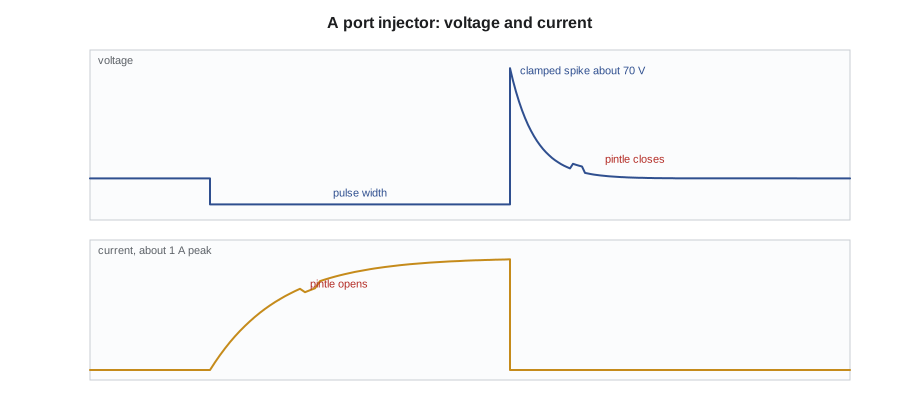
The current waveform, measured with a low-amperage current probe clamped around the injector's wire, shows the electrical and mechanical behaviour even more clearly. Current rises in a curve as the coil's magnetic field builds, and when the pintle starts to move it changes the coil's inductance, which shows as a small notch in the rising current. On a high-impedance port injector, typical peak current is about 1 ampere. An injector with a shorted coil draws more current and rises faster; one with an open coil draws none; one that is sticking may show a late or missing notch.
Comparing cylinders
The most powerful use of a scope on injectors is comparison. All the injectors on an engine are the same part, driven the same way, so their waveforms should look nearly identical. The scope can capture each in turn, or a multi-channel scope can capture several at once, and any one that differs is suspect. Kiran captures all six injectors on van 1 at idle and runs her analysis script on each capture to measure the pulse width, the clamped spike and the time from the end of the pulse to the pintle closing bump.
# Compare port injector waveforms: pulse width, turn-off spike and closing time (captures at idle)
caps = {   # cylinder: (pulse width ms, peak spike V, closing bump after turn-off ms, peak current A)
    1: (3.10, 71.8, 0.62, 1.02), 2: (3.10, 71.5, 0.60, 1.01), 3: (3.08, 72.0, 0.63, 1.03),
    4: (3.12, 71.6, 0.61, 1.02), 5: (3.11, 71.9, 0.62, 1.02), 6: (3.09, 71.7, 0.64, 1.01),
}
names = ("pulse width ms", "spike V", "closing ms", "current A")
for k, name in enumerate(names):
    vals = [c[k] for c in caps.values()]
    avg = sum(vals) / len(vals)
    worst = max(caps, key=lambda cyl: abs(caps[cyl][k] - avg))
    dev = (caps[worst][k] - avg) / avg
    print(f"{name:<15} average {avg:6.2f}; largest difference cylinder {worst}: {dev:+.1%}")
print("all within a few percent: the injectors are electrically and mechanically matched")pulse width ms average 3.10; largest difference cylinder 3: -0.6% spike V average 71.75; largest difference cylinder 2: -0.3% closing ms average 0.62; largest difference cylinder 2: -3.2% current A average 1.02; largest difference cylinder 3: +1.1% all within a few percent: the injectors are electrically and mechanically matched
The six injectors on van 1 are matched within a few percent on every measurement. Cylinder 5's injector opens, delivers and closes like the others. Combined with the injector balance test from the emissions course, which Kiran also repeats on this engine's port injectors, it clears the injector. The misfire must be mechanical: cylinder 5's compression. Lesson 8 tests that.
Direct injectors: high voltage, special care
Gasoline direct injectors spray fuel straight into the combustion chamber against pressures of many megapascals, so they must open very fast and with great force. Their drivers use a peak-and-hold strategy: a boost circuit in the module first applies a high voltage, commonly around 50 to 90 volts depending on the system, to drive a large current through the injector and snap it open, then drops to a lower holding current from the battery supply. The waveform on a direct injector shows the boost spike, the hold period with a chopped, regulated current, and a turn-off spike.
Those voltages are dangerous to touch and can damage ordinary probes and meters, and some systems switch both sides of the injector. Kiran follows the manufacturer's instructions and uses the scope's rated attenuators and a current probe rather than back-probing a direct injector's terminals casually. Most of the time, direct injector problems are diagnosed with scan data first: the module's injector circuit monitoring, fuel rail pressure desired and actual, and per-cylinder corrections. Van 2's engine has both port and direct injectors, which is why Marty insists every apprentice can tell them apart by their connectors and wiring.
Ignition coils
A coil-on-plug ignition coil is a transformer. The module, or a driver built into the coil, switches current through the primary winding for a controlled time, the dwell, building a magnetic field. When it switches off, the field collapses and induces a very high voltage in the secondary winding, which fires the spark plug. Scoping the secondary directly is done with a capacitive probe or a coil-on-plug probe held over the coil; scoping the primary is done with a current probe on the coil's power wire, or on the control wire for coils with an external driver.
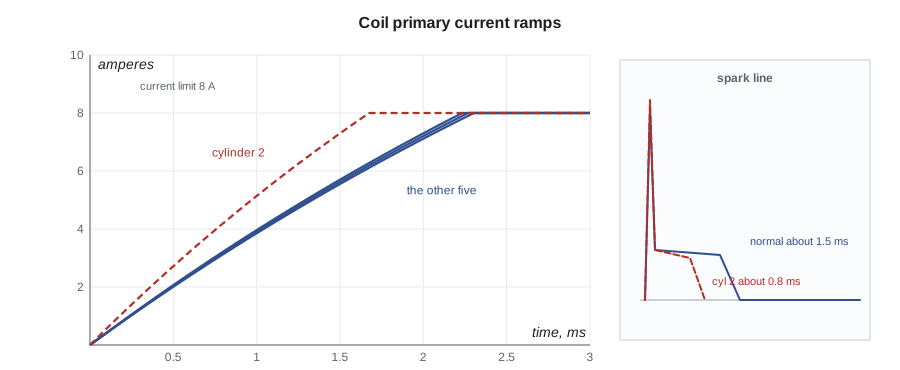
The primary current waveform is the most useful single test of a coil. When the driver switches on, current rises in a ramp whose slope depends on the battery voltage and the primary winding's inductance and resistance. Many systems limit the current at a set value, often 6 to 10 amperes, so the waveform rises and then flattens. A coil with shorted primary turns has less inductance, so its current rises faster; a coil with high resistance rises slowly and may not reach its limit. All the coils on an engine should produce nearly identical ramps. Kiran clamps a current probe on the coil power feed of Harold's SUV, which feeds three coils on one bank, so each coil's ramp appears in turn.
# Coil primary current ramps: time to reach 6 A and the inductance it implies
v_supply = 13.8
r_primary = 0.55          # ohms, including the driver (illustrative)
ramps = {1: 1.62, 2: 1.18, 3: 1.60, 4: 1.63, 5: 1.61, 6: 1.59}   # ms to reach 6 A, from the captures
import math
avg_others = sum(t for c, t in ramps.items() if c != 2) / 5
for cyl, t_ms in ramps.items():
    t = t_ms / 1000
    # i(t) = V/R (1 - exp(-t R / L))  ->  L = -t R / ln(1 - i R / V)
    L = -t * r_primary / math.log(1 - 6 * r_primary / v_supply)
    flag = "  <- rises too fast: shorted turns" if t_ms < 0.85 * avg_others else ""
print(f"cylinder {cyl}: 6 A in {t_ms:.2f} ms, inductance about {L * 1000:.1f} mH{flag}")cylinder 1: 6 A in 1.62 ms, inductance about 3.3 mH cylinder 2: 6 A in 1.18 ms, inductance about 2.4 mH <- rises too fast: shorted turns cylinder 3: 6 A in 1.60 ms, inductance about 3.2 mH cylinder 4: 6 A in 1.63 ms, inductance about 3.3 mH cylinder 5: 6 A in 1.61 ms, inductance about 3.2 mH cylinder 6: 6 A in 1.59 ms, inductance about 3.2 mH
Cylinder 2's coil reaches 6 amperes about a quarter faster than the others, which means its primary inductance is about a quarter lower: some of its turns are shorted together. A coil like that still makes a spark at idle, but the stored energy is lower and the spark weaker. Under hard acceleration, when cylinder pressure is highest and the plug needs the most voltage to fire, it fails, which is exactly when Harold's misfire appears. The other shop's new plugs could not fix it.
Secondary ignition: the spark line
The secondary waveform, captured with a coil-on-plug probe, shows the firing line, the spike of voltage needed to start the spark across the plug gap, followed by the spark line, a lower voltage that lasts while the spark burns, typically about 1 to 2 milliseconds, and then ringing oscillations as the remaining energy dies away. A high firing line means a wide gap, lean mixture or high cylinder pressure; a short spark line means too little energy or very high resistance in the secondary path; a long, low spark line can mean a fouled plug or a short. Kiran captures cylinder 2: its spark line is about 0.8 milliseconds against about 1.5 on the others, confirming the low energy the current ramp predicted.
On the road, Kiran repeats the capture under load with the scope on the passenger seat. As the throttle opens wide, cylinder 2's firing line climbs and its spark occasionally fails to start at all; the scan tool's cylinder 2 misfire counter rises at the same moment. The new coil, fitted with a dab of the dielectric grease the manufacturer specifies inside the boot, produces a ramp matching the others and a normal spark line, and the misfire counter stays at zero through three full-throttle runs.
Solenoids and motors
The same principles apply to other actuators. A solenoid, such as a purge valve or a variable valve timing control valve, produces a turn-off spike whose height shows its coil is intact, and a current trace whose shape shows whether its armature moves. A motor, such as an electronic throttle motor or a fuel pump, produces a current with small ripples, one for each commutator segment as the brushes pass it, as Marty showed Kiran on the training board. A missing or weak ripple means a worn segment or a dead spot; a current higher than normal means the motor is working harder against friction or a restriction.
Electronic throttle bodies are driven by an H-bridge, a set of four transistors that can drive the motor in either direction with a pulse-width modulated signal. Their position is reported by two sensors that must always agree. Scoping the motor's drive and the two position signals together during a throttle sweep shows whether the motor responds smoothly and whether the sensors track each other without gaps. A throttle that sticks at one position, from carbon build-up or a worn gear, shows a step in the position signals while the drive duty climbs.
| Actuator | Measure | What a fault looks like |
|---|---|---|
| Port injector | Control wire voltage and current | Missing or small spike, high current, late or missing pintle notch |
| Direct injector | Current with a rated probe; scan data | Boost or hold current out of pattern; rail pressure not following desired |
| Ignition coil | Primary current ramp; secondary spark line | Ramp faster or slower than others; short spark line |
| Solenoid valve | Control wire voltage and current | Small or missing spike; current without the armature's notch |
| Motor or pump | Current ripple | Missing ripples from a worn segment; high current from friction |
Worked problem
Estimating injector flow from pulse width
A port injector flows 250 millilitres per minute at its rated pressure. At idle, the module commands 3.1 milliseconds of pulse width every two crankshaft revolutions at 700 rpm. Ignoring opening time, about how much fuel does it deliver per minute?
Show solution
- The engine completes 700 ÷ 2 = 350 cycles per minute; the injector opens once per cycle.
- Open time per minute = 350 × 3.1 ms = 1,085 ms, or about 1.09 seconds.
- Flow = 250 mL per minute × 1.09 s ÷ 60 s = about 4.5 mL per minute.
Answer: About 4.5 mL per minute; in practice the opening delay makes the real figure a little lower.
Common mistakes
MistakeCondemning an injector on resistance alone.
InsteadScope its voltage and current; a coil can measure correctly and still stick mechanically.
MistakeBack-probing direct injector terminals with ordinary leads.
InsteadUse rated attenuators and current probes and follow the manufacturer's procedure.
MistakeReplacing spark plugs for a misfire under load without testing the coil.
InsteadCompare primary current ramps and spark lines across all cylinders.
MistakeLooking at one cylinder's waveform in isolation.
InsteadCompare with the other cylinders; the odd one out is the suspect.
MistakeIgnoring the motor's current ripple.
InsteadMissing ripples and high current reveal worn motors and restrictions.
Summary and key terms
- A port injector's waveform shows the pulse width, a clamped turn-off spike and the pintle closing.
- Compare all injectors; matched waveforms clear the injectors and point elsewhere.
- Direct injectors use high boost voltages; measure them only with rated tools and procedures.
- A coil's primary current ramp reveals shorted turns or high resistance.
- The secondary spark line shows how much energy reaches the plug.
- Solenoids show coil condition in their spike and armature movement in their current.
- Motor current ripples show commutator condition; high current shows friction or restriction.
- Pulse width
- The time an injector is held open by its driver.
- Pintle
- The moving valve inside an injector that opens and closes the fuel path.
- Peak-and-hold
- A driver strategy using a high initial current to open an injector, then a lower current to hold it.
- Dwell
- The time current flows through an ignition coil's primary winding before it fires.
- Firing line
- The voltage spike needed to start the spark across the plug gap.
- Spark line
- The lower voltage while the spark burns.
- H-bridge
- A four-transistor circuit that can drive a motor in either direction.
Practice problems
Work each problem on paper first, then reveal the answer to check.
Why did the matched injector waveforms on van 1 point to compression?
Show answer
They cleared the injector electrically and mechanically, leaving the cylinder's mechanical condition.
What does a faster-rising coil primary current mean?
Show answer
Lower inductance, usually from shorted primary turns.
Why did Harold's misfire appear only under hard acceleration?
Show answer
High cylinder pressure needs the most firing voltage, which the weak coil could not supply.
Why must direct injectors be tested with special care?
Show answer
Their drivers use boost voltages that are dangerous and can damage ordinary tools.
Lesson quiz · 5 questions
Score 60% or more to complete this lesson.
Create a free account to save your progress, take quizzes and earn a certificate.