
AUTO-330 · Lesson 12 of 12 · 22 min
Capstone: a no-code hesitation from road test to verified repair
Kiran's engine performance term ends with a job Marty assigns to her alone, under the same rules as every capstone at Ridgeline: she plans the diagnosis, writes down what she expects before every test, may ask questions but not for answers, and writes the repair order herself. The job is Harold Kemp's SUV. Harold's complaint, in Simone's careful handwriting: "Hesitates when I press the gas gently pulling away or at about 50 to 60 km/h (30 to 40 mph). Only after it's warmed up, worse on hot days. No lights. Feels like it runs out of breath for a second." Harold adds that his brother-in-law told him to try a bottle of fuel system cleaner, which did nothing.
This lesson follows the job from the interview to the verified repair, step by step through Lesson 1's strategy, using the data analysis of Lessons 3 and 4, the scope and probes of Lessons 5 to 8, the pressure transducer of Lesson 9, the recording habits of Lesson 10 and the documentation of every lesson. It ends with the repair order.
Steps 1 and 2: verify and gather information
Kiran's plan for verification is a road test under Harold's conditions: engine fully warm, a hot afternoon, gentle tip-ins from a stop and at 50 to 60 km/h (30 to 40 mph). She sets up the scan tool to record a short list chosen to separate fuel, air and spark: engine speed, vehicle speed, pedal and throttle position, mass airflow, short-term and long-term fuel trims for both banks, upstream air-fuel ratio sensors, spark advance, knock retard, misfire counts and fuel rail pressure if the vehicle reports it. Harold's engine is the 3.6 litre V6 with port injection; its module does not report rail pressure, so she plans a pressure transducer for later. She sets a trigger on a short-term trim rising more than 10 percent in less than a second.
On the road, after twenty minutes, the hesitation is easy to feel: a soft sag for about a second on a gentle tip-in at 55 km/h (35 mph), then the engine pulls normally. The trigger fires three times. She also gathers information: no open recalls; one bulletin for a hesitation on this engine, which calls for an engine software update, but the module already has the newer calibration, so it does not apply. Ridgeline's records show the mass airflow sensor was cleaned and the oiled air filter replaced in the emissions course's Lesson 4, the work that fixed this SUV's last airflow problem.
Steps 3 and 4: basics and scan
The basic checks find nothing obvious: the air filter is the paper type Ridgeline fitted, the intake duct is sealed, the battery and charging voltages are good, there are no aftermarket accessories, and no connectors look disturbed. A full scan shows no codes in any module, no pending codes and all monitors complete. Mode 06 shows all results passing, none close to its limits.
The recordings tell the story more clearly. At each tip-in the airflow rises smoothly with the throttle, as it should. Spark advance, knock retard and misfire counts do not change. But the short-term fuel trims on both banks jump positive by more than 15 percent within half a second of the tip-in, and the air-fuel ratio sensors report a brief lean excursion, then the trims settle back over two or three seconds. Both banks equally. Kiran runs the three triggered recordings through a short script.
# Tip-in events from the road test recordings: what changed, and how much (both banks, warm engine)
events = [
    # (time s, airflow before, airflow after 0.5 s g/s, trim bank 1 before/peak %, trim bank 2 before/peak %, lambda min)
    (412.3, 6.1, 24.8, 1.0, 17.5, 0.5, 16.8, 1.11),
    (655.8, 7.4, 26.2, 0.5, 18.2, 1.0, 17.9, 1.12),
    (903.1, 6.8, 25.1, 1.5, 16.9, 0.0, 16.2, 1.10),
]
for t, m0, m1, b1a, b1b, b2a, b2b, lam in events:
    print(f"t = {t:6.1f} s: airflow {m0:4.1f} -> {m1:4.1f} g/s, trims B1 {b1a:+.1f} -> {b1b:+.1f} %, "
          f"B2 {b2a:+.1f} -> {b2b:+.1f} %, leanest lambda {lam:.2f}")
avg_jump = sum((e[4] - e[3] + e[6] - e[5]) / 2 for e in events) / len(events)
print(f"average trim jump {avg_jump:.1f} % on both banks within 0.5 s: the mixture goes lean for a moment on every tip-in")t = 412.3 s: airflow 6.1 -> 24.8 g/s, trims B1 +1.0 -> +17.5 %, B2 +0.5 -> +16.8 %, leanest lambda 1.11 t = 655.8 s: airflow 7.4 -> 26.2 g/s, trims B1 +0.5 -> +18.2 %, B2 +1.0 -> +17.9 %, leanest lambda 1.12 t = 903.1 s: airflow 6.8 -> 25.1 g/s, trims B1 +1.5 -> +16.9 %, B2 +0.0 -> +16.2 %, leanest lambda 1.10 average trim jump 16.5 % on both banks within 0.5 s: the mixture goes lean for a moment on every tip-in
Step 5: theory and test plan
Kiran writes her possible causes in the ranked table from Lesson 1. The evidence: a lean moment on tip-in on both banks, airflow following the throttle normally, no misfires, no codes, only when hot. A vacuum leak would show most at idle and would not depend so much on the tip-in. A dirty or slow airflow sensor would show airflow lagging or falling short, which it does not. An ignition fault would cause misfires. Injectors failing together on both banks is unlikely. What would make the mixture go lean on both banks at the moment the engine suddenly needs more fuel, worse when hot? A fuel supply that cannot keep up with the sudden demand: a weak pump, a restricted filter or strainer, a leaking pressure regulator, or a poor pump supply voltage. She writes her plan with expected results:
- Fuel rail pressure with a transducer during a tip-in, hot: if the theory is right, pressure dips well below specification at each tip-in; if it is wrong, it stays steady.
- Fuel pump current with a probe, hot and cold: a worn pump shows low speed or a weak commutator segment; a restriction shows high current.
- Pump supply voltage drop under load: a poor supply shows a large drop between the battery and the pump.
Marty reads the plan and nods without saying anything, which Kiran has learned means it is good.
Step 6: test and isolate
Kiran fits the medium-range pressure transducer to the fuel rail's test port and routes its cable and the current probe's cable out under the hood, secured away from the exhaust and the fan, with the leads protected from heat, and the scope on the passenger seat. Channel 1 is rail pressure, channel 2 is pump current, channel 3 is the throttle position signal as a marker. She starts with the engine cold and repeats the tip-in route, then again after forty minutes of hard driving on a 31 °C (88 °F) afternoon. The specification for rail pressure on this returnless system is 400 kPa (58 psi), held within a few percent.
# Rail pressure and pump current at a tip-in, cold and hot (captured with transducer and current probe)
spec = 400
runs = {
    "cold": {"rest": 402, "dip": 384, "amps": 6.4, "ripple_hz": 1010},
    "hot":  {"rest": 396, "dip": 286, "amps": 5.1, "ripple_hz": 760},
}
segments = 8
for name, r in runs.items():
    drop = (r["rest"] - r["dip"]) / r["rest"]
    rpm = r["ripple_hz"] / segments * 60
    print(f"{name}: rail {r['rest']} kPa at rest, {r['dip']} kPa at the tip-in, a dip of {drop:.0%} (spec {spec} kPa)")
print(f" pump current {r['amps']} A, pump speed {rpm:,.0f} rpm")cold: rail 402 kPa at rest, 384 kPa at the tip-in, a dip of 4% (spec 400 kPa)
pump current 6.4 A, pump speed 7,575 rpm
hot: rail 396 kPa at rest, 286 kPa at the tip-in, a dip of 28% (spec 400 kPa)
pump current 5.1 A, pump speed 5,700 rpm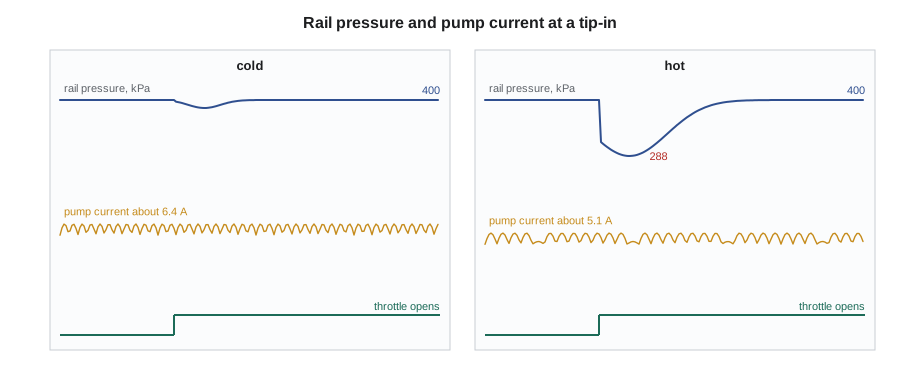
The theory is supported. Cold, the rail pressure dips only about 4 percent at a tip-in and recovers at once. Hot, it sags by more than a quarter and takes over a second to recover, which matches the lean moment and the feel of the hesitation exactly. At the same time the pump's current falls from about 6.4 to 5.1 amperes and its speed, counted from the commutator ripple, falls from about 7,600 to 5,700 rpm. A restriction would make the pump work harder and draw more current, not less; a pump that slows and draws less current while hot is either getting less voltage or wearing out. The scope capture also shows one small ripple repeating once per revolution in the hot capture, the sign of a worn commutator segment that Lesson 8 showed on the training board's pump.
To separate low voltage from a worn pump, Kiran measures the voltage drop on the pump's power and ground circuits under load, hot, with the engine idling and then during a tip-in. Power side: 0.3 volts from the battery to the pump connector. Ground side: 0.1 volts. Both are acceptable. The pump receives full voltage and still slows when hot. The fault is the pump itself.
# Voltage drop on the fuel pump circuit under load, hot: is the supply or the pump at fault?
battery = 13.9
at_pump_feed, at_pump_ground = 13.6, 0.1
feed_drop = battery - at_pump_feed
volts_at_pump = at_pump_feed - at_pump_ground
limit = 0.5                     # typical maximum drop on each side under load
print(f"feed side drop {feed_drop:.1f} V, ground side drop {at_pump_ground:.1f} V (limit about {limit} V each)")
print(f"voltage across the pump: {volts_at_pump:.1f} V of {battery} V")
print("the supply is good: a pump that slows with full voltage and lower current is worn")feed side drop 0.3 V, ground side drop 0.1 V (limit about 0.5 V each) voltage across the pump: 13.5 V of 13.9 V the supply is good: a pump that slows with full voltage and lower current is worn
Step 7: repair
The fuel pump on this SUV is part of a module in the tank, with its strainer, level sender and pressure sensor or regulator. The repair is a new pump module, which Kiran fits following the manufacturer's procedure and the safety steps from the fuel course: battery disconnected, fuel system pressure relieved, the tank level low enough to work safely, no ignition sources, and a fire extinguisher at hand. She inspects the old module's strainer, which is clean, so a restriction was never the problem, and the module's connector, which shows no heat damage. The lock ring is torqued to specification and the new seal fitted dry, as the instructions say.
She checks for leaks with the key on to prime the system, then starts the engine and repeats the tests with the transducer and current probe still connected. Cold, the rail holds within 2 percent at a tip-in; the pump's current is 6.1 amperes and its ripple regular. Hot, after the same forty minutes of hard driving, the rail dips only 3 percent and recovers at once, the current is 6.0 amperes, and the ripple shows no weak segment.
Step 8: verify and document
The verification repeats the original road test, with the same recording and the same trigger. Over half an hour of hot tip-ins at the speeds Harold described, the trigger never fires, the short-term trims stay within 3 percent at every tip-in, and the hesitation has gone. A final scan shows no codes in any module. Kiran removes the test equipment, checks the test port's cap and the transducer adapter for leaks, and writes the repair order.
# Before and after: the evidence for the repair order
before = {"rail dip, hot": 0.28, "trim jump, hot": 16.9, "pump speed hot, rpm": 5700, "pump current hot, A": 5.1}
after = {"rail dip, hot": 0.03, "trim jump, hot": 2.4, "pump speed hot, rpm": 7500, "pump current hot, A": 6.0}
for k in before:
    b, a = before[k], after[k]
    if k.startswith("rail"):
        print(f"{k:<22} before {b:6.0%}   after {a:6.0%}")
    else:
        print(f"{k:<22} before {b:6}   after {a:6}")
# repair order totals (illustrative prices)
rate, hours = 165.0, 2.4
parts = 486.0
work = rate * hours
tax = (work + parts) * 0.05
print(f"shop time {hours} h at {rate:.2f}: {work:,.2f} CAD; pump module {parts:,.2f} CAD; GST 5 %: {tax:,.2f}; total {work + parts + tax:,.2f} CAD")rail dip, hot before 28% after 3% trim jump, hot before 16.9 after 2.4 pump speed hot, rpm before 5700 after 7500 pump current hot, A before 5.1 after 6.0 shop time 2.4 h at 165.00: 396.00 CAD; pump module 486.00 CAD; GST 5 %: 44.10; total 926.10 CAD
The labour includes the diagnosis Bev approved at the start, the second hour she approved when Kiran called Harold with the test results, and the pump replacement at the published labour time. Simone explains the order to Harold with the before and after captures on the tablet, and Harold, who has always wanted to know why, studies them for a long time.
| Part | What Kiran wrote |
|---|---|
| Complaint | Customer: hesitates on gentle acceleration when warm, worse on hot days, no lights. Verified on road test: sag about 1 s on tip-in at 55 km/h (35 mph), engine hot; no codes in any module. |
| Cause | Fuel pump worn: hot, rail pressure dips about 28 % at tip-in (spec 400 kPa (58 psi)), pump slows to about 5,700 rpm with lower current and a weak commutator segment; supply voltage drops good (0.3 V feed, 0.1 V ground). Lean moment on both banks matches. Bulletin checked, calibration already current. |
| Correction | Replaced fuel pump module. Hot tip-in dip now 3 %, trims within 3 %, pump speed about 7,500 rpm, no weak segment. Road test 30 min hot, no hesitation; full scan, no codes. |
Marty's review
At the end of the week Marty reviews the job with Kiran, as he does every capstone. He picks out three things she did well: she wrote expected results before each test, she chose tests that could prove her wrong, and she separated a worn pump from a supply problem with a voltage drop test instead of assuming. He also asks one question: what would she have done if the fault had been at the pump connector? She answers that the voltage drop test would have shown a large drop on the feed or ground side, and the repair would have been the connector and terminals, not the pump. Marty signs off her engine performance competencies in her apprenticeship record.
Kiran notes in her own log that the fuel system cleaner would never have fixed a worn pump, that the old airflow sensor problem was not the answer just because it had been the answer before, and that the tool that solved the job was the plan, not the scope. The scope, the transducer and the current probe only answered the questions the plan asked.
Worked problem
Why the current fell instead of rising
A fuel pump that is pushing against a restriction draws more current; this one drew less when hot. Explain why that pointed away from a restriction.
Show solution
- A restriction raises the pressure the pump works against at its outlet, so it needs more torque and draws more current.
- A pump with worn brushes, a worn commutator or a hot armature loses torque and speed; with less work done, it draws less current and delivers less fuel.
- The voltage drop test then ruled out a poor supply, which would also lower current.
Answer: Lower current with lower speed and good supply voltage means the pump itself is failing, not something it is pushing against.
Common mistakes
MistakeAccepting a fuel additive as a diagnosis.
InsteadTest the fuel supply under the conditions of the complaint.
MistakeBlaming the part that failed last time.
InsteadLet this job's evidence decide; the airflow was normal.
MistakeTesting the fuel system only cold.
InsteadTest under the complaint's conditions: hot, under load.
MistakeCondemning the pump without checking its supply.
InsteadMeasure voltage drop on the feed and ground under load.
MistakeEnding at the repair.
InsteadRepeat the original road test with the same recording, scan all modules and document the three Cs.
Summary and key terms
- Plan the diagnosis and write expected results before each test.
- Record a short list of parameters chosen to separate fuel, air and spark.
- A lean moment on both banks at tip-in, with normal airflow, points at fuel supply.
- A transducer and a current probe together show pressure, pump speed and pump health.
- Voltage drop under load separates a poor supply from a worn pump.
- Verify with the same test and recording that showed the fault.
- Document the complaint, cause and correction with the before and after readings.
- Tip-in
- A quick, moderate opening of the throttle from a steady condition.
- Lean excursion
- A brief period when the mixture has more air than the fuel system is supplying for.
- Returnless fuel system
- A system that regulates pressure at the tank, with no return line from the rail.
- Pump module
- The in-tank assembly of pump, strainer, level sender and regulator or sensor.
- Capstone
- A final job that uses the whole course, done independently.
Practice problems
Work each problem on paper first, then reveal the answer to check.
Why did Kiran choose a transducer and a current probe together?
Show answer
To see the pressure and the pump's speed and health at the same moment.
What separated a worn pump from a poor supply?
Show answer
The voltage drop test showed good feed and ground under load.
Why did the problem appear only when hot?
Show answer
The worn pump lost speed when hot and could not supply the tip-in demand.
How was the repair verified?
Show answer
With the same hot road test, recording and trigger, plus a full scan.
Lesson quiz · 5 questions
Score 60% or more to complete this lesson.
Create a free account to save your progress, take quizzes and earn a certificate.