
AUTO-130 · Lesson 9 of 12 · 22 min
Parking brakes and electronic parking brakes
Gord Haney is back. His pickup's new rear brake line from Lesson 3 is fine, but when he parked on the steep ramp of the yard where he keeps his landscaping trailer, with the parking brake pedal pushed to the floor and the transmission in park, the truck crept a few centimetres before the parking pawl caught it with a clunk. “That's not how a parking brake is supposed to work,” he says, and he is right. The same week, Dr. Amara Singh's electric car comes back for the rear pads that Lesson 7 found worn and rusty, and its rear calipers have electric motors built into them. Kiran will service both kinds of parking brake in the same week.
This lesson explains what a parking brake must do, the mechanical designs that use cables to apply drum brakes, drum-in-hat brakes or caliper mechanisms, how they are adjusted, and how electronic parking brakes work and are serviced, including the service modes that retract their pistons. It also covers the extra jobs an electronic parking brake can do, such as holding the car at a stop and stopping it in an emergency.
What a parking brake must do
The parking brake holds a parked vehicle in place, on a hill as well as on the flat, without relying on the hydraulic system. It must be separate from the service brakes, so that it still works if the hydraulic system fails, and it must hold mechanically, without needing pressure that could leak away. On a vehicle with an automatic transmission, the parking pawl in the transmission also holds the drive wheels, but the pawl is not designed to be the only thing holding a vehicle on a slope; it can break, or jump out under load, and it holds only the driven axle. The parking brake should always be applied first, and the transmission shifted into park afterwards, so that the weight of the vehicle sits on the brakes.
Canada Motor Vehicle Safety Standard 135 requires a light vehicle's parking brake to hold it, loaded, on a 20 percent grade facing both uphill and downhill, with a limited force on the lever or pedal. A 20 percent grade rises 20 units for every 100 units of horizontal distance, a slope of a little over 11 degrees, which is steeper than most streets but common on driveways, ramps and parking garages.
In this formula, F is the force along the slope that the parking brake must resist, m is the vehicle's mass, g is the acceleration of gravity and theta is the angle of the slope. The angle is found from the grade with the arctangent: theta equals the arctangent of the grade divided by 100.
# Force the parking brake must hold on a slope, and the wheel torque that means at the rear axle
import math
UNITS = "metric"
vehicles = [("Gord's pickup, loaded with a trailer tongue", 2600, 0.39), ("Dr. Singh's EV", 1690, 0.32)]   # kg, tire radius m
for name, m, r in vehicles:
    for grade in (10, 20, 30):
        theta = math.atan(grade / 100)
        f = m * 9.81 * math.sin(theta)                  # N along the slope
        torque = f * r / 2                              # N m at each rear wheel (rear-only parking brake)
        if UNITS == "metric":
            print(f"{name:<44} {grade:2d} % grade: hold {f / 1000:4.1f} kN, {torque:5.0f} N m per rear wheel")
        else:
print(f"{name:<44} {grade:2d} % grade: hold {f * 0.2248:5.0f} lb, {torque * 0.7376:5.0f} lb ft per rear wheel")Gord's pickup, loaded with a trailer tongue 10 % grade: hold 2.5 kN, 495 N m per rear wheel Gord's pickup, loaded with a trailer tongue 20 % grade: hold 5.0 kN, 975 N m per rear wheel Gord's pickup, loaded with a trailer tongue 30 % grade: hold 7.3 kN, 1429 N m per rear wheel Dr. Singh's EV 10 % grade: hold 1.6 kN, 264 N m per rear wheel Dr. Singh's EV 20 % grade: hold 3.3 kN, 520 N m per rear wheel Dr. Singh's EV 30 % grade: hold 4.8 kN, 762 N m per rear wheel
Gord's yard ramp is steep, about 25 percent near the top, and with the truck loaded and the trailer tongue on the hitch its parking brake has a lot of work to do. The numbers show why a parking brake that is merely weak, rather than broken, can fail on a ramp like that while holding perfectly well in a flat parking lot.
Mechanical parking brakes
A mechanical parking brake is applied by a hand lever, a foot pedal or a pull handle, which pulls a front cable. The front cable runs to an equalizer, a bracket that divides the pull evenly between two rear cables, one to each rear wheel. Each rear cable runs inside a steel conduit and pulls a lever at the brake. How that lever applies the brake depends on the design.
- Rear drum brakes. The cable pulls the parking brake lever on the secondary or trailing shoe, and a strut between the shoes pushes them both against the drum. This is the design on Theo's car in Lesson 8, where the parking brake also works the self-adjusters.
- Drum-in-hat. Many vehicles with rear disc brakes, including Gord's pickup, have a small duo-servo drum brake inside the hat of each rear rotor, used only for parking. The hat's inside surface is the drum. These shoes are adjusted by a star wheel reached through a hole in the rotor or backing plate.
- Integrated caliper. Other rear disc calipers have a parking mechanism inside the caliper: the cable turns a lever on the back of the caliper, which drives the piston out through a screw, a ramp and ball mechanism, or a cam, and an automatic adjuster inside keeps the mechanism in step as the pads wear. Their pistons must be screwed back into the bore with a special tool when new pads are fitted, rather than pushed straight in.
Cables are the weak point of mechanical parking brakes in a salt climate. Water gets into the conduits, the inner cable rusts, and the cable seizes, either partly applied, so the brake drags, or partly released, so it cannot apply fully. Parking brakes that are rarely used are most at risk, because nothing moves the cable often enough to keep it free. A driver who uses the parking brake every time they park keeps it working.
Diagnosing and adjusting Gord's parking brake
Kiran starts with the lever travel: Gord's pedal goes almost to the floor before it holds, much more than the specification. With the truck on the lift, she has Theo apply the pedal while she watches the cables: the front cable and equalizer move freely, but the right rear cable barely moves at the wheel end, and when she releases the pedal the left cable springs back while the right stays slack. The right rear cable is seized in its conduit. Inside the rear rotors, both drum-in-hat shoe sets are rusty, glazed and poorly adjusted, and the right side's star wheel is seized.
The repair follows the usual order for parking brakes: first the brake itself, then the cables. Kiran replaces the right rear cable, cleans and lubricates the backing plates, fits new parking brake shoes and hardware on both sides, frees and lubricates the star wheel adjusters, and adjusts the shoes so that the rotor just turns with a slight drag, then backs them off the number of notches the service information specifies. Only then does she check the cable adjustment at the equalizer. Adjusting the cable first, to make up for shoes that are out of adjustment, would leave the lever arms at the brakes pulled partly on all the time; the brakes would drag and the self-adjusters, where fitted, would stop working. Finally she burnishes the new parking shoes with a few gentle applications while driving slowly, as the procedure describes.
# Gord's parking brake: pedal travel and the hold test after the repair
UNITS = "metric"
spec = (4, 7)                   # pedal clicks to full hold, specification
before, after = 13, 6
print(f"pedal clicks before repair: {before}  -> {'too many: adjust or repair' if before > spec[1] else 'OK'}")
print(f"pedal clicks after repair:  {after}  -> {'within specification' if spec[0] <= after <= spec[1] else 'check again'}")
tests = [("flat ground, drive engaged at idle, brakes released", "held"),
         ("25 % ramp, nose down, loaded, transmission in neutral", "held"),
         ("25 % ramp, nose up, loaded, transmission in neutral", "held")]
for t, result in tests:
print(f"hold test: {t:<58} {result}")pedal clicks before repair: 13 -> too many: adjust or repair pedal clicks after repair: 6 -> within specification hold test: flat ground, drive engaged at idle, brakes released held hold test: 25 % ramp, nose down, loaded, transmission in neutral held hold test: 25 % ramp, nose up, loaded, transmission in neutral held
The hold tests are done with care: on the ramp at Gord's yard, with Gord's permission, with the driver's door open and a foot ready on the service brake, and with the transmission in neutral so that only the parking brake is holding. The truck holds facing both ways.
Electronic parking brakes
Most new cars and many trucks now have an electronic parking brake, often shortened to EPB. The driver uses a switch instead of a lever, and an electric motor applies the brake. There are two main designs. In a cable-puller system, a single motor unit pulls conventional cables to the rear brakes, much like a mechanical system with a motor in place of the lever. In the more common caliper-integrated system, each rear caliper has a small electric motor and gearbox bolted to its back, which turns a spindle inside the piston. The spindle's nut drives the piston out against the pads mechanically, and because the thread is self-locking, the brake stays applied with no power. A control module, often part of the anti-lock or stability control module, runs the motors and checks their current to know when the pads are clamped.
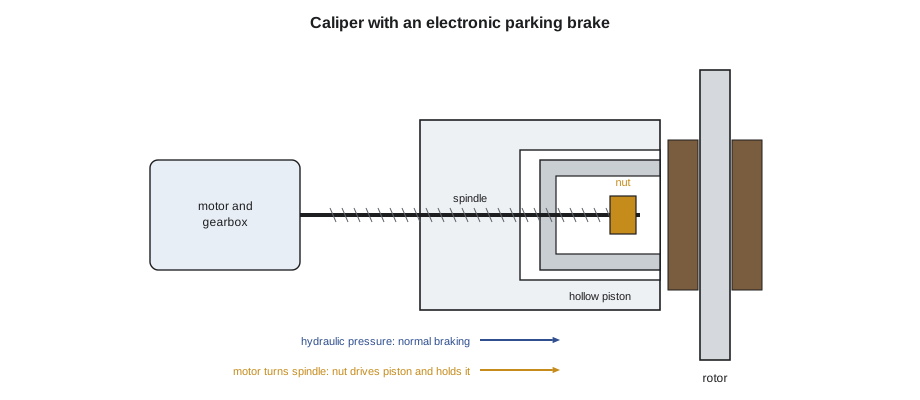
An electronic parking brake can do things a lever cannot. It can apply automatically when the vehicle is shut off or the driver's door opens, and release automatically when the driver pulls away with a seat belt fastened. An auto-hold function can keep the vehicle stopped at a light without the driver's foot on the pedal. And if the driver holds the switch while the vehicle is moving, the system brakes the vehicle in a controlled way, usually by commanding the stability control system to apply all four service brakes, so that the switch can be used as an emergency brake if the pedal fails.
Servicing an electronic parking brake
The rule for caliper-integrated electronic parking brakes is simple: never push the piston back into the bore while the parking brake mechanism is extended, and never try to apply or release it while the caliper is off. The spindle and nut inside the piston must be retracted by the motor first. On most vehicles that is done with a scan tool, which puts the system into a service or maintenance mode that drives the pistons fully back and keeps the system from applying while the work is done. Some vehicles have a switch-and-pedal sequence that does the same thing, and a few allow the motor to be removed and the spindle turned by hand; the service information says which. Forcing a piston back over its extended spindle can strip the nut, and removing a caliper with the motor powered can make it apply against nothing and jam.
Kiran follows the procedure on Dr. Singh's car. Because the car is electric, she first confirms that it is shut down and in the state the service information requires for brake work, and that the integrated brake system from Lesson 5 is in its maintenance mode, so it will not run a self-test with her hands in a caliper. She connects the scan tool, selects the electronic parking brake maintenance function, and watches the motors run the pistons back. She replaces the rear rotors and pads, lubricates the caliper slides, pushes the pistons back with the bleeder open, refits the calipers and connectors, and then uses the scan tool to exit the maintenance mode. The system then runs a calibration that applies and releases the motors several times to learn the new pad position, which the scan tool shows as complete. Finally she checks that the dash shows no parking brake fault and that the brake applies and releases on the switch.
# Electronic parking brake motor current during an apply (illustrative values from a scan tool graph)
UNITS = "metric"
samples = [(0.0, 0.0), (0.1, 6.5), (0.3, 1.8), (0.5, 1.9), (0.7, 2.0), (0.8, 5.5), (0.9, 9.8), (1.0, 12.4)]   # seconds, amps
cutoff = 12.0                 # A, the module stops the motor when the clamp current is reached
for t, amps in samples:
    phase = "inrush" if t < 0.2 else ("running free" if amps < 3 else ("clamping" if amps < cutoff else "clamp reached: stop"))
    print(f"{t:3.1f} s  {amps:4.1f} A  {phase}")
free_run = [a for t, a in samples if 0.2 < t < 0.75]
print(f"free-running current {sum(free_run) / len(free_run):.1f} A -> " + ("normal" if max(free_run) < 3 else "high: mechanism binding"))0.0 s 0.0 A inrush 0.1 s 6.5 A inrush 0.3 s 1.8 A running free 0.5 s 1.9 A running free 0.7 s 2.0 A running free 0.8 s 5.5 A clamping 0.9 s 9.8 A clamping 1.0 s 12.4 A clamp reached: stop free-running current 1.9 A -> normal
Motor current tells the module, and the technician, a lot about an electronic parking brake. During an apply, the current jumps briefly as the motor starts, falls to a low value while the piston runs freely toward the pads, then rises steadily as the pads clamp, and the module stops the motor when the current reaches the level that matches the right clamping force. A free-running current that is too high points to a binding mechanism, often corrosion inside the caliper; a motor that never reaches its cutoff current points to a stripped spindle or a mechanical fault. Many scan tools can display this graph, and many electronic parking brake codes are set by the module when the current pattern is wrong.
Worked problem
Why did Gord's truck creep on the ramp?
Explain what was wrong and why the transmission's park position is not enough.
Show solution
- The right rear parking brake cable had rusted solid inside its conduit, so it could not pull that side's brake on; only the left side was working, and it was poorly adjusted.
- The parking shoes inside both rear rotors were rusty, glazed and out of adjustment, so even the working side had little holding force.
- On a steep ramp, loaded, the truck needs a large holding force at the rear wheels, more than the weak brake could give, so the truck rolled until the transmission's parking pawl caught it.
- The pawl is a small locking tooth that holds only the rear axle through the driveline and can be damaged by shock loads; the parking brake should hold the truck first.
- With a new cable, new shoes and correct adjustment, the truck now holds on the ramp in both directions.
Answer: A seized cable and worn, unadjusted shoes left the parking brake weak; the repair restored full holding force.
Common mistakes
MistakeShifting into park before applying the parking brake on a slope.
InsteadApply the parking brake first, then shift into park.
MistakeAdjusting the cable to make up for unadjusted shoes.
InsteadService and adjust the brake first, then the cable.
MistakePushing back an electronic parking brake piston with the mechanism extended.
InsteadRetract it with the scan tool's maintenance mode first.
MistakeSkipping the calibration after electronic parking brake work.
InsteadExit the maintenance mode and complete the learn procedure.
MistakeTreating a seldom-used parking brake as fine.
InsteadSeldom-used cables and shoes seize; check and test them.
Summary and key terms
- A parking brake holds the vehicle mechanically, separate from the hydraulic system, and should be applied before shifting into park.
- Light vehicles' parking brakes must hold on a 20 percent grade.
- Mechanical systems use cables to apply rear drums, drum-in-hat shoes or integrated caliper mechanisms.
- Cables seize in salt climates; the brake is serviced and adjusted before the cable.
- Electronic parking brakes use motors on the calipers or a cable puller, and add auto-hold and emergency braking.
- Their pistons are retracted and recalibrated with a maintenance mode, usually through a scan tool.
- Parking pawl
- A locking tooth in an automatic transmission that holds the output shaft in park.
- Equalizer
- A bracket that divides the parking brake cable pull between the two rear brakes.
- Drum-in-hat
- A small parking brake drum formed inside the hat of a rear rotor.
- Electronic parking brake
- A parking brake applied and released by electric motors under module control.
- Maintenance mode
- A scan tool or switch procedure that retracts and disables the electronic parking brake for service.
- Auto-hold
- A function that holds the vehicle at a stop without the driver pressing the pedal.
- Clamp current
- The motor current at which the module judges the parking brake fully applied.
Practice problems
Work each problem on paper first, then reveal the answer to check.
Why should the parking brake be applied before shifting into park on a slope?
Show answer
So the vehicle's weight rests on the brakes, not on the transmission's parking pawl.
What grade must a light vehicle's parking brake hold under the federal standard?
Show answer
20 percent, facing uphill and downhill.
Why is the parking brake adjusted at the shoes before the cable?
Show answer
Adjusting the cable first would leave the levers partly applied, causing drag.
What does a high free-running motor current on an electronic parking brake suggest?
Show answer
A binding or corroded mechanism.
Lesson quiz · 5 questions
Score 60% or more to complete this lesson.
Create a free account to save your progress, take quizzes and earn a certificate.