
AUTO-130 · Lesson 12 of 12 · 21 min
Capstone: diagnosing a brake complaint from road test to repair
In late February, van 1 comes in. Its driver, Marcus Bell, has written a note for Hal Osei, who passes it to Simone: “Pulls to the left when I brake, worse in hard stops. Pedal shakes coming off the highway. Pedal a bit lower than the other vans. Smelled hot brakes after the long hill on Tuesday.” Marty tells Kiran that this one is hers from start to finish: interview, road test, inspection, measurement, diagnosis, estimate, repair, verification and the report to the customer. He will check her work at the points a journeyperson would, and sign it off, but she runs the job.
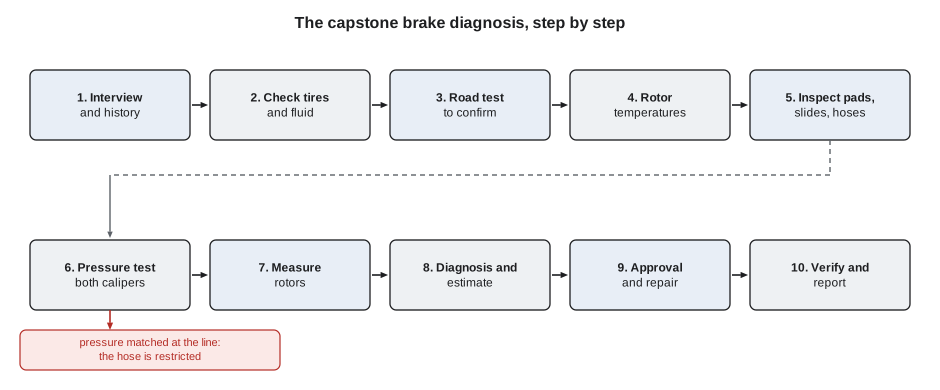
This capstone lesson follows Kiran through that job, step by step, using everything in the course. It also sets out the order that every brake diagnosis should follow, because a pull, a pulsation and a low pedal each have several possible causes, and the order of the tests is what separates the real cause from a guess.
Step 1: the interview and the history
Kiran calls Marcus before she touches the van. Good questions narrow the problem quickly. Does the pull happen every time you brake, or only sometimes? Only when braking, or also when driving? Has it got worse? When did the shaking start, and does it come through the steering wheel, the pedal or both? Did anything change recently, such as tires, an alignment, a pothole or a brake job? Marcus says the pull is every time he brakes, gets worse the harder he brakes, and does not happen when he is just driving. The shaking is mainly in the pedal, a little in the wheel, only in stops from highway speed, and started about a month ago. The van has had no work since its last service, when Ridgeline flushed its brake fluid.
She then checks Ridgeline's records. Van 1's front pads and rotors were replaced about 48,000 km ago; its fluid was flushed at its last service; its tires were rotated then too. A pull that happens only when braking, not when driving, points to the brakes rather than to the alignment or tires, though tire pressures and condition are checked anyway, because a soft tire can also cause a pull under braking.
Step 2: confirm the complaint
Kiran checks the basics before the road test: tire pressures, set to the door placard, and tread; brake fluid level, at the full mark, with a boiling point test giving a good result; no warning lamps; and a pedal that is firm with the engine running but sits a little lower than she expects. On the road, with Marty in the passenger seat, she makes a series of stops at increasing firmness on a quiet road. The van pulls left, clearly, more in harder stops, and when she lets the steering wheel go lightly in a gentle stop it turns left on its own. From highway speed the pedal pulses. Back at the shop, she immediately measures the temperature of each wheel's rotor face with an infrared thermometer.
# Rotor temperatures right after the road test (infrared thermometer, same spot on each rotor)
UNITS = "metric"
temps = {"left front": 168, "right front": 96, "left rear": 74, "right rear": 71}    # C
for wheel, t in temps.items():
    print(f"{wheel:<12} {t:4d} C")
front_diff = temps["left front"] - temps["right front"]
print(f"front left-right difference: {front_diff} C ->",
"the right front is doing much less work than the left" if front_diff > 30 else "normal")left front 168 C right front 96 C left rear 74 C right rear 71 C front left-right difference: 72 C -> the right front is doing much less work than the left
The temperatures confirm what the steering wheel said: the right front brake is doing much less work than the left. A pull under braking always means one side is braking more than the other. That can come from the stronger side, for example a grabbing pad, or from the weaker side, and here the weaker side is the cooler one. The question now is why the right front brake is weak.
Step 3: inspect
On the lift, Kiran removes both front wheels and inspects before taking anything apart. The front pads have plenty of material, about half their original thickness, and wear evenly on both sides, so the calipers are sliding; she checks the guide pins anyway and they move freely. The right front pads have a hard, glossy glaze; the left front pads look normal. The left front rotor has a bluish tint and darker patches on its faces; the right front rotor looks almost new. The right front hose is original, with fine cracks in its outer cover, and when she squeezes it, it feels softer than the left one, which was replaced after a minor collision last year according to the records.
A soft, cracked hose on the weak side is a strong clue, but Marty's rule is to test before replacing. Lesson 3 described a hose that collapses inside and acts as a one-way valve, keeping a brake applied. A hose can also restrict flow in the other direction, so that pressure reaches the caliper slowly and never fully during a normal stop. To find out, Kiran fits a pressure gauge to each front caliper's bleeder port, bleeds the air from the gauge lines, and has Theo apply the pedal with steady force, the engine running.
# Pressure at each front caliper with the same steady pedal application
UNITS = "metric"
readings = [("light pedal", 1400, 850), ("moderate pedal", 4200, 2600), ("hard pedal", 7600, 5100)]     # left, right in kPa
for label, left, right in readings:
    gap = (left - right) / left * 100
    print(f"{label:<15} left {left:6} kPa, right {right:6} kPa, right is {gap:3.0f} % lower")
print("after holding for 5 seconds the right rose to match the left: a restriction that slows the flow, upstream of the caliper")light pedal left 1400 kPa, right 850 kPa, right is 39 % lower moderate pedal left 4200 kPa, right 2600 kPa, right is 38 % lower hard pedal left 7600 kPa, right 5100 kPa, right is 33 % lower after holding for 5 seconds the right rose to match the left: a restriction that slows the flow, upstream of the caliper
The right front gets much less pressure than the left in any normal stop, although if the pedal is held long enough the pressure slowly equalizes. That pattern points to a restriction that slows the flow into the right caliper. Kiran moves the right gauge to the line side of the hose, at the steel line junction, and the pressure there matches the left caliper immediately. The restriction is in the hose. The glazed right pads fit too: a brake that works weakly but often, never reaching full pressure, tends to glaze.
The pulsation needs its own explanation. Because the left front brake has been doing most of the work for weeks, its rotor has run very hot, which explains the bluish tint, the burning smell on the long hill, and the dark patches, which are deposits of pad material transferred unevenly at high temperature. Kiran measures both front rotors.
# Van 1's front rotors: thickness at eight points and lateral runout
UNITS = "metric"
discard, machine_to, max_var, max_runout = 28.0, 28.4, 0.015, 0.050     # mm
rotors = {"left front":  ([29.214, 29.198, 29.177, 29.169, 29.181, 29.203, 29.221, 29.224], 0.028),
          "right front": ([29.356, 29.353, 29.351, 29.350, 29.352, 29.354, 29.356, 29.357], 0.021)}
for name, (t, runout) in rotors.items():
    var = max(t) - min(t)
    notes = []
    if min(t) <= discard: notes.append("below discard")
    if var > max_var: notes.append(f"thickness variation {var:.3f} too high")
    if runout > max_runout: notes.append(f"runout {runout:.3f} too high")
print(f"{name}: min {min(t):.3f}, variation {var:.3f}, runout {runout:.3f} mm ->", "; ".join(notes) if notes else "within limits")left front: min 29.169, variation 0.055, runout 0.028 mm -> thickness variation 0.055 too high right front: min 29.350, variation 0.007, runout 0.021 mm -> within limits
The left rotor's runout is fine, so this thickness variation was not caused by a wobble, as Ines Moreau's was in Lesson 7; it comes from heat and uneven pad deposits. The rotor is still thick enough to machine, but with heat discoloration and hard patches, and with new pads going on both sides, Kiran recommends new rotors as a pair. The right rotor is in good condition, but rotors are replaced or machined in pairs on an axle so that both sides brake alike, and a new pair costs less than machining one and replacing the other.
Step 4: the diagnosis and the estimate
Kiran writes her diagnosis before she writes the estimate, because the estimate must follow from it. The cause of the pull is a restricted right front brake hose. The pulsation is from heat-related thickness variation on the left front rotor, which overheated because it was doing most of the work. The slightly low pedal is from the soft right front hose swelling under pressure. The burning smell was the overheated left front brake. The fix is to replace both front hoses as a pair, both front rotors and pads, with the slides serviced, then bleed, bed in and verify.
# Estimate for van 1 (prices and labour times are illustrative)
UNITS = "metric"
rate = 165                       # labour per hour
parts = [("front brake hoses (pair) with new banjo washers", 96.00),
         ("front rotors (pair)", 238.00),
         ("front pads, fleet formula, with hardware", 142.00),
         ("brake fluid, DOT 4 LV", 18.00),
         ("shop supplies", 8.00)]
labour = [("diagnosis: road test, temperatures, pressure tests, measurement", 1.0),
          ("replace both front hoses and bleed the system", 0.9),
          ("replace front pads and rotors, service slides", 1.3)]
parts_total = sum(p for _, p in parts)
labour_total = sum(h for _, h in labour) * rate
tax = 0.05
for name, p in parts: print(f"part   {name:<62} {p:8.2f}")
for name, h in labour: print(f"labour {name:<62} {h * rate:8.2f}  ({h} h)")
taxable = parts_total + labour_total
print(f"parts {parts_total:.2f} + labour {labour_total:.2f}; GST 5 % {taxable * tax:.2f}; total {parts_total + labour_total + taxable * tax:.2f} CAD")part front brake hoses (pair) with new banjo washers 96.00 part front rotors (pair) 238.00 part front pads, fleet formula, with hardware 142.00 part brake fluid, DOT 4 LV 18.00 part shop supplies 8.00 labour diagnosis: road test, temperatures, pressure tests, measurement 165.00 (1.0 h) labour replace both front hoses and bleed the system 148.50 (0.9 h) labour replace front pads and rotors, service slides 214.50 (1.3 h) parts 502.00 + labour 528.00; GST 5 % 51.50; total 1081.50 CAD
Simone sends the estimate to Hal with Kiran's diagnosis in plain words and the measured pressures and rotor readings attached, as Ridgeline does for every fleet customer. Alberta's consumer protection rules require the customer's authorization before work beyond an estimate, and Ridgeline's policy is the same for every customer anyway: no work without approval, and a call before any change. Hal approves the job within the hour.
Step 5: the repair
Kiran replaces the two front hoses with the van supported safely on the lift and the calipers hung on hooks, fits new copper washers on the banjo bolts, routes each hose without twists using its stripe, and torques the fittings to specification. She replaces the pads and rotors following the checklist from Lesson 6: abutments cleaned to bare metal, new clips, guide pins cleaned and lubricated with the specified grease, hub faces cleaned, rotors fitted and their runout checked on the hub, bracket and caliper bolts torqued, wheels fitted with the nuts tightened in a star pattern with a torque wrench. She bleeds the whole system with the pressure bleeder, in the sequence for this van, so that the fluid that was in the old hoses is flushed out too.
Marty checks her work at two points, as the shop's quality procedure requires for brake jobs: the torque on every fastener she tightened, against her written list, and the bleeding, by checking the pedal height and firmness himself before the van leaves the bay.
Step 6: verify and deliver
Before the road test, Kiran pumps the pedal until it is firm and checks the fluid level. On the road, she beds in the new pads as their manufacturer specifies, then repeats the same series of stops as before. The van stops straight, with no pull at any firmness and no pulsation from highway speed. The pedal is high and firm. Back at the shop she measures the rotor temperatures again and repeats the pressure test at the calipers.
# Verification after the repair
UNITS = "metric"
temps_after = {"left front": 121, "right front": 117}             # C after the same road test
press_after = {"left front": 4150, "right front": 4100}             # kPa, moderate pedal
t_gap = abs(temps_after["left front"] - temps_after["right front"])
p_gap = abs(press_after["left front"] - press_after["right front"]) / press_after["left front"] * 100
print(f"front rotor temperatures {temps_after['left front']} and {temps_after['right front']} C: difference {t_gap} C ->", "balanced" if t_gap <= 15 else "check again")
print(f"front caliper pressures {press_after['left front']} and {press_after['right front']} kPa: difference {p_gap:.0f} % ->", "balanced" if p_gap <= 5 else "check again")
checks = ["no pull at light, moderate or hard braking", "no pulsation from highway speed", "pedal high and firm, holds under steady pressure",
          "fluid level correct, bleeder caps fitted", "wheel nuts torqued and recorded", "no warning lamps, no codes"]
for c in checks:
print("verified:", c)front rotor temperatures 121 and 117 C: difference 4 C -> balanced front caliper pressures 4150 and 4100 kPa: difference 1 % -> balanced verified: no pull at light, moderate or hard braking verified: no pulsation from highway speed verified: pedal high and firm, holds under steady pressure verified: fluid level correct, bleeder caps fitted verified: wheel nuts torqued and recorded verified: no warning lamps, no codes
The last part of the job is the report. Kiran writes the three Cs on the repair order: the complaint in Marcus's words, the cause she found and how she found it, and the correction she made, with the measurements. She adds a recommendation that is easy to miss: van 1's rear hoses are also original and show the same fine cracking, and the other two vans are the same age, so Hal should have all their hoses inspected at their next service. Van 2's right front, in Lesson 6, was a sliding problem, not a hose, but a fleet of identical vehicles tends to develop the same faults at about the same time.
Worked problem
The report to Hal
Write the cause and correction section of van 1's repair order in plain words.
Show solution
- Cause: the right front brake hose was restricted inside, so the right front brake received much less pressure than the left in normal stops; the van pulled left, and the left front brake did most of the work and overheated.
- The overheated left front rotor developed uneven thickness from heat and pad deposits, which caused the pedal pulsation; the soft right hose also swelled under pressure, which lowered the pedal.
- Correction: replaced both front brake hoses, front rotors and front pads; serviced the caliper slides; flushed and bled the brake system; bedded in the pads; road tested.
- Verification: no pull, no pulsation, firm pedal; caliper pressures and rotor temperatures now match side to side.
- Recommendation: inspect the rear hoses on this van, and all hoses on the fleet's other two vans, at their next service.
Answer: Restricted right front hose, causing a pull, an overheated left rotor and pulsation; both hoses, rotors and pads replaced and the repair verified.
Common mistakes
MistakeReplacing parts before confirming the complaint.
InsteadInterview, check tires and fluid, and road test first.
MistakeAssuming a pull comes from the hotter side.
InsteadFind which side is weak and why; here the cooler side was the faulty one.
MistakeReplacing one hose, one rotor or one set of pads.
InsteadReplace axle parts in pairs so both sides brake alike.
MistakeSkipping verification measurements.
InsteadRepeat the road test, temperatures and pressures after the repair.
MistakeWriting only the parts on the repair order.
InsteadRecord the complaint, cause and correction with the measurements.
Summary and key terms
- A brake diagnosis starts with the interview, the history and a check of tires and fluid.
- A road test confirms the complaint; rotor temperatures show which brakes are working hardest.
- A pull under braking means unequal braking side to side; find the weak or strong side and test it.
- Pressure gauges at both calipers locate a restriction; a pressure that matches at the line points to the hose.
- Rotors are measured for thickness, variation and runout to explain pulsation.
- The repair is verified with the same tests, and the report records complaint, cause and correction.
- Three Cs
- Complaint, cause and correction, the three parts of a repair order report.
- Infrared thermometer
- A tool that measures surface temperature without contact.
- Restricted hose
- A brake hose whose inner layer slows or blocks the flow of fluid.
- Pull
- A tendency of the vehicle to turn to one side, under braking or while driving.
- Glazed pad
- A pad with a hard, shiny surface and reduced friction, often from overheating or light use.
- Verification
- Testing after a repair to prove the fault is fixed.
- Quality check
- A second technician's inspection of critical steps before delivery.
Practice problems
Work each problem on paper first, then reveal the answer to check.
A van pulls right when braking, and the left front rotor is much cooler than the right after a road test. Which side is likely faulty?
Show answer
The left front, which is doing less work; find out why.
Pressure is low at a caliper but normal at the line side of its hose. What is the likely fault?
Show answer
A restricted hose.
Why are hoses, rotors and pads replaced in pairs on an axle?
Show answer
So that both sides brake equally.
What are the three Cs of a repair order?
Show answer
Complaint, cause and correction.
Lesson quiz · 5 questions
Score 60% or more to complete this lesson.
Create a free account to save your progress, take quizzes and earn a certificate.