
AUTO-130 · Lesson 4 of 12 · 22 min
Brake fluid and bleeding
When Kiran tested the brake fluid on one of Hal Osei's vans back in AUTO-110, it failed, and Hal approved a flush for that van. Van 2 has never had one. Before she installs its new pads, she dips a test strip in its reservoir and holds it against the colour chart, then draws a sample with a clean syringe for the shop's boiling point tester. The strip shows high copper; the tester shows a boiling point of 182 °C, far below that of new fluid. “That's what the driver meant by 'different',” Marty says. “Half a year of hard stops on fluid like that, and one day on a long hill the pedal goes to the floor.”
This lesson explains what brake fluid must do, why it absorbs water and why that lowers its boiling point, the grades of fluid and which ones may be mixed, how fluid is tested, and how brake systems are bled and flushed, from the simple two-person method to scan tool procedures for anti-lock and brake-by-wire systems.
What brake fluid must do
Brake fluid has a demanding job. It must stay liquid and flow easily from the coldest winter morning, well below −30 °C, to the temperatures reached next to a hot caliper piston, which can exceed 200 °C after repeated hard stops. It must not boil, because vapour compresses and the pedal goes soft. It must not swell or soften the rubber seals and hoses it touches, and it must protect the steel, cast iron and aluminum parts of the system from corrosion. And because the anti-lock and stability control valves open and close in thousandths of a second, it must stay thin enough to flow through their tiny passages even when cold.
Most brake fluids are based on glycol ethers, with additives to protect metals and rubber. These fluids are hygroscopic: they absorb water from the air. Water enters through the reservoir vent, through the walls of hoses and past seals, and every time the reservoir is opened. A typical system absorbs enough water to raise its moisture content by roughly one to two percent a year, more in humid climates. Absorbing water is deliberate, in a sense: water spread through the fluid is far less harmful than water collecting in drops in the low points of the system, where it would freeze in winter and rust the parts. But water lowers the boiling point sharply.
Boiling points and the DOT grades
In Canada and the United States, brake fluid grades are set by the federal motor vehicle safety standards, CMVSS 116 and FMVSS 116, and named DOT 3, DOT 4 and DOT 5, after the US Department of Transportation. The standard sets a minimum dry boiling point, for fresh fluid, and a minimum wet boiling point, measured after the fluid has absorbed about 3.7 percent water, roughly what it reaches after two years in service. The industry also sells DOT 5.1, a glycol fluid that meets the DOT 5 boiling points.
| Grade | Base | Dry boiling point (minimum) | Wet boiling point (minimum) |
|---|---|---|---|
| DOT 3 | Glycol ether | 205 °C | 140 °C |
| DOT 4 | Glycol ether with borate esters | 230 °C | 155 °C |
| DOT 5.1 | Glycol ether with borate esters | 260 °C | 180 °C |
| DOT 5 | Silicone | 260 °C | 180 °C |
DOT 3, DOT 4 and DOT 5.1 are all glycol-based and can be mixed with each other without damage, although mixing a lower grade into a higher one lowers the boiling point of the mixture. A vehicle should be filled with the grade printed on its reservoir cap or in its service information, or a higher glycol grade if the manufacturer allows it. Many newer vehicles with stability control specify a low-viscosity DOT 4 fluid, sometimes sold as DOT 4 LV, which flows better through the valves when cold.
DOT 5 is completely different. It is silicone-based, does not absorb water and does not harm paint, but it must never be mixed with glycol fluids, because they do not blend; the mixture separates and can form gels and pockets of free water. It also tends to hold tiny air bubbles and is slightly more compressible. DOT 5 is used in some military, collector and show vehicles, and is not used in modern vehicles with anti-lock brakes unless the manufacturer specifies it. A vehicle that has been filled with DOT 5 by mistake needs a complete flush and often new seals.
# Boiling point of DOT 4 fluid as it absorbs water (illustrative curve between the dry and wet values)
import math
UNITS = "metric"
dry, wet = 245.0, 158.0        # C, a typical DOT 4 fluid, new and at 3.7 % water
k = -math.log((wet - 100) / (dry - 100)) / 3.7         # fitted so that the curve passes through both values
def boiling(water_pct):
    return 100 + (dry - 100) * math.exp(-k * water_pct)
for w in (0, 1, 2, 3, 3.7, 5):
    t = boiling(w)
    print(f"{w:4.1f} % water: boils at about " + (f"{t:4.0f} C" if UNITS == "metric" else f"{t * 9 / 5 + 32:4.0f} F"))
caliper_peak = 195             # C, near the pistons after repeated hard stops on a loaded van (illustrative)
for w in (1, 3):
    margin = boiling(w) - caliper_peak
print(f"at {w} % water the margin over a {caliper_peak if UNITS == 'metric' else round(caliper_peak * 9 / 5 + 32)} degree caliper is {margin if UNITS == 'metric' else margin * 1.8:5.0f} degrees")0.0 % water: boils at about 245 C 1.0 % water: boils at about 213 C 2.0 % water: boils at about 188 C 3.0 % water: boils at about 169 C 3.7 % water: boils at about 158 C 5.0 % water: boils at about 142 C at 1 % water the margin over a 195 degree caliper is 18 degrees at 3 % water the margin over a 195 degree caliper is -26 degrees
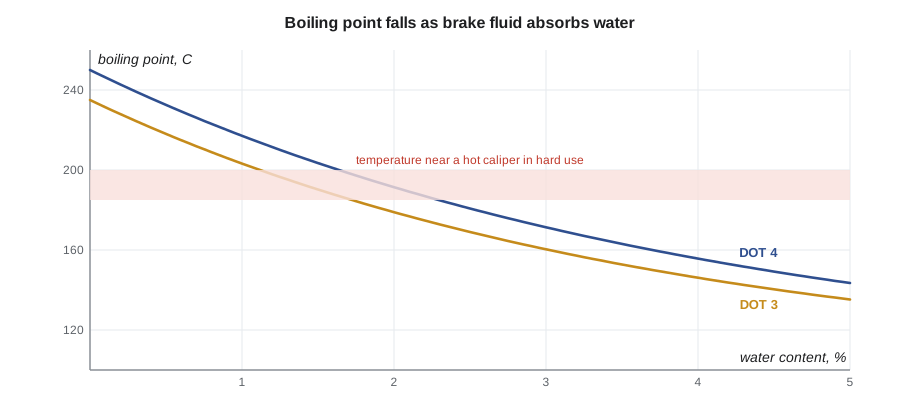
The curve is a fitted estimate, but its shape is right: the first one or two percent of water does the most damage. Van 2's fluid, with a boiling point near that of fluid with about four percent water, would have little or no margin above the temperature its front calipers reach on a hard day.
Water does a second kind of damage. As the corrosion inhibitors in the fluid are used up, the fluid begins to attack the metals in the system. Copper dissolved from the brazed steel lines and from fittings is the first sign; test strips that measure copper content were developed for this reason, and many shops use a limit of about 200 parts per million as a replacement point. Left longer, the fluid corrodes caliper bores and the precise valves inside the anti-lock unit, which is one of the most expensive parts of the brake system to replace.
Testing brake fluid
Colour alone is not a reliable test. New glycol fluid is clear to amber and darkens with age, but a darker fluid is not always worse, and clear fluid can be full of water. Ridgeline uses three tests. Copper test strips measure the depletion of corrosion inhibitors. A boiling point tester heats a small sample and reads its actual boiling point, which is the most direct measure of what matters. Handheld moisture pens that measure the fluid's electrical conductivity are quick but can be fooled by the fluid's chemistry and are used only as a rough check. The manufacturer's service schedule is the final word: many specify a flush every two or three years regardless of test results, and severe-service schedules, like the one Hal's vans follow, often specify one more often.
# Brake fluid service decision for the shop's vehicles (limits are the shop's policy, illustrative)
UNITS = "metric"
def check(name, years, copper_ppm, bp_c, service_years):
    reasons = []
    if copper_ppm >= 200: reasons.append(f"copper {copper_ppm} ppm")
    if bp_c < 190: reasons.append("boiling point " + (f"{bp_c} C" if UNITS == "metric" else f"{round(bp_c * 9 / 5 + 32)} F"))
    if years >= service_years: reasons.append(f"{years} years old, schedule is {service_years}")
    print(f"{name:<22}", "FLUSH: " + ", ".join(reasons) if reasons else "fluid OK")
check("van 2", 3, 250, 182, 2)
check("Gord's pickup (new line)", 1, 50, 228, 3)
check("Ines Moreau's hybrid", 2, 100, 205, 3)
check("Dr. Singh's EV", 4, 150, 196, 3)van 2 FLUSH: copper 250 ppm, boiling point 182 C, 3 years old, schedule is 2 Gord's pickup (new line) fluid OK Ines Moreau's hybrid fluid OK Dr. Singh's EV FLUSH: 4 years old, schedule is 3
Handling brake fluid
Glycol brake fluid is a strong solvent of paint, so it is wiped off immediately with plenty of water if it is spilled on a painted surface, and fender covers are used whenever the reservoir is opened. It irritates eyes and skin, so safety glasses and nitrile gloves are worn, as the safety data sheet requires. Because it absorbs water from the air, it is bought in small containers, kept tightly capped, and never reused once it has been drained from a vehicle or left open on the bench. Old fluid is collected for disposal as hazardous waste, separately from used oil, and never poured down a drain. Nothing but clean brake fluid of the right type may enter the system; even a trace of engine oil, power steering fluid or a petroleum-based solvent can make the rubber seals swell and fail, which means replacing every seal in the system.
Bleeding and flushing
Bleeding removes air from the hydraulic system. Flushing replaces old fluid with new. They use the same methods: fluid is pushed through the system from the master cylinder to each wheel and out of the bleeder screws, until clean fluid with no bubbles comes out. A bleeder screw is a small hollow valve on each caliper or wheel cylinder; when it is loosened a fraction of a turn, fluid can escape through the hole in its centre. A clear hose is fitted over it and led into a catch bottle, with its end below the fluid level, so that air cannot be drawn back in and the bubbles can be seen.
The usual sequence starts at the wheel farthest from the master cylinder and ends at the closest, so that air is pushed toward the exit rather than past wheels that have already been bled. On many vehicles with a front-rear split that means right rear, left rear, right front, left front. Diagonal systems and many anti-lock systems have their own sequences, so the service information is always checked. The reservoir must never be allowed to run low during bleeding; if it does, air enters the master cylinder and the job starts again.
- Manual bleeding takes two people. One pumps the pedal a few times and holds it down; the other opens the bleeder, lets fluid and air out, and closes it before the pedal is released. Repeat until the fluid is clear. It is simple and needs no equipment, but pushing the pedal past its normal travel on an old master cylinder can damage the seals on deposits in the unused part of the bore, so the pedal stroke is limited, for example with a block of wood under it.
- Pressure bleeding uses a tank of fluid connected to the reservoir with an adapter and pressurized to a low pressure, typically about 100 to 140 kPa. The technician then opens each bleeder in turn. One person can do it, the reservoir cannot run dry, and it is the preferred method for a full flush.
- Vacuum bleeding pulls fluid out of each bleeder with a vacuum pump. It is quick, but air can be drawn in around the bleeder's threads, making the bubbles misleading, so the threads are often sealed with grease or tape.
- Gravity bleeding simply leaves the bleeders open and lets fluid run out under its own weight. It is slow but gentle, and is sometimes used after replacing a single caliper.
Anti-lock units contain valves and chambers that the normal method may not reach. If air gets into the unit, for example because the master cylinder was replaced dry or the reservoir ran empty, a scan tool is needed: it commands the pump and valves to cycle while the technician bleeds each wheel in the sequence the procedure gives. Hybrids and vehicles with brake-by-wire, such as Ines Moreau's car, can apply the brakes themselves with a high-pressure pump and accumulator, so their bleeding procedures often require the system to be put into a service mode with a scan tool first; the high-pressure accumulator can push fluid out with great force if a line is opened while the system is active. Lesson 11 returns to these systems.
# Fluid needed for a flush, and the bleeding sequence for van 2 (front-rear split)
UNITS = "metric"
system_ml = 1000                     # approximate total capacity of van 2's brake system
flush_factor = 1.5                   # push through half again the capacity to clear old fluid
need_ml = system_ml * flush_factor
bottle_ml = 355                      # one 12 oz container
bottles = -(-need_ml // bottle_ml)   # round up
print(f"fluid to push through: about {need_ml:.0f} mL" if UNITS == "metric" else f"fluid to push through: about {need_ml / 29.57:.0f} fl oz")
print(f"containers to open: {bottles:.0f} (never reuse fluid from an opened container left uncapped)")
sequence = ["right rear", "left rear", "right front", "left front"]
for n, wheel in enumerate(sequence, 1):
print(f"{n}. {wheel}: bleed until the fluid in the hose is clear and free of bubbles")fluid to push through: about 1500 mL containers to open: 5 (never reuse fluid from an opened container left uncapped) 1. right rear: bleed until the fluid in the hose is clear and free of bubbles 2. left rear: bleed until the fluid in the hose is clear and free of bubbles 3. right front: bleed until the fluid in the hose is clear and free of bubbles 4. left front: bleed until the fluid in the hose is clear and free of bubbles
Kiran flushes van 2 with the pressure bleeder after installing its new pads and rotors, watching the dark old fluid in the clear hose turn to fresh amber at each wheel. She tightens each bleeder to its specified torque, which is small, because bleeder screws snap easily, especially when corroded, and refits the rubber dust caps that keep water and dirt out of them. She checks the pedal with the engine off and on: firm, high, and steady under the hold test from Lesson 3. A retest of the fresh fluid shows a boiling point of 244 °C.
Worked problem
Is van 2's fluid safe for one more month?
Hal asks whether van 2's flush can wait until its next scheduled service in a month. Its fluid boils at 182 °C, and its front calipers can reach about 195 °C on a long downhill with a full load. What do you tell him?
Show solution
- The fluid's boiling point is below the temperature its calipers can reach in hard use, so on a bad day it can boil and the pedal can go to the floor.
- Its copper content shows that the inhibitors are used up, so corrosion of the calipers and anti-lock unit has started.
- The flush takes well under an hour and costs a small fraction of an anti-lock unit.
- Ridgeline recommends doing it now, with the brake job.
Answer: No; the fluid can boil in normal use for this van, and it is corroding the system. It should be flushed now.
Common mistakes
MistakeJudging brake fluid by its colour.
InsteadTest the boiling point or copper content, and follow the schedule.
MistakeMixing DOT 5 silicone fluid with glycol fluids.
InsteadNever mix them; use the grade the manufacturer specifies.
MistakeUsing fluid from a container left open on the bench.
InsteadUse fresh fluid from a sealed container.
MistakeLetting the reservoir run low while bleeding.
InsteadKeep it topped up, or use a pressure bleeder.
MistakeOpening lines on a brake-by-wire system without its service mode.
InsteadFollow the procedure and depressurize the accumulator first.
Summary and key terms
- Brake fluid must flow when cold, resist boiling when hot, protect metals and suit the seals.
- Glycol fluids absorb water, which lowers the boiling point quickly.
- DOT 3, 4 and 5.1 are glycol fluids that may be mixed; DOT 5 is silicone and must not be mixed with them.
- Fluid is tested by boiling point or copper content, not by colour, and replaced on schedule.
- Bleeding removes air and flushing replaces fluid, from the farthest wheel to the closest unless the procedure says otherwise.
- Anti-lock and brake-by-wire systems often need scan tool procedures to bleed.
- Hygroscopic
- Able to absorb water from the air.
- Dry boiling point
- The boiling point of fresh brake fluid with no water.
- Wet boiling point
- The boiling point of brake fluid after it has absorbed about 3.7 percent water.
- DOT 5
- A silicone-based brake fluid that must not be mixed with glycol fluids.
- Bleeder screw
- A small valve on a caliper or wheel cylinder used to let out air and fluid.
- Pressure bleeder
- A tank that pushes fresh fluid into the reservoir at low pressure.
- Copper test strip
- A strip that shows how much copper the fluid has dissolved, indicating inhibitor depletion.
Practice problems
Work each problem on paper first, then reveal the answer to check.
Why does brake fluid absorb water, and why is that a problem?
Show answer
Glycol fluids are hygroscopic; water lowers the boiling point and causes corrosion.
Can DOT 4 be added to a system filled with DOT 3?
Show answer
Yes, they are both glycol fluids; the mixture's boiling point lies between them.
What is the wet boiling point of a DOT 3 fluid at minimum?
Show answer
140 °C.
Why is the bleeding sequence usually farthest wheel first?
Show answer
So that air is pushed toward the exits instead of past wheels already bled.
Lesson quiz · 5 questions
Score 60% or more to complete this lesson.
Create a free account to save your progress, take quizzes and earn a certificate.