
AUTO-130 · Lesson 2 of 12 · 23 min
Brake hydraulics: pressure, force and leverage
Kiran puts van 2 on the lift in bay 5 and pulls the front wheels. The grinding noise was the steel backing plate of the right front inner pad on the rotor; the friction material is gone. Before she orders parts, Marty stops her. “You'll fix this van in Lesson 6 of my course,” he says, grinning. “Today I want you to understand how a driver's foot, pushing with about as much force as it takes to hold a bag of groceries, squeezes those pads hard enough to stop four tonnes.” He hands her a tape measure, a pressure gauge kit with adapters and a calculator.
This lesson explains the hydraulic principles that every brake system relies on: Pascal's law, how pressure and area turn a small force into a large one, the leverage of the brake pedal, how the master cylinder produces pressure, how calipers turn pressure into clamping force and braking torque, and why the trade-off between force and travel shapes every brake system. It also shows how the braking force is shared between the front and rear axles.
Pressure, force and area
Pressure is force spread over an area. If a force of 1,000 newtons pushes on a piston with a face area of 1 square centimetre, the pressure in the fluid in front of it is 1,000 newtons per square centimetre, or 10 megapascals. The same force on a piston twice as large produces half the pressure.
In SI units, pressure is measured in pascals, where one pascal is one newton per square metre. That unit is very small, so brake pressures are given in kilopascals, megapascals or bar; one megapascal is 1,000 kilopascals, or 10 bar, or about 145 psi. In US practice brake pressures are given in pounds per square inch. A typical light-vehicle brake system works at a few hundred kilopascals in a gentle stop and 8 to 12 megapascals in a panic stop.
Liquids are almost incompressible. Push on a liquid in a closed container and it does not shrink; instead the pressure rises equally everywhere in it. This is Pascal's law, named after the French scientist Blaise Pascal: pressure applied to a confined fluid is transmitted undiminished to every part of the fluid and to the walls of its container. It is why a hydraulic brake works. The master cylinder raises the pressure of the brake fluid, and that same pressure appears at every caliper and wheel cylinder connected to it, no matter how long or winding the lines are.
Force multiplication
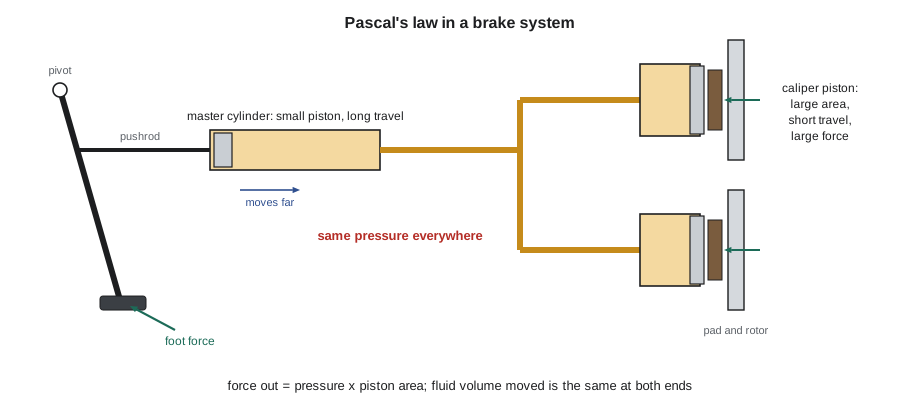
Pascal's law lets a hydraulic system multiply force. The pressure is the same at both ends, but the force at each piston equals the pressure times that piston's area. A small piston at the input and a large piston at the output make a large output force from a small input force. The ratio of the forces equals the ratio of the areas, and since area depends on diameter squared, a caliper piston twice the diameter of the master cylinder piston produces four times the force.
There is a price. The fluid pushed out of the small piston fills the space behind the large one, and the volume is the same at both ends. The large piston therefore moves a much smaller distance: if its area is four times larger, it moves one quarter as far. Work, force times distance, is conserved, apart from small losses. In a brake system this trade-off is useful, because the pads only need to move a fraction of a millimetre to touch the rotor and then squeeze it. But it means that anything that uses up fluid volume, such as air in the lines, hoses that swell, worn pads that let the pistons sit further out, or a drum brake whose shoes are out of adjustment, makes the pedal travel further before the brakes apply.
The pedal lever
Before the fluid does any multiplying, the pedal does. The brake pedal is a lever. The driver pushes on the pedal pad, the pedal swings about its pivot, and the pushrod is attached to the pedal arm a short distance from the pivot. The pedal ratio is the distance from the pivot to the centre of the pedal pad divided by the distance from the pivot to the pushrod attachment. Most cars and light trucks with power brakes have a pedal ratio of about 3 to 1 up to 4 to 1; vehicles without a booster use higher ratios, up to about 6 to 1, to make up for it.
Kiran measures van 2's pedal with the tape measure while Marty holds a flashlight under the dash. The pedal pad is 340 mm from the pivot, and the pushrod clevis pin is 89 mm from it, a ratio of about 3.8 to 1.
# Pedal ratio and pushrod force for van 2
UNITS = "metric"
pad_to_pivot = 340          # mm
rod_to_pivot = 89          # mm
ratio = pad_to_pivot / rod_to_pivot
print(f"pedal ratio = {pad_to_pivot} / {rod_to_pivot} = {ratio:.2f} to 1")
for foot in (100, 250, 500):        # driver's foot force, N
print(f"foot force {foot:4d} N -> pushrod force {foot * ratio:6.0f} N (before the booster adds its share)")pedal ratio = 340 / 89 = 3.82 to 1 foot force 100 N -> pushrod force 382 N (before the booster adds its share) foot force 250 N -> pushrod force 955 N (before the booster adds its share) foot force 500 N -> pushrod force 1910 N (before the booster adds its share)
A normal stop takes a foot force of about 100 to 250 newtons; a panic stop can reach 500 newtons or more for a strong driver. The power booster, described in Lesson 5, then adds several times the driver's own force, so that the pushrod force entering the master cylinder in a hard stop on van 2 is about 3,800 newtons. In this lesson's calculations, that boosted force is used as the input to the hydraulic system.
The master cylinder makes the pressure
The master cylinder is a cylinder full of brake fluid with a piston pushed by the pushrod. When the piston moves forward, it first closes off a small port to the reservoir and then pressurizes the fluid ahead of it. Lesson 3 describes its construction. For now the important number is its bore, the diameter of the piston. The pressure it makes equals the pushrod force divided by the piston's area.
A smaller bore gives more pressure for the same force, but it moves less fluid per millimetre of pedal travel, so the pedal must travel further to move the caliper pistons. A larger bore gives a shorter, firmer pedal but needs more force. The manufacturer chooses the bore to suit the calipers and the booster. Installing a master cylinder with the wrong bore, for example a part for a different engine or option package, changes the pedal feel and the braking force, which is why parts must be matched to the vehicle exactly.
# Line pressure from the pushrod force and the master cylinder bore
import math
UNITS = "metric"
bore_mm = 25.4                                   # master cylinder bore (1.00 in)
area_mm2 = math.pi / 4 * bore_mm ** 2
for push_n in (950, 2000, 3800):                 # pushrod force in newtons, gentle to hard stop
    p_mpa = push_n / area_mm2                    # N/mm2 = MPa
    if UNITS == "metric":
        print(f"pushrod {push_n:5d} N on a {bore_mm} mm bore: {p_mpa:5.2f} MPa = {p_mpa * 1000:6.0f} kPa")
    else:
        print(f"pushrod {push_n * 0.2248:4.0f} lb on a 1.00 in bore: {p_mpa * 145.04:5.0f} psi")
for bore in (22.2, 25.4, 28.6):                  # 7/8, 1 and 1 1/8 in bores
    p = 3800 / (math.pi / 4 * bore ** 2)
print(f"same 3800 N push, bore {bore} mm ({bore / 25.4:.3f} in): {p:5.2f} MPa ({p * 145.04:5.0f} psi)")pushrod 950 N on a 25.4 mm bore: 1.87 MPa = 1875 kPa pushrod 2000 N on a 25.4 mm bore: 3.95 MPa = 3947 kPa pushrod 3800 N on a 25.4 mm bore: 7.50 MPa = 7499 kPa same 3800 N push, bore 22.2 mm (0.874 in): 9.82 MPa ( 1424 psi) same 3800 N push, bore 25.4 mm (1.000 in): 7.50 MPa ( 1088 psi) same 3800 N push, bore 28.6 mm (1.126 in): 5.92 MPa ( 858 psi)
Kiran checks the calculation with real numbers. With a pressure gauge on van 2's right front caliper bleed port, and Marty pressing hard on the pedal with the engine running, the gauge reads about 7.3 megapascals, close to the calculated value. Gauges like this are used to diagnose problems such as a restricted hose, because the pressure at the two calipers on the same axle should match.
From pressure to clamping force
At each wheel, the line pressure acts on the caliper pistons. The clamping force on the rotor equals the pressure times the total area of the pistons on one side of the rotor. Van 2's front calipers are floating calipers with two pistons of 51 mm diameter on the inboard side; Lesson 6 explains why a floating caliper only needs pistons on one side. Their combined area is about 4,090 square millimetres, eight times the master cylinder's area, so the clamping force is about eight times the pushrod force.
The clamping force does not stop the rotor by itself. Friction between the pads and the rotor produces a drag force equal to the clamping force times the pad's coefficient of friction, which is about 0.35 to 0.45 for typical pads, and because there is a pad on each face of the rotor, the drag acts twice. That drag acts at the effective radius of the pads, roughly the distance from the hub's centre to the centre of the pad, and produces a braking torque on the wheel.
Finally, the braking torque at the wheel becomes a braking force at the tire's contact patch: the torque divided by the tire's rolling radius. Bigger rotors, which give a bigger effective radius, produce more torque for the same clamping force, which is one reason heavy vehicles and performance cars use large rotors. Bigger wheels, on the other hand, slightly reduce the braking force for the same torque.
# From line pressure to deceleration for van 2 (loaded, front axle only, then both axles)
import math
UNITS = "metric"
p_mpa = 7.5                        # line pressure in a hard stop
mu_pad = 0.40
front_piston_area = 2 * math.pi / 4 * 51 ** 2      # mm2, two 51 mm pistons per front caliper
rear_piston_area = 1 * math.pi / 4 * 45 ** 2       # mm2, one 45 mm piston per rear caliper
front_r_eff, rear_r_eff = 0.140, 0.125              # m
tire_radius = 0.370                                  # m
mass = 3900                                          # kg
def axle(area, r_eff, p):
    clamp = p * area                                 # newtons
    torque = 2 * mu_pad * clamp * r_eff              # N m per wheel
    force = torque / tire_radius                     # N at the tire, per wheel
    return clamp, torque, 2 * force                  # per-wheel clamp and torque, force for the axle
fc, ft, ff = axle(front_piston_area, front_r_eff, p_mpa)
rc, rt, rf = axle(rear_piston_area, rear_r_eff, p_mpa)
if UNITS == "metric":
    print(f"front: clamp {fc / 1000:5.1f} kN, torque {ft:5.0f} N m per wheel, axle force {ff / 1000:5.1f} kN")
    print(f"rear:  clamp {rc / 1000:5.1f} kN, torque {rt:5.0f} N m per wheel, axle force {rf / 1000:5.1f} kN")
else:
    print(f"front: clamp {fc * 0.2248:5.0f} lb, torque {ft * 0.7376:5.0f} lb ft per wheel, axle force {ff * 0.2248:5.0f} lb")
    print(f"rear:  clamp {rc * 0.2248:5.0f} lb, torque {rt * 0.7376:5.0f} lb ft per wheel, axle force {rf * 0.2248:5.0f} lb")
total = ff + rf
print(f"front share of braking force: {ff / total * 100:.0f} %")
print(f"deceleration if the tires can carry it: {total / mass / 9.81:.2f} g")front: clamp 30.6 kN, torque 3432 N m per wheel, axle force 18.6 kN rear: clamp 11.9 kN, torque 1193 N m per wheel, axle force 6.4 kN front share of braking force: 74 % deceleration if the tires can carry it: 0.65 g
The result, about 0.65 g with the front axle doing about three-quarters of the work, is typical for a loaded van in a hard stop on dry pavement. Note how every factor in the chain matters: the driver's foot, the pedal ratio, the booster, the master cylinder bore, the piston areas, the pad friction, the rotor size and the tire size. A technician who replaces a part with one that changes any of them, for example cheaper pads with a lower coefficient of friction, changes how the vehicle stops.
Front-to-rear balance
Lesson 1 showed that weight moves forward during a stop. A brake system is designed so that, at the deceleration the vehicle usually reaches, the front and rear braking forces are in about the same proportion as the loads on the front and rear tires. Then both axles approach their grip limit together. If the rear brakes are too strong for the load on the rear tires, the rear wheels lock first, and a vehicle whose rear wheels are skidding tends to swing around. If the rear brakes are too weak, the front tires do all the work, the stopping distance is longer and the front brakes wear out faster.
Designers set the basic balance with the sizes of the rear pistons and rotors, as van 2's numbers show. Because the ideal balance changes with load and deceleration, older vehicles added a proportioning valve, which limits rear pressure above a certain level, and pickups and vans often used a load-sensing valve linked to the rear axle, so that the rear brakes worked harder when the truck was loaded. Nearly all modern vehicles do this electronically instead: the anti-lock brake controller watches the wheel speeds and reduces rear pressure as soon as the rears start to slip more than the fronts, a function called electronic brake force distribution. Lesson 3 covers the valves and Lesson 10 the electronic method.
Fluid volume and pedal travel
Pressure and force are only half the story; the other half is volume. When the driver pushes the pedal, the master cylinder must displace enough fluid to move every caliper piston out until the pads touch the rotors, to fill the slight swelling of the hoses and calipers under pressure, and to compress the pads themselves. The system is designed so that this happens well before the pedal reaches the end of its travel, leaving a reserve.
# How much pedal travel van 2 uses up before the pads clamp (illustrative volumes)
import math
UNITS = "metric"
mc_area = math.pi / 4 * 25.4 ** 2           # mm2
pedal_ratio = 3.8
volumes_mm3 = [("take up pad clearance, 4 calipers", 1100),
               ("caliper and hose swelling at high pressure", 1500),
               ("pad compression", 900)]
total = 0
for item, vol in volumes_mm3:
    total += vol
    print(f"{item:<45} {vol:5d} mm3")
stroke = total / mc_area                     # mm of master cylinder travel
print(f"master cylinder stroke {stroke:.1f} mm -> pedal travel {stroke * pedal_ratio:.0f} mm" if UNITS == "metric"
      else f"master cylinder stroke {stroke / 25.4:.2f} in -> pedal travel {stroke * pedal_ratio / 25.4:.1f} in")
air = 1500                                    # mm3 of trapped air compressed to a small fraction under pressure
print(f"a small air bubble adds about {air / mc_area * pedal_ratio:.0f} mm of travel" if UNITS == "metric"
else f"a small air bubble adds about {air / mc_area * pedal_ratio / 25.4:.1f} in of travel")take up pad clearance, 4 calipers 1100 mm3 caliper and hose swelling at high pressure 1500 mm3 pad compression 900 mm3 master cylinder stroke 6.9 mm -> pedal travel 26 mm a small air bubble adds about 11 mm of travel
The numbers are illustrative, but the lesson is real. A little trapped air, a swollen old hose or a caliper whose pistons have been pushed back too far all use up pedal travel, and the driver feels a low or spongy pedal. Van 2's driver said the pedal felt different; Kiran writes that down as something to check after the pads are replaced.
Worked problem
Why does a bigger caliper piston need more pedal travel?
A technician replaces a front caliper with a heavy-duty version whose piston area is 20 percent larger, without changing the master cylinder. What happens to the braking force and the pedal travel?
Show solution
- The line pressure for a given pushrod force does not change, because the master cylinder is the same.
- The clamping force at that wheel rises by 20 percent, because force equals pressure times area.
- That caliper's pistons need 20 percent more fluid to move the same distance, so the pedal travels further before the pads clamp.
- If only one side is changed, that side brakes harder and the vehicle pulls toward it.
Answer: More force at that wheel, more pedal travel, and a pull if the two sides differ; calipers are matched in pairs and to the master cylinder.
Common mistakes
MistakeThinking that longer brake lines lose pressure.
InsteadPascal's law: static pressure is the same everywhere in the fluid.
MistakeTreating a smaller master cylinder as a cheap upgrade.
InsteadIt raises pressure but lengthens pedal travel; use the specified part.
MistakeIgnoring pad friction when choosing parts.
InsteadA lower friction coefficient means less torque for the same pressure.
MistakeReplacing one caliper with a different piston size.
InsteadCalipers on an axle must match, or the vehicle will pull.
MistakeIgnoring fluid volume.
InsteadAir, swollen hoses and retracted pistons all use pedal travel.
Summary and key terms
- Pressure is force divided by area; Pascal's law spreads it equally through the fluid.
- Hydraulic systems multiply force by the ratio of piston areas but reduce travel by the same ratio.
- The pedal is a lever with a ratio of about 3 to 4 to 1 on power brakes.
- Master cylinder pressure is the pushrod force divided by the bore area.
- Clamping force is pressure times piston area; braking torque adds pad friction and effective radius.
- Front and rear brakes are balanced to the loads on each axle during a stop.
- Anything that uses up fluid volume makes the pedal low or spongy.
- Pressure
- Force per unit area, in pascals or pounds per square inch.
- Pascal's law
- Pressure applied to a confined fluid is transmitted equally throughout it.
- Pedal ratio
- The pedal pad lever arm divided by the pushrod lever arm.
- Master cylinder bore
- The diameter of the master cylinder piston.
- Clamping force
- The force pressing the pads against the rotor.
- Effective radius
- The distance from the hub centre at which the pad friction acts.
- Brake balance
- The share of braking force between the front and rear axles.
Practice problems
Work each problem on paper first, then reveal the answer to check.
A pushrod force of 2,000 N acts on a master cylinder piston of 500 mm². What is the line pressure?
Show answer
2,000 / 500 = 4 N/mm², or 4 MPa.
A caliper has two pistons with a total area of 4,000 mm². At 5 MPa, what is the clamping force?
Show answer
5 × 4,000 = 20,000 N, or 20 kN.
Why does the caliper piston move much less than the master cylinder piston?
Show answer
The same fluid volume spreads over a much larger area.
What happens if the rear brakes are too strong for the load on the rear tires?
Show answer
The rear wheels lock first and the vehicle can spin.
Lesson quiz · 5 questions
Score 60% or more to complete this lesson.
Create a free account to save your progress, take quizzes and earn a certificate.