
AUTO-130 · Lesson 7 of 12 · 21 min
Rotor measurement and machining
Ines Moreau drives for a rideshare company, and her 2019 hybrid covers a lot of distance in city traffic. She comes in on a Tuesday because the brake pedal has started to pulse under her foot when she slows from highway speed, and the steering wheel shakes a little in the same stops. Three months ago she had winter tires fitted at another shop. Simone books her in with Kiran, and Marty sets a dial indicator, a magnetic base and a rotor micrometer on the cart. “Everyone calls this warped rotors,” he says. “They're almost never warped. Today you find out what they actually are.”
Pulsation, noise and pulls often come from the rotors, and rotors are measured, not judged by eye. This lesson explains the measurements that matter: thickness and the minimum thickness, thickness variation, lateral runout and hub runout. It explains how runout turns into thickness variation over thousands of kilometres, how rotors are machined on a bench lathe or an on-car lathe, when they should be replaced instead, and how to deal with rust on rotors that are used very little, as on Dr. Amara Singh's electric car.
Rotor thickness and the minimum
Every stop wears a little metal off the rotor faces, and machining removes more. A rotor that becomes too thin holds less heat, so it runs hotter, fades sooner and can crack; it also lets the caliper pistons stand further out of their bores. Manufacturers therefore set a minimum thickness, which is usually cast or stamped on the rotor's hat or edge, often marked MIN TH or as a number followed by MIN. That figure is the discard thickness: a rotor at or below it is scrapped.
Many service manuals also give a machine-to thickness, slightly larger than the discard figure. A rotor that would end up thinner than the machine-to figure after machining is replaced rather than machined, because it would reach the discard thickness too soon in service. Thickness is measured with an outside micrometer, preferably one with pointed or narrow anvils that can reach past the rust ridge at the outer edge, at several points around the rotor and about 10 mm in from the outer edge, where the pads sweep.
Thickness variation
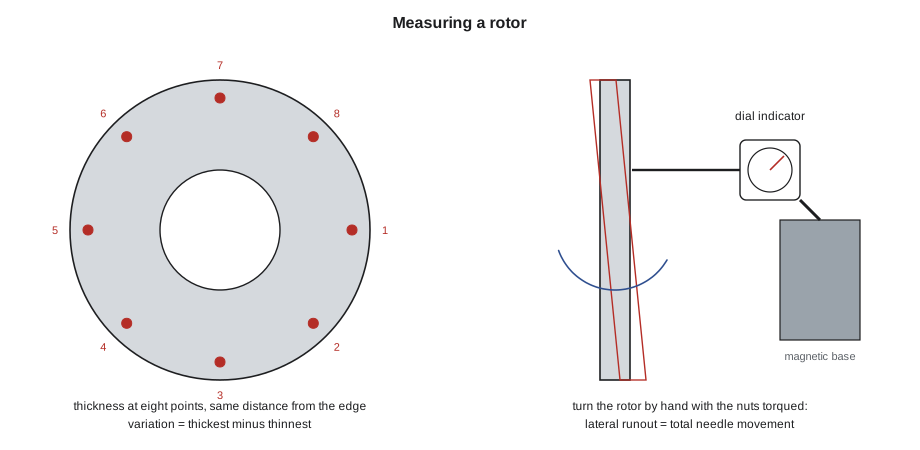
If the rotor is thicker in some places than in others, the pads are pushed apart slightly as the thick spots pass between them and allowed together at the thin spots. Under braking, that changes the clamping force with every revolution, which the driver feels as a pulsation in the pedal and, on the front, often as a shake in the steering wheel. This is thickness variation, also called parallelism or disc thickness variation. It takes very little to be felt: most manufacturers allow only about 0.010 to 0.015 mm, about a tenth the thickness of a human hair. To find it, the technician measures the thickness at eight or more points evenly spaced around the rotor, at the same distance from the edge, and subtracts the smallest reading from the largest.
# Ines Moreau's front rotors: thickness at eight points near the outer edge
UNITS = "metric"
discard = 21.4          # mm (cast on the rotor)
machine_to = 21.6         # mm
max_variation = 0.012      # mm
rotors = {"left front":  [21.892, 21.884, 21.871, 21.866, 21.870, 21.881, 21.893, 21.897],
          "right front": [21.905, 21.902, 21.899, 21.896, 21.897, 21.901, 21.904, 21.906]}
for name, r in rotors.items():
    thin, thick = min(r), max(r)
    variation = thick - thin
    print(f"{name}: thinnest {thin:.3f} mm, variation {variation:.3f} mm", end=" -> ")
    if thin <= discard:
        print("at or below discard: replace")
    elif variation > max_variation:
        cut_needed = variation + 0.30          # remove the variation plus a clean-up allowance for the light scoring
        print("variation too high;", "machine" if thin - cut_needed >= machine_to else "replace (would end below machine-to)")
    else:
print("within limits")left front: thinnest 21.866 mm, variation 0.031 mm -> variation too high; replace (would end below machine-to) right front: thinnest 21.896 mm, variation 0.010 mm -> within limits
The left front rotor has about two and a half times the allowed variation; the right one is just within the limit. That explains the pulsation, and with the light scoring both rotors also carry, cleaning up the left one would take it below the machine-to thickness. But Marty wants to know why it happened, because a machined or new rotor will develop the same fault again unless the cause is found.
Lateral runout
Lateral runout is the side-to-side wobble of the rotor face as it turns. It is measured with a dial indicator on a magnetic base clamped to a solid part of the suspension, with its plunger touching the rotor face about 10 mm in from the outer edge. Before measuring, the rotor must be held tightly against the hub, either by the wheel or by fitting all the wheel nuts, with conical washers if needed, tightened to specification. The rotor is turned slowly by hand through a full revolution, and the total movement of the needle, from its lowest to its highest reading, is the runout. Typical limits are about 0.05 mm or less, and some manufacturers allow even less.
A rotor with runout does not cause a pulsation at first, because the floating caliper simply follows the wobble. The trouble comes over the next several thousand kilometres. With the brakes released, the pads sit very close to the rotor, and on each revolution the high spot of the wobble brushes lightly against one pad and then the other. Those light contacts wear the rotor very slightly more at those spots, and over time the runout turns into thickness variation, which the driver then feels. Uneven deposits of pad material can do the same thing. That is why the problem usually appears some time after a brake job or a tire change, and why fixing the runout is the real repair.
Runout comes from several sources. Rust or dirt between the rotor hat and the hub face tilts the rotor slightly, and so does a small burr or a piece of old rotor coating. The hub itself can have runout, from a damaged flange or a worn wheel bearing. And uneven wheel nut torque, especially nuts run on hard with an impact wrench in no particular order, can distort the rotor hat as it is clamped. Kiran checks each source.
# Ines Moreau's left front: runout readings to find the cause
UNITS = "metric"
limit = 0.050                                   # mm lateral runout limit
readings = [("rotor runout as found, wheel nuts torqued", 0.112),
            ("hub flange runout, rotor removed", 0.012),
            ("rotor runout after cleaning hub and hat, nuts torqued in a star pattern", 0.031)]
for what, r in readings:
    print(f"{what:<72} {r:.3f} mm", "OK" if r <= limit else "too high")
print("cause: rust on the hub face plus uneven nut torque; the hub itself is good")
print("tire shop's nut torque found when the wheel came off (left front, five nuts):", [155, 210, 120, 240, 185], "N m (spec 103)")rotor runout as found, wheel nuts torqued 0.112 mm too high hub flange runout, rotor removed 0.012 mm OK rotor runout after cleaning hub and hat, nuts torqued in a star pattern 0.031 mm OK cause: rust on the hub face plus uneven nut torque; the hub itself is good tire shop's nut torque found when the wheel came off (left front, five nuts): [155, 210, 120, 240, 185] N m (spec 103)
The breakaway torques on the wheel nuts, which Kiran measured with a torque wrench as she loosened them, were wildly uneven and well above the specification. With the hub face cleaned to bare metal and the nuts tightened correctly, the runout falls well within the limit; the hub is good. So the repair is to correct the thickness variation, by machining or replacing the rotors, and to mount everything cleanly and torque it properly. If the hub runout had been high, the choices would have been correction plates, thin tapered shims placed between hub and rotor to cancel the runout, or replacing the hub.
Machining rotors
A rotor with thickness variation, grooves or light scoring that will remain above the machine-to thickness can be machined, or resurfaced, on a brake lathe. Machining cuts a thin layer from both faces at once with two cutting bits, leaving the faces flat and parallel.
- A bench lathe holds the rotor on an arbor with adapters, cones and spacers. It is fast and accurate if the rotor is mounted carefully and the adapters are clean. A silencer band is wrapped around the rotor's edge to damp vibration, which would otherwise leave a rough finish. The weakness of a bench lathe is that it machines the rotor true to the lathe, not to the vehicle's hub; any runout of the hub remains.
- An on-car lathe bolts to the caliper bracket or the hub and machines the rotor on the vehicle, turned by its own motor. It first measures and compensates for the runout of the whole assembly, so the finished rotor runs true on that hub. It is the preferred method when runout is the problem and on hub-and-rotor assemblies that are hard to remove.
After machining, the faces should have a smooth, non-directional finish, achieved by a final light cut and a few seconds with a sanding pad or a scratch-pattern tool on each face, followed by cleaning with soap and water to remove metal particles. The rotor's new thickness is measured and recorded on the repair order to show that it is above the machine-to figure.
Whether to machine or replace is partly technical and partly economic. Many modern rotors are made thinner and lighter than older ones, leaving little material to cut; many cost less than the labour to machine them; and a new rotor has a fresh coating against rust. Many shops, Ridgeline included, now replace most car rotors and machine mainly heavy truck rotors, hub-and-rotor assemblies and rotors with a correctable fault on otherwise new parts. For Ines Moreau's car, both front rotors would end up just below the machine-to thickness once their variation and scoring were cleaned up, so Kiran prices new rotors and pads, with the hub faces cleaned and the nuts torqued to specification.
# Machine or replace? (the shop's labour time and prices are illustrative)
UNITS = "metric"
labour_rate = 165                 # per hour
machine_hours_per_rotor = 0.4
rotor_price = 96                # each, new coated rotor
thin_after_cut = {"left front": 21.57, "right front": 21.59}
machine_to = 21.6
for name, t in thin_after_cut.items():
    if t < machine_to:
        print(f"{name}: would end at {t} mm, below machine-to {machine_to}: replace")
    else:
        print(f"{name}: would end at {t} mm: machining possible")
cost_machine = 2 * machine_hours_per_rotor * labour_rate
cost_replace = 2 * rotor_price
print(f"machining both: {cost_machine:.0f} CAD labour; new pair: {cost_replace:.0f} CAD parts")left front: would end at 21.57 mm, below machine-to 21.6: replace right front: would end at 21.59 mm, below machine-to 21.6: replace machining both: 132 CAD labour; new pair: 192 CAD parts
Rusty rotors on vehicles that rarely use their brakes
Dr. Amara Singh's electric car does almost all its everyday braking by regeneration, with the drive motor slowing the car and charging the battery. Lesson 11 explains how. Its friction brakes, especially the rears, are used only in hard stops and at very low speed, so their rotor faces are not wiped clean by the pads often enough. After a winter of Calgary road salt, the rear rotors have a band of heavy rust on their faces, with only a narrow shiny strip where the pads touch, and a grinding sound when the car first moves in the morning. The pads have plenty of material left.
Light surface rust that forms overnight on any rotor is normal and wipes off in the first few stops. Heavy rust that the pads no longer clean off reduces braking, makes noise, and eventually pits the rotor faces so deeply that the pads cannot bed in. For Dr. Singh's car, Kiran measures the rear rotors: thickness is good and runout is fine, but the faces are pitted. The fix is new rear rotors and pads, with the caliper slides serviced, because sliding parts that rarely move also seize. To prevent a repeat, Marty suggests a few firm stops each week from moderate speed, done safely with no traffic behind, which some electric cars help with: their manufacturers offer a setting or service function that uses the friction brakes more often to keep them clean. Kiran also checks the car's service schedule, which calls for brake inspection and slide lubrication at fixed intervals because of exactly this problem.
Worked problem
Why did Ines's brakes pulse three months after new tires?
Explain the cause and the repair in terms she will understand.
Show solution
- When the winter tires were fitted, the wheel nuts were run on unevenly and much too tight, and rust on the hub face tilted the left front rotor slightly.
- That small wobble made the pads brush one spot of the rotor on every turn, and over three months of driving the rotor wore unevenly, becoming thicker in some places than in others.
- The uneven thickness makes the pads push the pedal back and forth with every turn of the wheel in a stop.
- The repair is new front rotors and pads, hub faces cleaned to bare metal, and the wheel nuts tightened in a star pattern to specification with a torque wrench, which removes the cause as well as the symptom.
- Ridgeline will recheck the torque on her nuts when she returns for her summer tire change.
Answer: Uneven nut torque and rust on the hub caused runout, which wore into thickness variation; new rotors and correct mounting fix both.
Common mistakes
MistakeCalling every pulsation warped rotors and replacing parts.
InsteadMeasure thickness variation and runout, then find the cause.
MistakeMeasuring runout with the rotor loose on the hub.
InsteadClamp it with the wheel nuts torqued to specification first.
MistakeMachining a rotor below its machine-to thickness.
InsteadReplace it; it would reach discard too soon.
MistakeMounting a rotor on a rusty hub face.
InsteadClean the hub face to bare metal.
MistakeLeaving metal particles on a machined rotor.
InsteadWash it with soap and water after the final finish.
Summary and key terms
- Rotor thickness is measured with a micrometer; the discard figure is on the rotor, the machine-to figure in the service information.
- Thickness variation of only about a hundredth of a millimetre causes pedal pulsation.
- Lateral runout is measured with a dial indicator; it slowly wears into thickness variation.
- Runout comes from rust on the hub, damaged hubs and uneven wheel nut torque.
- Bench lathes machine to the lathe; on-car lathes machine to the vehicle's hub.
- Rarely used rotors, as on electric cars, can rust and pit and need regular use or service.
- Discard thickness
- The minimum thickness at which a rotor must be scrapped.
- Machine-to thickness
- The minimum thickness a rotor may have after machining.
- Thickness variation
- The difference between the thickest and thinnest points around a rotor.
- Lateral runout
- The side-to-side wobble of a rotor face as it turns.
- Dial indicator
- A gauge that measures small movements with a plunger and a dial.
- On-car lathe
- A lathe that machines the rotor on the vehicle, compensating for hub runout.
- Correction plate
- A thin tapered shim that cancels hub runout.
Practice problems
Work each problem on paper first, then reveal the answer to check.
A rotor's readings range from 21.866 to 21.897 mm. What is its thickness variation?
Show answer
0.031 mm.
Why does runout often not cause pulsation until thousands of kilometres later?
Show answer
It slowly wears the rotor unevenly, which creates thickness variation.
Where is the discard thickness usually found?
Show answer
Cast or stamped on the rotor's hat or edge.
When is an on-car lathe preferred?
Show answer
When the problem is runout, or the rotor is hard to remove, because it machines the rotor true to the hub.
Lesson quiz · 5 questions
Score 60% or more to complete this lesson.
Create a free account to save your progress, take quizzes and earn a certificate.