
AUTO-130 · Lesson 5 of 12 · 22 min
Power brake boosters: vacuum, hydraulic and electric
The Lindqvists' minivan arrives with a complaint that Simone writes on the repair order word for word: “Brake pedal very hard first thing in the morning, then OK. Hissing under dash sometimes.” Erik Lindqvist adds that his teenage son, who has just started driving, says the van “barely stops” on cold mornings. Marty hands the job to Kiran. “Hard pedal, normal stops once it's warm, a hiss. You've got everything you need in that sentence. Learn how the booster works and you'll find it in twenty minutes.”
This lesson explains why most vehicles need a power brake booster, how a vacuum booster turns the difference between atmospheric pressure and engine vacuum into force, why boosters give less help at altitude, how to test one, and the other kinds of boosters: vacuum pumps on engines that make little vacuum, hydraulic boosters on heavy trucks, and the electric boosters used on hybrids and electric vehicles.
Why boosters are needed
Lesson 2 showed that stopping a loaded van hard needs a pushrod force of about 3,800 newtons. With a pedal ratio of 3.8, that would take a foot force of 1,000 newtons without help, which very few drivers could produce, and nobody could produce comfortably a hundred times a day. Manual brakes could use a higher pedal ratio and smaller master cylinder, but then the pedal would travel too far. A power booster solves the problem by adding force to the driver's push, typically three to six times as much as the driver supplies, so that normal stops need only a light foot. Every modern car and light truck has one.
How a vacuum booster works
The vacuum booster is the round black canister between the firewall and the master cylinder. Inside, a large flexible diaphragm with a backing plate divides it into two chambers. The front chamber, toward the master cylinder, is always connected to a source of vacuum, usually the engine's intake manifold, through a hose and a one-way check valve. The rear chamber, toward the driver, is connected through a control valve either to the front chamber or to the outside air, filtered through a small element around the pushrod.
At rest, the control valve connects the two chambers, so both are at vacuum and the diaphragm has the same pressure on both sides. When the driver presses the pedal, the pushrod first closes the passage between the chambers and then opens the rear chamber to the air. Atmospheric pressure flows in behind the diaphragm, while the front still has vacuum, and the pressure difference pushes the diaphragm forward with a large force, which acts on the master cylinder pushrod together with the driver's own push. When the driver holds the pedal steady, the valve closes both passages and holds the force; when the driver releases it, the valve reconnects the chambers and the diaphragm returns. A rubber reaction disc between the valve and the output rod feeds part of the output force back to the pedal, so the driver feels the braking force grow in proportion to the push.
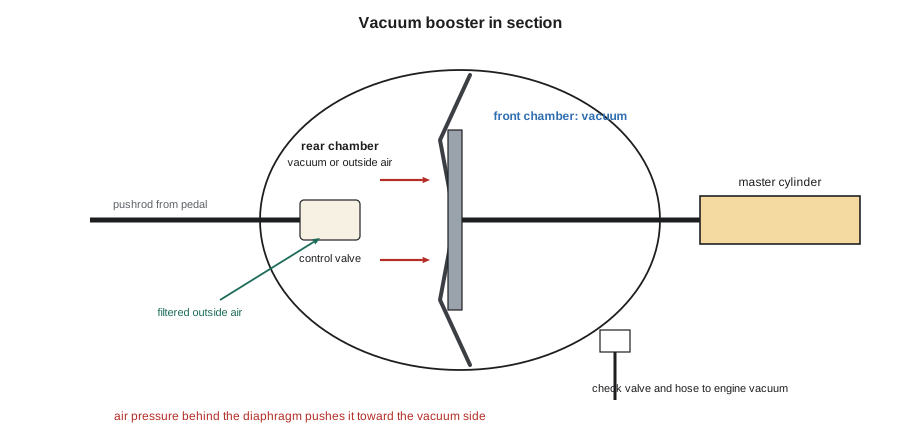
The force a booster can add is the pressure difference across the diaphragm multiplied by its area. To get more force without a larger canister, many trucks and vans, including Hal's, use a tandem booster with two diaphragms one behind the other in the same housing. When the rear chamber is fully open to the air, the booster cannot add any more force, a point called the runout point; beyond it, any further braking force comes from the driver's foot alone, and the pedal suddenly feels much harder. A booster that runs out early, because its vacuum supply is weak, gives exactly the feel the Lindqvists described.
Vacuum and altitude
Engine vacuum is not an absolute value; it is the difference between the outside air pressure and the pressure in the intake manifold. At idle, a healthy gasoline engine's manifold pressure is low, so the difference is large. At Calgary's altitude, the outside air pressure is lower, about 89 kilopascals instead of 101 at sea level, and so the vacuum available to the booster is smaller too. Manufacturers size boosters with a margin for altitude, but a booster with a small leak or a weak vacuum supply, which might go unnoticed at sea level, can run out early at altitude.
In this formula, P sub atm is the outside air pressure, P sub vac is the absolute pressure in the booster's vacuum chamber, and A is the effective diaphragm area. The force is the most the booster can add, at its runout point.
# Maximum assist from van 2's tandem booster at sea level and at the shop's altitude
import math
UNITS = "metric"
d1, d2 = 0.203, 0.229                   # m, diaphragm diameters (8 in and 9 in)
area = math.pi / 4 * (d1 ** 2 + d2 ** 2) * 0.90      # m2, effective area (90 % of the full circles)
manifold_abs = 30.0                     # kPa absolute at idle, about the same for this engine at both places
for place, p_atm in [("sea level", 101.3), ("Calgary", 89.4)]:
    dp = p_atm - manifold_abs           # kPa
    force = dp * 1000 * area            # N
    if UNITS == "metric":
        print(f"{place:<10} air {p_atm:5.1f} kPa, vacuum {dp:4.1f} kPa -> max assist {force / 1000:4.1f} kN")
    else:
        print(f"{place:<10} air {p_atm * 0.2953:4.1f} inHg, vacuum {dp * 0.2953:4.1f} inHg -> max assist {force * 0.2248:4.0f} lb")
loss = (1 - (89.4 - manifold_abs) / (101.3 - manifold_abs)) * 100
print(f"assist available at the shop is about {loss:.0f} % lower than at sea level")sea level air 101.3 kPa, vacuum 71.3 kPa -> max assist 4.7 kN Calgary air 89.4 kPa, vacuum 59.4 kPa -> max assist 3.9 kN assist available at the shop is about 17 % lower than at sea level
Many modern engines make less manifold vacuum than older ones, because direct injection, variable valve timing and turbocharging let them run with the throttle wide open much of the time. A turbocharged engine under boost has no manifold vacuum at all; the check valve keeps the booster's stored vacuum from being lost when that happens. To keep the booster supplied, many of these engines, and all diesels, which have no throttle to make vacuum, have a separate vacuum pump driven by the camshaft or by an electric motor. Some vehicles use an electric vacuum pump that switches on only when a pressure sensor on the booster shows that vacuum has fallen below a set level, and sets a code if it cannot keep up.
Testing a vacuum booster
Booster tests are simple and quick, and Kiran does them in order before taking anything apart.
- Reserve test. With the engine off, pump the pedal five or six times to use up any stored vacuum; the pedal will become high and hard. Hold firm pressure on the pedal and start the engine. If the booster and its vacuum supply are working, the pedal drops slightly under the foot as vacuum builds and the booster begins to help.
- Vacuum hold test. Run the engine for a minute, then shut it off and wait about ninety seconds. Apply the pedal several times. A good booster and check valve hold enough vacuum for at least two or three assisted applications, each a little harder than the last. If the first application is already hard, vacuum is leaking away, through the check valve, the hose, or the booster itself.
- Leak test with the pedal held. With the engine idling, hold the pedal down steadily. There should be no hiss and no change in idle speed. A hiss from inside the car with the pedal held, often with the idle dipping, points to a leaking diaphragm or control valve, which means replacing the booster.
- Vacuum supply test. A vacuum gauge teed into the booster hose should show steady, normal engine vacuum at idle, allowing for altitude as AUTO-120 explained. Low vacuum points to the engine or the hose; normal vacuum with poor assist points to the booster.
# The Lindqvists' minivan: booster test results
UNITS = "metric"
reserve_test_pedal_dropped = True
hold_test_assisted_applications = 0          # after 90 s with the engine off
hiss_with_pedal_held = False
vacuum_at_idle = 54                       # kPa, measured at the booster hose with a tee
normal_at_idle = 59                      # kPa, typical for this engine at the shop's altitude
print("reserve test:", "booster assists once vacuum builds" if reserve_test_pedal_dropped else "no assist: check the supply")
print("hold test:", f"{hold_test_assisted_applications} assisted applications" + (" -> vacuum is leaking away with the engine off" if hold_test_assisted_applications < 2 else ""))
print("pedal-held leak test:", "hiss: booster diaphragm or valve" if hiss_with_pedal_held else "no hiss, idle steady")
print(f"vacuum at idle {vacuum_at_idle} kPa vs about {normal_at_idle} kPa normal ->", "supply OK while running" if vacuum_at_idle >= 0.85 * normal_at_idle else "low supply")reserve test: booster assists once vacuum builds hold test: 0 assisted applications -> vacuum is leaking away with the engine off pedal-held leak test: no hiss, idle steady vacuum at idle 54 kPa vs about 59 kPa normal -> supply OK while running
The results point clearly to the check valve or the hose. The booster works when the engine runs, and does not leak with the pedal held, but it loses all its vacuum overnight, so the first stops of the morning are made with no assist until the engine has run for a while. Kiran removes the check valve from the booster's grommet and blows through it from the booster side, which should be blocked: air passes freely. The plastic elbow of the vacuum hose next to it has a crack that opens when it is cold and closes when the engine bay warms up, which explains the occasional hiss under the hood, heard inside the van. A new check valve, grommet and hose fix the complaint, and the vacuum hold test now gives three assisted applications.
Hydraulic boosters
Heavy pickups and vans with diesel engines, and some other vehicles, use a hydraulic booster, often called by the trade name Hydro-Boost, instead of a vacuum booster. It uses pressure from the power steering pump. A spool valve in the booster, moved by the pedal pushrod, directs pump pressure behind a power piston that pushes the master cylinder pushrod. Because hydraulic pressure is much higher than the pressure difference across a vacuum diaphragm, a hydraulic booster is compact and gives strong assist regardless of altitude. A nitrogen-charged accumulator stores enough pressure for two or three assisted stops if the engine stalls or the steering pump belt breaks.
Problems with hydraulic boosters show up as a hard pedal, a grabbing pedal, or a pedal that returns slowly, and often go with steering complaints, because both share the same pump and fluid. Testing starts with the power steering fluid level and condition and the pump belt, then pressure and flow tests on the pump. The accumulator is tested by running the engine, shutting it off and counting the assisted applications; a booster that has lost its accumulator charge gives only a hard pedal once the engine stops. Accumulators can hold high pressure even with the engine off, so they are depressurized by pumping the pedal before any lines are opened.
Electric boosters and integrated brake systems
Hybrids and electric vehicles cannot rely on engine vacuum, because their engines are often off or absent. They also need to blend regenerative braking, in which the electric motor slows the car, with the friction brakes, so that the driver feels the same pedal whatever mix is used. Lesson 11 covers blending. These vehicles use one of two arrangements. An electric booster replaces the vacuum booster with an electric motor that drives the master cylinder's pushrod through a gear or ball screw, controlled by a module that reads a pedal travel sensor. An integrated brake system goes further: the pedal pushes a small master cylinder connected to a pedal feel simulator, and an electric motor or pump with an accumulator produces the actual brake pressure on command. In normal operation, nothing but wires connects the driver's foot to the wheels' pressure; if the system fails, valves connect the pedal's master cylinder directly to the brakes so that the driver can still stop, with a harder pedal.
Both Dr. Singh's electric car and Ines Moreau's hybrid have such systems. Their advantages go beyond energy recovery: the motor can build full braking pressure in a fraction of a second, which helps automatic emergency braking and stability control, and the module can use the brakes to hold the car on a hill. Their service is more involved. The module performs self-tests whenever a door opens or the driver's seat is occupied, and on some designs it can apply pressure at that moment, so the service information often requires the system to be put into a maintenance mode, sometimes simply by disconnecting a fuse and sometimes with a scan tool, before any work on the brakes. Marty is strict about this: “If you have your fingers in a caliper when the car decides to test its brakes, you will lose them.”
# Assist ratio: how much the booster multiplies the driver's effort (van 2, normal stop)
UNITS = "metric"
pedal_ratio = 3.8
for foot_n, boost_ratio in [(150, 1.0), (150, 4.5), (250, 4.5)]:
    pushrod = foot_n * pedal_ratio * boost_ratio
    label = "no assist (engine off, vacuum used up)" if boost_ratio == 1 else f"booster ratio {boost_ratio}"
    if UNITS == "metric":
        print(f"foot {foot_n} N, {label:<40} -> pushrod {pushrod:5.0f} N")
    else:
        print(f"foot {foot_n * 0.2248:3.0f} lb, {label:<40} -> pushrod {pushrod * 0.2248:4.0f} lb")
print("without assist, the same foot force gives under a quarter of the pushrod force")foot 150 N, no assist (engine off, vacuum used up) -> pushrod 570 N foot 150 N, booster ratio 4.5 -> pushrod 2565 N foot 250 N, booster ratio 4.5 -> pushrod 4275 N without assist, the same foot force gives under a quarter of the pushrod force
The calculation shows what the Lindqvists' son was feeling. With no assist, his normal foot force gave less than a quarter of the usual pushrod force, so the van seemed barely to stop until he pushed much harder. Brakes that need a strong push on a cold morning are a hazard, especially for a new driver who has not yet learned how the vehicle should feel, and Kiran writes the explanation on the repair order so Simone can pass it on.
Worked problem
Hard pedal: booster or supply?
A car has a hard pedal at all times, engine running. The reserve test shows no drop when the engine starts. A vacuum gauge on the booster hose reads zero. What next?
Show solution
- The booster is getting no vacuum, so the problem is upstream of it.
- Check the hose for collapse, cracks or a disconnected end, and the check valve for a blockage.
- If the engine uses a vacuum pump, check the pump and, on an electric pump, its fuse, relay, sensor and codes.
- Only once the supply is restored is the booster itself tested.
Answer: Test the supply first: hose, check valve and vacuum source; the booster cannot help without vacuum.
Common mistakes
MistakeReplacing a booster for a hard morning pedal without testing.
InsteadDo the hold test; a leaking check valve or hose is a common cause.
MistakeForgetting altitude when judging vacuum.
InsteadCompare readings with normal values for the shop's elevation.
MistakeOpening a hydraulic booster line with the accumulator charged.
InsteadPump the pedal to discharge it first.
MistakeWorking on an integrated brake system without its maintenance mode.
InsteadDisable automatic self-tests as the procedure requires.
MistakeIgnoring the pushrod length after replacing a booster.
InsteadCheck the clearance so the master cylinder ports are not blocked.
Summary and key terms
- A booster adds several times the driver's force so that normal stops need a light push.
- A vacuum booster uses the pressure difference between outside air and engine vacuum across a diaphragm.
- At altitude the outside pressure, and so the available assist, is lower.
- Reserve, hold and pedal-held leak tests separate supply faults from booster faults.
- Engines with little vacuum use vacuum pumps; heavy trucks often use hydraulic boosters.
- Hybrids and electric vehicles use electric boosters or integrated systems that need service modes before work.
- Vacuum booster
- A diaphragm unit that uses engine vacuum and outside air to add force to the pushrod.
- Check valve
- A one-way valve that holds vacuum in the booster when engine vacuum drops.
- Runout point
- The point beyond which the booster can add no more force.
- Tandem booster
- A vacuum booster with two diaphragms in one housing.
- Hydraulic booster
- A booster powered by pressure from the power steering pump.
- Accumulator
- A pressurized reservoir that stores energy for assisted stops when the pump stops.
- Integrated brake system
- An electric system that makes brake pressure on command, with a pedal feel simulator.
Practice problems
Work each problem on paper first, then reveal the answer to check.
Why does a vacuum booster give less assist in Calgary than at sea level?
Show answer
The outside air pressure is lower, so the pressure difference across the diaphragm is smaller.
What does a hiss from under the dash with the pedal held suggest?
Show answer
A leaking booster diaphragm or control valve.
What does a booster check valve do?
Show answer
It lets air flow out of the booster to the vacuum source but not back, holding vacuum.
Why do diesels need vacuum pumps or hydraulic boosters?
Show answer
They have no throttle and make little manifold vacuum.
Lesson quiz · 5 questions
Score 60% or more to complete this lesson.
Create a free account to save your progress, take quizzes and earn a certificate.