
AUTO-130 · Lesson 1 of 12 · 25 min
How brakes stop a vehicle
It is late October and the first snow of the season has already come and gone twice. Kiran Dhaliwal is six months into her apprenticeship at Ridgeline Auto Service, and Marty Kowalchuk has promised her that this is the month she starts on brakes. On Monday morning Hal Osei, the fleet manager for Prairie Parcel, calls Simone Tremblay at the service desk. Van 2 of his three delivery vans has started making a grinding noise when it stops, and its driver says the pedal feels different. It is the second set of front brakes on that van in eleven months.
“Courier vans eat brakes,” Marty says when Simone puts the repair order on the board. “They weigh almost four tonnes loaded, they stop a hundred times a day, and the drivers are always in a hurry. Before you touch one, you need to understand what a brake actually does.” He sends Kiran to the whiteboard in the training room and draws a van, a hill and a stop sign.
This lesson explains the physics of stopping: what a brake does with the vehicle's energy, why heavier and faster vehicles are so much harder to stop, how the tires limit every stop, how weight shifts to the front wheels during braking, and how stopping distance is made up of reaction distance and braking distance. It ends with an overview of the brake system's parts and of the standards every new vehicle's brakes must meet. The rest of the course takes each part in turn.
A brake is a heat machine
A moving vehicle has kinetic energy, the energy of motion. To stop it, that energy has to go somewhere. In almost every car and truck on the road, the service brakes turn it into heat: brake pads or shoes are pressed against a rotor or drum that turns with the wheel, and friction between them converts the motion into heat in the rotor, the drum and the pads. The heat then passes to the air flowing around the brakes. Hybrids and electric vehicles also recover part of the energy as electricity, which Lesson 11 covers, but they still carry friction brakes for hard stops and emergencies.
Kinetic energy depends on mass and on the square of speed. Doubling the mass doubles the energy; doubling the speed multiplies it by four. That square is the single most important fact about brakes. A van stopping from 100 km/h must get rid of almost twice as much energy as the same van stopping from 70 km/h, even though the speed is only about 40 percent higher.
In this formula, E is the kinetic energy in joules, m is the mass in kilograms, and v is the speed in metres per second. To convert kilometres per hour to metres per second, divide by 3.6. In US units the same relation can be used with mass in slugs and speed in feet per second to give foot-pounds, but it is easier to convert to metric, calculate, and convert the answer back, which is what the code in this lesson does.
# Kinetic energy of the shop's vehicles at highway and city speeds
UNITS = "metric"                       # "metric" or "US"
vehicles = [("courier van, loaded", 3900), ("courier van, empty", 2700), ("Gord's pickup", 2220), ("Dr. Singh's EV", 1690)]   # mass in kg
speeds_kmh = [50, 100] if UNITS == "metric" else [48.3, 96.6]                                                            # 30 and 60 mph
for name, m in vehicles:
    for v_kmh in speeds_kmh:
        v = v_kmh / 3.6                       # m/s
        e = 0.5 * m * v ** 2                  # joules
        if UNITS == "metric":
            print(f"{name:<22} at {v_kmh:5.0f} km/h: {e / 1000:6.0f} kJ")
        else:
print(f"{name:<22} at {v_kmh / 1.609:5.0f} mph: {e * 0.7376 / 1000:6.0f} thousand ft lb ({e / 1055:5.0f} BTU)")courier van, loaded at 50 km/h: 376 kJ courier van, loaded at 100 km/h: 1505 kJ courier van, empty at 50 km/h: 260 kJ courier van, empty at 100 km/h: 1042 kJ Gord's pickup at 50 km/h: 214 kJ Gord's pickup at 100 km/h: 856 kJ Dr. Singh's EV at 50 km/h: 163 kJ Dr. Singh's EV at 100 km/h: 652 kJ
The loaded van at highway speed carries about four times as much energy as it does at city speed, and almost twice as much as the empty van. All of that energy ends up as heat in four rotors and eight pads, most of it in the front ones, every time the driver stops from highway speed. Do that a few times in a row coming down a long hill and the rotors can reach several hundred degrees.
Heat, fade and why brakes are sized the way they are
Brake parts are designed to absorb and shed heat. A rotor is a heavy disc of cast iron because cast iron stores a lot of heat for its cost, resists wear, and keeps its strength when hot. Many rotors are vented, with cooling vanes between their two friction faces, so that air is pumped through them as they turn. Pads and shoes are made of friction materials whose grip stays fairly steady over a wide range of temperatures.
When brakes get too hot, they lose effectiveness, a condition called fade. There are three kinds. In friction fade, the pad material overheats and its friction falls, so the driver has to push harder for the same deceleration; the pedal stays firm but the vehicle does not slow as it should. In fluid fade, the brake fluid near the calipers boils, forming vapour bubbles that compress, so the pedal goes soft and sinks toward the floor; Lesson 4 explains why old, wet fluid boils sooner. In mechanical fade, a drum expands away from its shoes as it heats, so the pedal travel increases; Lesson 8 covers drums. Fade on a long downhill is why drivers of heavy vehicles are taught to use a lower gear.
# Temperature rise of the front rotors in one stop (all energy into the rotors, no cooling during the stop)
UNITS = "metric"
m_vehicle = 3900          # kg, loaded van
front_share = 0.70        # fraction of braking done by the front axle
rotor_mass = 10.5         # kg, each front rotor
c_iron = 460              # J/(kg K), specific heat of cast iron
for v_kmh in (50, 80, 100):
    v = v_kmh / 3.6
    e_front = 0.5 * m_vehicle * v ** 2 * front_share
    rise = e_front / (2 * rotor_mass * c_iron)
    if UNITS == "metric":
        print(f"stop from {v_kmh:3d} km/h: each front rotor warms by about {rise:4.0f} C")
    else:
        print(f"stop from {v_kmh / 1.609:3.0f} mph: each front rotor warms by about {rise * 1.8:4.0f} F")
print("ten hard stops close together, with little time to cool, can add several hundred degrees")stop from 50 km/h: each front rotor warms by about 27 C stop from 80 km/h: each front rotor warms by about 70 C stop from 100 km/h: each front rotor warms by about 109 C ten hard stops close together, with little time to cool, can add several hundred degrees
The real rise is somewhat lower, because some heat goes into the pads and hubs and some is carried away during the stop. Even so, the calculation shows why delivery vans and towing pickups wear their brakes quickly, and why Hal's drivers are told to avoid repeated hard stops and to let the brakes cool before parking with the parking brake set after a long downhill.
The tires decide
A brake can only stop the wheel. What stops the vehicle is the grip between the tires and the road. The largest braking force a tire can produce is the load on that tire multiplied by the coefficient of friction between the tire and the road, written with the Greek letter mu. On dry asphalt mu is about 0.8 to 0.9 for a good tire; on wet asphalt about 0.5 to 0.7; on packed snow about 0.2 to 0.3; and on glare ice it can fall to 0.1 or less. These values are typical, and real ones vary with the tire, its tread depth, its temperature and the road surface.
The maximum possible deceleration is mu times the acceleration of gravity, 9.81 m/s². On dry pavement, a well-equipped car can therefore decelerate at about 0.8 to 0.9 g. If the brakes apply more force than the tire can transmit, the wheel slows faster than the vehicle and begins to skid. A skidding tire has less grip than one that is still rolling with a little slip, and it cannot steer. Preventing that is the job of anti-lock brakes, described in Lesson 10. Winter tires, which Ridgeline fits every fall, have softer rubber and many small slits called sipes that improve grip in the cold, and they shorten stopping distances on snow and ice more than any change to the brakes could.
Weight transfer
When a vehicle brakes, its mass continues to push forward at the centre of gravity, which sits above the road. That pushes the front of the vehicle down and lifts the rear, moving load from the rear wheels to the front wheels. The amount moved depends on the deceleration, the height of the centre of gravity and the wheelbase. A high van with a heavy load transfers a great deal of weight; a low sports car much less.
Because the front tires carry more of the load during a stop, they can produce more braking force, and so the front brakes are made larger than the rear ones. On most cars and light trucks the front brakes do roughly 60 to 75 percent of the work in a hard stop. If the rear brakes were as strong as the front, the lightly loaded rear wheels would lock first and the vehicle could spin. Brake systems therefore use smaller rear calipers or drums, and valves or electronic controls that limit rear pressure, to keep the rear wheels from locking before the front ones; Lesson 3 explains the valves and Lesson 10 the electronic method.
Here delta W is the weight moved from the rear axle to the front, W is the vehicle's weight, a is the deceleration, h is the height of the centre of gravity, g is the acceleration of gravity and L is the wheelbase. The ratio a over g is simply the deceleration in g.
# Weight transfer during braking for the loaded van and Gord's pickup
UNITS = "metric"
def transfer(front_kg, rear_kg, cg_height_m, wheelbase_m, decel_g):
    total = front_kg + rear_kg
    moved = total * decel_g * cg_height_m / wheelbase_m
    return front_kg + moved, rear_kg - moved
for name, f, r, h, l in [("loaded van", 1750, 2150, 0.95, 3.75), ("Gord's pickup", 1290, 930, 0.72, 3.66)]:
    for g in (0.3, 0.8):
        nf, nr = transfer(f, r, h, l, g)
        share = nf / (nf + nr) * 100
        if UNITS == "metric":
            print(f"{name:<14} at {g} g: front {nf:5.0f} kg, rear {nr:5.0f} kg -> front carries {share:3.0f} %")
        else:
print(f"{name:<14} at {g} g: front {nf * 2.205:5.0f} lb, rear {nr * 2.205:5.0f} lb -> front carries {share:3.0f} %")loaded van at 0.3 g: front 2046 kg, rear 1854 kg -> front carries 52 % loaded van at 0.8 g: front 2540 kg, rear 1360 kg -> front carries 65 % Gord's pickup at 0.3 g: front 1421 kg, rear 799 kg -> front carries 64 % Gord's pickup at 0.8 g: front 1639 kg, rear 581 kg -> front carries 74 %
At rest the loaded van carries more weight on its rear axle than on its front, but in a hard stop the balance swings to the front. That is why its front pads wear out two or three times as fast as its rears, and why van 2 is in for front brakes again.
Stopping distance
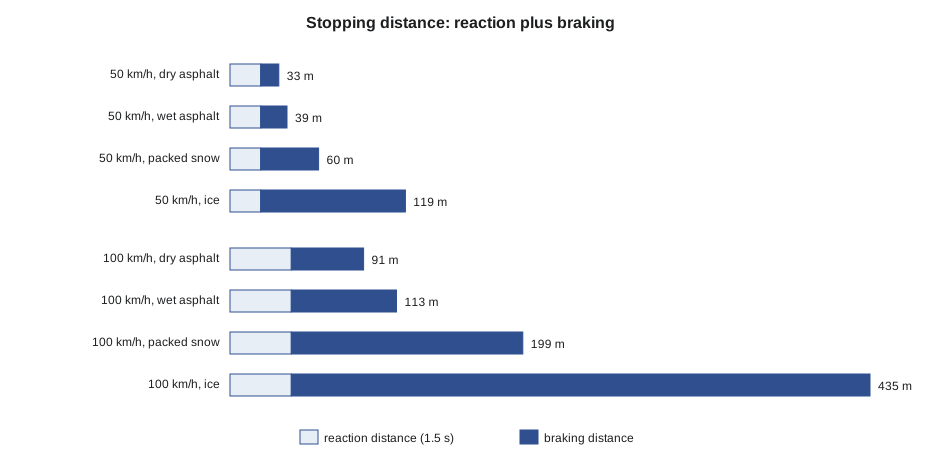
A driver's stopping distance has two parts. The reaction distance is how far the vehicle travels between the moment the driver sees a hazard and the moment the brakes begin to act. It includes the time to notice, decide, move the foot to the pedal and take up the slack in the system, typically about 1 to 1.5 seconds for an alert driver, and much more for a distracted one. During that time the vehicle is still travelling at full speed. The braking distance is the distance covered while decelerating to a stop.
In this formula, d is the total stopping distance, v the starting speed, t sub r the reaction time, and a the average deceleration. The braking part grows with the square of speed, so stopping distances grow much faster than speed. Worn brakes, glazed pads, old fluid and worn tires all reduce the deceleration a driver can achieve and lengthen the second part; nothing a technician does can shorten the first.
# Stopping distance: reaction distance plus braking distance
UNITS = "metric"
t_react = 1.5                                   # seconds
surfaces = [("dry asphalt", 0.80), ("wet asphalt", 0.55), ("packed snow", 0.25), ("ice", 0.10)]
speeds = [50, 100] if UNITS == "metric" else [30, 60]
for spd in speeds:
    v = spd / 3.6 if UNITS == "metric" else spd * 0.44704      # m/s
    for road, mu in surfaces:
        a = mu * 9.81
        react = v * t_react
        brake = v ** 2 / (2 * a)
        if UNITS == "metric":
            print(f"{spd:3d} km/h on {road:<12}: reaction {react:5.1f} m + braking {brake:6.1f} m = {react + brake:6.1f} m")
        else:
print(f"{spd:3d} mph on {road:<12}: reaction {react * 3.281:5.0f} ft + braking {brake * 3.281:6.0f} ft = {(react + brake) * 3.281:6.0f} ft")50 km/h on dry asphalt : reaction 20.8 m + braking 12.3 m = 33.1 m 50 km/h on wet asphalt : reaction 20.8 m + braking 17.9 m = 38.7 m 50 km/h on packed snow : reaction 20.8 m + braking 39.3 m = 60.2 m 50 km/h on ice : reaction 20.8 m + braking 98.3 m = 119.2 m 100 km/h on dry asphalt : reaction 41.7 m + braking 49.2 m = 90.8 m 100 km/h on wet asphalt : reaction 41.7 m + braking 71.5 m = 113.2 m 100 km/h on packed snow : reaction 41.7 m + braking 157.3 m = 199.0 m 100 km/h on ice : reaction 41.7 m + braking 393.3 m = 434.9 m
The parts of a brake system
Every modern car and light truck has two independent braking systems. The service brakes are the ones the driver uses with the pedal. The parking brake, applied by a lever, a pedal or an electric switch, holds the parked vehicle and can be used to slow it if the service brakes fail. Lesson 9 covers parking brakes.
The service brake system is hydraulic. The pedal pushes a rod into the master cylinder, usually with help from a power booster. The master cylinder turns the driver's push into fluid pressure, which travels through steel lines and flexible hoses to a caliper or wheel cylinder at each wheel. There, the pressure pushes pistons that press friction material against a rotor or drum. Electronic systems, anti-lock brakes and stability control, sit between the master cylinder and the wheels and can reduce, hold or even build pressure at each wheel on their own.
| Part | What it does | Lesson |
|---|---|---|
| Pedal and pushrod | Multiplies the driver's foot force by leverage | 2 |
| Power booster | Adds force to the driver's push using vacuum, hydraulic pressure or an electric motor | 5 |
| Master cylinder | Converts the pushrod force into hydraulic pressure in two separate circuits | 3 |
| Lines, hoses and valves | Carry and control the pressure to each wheel | 3 |
| Brake fluid | Transmits the pressure; must not boil or corrode | 4 |
| Disc brakes | Calipers press pads against rotors | 6, 7 |
| Drum brakes | Wheel cylinders press shoes against drums | 8 |
| Parking brake | Holds the parked vehicle mechanically or electrically | 9 |
| ABS, traction and stability control | Prevent wheel lock and help keep control | 10 |
| Regenerative and brake-by-wire systems | Recover energy and blend electric and friction braking | 11 |
Brakes are safety-critical, and the rules reflect that. In Canada, every new passenger vehicle must meet Canada Motor Vehicle Safety Standard 135, which sets stopping distances, fade and recovery tests, parking brake performance and warning lamp requirements for light vehicles, and CMVSS 126, which has required electronic stability control on new light vehicles since September 2011. A shop does not certify brakes against those standards, but it must restore them to the manufacturer's specifications, using parts that meet them, and it must never leave a vehicle less safe than it arrived. Ridgeline is licensed for Alberta out-of-province vehicle inspections, which include a brake inspection against the provincial inspection standard, so Marty and the other certified technicians measure and record brakes in a set way.
Marty's first rule of brake work
Before Kiran starts on van 2, Marty gives her the rules he gives every apprentice. A brake job always starts with a road test, if the vehicle is safe to drive, and with a conversation with the customer or driver about exactly what they notice and when. Brakes are inspected and measured, not guessed at. Parts on the same axle are replaced in pairs, so that both sides brake equally. The vehicle is road tested again before delivery, and the pedal is pumped up before the vehicle moves at all, because a freshly serviced caliper needs several strokes to push its pistons back against the pads.
And brake dust is treated with respect. Older brake linings contained asbestos, and although asbestos has been banned in Canada since the end of 2018, old parts and some imported parts may still contain it. Brakes are never blown off with compressed air. They are cleaned with a low-pressure wet method or an approved enclosure, and the shop's procedures for dust, which Kiran learned in AUTO-110, apply to every brake job.
Worked problem
How much energy does van 2 lose in a day?
Van 2 makes about 120 stops a day, averaging about 50 km/h, with an average mass of about 3,300 kg as its load is delivered. Roughly how much heat do its brakes produce in a day?
Show solution
- Speed 50 km/h is about 13.9 m/s (13.4 m/s).
- Energy per stop is ½ × 3,300 × 13.9² ≈ 319 kJ (½ × 3,311 × 13.4² ≈ 297 kJ, about 219,000 ft·lb).
- Over 120 stops that is about 38 MJ (36 MJ), roughly the energy in a litre of gasoline (a quarter gallon), all turned into heat in the brakes.
- Most of it, about 70 percent, goes into the front pads and rotors.
Answer: Roughly 36 to 38 megajoules a day, most of it at the front, which is why the van's front brakes wear so fast.
Common mistakes
MistakeThinking that stronger brakes always mean shorter stops.
InsteadThe tires set the limit; brakes only need to be strong enough to reach it without fading.
MistakeForgetting that energy rises with the square of speed.
InsteadA small rise in speed means a large rise in heat and braking distance.
MistakeMaking the rear brakes as strong as the front.
InsteadWeight moves forward in a stop; the rear must not lock first.
MistakeBlowing brake dust off with compressed air.
InsteadUse a wet method or an approved enclosure.
MistakeMoving a freshly serviced vehicle before pumping the pedal.
InsteadPump until the pedal is firm, then road test.
Summary and key terms
- A friction brake turns kinetic energy into heat, which the rotors, drums and pads must absorb and shed.
- Kinetic energy grows with mass and with the square of speed.
- Too much heat causes fade: friction fade, fluid fade or mechanical fade.
- The tire's grip, set by load and the coefficient of friction, limits every stop.
- Weight moves to the front in a stop, so the front brakes do most of the work.
- Stopping distance is reaction distance plus braking distance, and braking distance grows with speed squared.
- The service brakes are hydraulic, with electronic control; the parking brake is separate.
- Kinetic energy
- The energy of a moving mass, equal to half the mass times the speed squared.
- Fade
- Loss of braking effectiveness from overheated pads, boiling fluid or expanded drums.
- Coefficient of friction
- The ratio of the friction force to the load pressing two surfaces together.
- Weight transfer
- The shift of load from the rear axle to the front during braking.
- Reaction distance
- The distance travelled before the brakes begin to act.
- Braking distance
- The distance travelled while decelerating to a stop.
- Service brakes
- The pedal-operated hydraulic brakes used to slow and stop the vehicle.
Practice problems
Work each problem on paper first, then reveal the answer to check.
A vehicle's speed rises from 50 to 100 km/h. By how much does its kinetic energy increase?
Show answer
By a factor of four, because energy depends on speed squared.
Why are front brakes larger than rear brakes?
Show answer
Weight moves to the front in a stop, so the front tires can carry more braking force.
What is fluid fade, and how does the pedal feel?
Show answer
Brake fluid boils near the calipers; vapour compresses and the pedal goes soft and low.
At 100 km/h, with a 1.5 s reaction time, how far does a vehicle travel before braking starts?
Show answer
27.8 m/s × 1.5 s ≈ 42 m.
Lesson quiz · 5 questions
Score 60% or more to complete this lesson.
Create a free account to save your progress, take quizzes and earn a certificate.