
AUTO-120 · Lesson 3 of 12 · 22 min
Engine displacement, compression and power
Gord Haney stops by the counter on a slow afternoon to pay for his sway bar bushings and stays to talk. He tows a trailer of landscaping equipment, and he has noticed that his pickup pulls noticeably harder on the flat roads east of the city than it does in the mountains when he takes the trailer to a job near Canmore. “Is something wrong with it?” he asks. Simone sends him to the shop floor, where Marty hands the question to Kiran. “You tell him. Work it out first.”
To answer, Kiran needs the numbers that describe what an engine can do: its displacement, its compression ratio, the torque and power it makes, how well it fills its cylinders, and how all of these change with the air it breathes. This lesson explains each one and how technicians use them, from reading a specification sheet to judging whether a complaint is a fault or simply physics.
Displacement
Displacement, also called swept volume, is the volume the pistons sweep as they move from bottom dead centre to top dead centre, added up for all the cylinders. It is the most common single figure used to describe an engine's size: the 2.0 litre training engine, the 3.6 litre minivan V6 and Gord's 5.3 litre V8. In the United States, engine displacement was traditionally given in cubic inches, and Gord's engine family is still often called a 325 by people who grew up with that measure.
Here V_d is the displacement, B is the bore, S is the stroke and n is the number of cylinders. The first part of the formula, pi over four times the bore squared, is the area of the piston crown. Multiplying it by the stroke gives the volume swept by one piston, and multiplying that by the number of cylinders gives the engine's displacement.
# Displacement from bore and stroke
import math
engines = [("training engine, inline four", 8.60, 8.60, 4),
           ("Gord's pickup, V8", 9.60, 9.20, 8),
           ("Lindqvists' minivan, V6", 9.60, 8.30, 6)]
for name, bore, stroke, n in engines:
    one = math.pi / 4 * bore ** 2 * stroke          # swept volume of one cylinder
    total = one * n
print(f"{name:<30} one cylinder {one:6.1f} cm3, engine {total:7.0f} cm3 = {total / 1000:.1f} L")training engine, inline four one cylinder 499.6 cm3, engine 1998 cm3 = 2.0 L Gord's pickup, V8 one cylinder 665.9 cm3, engine 5327 cm3 = 5.3 L Lindqvists' minivan, V6 one cylinder 600.8 cm3, engine 3605 cm3 = 3.6 L
Bore and stroke are entered in centimetres so the result comes out in cubic centimetres; a thousand cubic centimetres make a litre. Displacement tells the technician how much air the engine can draw in per cycle, and therefore roughly how much power it can make, but two engines of the same displacement can be very different. A small turbocharged engine can outperform a larger engine that breathes at atmospheric pressure, and an engine tuned for economy can make far less power than one of the same size tuned for performance.
Compression ratio
The compression ratio compares the volume above the piston at BDC with the volume above it at TDC. The small volume left at TDC is the clearance volume, made up of the combustion chamber in the head, the space taken by the head gasket's thickness, any gap between the piston crown and the block deck, and any dish or valve pockets in the piston (a domed piston reduces it).
In this formula, V_s is the swept volume of one cylinder and V_c is the clearance volume. A typical modern gasoline engine has a ratio between about 10 and 12.5 to one; Gord's engine is about 11 to one. Higher ratios extract more work from each charge of fuel and air, which improves both power and economy, but they also raise the temperature and pressure of the mixture during compression. Too high, and the end of the mixture can explode on its own before the flame reaches it. This uncontrolled burning is called detonation, knock or pinging, and it can crack pistons and damage head gaskets. The engine control module listens for it with knock sensors on the block and retards the spark when it hears it.
Fuel's resistance to knock is its octane rating. An engine designed for regular fuel runs correctly on regular; using a higher octane fuel than specified adds nothing. An engine that specifies premium fuel can usually run on regular, but the control module will retard the timing to protect it and power and economy will fall. Direct injection, which cools the mixture as the fuel evaporates inside the cylinder, has allowed manufacturers to raise compression ratios without knock.
Compression ratio matters to technicians in two ways. When an engine is rebuilt, machining the deck or the head, or using a thinner head gasket, reduces the clearance volume and raises the ratio, so the service information's limits on how much material may be removed must be followed. And the ratio sets what a compression gauge will read during a test, which Lesson 10 covers. A higher-ratio engine produces a higher cranking pressure, and so does a lower altitude.
# Compression ratio of the training engine from measured volumes
import math
swept = math.pi / 4 * 8.6 ** 2 * 8.6 * 1     # one cylinder, cm3
chamber = 42.0                                       # combustion chamber in the head, cm3 (measured by filling it)
gasket = math.pi / 4 * 8.7 ** 2 * 0.07 * 1        # compressed head gasket: bore 8.7 cm, thickness 0.07 cm
deck = math.pi / 4 * 8.6 ** 2 * 0.02 * 1        # piston 0.02 cm below the deck at TDC
dish = 5.0                                           # dish in the piston crown, cm3
clearance = chamber + gasket + deck + dish
print(f"swept {swept:.1f} cm3; clearance {clearance:.1f} cm3 (chamber {chamber}, gasket {gasket:.1f}, deck {deck:.1f}, dish {dish})")
print(f"compression ratio {(swept + clearance) / clearance:.2f} : 1")
thinner = gasket * 0.05 / 0.07
cl2 = clearance - gasket + thinner
print(f"with a 0.05 cm gasket: {(swept + cl2) / cl2:.2f} : 1")swept 499.6 cm3; clearance 52.3 cm3 (chamber 42.0, gasket 4.2, deck 1.2, dish 5.0) compression ratio 10.55 : 1 with a 0.05 cm gasket: 10.77 : 1
Builders measure the chamber volume by sealing a clear plate over it and filling it from a graduated burette with a light oil; the volume of oil it takes is the chamber volume. Every part of the clearance volume matters. On the training engine, changing to a thinner head gasket would raise the compression ratio noticeably, which is why gaskets are replaced with the thickness the service information specifies, and why a technician never adds a second gasket or a thicker one to cure a problem.
Torque and power
Torque is a turning force: the force on the end of a lever multiplied by the lever's length, as Kiran learned with torque wrenches in AUTO-110. The torque an engine delivers at its crankshaft depends on how hard the gas pushes on the pistons, so it rises and falls with how well the engine fills its cylinders at each speed. Power is the rate of doing work: torque multiplied by rotational speed. An engine can make a lot of torque at low speed and still not much power, because it is turning slowly; power is what decides how fast a vehicle can climb a hill or accelerate a load.
In the first formula P is power in kilowatts, T is torque in newton metres and n is speed in revolutions per minute. In the second, power is in horsepower and torque in pound-feet; the two curves cross at 5,252 rpm, which is why a horsepower and a pound-foot of torque are equal there on any dynamometer chart.
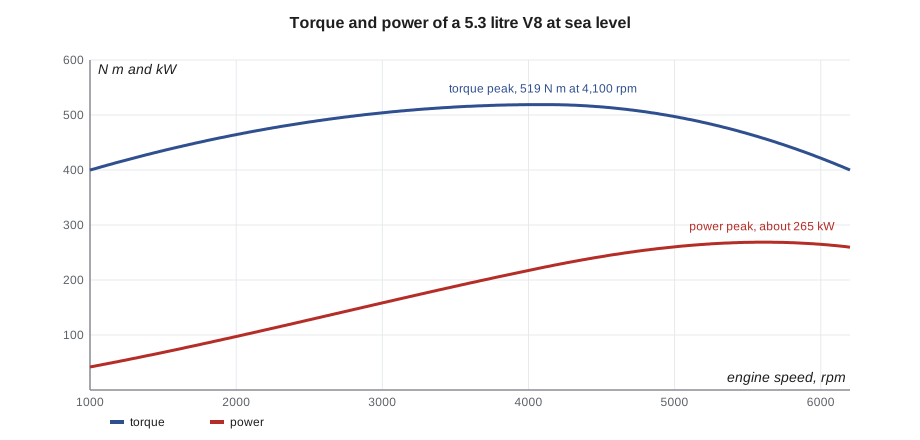
Gord's engine is rated at about 265 kW (355 hp) at 5,600 rpm and 519 N·m (383 lb·ft) of torque at 4,100 rpm. These figures are measured under standard sea-level conditions on a dynamometer and corrected to a standard air pressure and temperature, so that engines tested in different places can be compared fairly.
Another way to compare engines of different sizes is brake mean effective pressure, BMEP: the average pressure that would have to act on the pistons during each power stroke to produce the measured torque. It shows how hard an engine is working for its size. Engines that breathe at atmospheric pressure reach about 1,100 to 1,300 kPa at peak torque; turbocharged engines reach well over 2,000 kPa.
# Power, torque and BMEP for Gord's engine
import math
torque = 519               # N m at peak torque
rpm_t = 4100
power_at_t = torque * rpm_t / 9549
print(f"at {rpm_t} rpm: {torque} N m gives {power_at_t:.0f} kW")
rated_power, rpm_p = 265, 5600
torque_at_p = rated_power * 9549 / rpm_p
print(f"at {rpm_p} rpm: {rated_power} kW needs {torque_at_p:.0f} N m")
displacement_m3 = 5.327e-3
bmep_kpa = 4 * math.pi * torque / displacement_m3 / 1000
print(f"BMEP at peak torque {bmep_kpa:.0f} kPa")at 4100 rpm: 519 N m gives 223 kW at 5600 rpm: 265 kW needs 452 N m BMEP at peak torque 1224 kPa
Volumetric efficiency
An engine never quite fills its cylinders with air at atmospheric pressure. Restrictions in the air filter, throttle, intake manifold, ports and valves, and the short time the valves are open, all reduce the amount of air that gets in. Volumetric efficiency, VE, compares the mass of air actually drawn in with the mass that would fill the displacement at the outside air's density. A good engine that breathes at atmospheric pressure reaches about 85 to 95 percent at its torque peak, and much less at idle, where the throttle is nearly closed. Supercharged and turbocharged engines can exceed 100 percent.
Technicians meet volumetric efficiency in diagnosis. The mass airflow sensor tells the control module how many grams of air enter each second, and a scan tool displays it. If the airflow at wide-open throttle is much lower than an engine of that size should take in, something is restricting it: a plugged air filter, a collapsed intake duct, a sticking throttle, a restricted exhaust or a mass airflow sensor that is reading low. A quick volumetric efficiency calculation, using the airflow, engine speed, displacement and air density, helps a technician decide whether the reading makes sense before chasing a fault.
# Volumetric efficiency from scan tool airflow (test drive, wide-open throttle)
pressure_kpa, air_temp_c = 89.4, 20            # outside air at the shop
density = pressure_kpa * 1000 / (287 * (air_temp_c + 273.15))     # kg per m3
displacement_m3 = 5.327e-3
rpm = 4000
maf_gs = 172                                     # mass airflow sensor reading, g/s
theory_gs = displacement_m3 * rpm / 2 / 60 * density * 1000     # each cylinder fills once every 2 turns
print(f"airflow that would exactly fill the displacement: {theory_gs:.0f} g/s; measured {maf_gs} g/s")
print(f"volumetric efficiency {maf_gs / theory_gs * 100:.0f} %")airflow that would exactly fill the displacement: 189 g/s; measured 172 g/s volumetric efficiency 91 %
A result between about 80 and 95 percent at wide-open throttle tells Kiran that the engine is breathing normally. A result of 60 percent would send her to check the air filter, the intake and the mass airflow sensor before anything else.
Altitude and power
Air pressure falls with height above sea level, and with it the density of the air. At Calgary's elevation of about 1,045 m, the average air pressure is about 89 kPa, roughly 88 percent of the sea-level value of 101.3 kPa. Because a naturally aspirated engine fills its cylinders with air at the pressure around it, it takes in less air at altitude, can burn less fuel, and makes less power, in close proportion to the pressure. Hot air is less dense too, so an engine makes less power on a hot day than a cold one.
# How much power does Gord's engine make where he drives?
rated_sea_level = 265               # rated at sea level, kW
places = [("sea level", 0), ("Calgary", 1045), ("Canmore", 1310), ("a mountain pass", 2000)]
for name, height in places:
    h_m = height * 1
    pressure = 101.325 * (1 - 2.25577e-5 * h_m) ** 5.25588      # standard atmosphere (kilopascals)
    ratio = pressure / 101.325
print(f"{name:<18} {height:>6,} m: {pressure * 1:5.1f} kPa, {ratio * 100:3.0f} % of sea level, about {rated_sea_level * ratio:4.0f} kW")sea level 0 m: 101.3 kPa, 100 % of sea level, about 265 kW Calgary 1,045 m: 89.4 kPa, 88 % of sea level, about 234 kW Canmore 1,310 m: 86.5 kPa, 85 % of sea level, about 226 kW a mountain pass 2,000 m: 79.5 kPa, 78 % of sea level, about 208 kW
The standard atmosphere formula in the code works in metres and kilopascals internally, because that is how it is defined. The answer for Gord is that nothing is wrong with his truck. At the heights he drives, his engine has lost a substantial share of its sea-level power, and with a loaded trailer behind it he feels every bit of that loss. Turbocharged engines lose much less, because the turbocharger can make up the missing pressure, which is one reason they are popular in mountain regions.
Altitude also matters to technicians in other ways. Compression readings, manifold vacuum and the boiling point of coolant all depend on the air pressure around the engine, and a specification written for sea level must be adjusted before a reading at Ridgeline is compared with it. Lessons 9 and 10 show how.
Piston speed
Mean piston speed is the average speed of the piston over a stroke: twice the stroke multiplied by revolutions per second. It is a useful measure of how hard an engine's bottom end is working, because the loads on the connecting rods and the wear on the rings rise with it. Most passenger car engines stay below about 20 metres per second at their highest speed; racing engines reach about 25. Long-stroke engines therefore tend to have lower maximum speeds than short-stroke ones.
# Mean piston speed at the top of each engine's speed range
engines = [("training engine", 0.0860, 6500), ("Gord's V8", 0.0920, 6000), ("minivan V6", 0.0830, 6400)]
for name, stroke, max_rpm in engines:
    speed = 2 * stroke * max_rpm / 60
print(f"{name:<16} {max_rpm} rpm: {speed:5.1f} m/s")training engine 6500 rpm: 18.6 m/s Gord's V8 6000 rpm: 18.4 m/s minivan V6 6400 rpm: 17.7 m/s
Worked problem
Answering Gord
Gord's pickup feels slow towing his trailer in the mountains. How should Kiran answer him, and what should she check before saying nothing is wrong?
Show solution
- Explain that a naturally aspirated engine loses power in proportion to the air pressure, and that in the mountains his engine has lost a large share of its sea-level power.
- Check that nothing else is making it worse: the air filter, the intake duct, any stored trouble codes, and the mass airflow reading at wide-open throttle on a road test.
- Work out the volumetric efficiency from the scan data; a normal result means the engine is breathing properly.
- Suggest he use the transmission's tow mode and a lower gear on long climbs, and check the trailer's weight against the truck's towing rating.
Answer: Explain the altitude loss, confirm with a quick check that the engine is breathing normally, and give him practical towing advice.
Common mistakes
MistakeTreating a slower truck at altitude as a fault without checking.
InsteadCalculate the expected loss, then check the air filter, intake and airflow data.
MistakeUsing a thicker or doubled head gasket.
InsteadUse only the thickness specified; it sets the compression ratio.
MistakeThinking higher octane fuel adds power to any engine.
InsteadOctane prevents knock; use the grade the manufacturer specifies.
MistakeComparing a compression reading with a sea-level figure.
InsteadAllow for altitude, as Lesson 10 shows.
MistakeConfusing torque with power.
InsteadPower is torque multiplied by speed.
Summary and key terms
- Displacement is the swept volume of all the cylinders: area of the bore times the stroke times the number of cylinders.
- Compression ratio is swept plus clearance volume divided by clearance volume; too high a ratio for the fuel causes knock.
- Power equals torque multiplied by speed; in kilowatts it is newton metres times rpm divided by 9,549.
- Volumetric efficiency compares the air actually drawn in with the air that would fill the displacement.
- A naturally aspirated engine loses power roughly in proportion to air pressure at altitude.
- Mean piston speed measures how hard the bottom end is working.
- Displacement
- The total volume swept by the pistons from BDC to TDC.
- Clearance volume
- The volume above the piston at TDC.
- Compression ratio
- The ratio of the cylinder volume at BDC to the volume at TDC.
- Knock
- Uncontrolled ignition of the end of the mixture, heard as pinging.
- Brake mean effective pressure
- The average pressure on the pistons that would produce the engine’s measured torque.
- Volumetric efficiency
- The ratio of air actually drawn in to the air that would fill the displacement.
Practice problems
Work each problem on paper first, then reveal the answer to check.
An engine has a bore of 9.0 cm, a stroke of 9.0 cm and six cylinders. What is its displacement?
Show answer
0.7854 × 81 × 9.0 × 6 = 3,435 cm³, about 3.4 L.
Swept volume 600 cm³ and clearance volume 60 cm³: what is the compression ratio?
Show answer
(600 + 60) / 60 = 11 to 1.
An engine makes 400 N·m at 3,000 rpm. What is its power?
Show answer
400 × 3,000 / 9,549 = 126 kW.
About what share of its sea-level power does a naturally aspirated engine have at Calgary's elevation?
Show answer
About 88 percent.
Lesson quiz · 5 questions
Score 60% or more to complete this lesson.
Create a free account to save your progress, take quizzes and earn a certificate.