
AUTO-120 · Lesson 4 of 12 · 22 min
Cylinder heads and valve trains
The training engine's cylinder head sits on Kiran's bench, upside down on two blocks of wood so the open valves cannot be bent against the bench top. Marty has given her a list: identify every part of the valve train, measure the valve clearances before the head came off (he recorded them for her), work out which shims would bring them back into specification, check a set of valve springs, and measure the head for warpage. “By Friday,” he says, “you'll know more about this head than the people who assembled it.”
The valve train is the set of parts that opens and closes the valves at the right moments and seals them tightly the rest of the time. This lesson describes the valves and their seats, guides, seals and springs; the different ways camshafts operate the valves; why some engines need their valve clearance adjusted and others do not; and how a technician inspects a cylinder head. Camshafts and their drives are covered in Lesson 5.
Valves, seats and guides
Engine valves are poppet valves: a round head on a long stem, which a spring pulls shut against a seat. The intake valve is larger, because the air entering the cylinder is pushed only by atmospheric pressure, while the exhaust is pushed out by the piston and by the remaining combustion pressure. Most engines today have four valves per cylinder, two intake and two exhaust, which gives more total valve area than two large valves and lets the spark plug sit in the centre of the chamber. Gord's V8 has two valves per cylinder.
The exhaust valve is the hottest part of the engine. Its head can run at well over 700 °C, and it gets rid of its heat mainly through its seat when it is closed and through its stem into the guide. Exhaust valves are made of heat-resistant steel, and in some engines their hollow stems contain sodium, which melts and carries heat up the stem. Sodium-filled valves must never be cut open or thrown in with ordinary scrap, because sodium reacts violently with water.
The valve seat is a ring of hard alloy pressed into the aluminum head. The valve and seat are ground at matching angles, usually 45 degrees, so that the valve face contacts a narrow band of the seat. That band must be complete and even for the valve to seal and to cool. The valve stem slides in a valve guide, a tube of iron or bronze pressed into the head. A valve stem seal on top of the guide meters a small amount of oil down the stem to lubricate it while keeping oil out of the ports. Worn guides or hardened seals let oil run down into the cylinder, especially when the engine has been idling or sitting, and the result is a puff of blue smoke at start-up.
Springs, retainers and keepers
The valve spring closes the valve and keeps it following the cam lobe as it opens and closes. At high engine speed the valve and the parts moving with it have so much momentum that a weak spring cannot pull them back in time; the valve then floats, staying open too long or bouncing on its seat, and power falls or a valve may touch a piston. The spring sits on a seat on the head and is held at the top by a retainer, which is locked to the stem by two small split cones called keepers or collets that fit in a groove in the stem.
Springs lose pressure as they age and with overheating, so when a head is serviced each spring is checked. Its free length is measured and compared with the specification; it is stood on a flat surface next to a square to check that it is straight; and its force is measured on a spring tester at its installed height, the length it has in the engine with the valve closed, and at its open height, the length with the valve fully open. A spring outside the limits is replaced.
# Valve spring check: force at installed height (training engine, illustrative limits)
installed_height = 38.0            # mm
force_limits = (170, 195)      # N at installed height
measured = [184, 181, 186, 179, 162, 183, 185, 180, 182, 187, 178, 184, 181, 183, 186, 168]
for n, f in enumerate(measured, start=1):
    ok = force_limits[0] <= f <= force_limits[1]
    print(f"spring {n:>2}: {f:5.0f} N at {installed_height} mm  {'OK' if ok else 'REPLACE'}")
bad = [n for n, f in enumerate(measured, start=1) if not force_limits[0] <= f <= force_limits[1]]
print(f"{len(bad)} of {len(measured)} springs outside limits: {bad}")spring 1: 184 N at 38.0 mm OK spring 2: 181 N at 38.0 mm OK spring 3: 186 N at 38.0 mm OK spring 4: 179 N at 38.0 mm OK spring 5: 162 N at 38.0 mm REPLACE spring 6: 183 N at 38.0 mm OK spring 7: 185 N at 38.0 mm OK spring 8: 180 N at 38.0 mm OK spring 9: 182 N at 38.0 mm OK spring 10: 187 N at 38.0 mm OK spring 11: 178 N at 38.0 mm OK spring 12: 184 N at 38.0 mm OK spring 13: 181 N at 38.0 mm OK spring 14: 183 N at 38.0 mm OK spring 15: 186 N at 38.0 mm OK spring 16: 168 N at 38.0 mm REPLACE 2 of 16 springs outside limits: [5, 16]
Two of the sixteen springs are weak. Marty asks Kiran why a careful technician would still replace the whole set on a high-mileage engine. The answer is that the others have aged the same way and are probably close to the limit, the cost of the springs is small next to the labour of getting to them, and a matched set keeps the valve train stable at high speed.
How the camshaft moves the valves
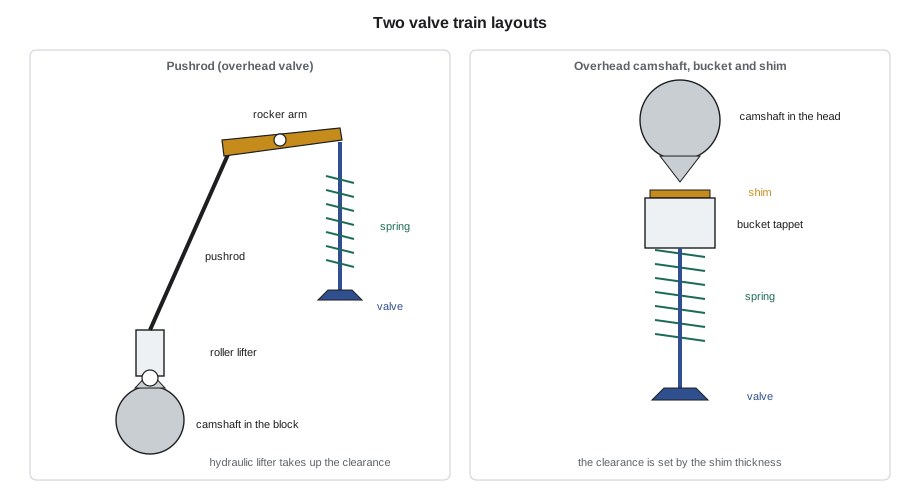
A camshaft has one lobe for every valve, shaped like an egg in section. The round part, the base circle, holds the valve closed; the raised part, the nose, opens it. The height of the nose above the base circle, multiplied by any rocker ratio, sets how far the valve opens, its lift, and the width of the lobe sets how long it stays open, its duration. There are several ways to transfer the lobe's motion to the valve.
- Pushrod, or overhead valve. A single camshaft in the block pushes on lifters, which push on pushrods, which rock the rocker arms that press on the valve stems. Gord's V8 uses hydraulic roller lifters, with a small roller on the bottom that rolls on the lobe to reduce friction.
- Direct-acting overhead camshaft. The lobe presses directly on a bucket, a cup-shaped tappet over the valve stem. The training engine uses buckets with a thin hardened disc, a shim, between the lobe and the bucket, or under the bucket, to set the clearance.
- Roller finger follower. A short rocker, the finger, has a roller in the middle that the lobe presses on. One end of the finger pivots on a hydraulic lash adjuster and the other presses on the valve. The Lindqvists' V6 and many modern engines use this layout because it has low friction and needs no adjustment.
- Rocker shaft. In some SOHC engines, rocker arms on a shaft above the camshaft carry adjusting screws that press on the valves.
Valve clearance
When a valve is closed, there must be a small gap somewhere between the base circle of the cam and the valve stem. This gap, the valve clearance or lash, makes sure the valve closes fully even when the parts expand with heat; the valve stem grows more than the head around it as it gets hot. Too little clearance holds the valve slightly open, so it leaks compression and cannot cool through its seat, and it will soon burn. Too much clearance makes the valve train tap loudly, opens the valve later and less far, and hammers the parts.
Engines with hydraulic lifters or hydraulic lash adjusters take up the clearance automatically. Oil from the engine's lubrication system fills a small chamber inside the lifter, and a tiny check valve traps it, so the lifter keeps the valve train just in contact with no lash. Hydraulic systems are quiet and need no routine adjustment, but they depend on clean oil at the correct pressure. A lifter that has lost its oil, because the oil is low, thin or dirty or because its check valve is stuck, collapses and taps, and Lesson 6 shows why some lifters in Gord's engine have an extra job that makes them more likely to fail.
Engines with mechanical, or solid, valve trains have their clearances checked at the intervals in the maintenance schedule and adjusted when they are out of specification. On a screw-adjusted rocker, the technician loosens a locknut and turns the screw. On a shim-and-bucket engine like the training engine, the clearance is changed by fitting a shim of a different thickness, which means removing the camshaft on many designs. Clearances are always measured with the engine cold and with the lobe for that valve pointing away from the follower, so the follower is on the base circle.
# Choosing replacement shims to bring valve clearances back to the middle of the range
intake_spec, exhaust_spec = (0.20, 0.30), (0.28, 0.38)     # cold clearance, mm
step = 0.02                                           # shims come in steps of 0.02 mm
readings = [  # valve, measured clearance, thickness of the shim now fitted (mm)
    ("1I", 0.24, 2.60), ("1E", 0.33, 2.56), ("2I", 0.17, 2.62), ("2E", 0.30, 2.58),
    ("3I", 0.26, 2.60), ("3E", 0.22, 2.64), ("4I", 0.27, 2.58), ("4E", 0.35, 2.54),
]
for valve, clr, shim in readings:
    lo, hi = intake_spec if valve.endswith("I") else exhaust_spec
    if lo <= clr <= hi:
        print(f"{valve:>3}: {clr:.2f} OK, keep shim {shim:.2f}")
        continue
    target = (lo + hi) / 2
    new = round((shim + clr - target) / step) * step
print(f"{valve:>3}: {clr:.2f} out of range, replace shim {shim:.2f} with {new:.2f} (new clearance about {clr + shim - new:.2f})")1I: 0.24 OK, keep shim 2.60 1E: 0.33 OK, keep shim 2.56 2I: 0.17 out of range, replace shim 2.62 with 2.54 (new clearance about 0.25) 2E: 0.30 OK, keep shim 2.58 3I: 0.26 OK, keep shim 2.60 3E: 0.22 out of range, replace shim 2.64 with 2.54 (new clearance about 0.32) 4I: 0.27 OK, keep shim 2.58 4E: 0.35 OK, keep shim 2.54
A valve whose clearance is too small, such as exhaust valve 3 here, needs a thinner shim; one whose clearance is too large needs a thicker one. Exhaust clearances usually close up with wear, because the valve sinks a little deeper into its seat each time the seat and face wear, and a valve that has lost its clearance completely is close to burning. Recording every measurement, not just the ones out of range, lets the next technician see the trend.
Valves are checked in an order that makes the most of each crankshaft position. With cylinder 1 at TDC on its compression stroke, both of its valves are on the base circle, along with some valves of other cylinders. The service information lists which valves can be checked in that position and which after turning the crankshaft one full turn, so the whole engine can be done in two positions.
Inspecting a cylinder head
When a head is removed, because of a head gasket failure, overheating or a valve problem, it is cleaned and inspected before it goes back on. Overheating can warp an aluminum head, and a warped head will not seal a new gasket. Warpage is measured with a precision straightedge laid across the gasket surface lengthwise, crosswise and diagonally, and a feeler gauge slid under it. The largest gap is compared with the limit in the service information, which is typically only a few hundredths of a millimetre. A head beyond the limit is resurfaced by a machine shop if the manufacturer allows it and if enough material remains, or replaced.
# Cylinder head warpage check with a straightedge and feeler gauge
limit = 0.05      # mm, maximum allowed
gaps = {"lengthwise, centre line": 0.03, "diagonal A": 0.04, "diagonal B": 0.02,
        "across cylinder 1": 0.01, "across cylinder 2": 0.02, "across cylinder 3": 0.02, "across cylinder 4": 0.01}
for where, g in gaps.items():
    print(f"{where:<24} {g:.2f} mm")
worst = max(gaps.values())
print(f"largest gap {worst:.2f} mm against a limit of {limit:.2f} mm:", "within limit" if worst <= limit else "resurface or replace")lengthwise, centre line 0.03 mm diagonal A 0.04 mm diagonal B 0.02 mm across cylinder 1 0.01 mm across cylinder 2 0.02 mm across cylinder 3 0.02 mm across cylinder 4 0.01 mm largest gap 0.04 mm against a limit of 0.05 mm: within limit
The head is also checked for cracks, especially between the valve seats and around the spark plug holes, where heat stress is highest. Cracks can be found by eye on a clean head, by dye penetrant, or by pressure testing the coolant passages at a machine shop. The valve guides are checked for wear by rocking a valve in its guide with a dial indicator, or by measuring the stem with a micrometer and the guide with a small hole gauge, and subtracting. The valves themselves are inspected for burned or cracked faces, bent stems and worn tips and keeper grooves.
A valve job restores the seal between the valves and seats. The seats are cut or ground to the correct angles and width, usually with a top and bottom angle that narrow and position the contact band; the valves are refaced or replaced; and the assembled valves are checked for leaks by pouring solvent into the ports and watching for seepage. Most general repair shops, including Ridgeline, send heads to a machine shop for this work, but the technician who removes and installs the head must know what to ask for and how to check that it was done.
Interference and the cost of a valve-train failure
In many engines the valves and pistons share the same space at different moments: when a valve is fully open, the piston is far enough down to clear it, but if the camshaft stops while the crankshaft keeps turning, the piston can hit an open valve. These are interference engines. If a timing belt breaks or a chain jumps on an interference engine, valves bend, and sometimes pistons crack. The repair can cost more than the vehicle is worth. In a non-interference engine, a failed timing drive just stops the engine. The training engine is an interference engine, which is why its timing belt replacement interval in Lesson 5 matters so much.
Valve-train noises are among the first things a technician hears on a road test. A light, rapid tick that rises and falls with engine speed, often heard best at the valve cover with a stethoscope, usually points to excessive valve clearance or a collapsed lifter. A heavier knock that changes with load points lower in the engine, to the bearings. Learning to tell them apart takes practice, and Kiran will listen to both on customer vehicles in Lesson 10.
Worked problem
A tick on the training engine
Before the training engine came off the car, it had a light tick from the front of the head that matched engine speed. Its recorded clearances are those in the shim calculation above. Which valve is the most likely cause, and what is the most serious finding?
Show solution
- The tick comes from a valve with too much clearance, so look for the largest clearance above its range.
- Exhaust valve 4 is near the top of its range, but no valve is far above its limit, so the tick is probably a valve near the high end combined with worn shim or bucket surfaces.
- The most serious finding is the opposite problem: exhaust valve 3 and intake valve 2 have too little clearance.
- A valve with too little clearance will not close fully when hot, will lose compression and will burn, so those shims are corrected first.
- Record every clearance, correct the out-of-range valves and recheck after reassembly.
Answer: The tight valves are the urgent finding; correcting them prevents a burned valve. The tick is from a valve at the loose end of its range.
Common mistakes
MistakeMeasuring valve clearance with the engine hot or the lobe on the follower.
InsteadMeasure cold, with the follower on the base circle.
MistakeIgnoring a valve whose clearance is too small because the engine is quiet.
InsteadTight valves burn; correct them first.
MistakeLaying a head flat on the bench with the valves open.
InsteadSupport it on blocks so open valves are not bent.
MistakeMixing up valve train parts during disassembly.
InsteadKeep lifters, buckets, shims and rockers in order and return each to its own position.
MistakeCutting or scrapping sodium-filled valves with ordinary steel.
InsteadHandle and dispose of them as the manufacturer directs.
Summary and key terms
- Intake valves are larger than exhaust valves; exhaust valves run hottest and cool mainly through their seats.
- Valve stem seals meter oil to the guides; worn seals or guides cause blue smoke at start-up.
- Springs are checked for free length, squareness and force at installed and open heights.
- The camshaft opens the valves through lifters and pushrods, buckets and shims, roller fingers or rocker shafts.
- Mechanical valve trains need their cold clearance checked and adjusted; hydraulic lifters and lash adjusters take it up with oil.
- Heads are checked for warpage, cracks, guide wear and valve condition; an interference engine's valves can be bent by a timing failure.
- Valve lash
- The clearance in the valve train when the valve is closed.
- Base circle
- The round part of a cam lobe that holds the valve closed.
- Keepers
- Split cones that lock the spring retainer to the valve stem.
- Installed height
- The length of the valve spring with the valve closed in the head.
- Hydraulic lash adjuster
- An oil-filled pivot that removes valve clearance automatically.
- Interference engine
- An engine in which an open valve and the piston can collide if the timing is lost.
- Valve float
- A condition at high speed in which the valve does not follow the cam because the spring cannot control it.
Practice problems
Work each problem on paper first, then reveal the answer to check.
A valve's clearance is 0.38 mm with a 2.50 mm shim; the target is 0.25 mm. What shim is needed?
Show answer
2.50 + 0.38 − 0.25 = 2.63 mm, rounded to the nearest available shim, 2.62 or 2.64 mm.
Why are exhaust valves more likely to lose their clearance than gain it?
Show answer
Seat and face wear lets the valve sink deeper, which reduces clearance.
Name three checks on a valve spring.
Show answer
Free length, squareness and force at installed height (and at open height).
What does a light tick that follows engine speed usually indicate?
Show answer
Excess valve clearance or a collapsed lifter.
Lesson quiz · 5 questions
Score 60% or more to complete this lesson.
Create a free account to save your progress, take quizzes and earn a certificate.