
AUTO-120 · Lesson 11 of 12 · 20 min
Gaskets, seals and fasteners in engine repair
Gord Haney sat in the customer lounge for a long time with Simone's estimate before he made up his mind. The truck earns his living, it has 312,000 km on it, and the body is still solid. He approved the larger job: lifters, lifter guides and gaskets on both banks, with the camshaft inspected and replaced only if needed. “If I'm paying to take one head off, I'm not paying to take the other one off next summer,” he said. Marty will lead the job, and Kiran will do much of the work under his eye. Before she removes a single bolt, he sits her down with the service information and a box of the gaskets and bolts that came with the parts order.
Engine repairs succeed or fail on details that are easy to rush: cleaning gasket surfaces properly, using the right sealant in the right place, and tightening fasteners in the correct sequence, to the correct torque and angle. This lesson covers the gaskets and seals used in engines, how surfaces are prepared, how head bolts and other critical fasteners work, and how a cylinder head is installed. It follows Gord's job from teardown to first start.
What gaskets and seals do
A gasket seals a joint between two stationary parts that cannot be made perfectly flat or perfectly smooth, such as a head and a block, an oil pan and a block, or a valve cover and a head. It fills the small irregularities of the surfaces and keeps sealing as the parts expand, contract and vibrate. A seal, by contrast, usually seals around a moving part, such as a rotating crankshaft, or is an O-ring in a groove that seals a pipe or sensor.
| Type | Where it is used | Notes |
|---|---|---|
| Multi-layer steel (MLS) | Head gaskets, exhaust manifolds | Thin embossed steel layers with a rubber coating; need very flat, smooth surfaces |
| Composite or fibre | Older head gaskets, some covers | Softer; tolerate rougher surfaces |
| Moulded rubber | Valve covers, oil pans, intake manifolds | Often in a groove or on a carrier; usually not reusable |
| Formed-in-place (RTV silicone) | Oil pans, front covers, corner joints | Bead applied by hand; flexible when cured |
| Anaerobic sealant | Rigid machined joints | Cures without air between close-fitting metal surfaces |
| Lip seal | Crankshaft and camshaft ends | Rubber lip held against a turning shaft by a spring |
| O-ring | Sensors, oil coolers, coolant pipes | Squeezed in a groove; replaced whenever disturbed |
The head gasket has the hardest job of any gasket in the engine. It must seal combustion pressure at each cylinder, coolant passing between the block and head, and oil feeding and draining from the valve train, all at once, while the aluminum head expands differently from the block below it. Most modern head gaskets are multi-layer steel. They seal with raised beads, embossments, around each opening that are crushed flat by the clamping force of the head bolts, and they rely on that force staying high and even. A head gasket is never reused.
Preparing surfaces
The surface a gasket seals against matters as much as the gasket itself. All traces of the old gasket and sealant are removed, without damaging the metal. On aluminum, that means plastic scrapers, chemical gasket removers, and soft nylon pads used carefully. Abrasive discs on air tools, which are quick, are not used on aluminum heads, blocks or covers, because they remove metal unevenly and the abrasive grit that flies off ends up in the oil passages and bearings; several manufacturers warn specifically against them. Before cleaning, Kiran plugs the open oil and coolant passages and covers the lifter bores with clean shop towels so nothing falls in.
Once clean, the surfaces are checked. The head and block deck are checked for flatness with a straightedge, as Lesson 4 described, and for scratches or pitting that cross a sealing area, especially around the combustion chambers and coolant passages. An MLS gasket needs a smooth, flat finish; a surface that has been gouged must be machined. The surfaces are wiped with a solvent that leaves no residue just before assembly, because oil on a gasket surface can let it slip or leak.
Bolt holes need attention too, especially the blind holes for head bolts, which are drilled into the block and do not go through. Any oil, coolant or debris in the bottom of a blind hole can stop a bolt from going fully down, so its torque reading is false, or, if the hole is full of liquid, the liquid cannot compress, and the bolt can crack the block as it is tightened. Kiran cleans each hole with a thread chaser, which reforms threads without cutting metal as a tap does, and blows it out with compressed air while wearing eye protection.
Using sealants correctly
Formed-in-place silicone sealant, often called RTV for room temperature vulcanizing, is used where the service information calls for it, such as between an oil pan and a front cover, and at the corners where three parts meet. A continuous bead of the diameter specified, often about 3 mm, is applied to one surface, inside the bolt holes, and the parts are assembled within the time the sealant allows, before it starts to skin over. Too much sealant squeezes into the engine, where pieces break off and can block the oil pickup screen; Lesson 8's van showed what a blocked screen does. The manufacturer's specified sealant is used, because some silicones release chemicals as they cure that can damage oxygen sensors.
Gaskets are installed dry unless the service information says otherwise. Coating a modern gasket with sealant can make it slip and leak. Threads that enter coolant passages receive the thread sealant specified, and some bolts come with a dry sealant patch already applied. Knowing which bolts need what is one more reason Marty insists on reading the procedure before starting.
How head bolts clamp
A bolt clamps parts together by acting as a stiff spring. As it is tightened, it stretches very slightly, and its tension pulls the head down onto the gasket with great force. That clamping force, not the torque, is what seals the gasket. Torque is only an indirect way of producing it, because most of the effort put into a wrench is lost to friction in the threads and under the bolt head. Dirty, rusty or dry threads absorb more torque in friction, so the bolt reaches the torque reading with less tension, and the gasket is clamped less than it should be.
To make the clamping force more consistent, most modern engines use torque-angle tightening, which Kiran first met in AUTO-110. Each bolt is tightened to a low initial torque, which pulls the parts together and seats the threads, and then turned through a set angle. Because the thread pitch is fixed, turning a set angle stretches the bolt by a set amount regardless of friction. Many head bolts are torque-to-yield, or stretch, bolts: the final angle takes them just past the point where they begin to stretch permanently, where their clamping force is high and very even. Once stretched, they cannot be relied on to do the same again, so they are replaced every time they are removed. Some manufacturers allow certain bolts to be reused if they have not stretched beyond a stated length, which is checked by measuring them.
# Can the old head bolts be reused? Compare their length with the new-bolt length (illustrative limit)
new_length = 155.0                  # mm
max_stretch = 0.5                 # mm allowed before the bolt must be replaced (if reuse is permitted at all)
old_bolts = [155.3, 155.4, 155.6, 155.2, 155.8, 155.5, 155.3, 155.4, 155.9, 155.2]
for n, length in enumerate(old_bolts, start=1):
    stretch = length - new_length
    print(f"bolt {n:>2}: {length:.1f} mm, stretched {stretch:.1f}", "" if stretch <= max_stretch else " <-- replace")
over = sum(1 for length in old_bolts if length - new_length > max_stretch)
print(f"{over} of {len(old_bolts)} bolts are beyond the limit. This engine's service information says to replace them all anyway.")bolt 1: 155.3 mm, stretched 0.3 bolt 2: 155.4 mm, stretched 0.4 bolt 3: 155.6 mm, stretched 0.6 <-- replace bolt 4: 155.2 mm, stretched 0.2 bolt 5: 155.8 mm, stretched 0.8 <-- replace bolt 6: 155.5 mm, stretched 0.5 bolt 7: 155.3 mm, stretched 0.3 bolt 8: 155.4 mm, stretched 0.4 bolt 9: 155.9 mm, stretched 0.9 <-- replace bolt 10: 155.2 mm, stretched 0.2 3 of 10 bolts are beyond the limit. This engine's service information says to replace them all anyway.
Gord's engine family uses torque-to-yield head bolts that the service information says must be replaced, so the measurement simply confirms the decision. Measuring is still a useful habit, because it shows a technician how much a bolt changes when it yields, and some engines do allow reuse within a limit.
Tightening sequence
Head bolts are tightened in a sequence, usually starting from the centre of the head and working outward in a spiral or criss-cross pattern, so the head is pulled down evenly and any slight bow in it is flattened from the middle out, rather than trapped in the middle. Each step of the procedure, the initial torque, the first angle and the final angle, is completed on every bolt in sequence before the next step begins. Skipping ahead, or tightening one bolt fully before the others, can distort the head or leave the gasket unevenly clamped.
# Head bolt sequence and steps for one cylinder head (example figures; always use the current service information)
# main bolts are numbered along the head: lower row 1-5 front to rear, upper row 6-10
lower, upper = [1, 2, 3, 4, 5], [6, 7, 8, 9, 10]
order = []
mid = 2
for k in range(3):                      # spiral out from the centre: middle pair, then alternate outward
    for i in sorted({mid - k, mid + k}):
        order += [lower[i], upper[i]]
steps = [("initial", "30 N m"), ("first angle", "90 degrees"), ("final angle", "70 degrees")]
print("sequence:", order)
for name, amount in steps:
    print(f"step {name:<12} {amount:<12} on bolts", order)
print("then the small upper bolts: 30 N m in their own sequence")sequence: [3, 8, 2, 7, 4, 9, 1, 6, 5, 10] step initial 30 N m on bolts [3, 8, 2, 7, 4, 9, 1, 6, 5, 10] step first angle 90 degrees on bolts [3, 8, 2, 7, 4, 9, 1, 6, 5, 10] step final angle 70 degrees on bolts [3, 8, 2, 7, 4, 9, 1, 6, 5, 10] then the small upper bolts: 30 N m in their own sequence
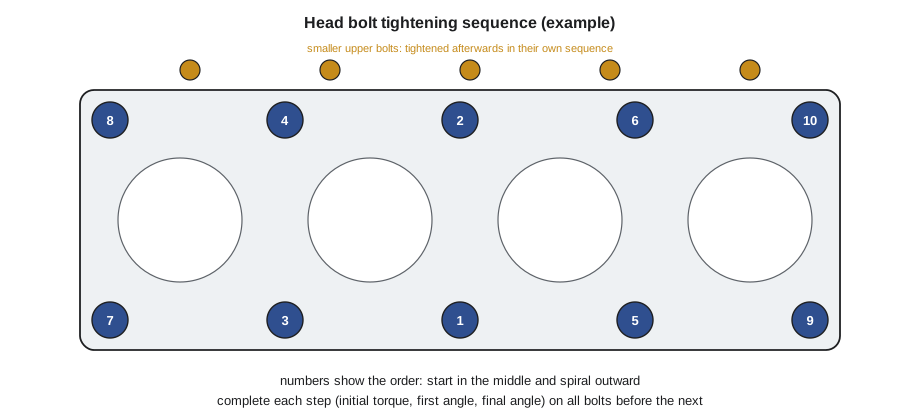
The angle is measured with a torque-angle gauge attached to the wrench, or with an electronic torque wrench that measures angle directly. Turning by eye, using the flats of the bolt head, is not accurate enough. Kiran also learns that the final angle on a large bolt takes a steady, continuous pull: stopping halfway and starting again changes the friction and the result.
Gord's job, step by step
With the procedure read and the parts checked against the order, the job goes in a planned sequence. The battery is disconnected, the coolant drained into a clean container for recycling, and the fuel pressure relieved as the service information directs. The intake manifold, with its injectors and fuel rail, comes off as an assembly, and its ports are covered. Exhaust manifold bolts, which are often rusted on a truck that has seen many winters of road salt, are soaked in penetrating oil the day before; Marty has a broken-bolt extraction kit ready but hopes not to need it. The valve covers come off, the rockers and pushrods are removed and kept in order, and the head bolts are loosened in the reverse of the tightening sequence, in stages, so the head is not distorted as it is released.
With the heads off, the lifter guides and lifters lift out. Cylinder 1's intake lifter is plainly bad: its roller is flat-spotted and its plunger is stuck. The camshaft lobe under it is measured with a micrometer across the nose and the base circle and compared with the other lobes; it is within a tiny margin of the others, and its surface is smooth, so the camshaft can stay. Kiran inspects the cylinder walls through the open deck: the crosshatch is still visible and there is no scoring. The valve lifter oil manifold, which feeds the deactivation lifters, is replaced along with its gasket, because a sticking solenoid in it can cause the same kind of lifter failure.
Reassembly follows the service information in order. New lifters are soaked in clean oil and installed in new guides. The block deck and head surfaces are cleaned and checked, the new MLS gaskets are placed dry on the block's dowels, facing the way marked on them, and the heads are lowered straight down onto the dowels so the gaskets are not disturbed. New head bolts are lightly oiled under their heads and on their threads, if the procedure specifies it, and tightened in sequence and in steps. Pushrods and rockers go back in their original positions, and the rocker bolts are tightened to their torque; on this engine, the hydraulic lifters set themselves, so there is no adjustment.
Before the first start, the engine is primed. Kiran disables the fuel and ignition and cranks the engine in short bursts until oil pressure shows on the gauge, so the new lifters fill and the bearings have oil before the engine runs. The cooling system is filled with the correct coolant and bled. The engine is started and watched closely for leaks, noises and warning lights, brought to operating temperature, and checked again. The lifters may tick for a few seconds as they fill and then fall silent. A road test confirms that the tick and the misfire are gone and that the engine switches into and out of four-cylinder mode smoothly.
# Gord's repair order totals (illustrative labour time, parts and rates)
labour_hours = 14.6             # both heads off, lifters, guides, valve lifter oil manifold, gaskets and bolts
rate = 165                   # per hour
parts = {"lifters (16)": 512.00, "lifter guides (4)": 96.00, "valve lifter oil manifold": 238.00,
         "head gasket set and intake gaskets": 295.00, "head bolts (2 sets)": 118.00, "oil, filter and coolant": 142.00}
shop_supplies = 8.00
labour = labour_hours * rate
parts_total = sum(parts.values())
subtotal = labour + parts_total + shop_supplies
tax = subtotal * 0.05
print(f"labour {labour_hours} h x {rate} = {labour:,.2f}")
for name, cost in parts.items():
    print(f"  {name:<36} {cost:8.2f}")
print(f"parts {parts_total:,.2f}, shop supplies {shop_supplies:.2f}")
print(f"tax {tax:,.2f}; total {subtotal + tax:,.2f} CAD (Alberta: 5 % GST on the whole invoice)")labour 14.6 h x 165 = 2,409.00 lifters (16) 512.00 lifter guides (4) 96.00 valve lifter oil manifold 238.00 head gasket set and intake gaskets 295.00 head bolts (2 sets) 118.00 oil, filter and coolant 142.00 parts 1,401.00, shop supplies 8.00 tax 190.90; total 4,008.90 CAD (Alberta: 5 % GST on the whole invoice)
The invoice is large, and Simone goes through it with Gord line by line when he picks up the truck. Kiran writes the correction on the repair order in the three-part form from AUTO-110, listing the parts replaced, the camshaft measurement that let it be reused, and the recommendation to change the oil at the correct interval with the specified oil. She also records the camshaft lobe measurements in the vehicle's history, so that the next technician who works on this engine can compare them.
Common mistakes
MistakeUsing an abrasive disc on aluminum gasket surfaces.
InsteadUse plastic scrapers and chemical removers; protect the passages.
MistakeLeaving oil or coolant in blind bolt holes.
InsteadChase the threads and blow out every hole.
MistakeReusing torque-to-yield head bolts.
InsteadReplace them unless the manufacturer allows reuse within a measured limit.
MistakeTightening one head bolt fully before the others.
InsteadComplete each step on every bolt in sequence.
MistakeApplying extra sealant to be safe.
InsteadUse the bead size specified; excess ends up in the oil pickup.
MistakeStarting the engine without priming new lifters.
InsteadCrank with fuel and ignition disabled until oil pressure builds.
Summary and key terms
- Gaskets seal stationary joints; seals and O-rings seal around moving parts and in grooves.
- Multi-layer steel head gaskets need flat, smooth, clean surfaces and high, even clamping force; never reuse them.
- Clean aluminum with non-abrasive methods, protect passages, and clean blind bolt holes.
- Sealants are used only where specified, in the bead size specified.
- Clamping force comes from bolt stretch; torque-angle tightening makes it consistent; torque-to-yield bolts are replaced.
- Tighten heads from the centre outward, step by step, and prime the engine before the first start.
- Multi-layer steel gasket
- A gasket made of thin embossed steel layers, used for most modern head gaskets.
- RTV sealant
- Room temperature vulcanizing silicone used as a formed-in-place gasket.
- Blind hole
- A threaded hole that does not pass through the part.
- Thread chaser
- A tool that cleans and reforms threads without cutting new metal.
- Clamping force
- The force with which a tightened fastener holds parts together.
- Torque-to-yield bolt
- A bolt tightened just past its yield point for even clamping; not reusable.
- Priming
- Building oil pressure by cranking before the first start.
Practice problems
Work each problem on paper first, then reveal the answer to check.
Why can liquid in a blind hole crack a block?
Show answer
Liquid cannot be compressed, so the bolt forces it against the bottom of the hole and splits the casting.
Why is torque-angle tightening more consistent than torque alone?
Show answer
The angle stretches the bolt by a set amount regardless of thread friction.
A head bolt measures 155.7 mm; new is 155.0 mm and the limit is 0.5 mm stretch. Can it be reused?
Show answer
No; it has stretched 0.7 mm.
In what order are head bolts loosened?
Show answer
In the reverse of the tightening sequence, in stages.
Lesson quiz · 5 questions
Score 60% or more to complete this lesson.
Create a free account to save your progress, take quizzes and earn a certificate.