
AUTO-120 · Lesson 9 of 12 · 23 min
Cooling systems and thermostats
A week after van 3 left, van 1 arrives on a tow truck. Its driver was climbing the long hill out of the river valley on a hot afternoon with a full load when the temperature gauge rose to the top and a coolant warning appeared. She pulled over, saw steam, and called Hal. The van was not driven again. “She did exactly the right thing,” Marty says. “Most head gaskets are killed by the driver who keeps going.” He hands Kiran a cooling system pressure tester and a cap adapter set. “Let it cool all the way down. Then find out why.”
Lesson 1 noted that much of the fuel's energy leaves an engine as heat in the coolant. This lesson explains how the cooling system removes that heat while keeping the engine at its best operating temperature, what coolant is and how it is tested, how the thermostat, water pump, radiator, cap and fans work, and how a technician diagnoses overheating, slow warm-up and coolant loss. It also covers the cooling systems in hybrid and electric vehicles, which Kiran will meet on Ines Moreau's and Dr. Amara Singh's cars.
Why engines need cooling, and why they must not run cold
Without cooling, the metal around the combustion chambers would soon reach temperatures where aluminum softens, oil breaks down, and pistons and valves fail. But an engine that runs too cold is not healthy either. Its oil stays thick and collects water and fuel, which form sludge; its clearances are wrong because the parts have not expanded as designed; its fuel does not vaporize well, so economy and emissions suffer; and the cabin heater does not work. Most engines are designed to run with coolant at about 90 to 105 °C, and the cooling system's job is to bring the engine to that temperature quickly and hold it there under every load and weather condition, from a −35 °C winter morning to towing up a mountain pass in summer.
Coolant
Engine coolant is a mixture of water and antifreeze, usually ethylene glycol, with additives. Water carries heat very well, but it freezes at 0 degrees and boils at 100 degrees at sea level, and on its own it corrodes iron and aluminum. Glycol lowers the freezing point and raises the boiling point, and the additives, called inhibitors, protect the metals, the water pump seal and the gaskets. Propylene glycol, which is less toxic, is used in some coolants. All glycol coolants are poisonous to people and animals, and they taste sweet, so spills are cleaned up at once and used coolant is collected for recycling, never poured down a drain.
Coolants differ in their inhibitor chemistry. Older green coolants used inorganic additives, such as silicates and phosphates, that wore out in two or three years. Most modern vehicles use organic acid technology (OAT) or hybrid organic acid technology (HOAT) coolants, which last much longer, often five years or more, and come in many colours depending on the manufacturer. Colour is not a reliable guide to chemistry, and mixing incompatible coolants can make the inhibitors drop out of solution as sludge. Kiran fills each system with the coolant the manufacturer specifies, or a product that states it meets that specification.
The mixture is normally half glycol and half water, which protects to about −37 °C. More glycol, up to about 60 percent, lowers the freezing point further; beyond that, protection gets worse, and pure glycol actually freezes at a higher temperature than a 60 percent mix and carries heat poorly. Water used for mixing should be distilled or deionized, because minerals in tap water can form scale. Many coolants are sold already mixed, which avoids mistakes.
# Freeze protection from a refractometer reading of glycol percentage (ethylene glycol, typical values)
table = [(30, -15), (40, -24), (50, -37), (60, -52)]     # (percent glycol, freeze point C)
def freeze_point(pct):
    for (p1, t1), (p2, t2) in zip(table, table[1:]):
        if p1 <= pct <= p2:
            return t1 + (t2 - t1) * (pct - p1) / (p2 - p1)
    raise ValueError("outside the table")
for vehicle, pct in [("van 1", 34), ("Gord's pickup", 48), ("Lindqvists' minivan", 52)]:
    fp = freeze_point(pct)
print(f"{vehicle:<20} {pct} % glycol: protected to about {fp:.0f} C", "" if fp <= -35 else "-> not enough for winter here")van 1 34 % glycol: protected to about -19 C -> not enough for winter here Gord's pickup 48 % glycol: protected to about -34 C -> not enough for winter here Lindqvists' minivan 52 % glycol: protected to about -40 C
Van 1's coolant is weak: someone has been topping it up with water. A refractometer, which measures how much a drop of coolant bends light, gives the glycol concentration accurately; test strips show the concentration and the condition of the inhibitors, and the pH. Coolant can also be checked for electrolysis: a voltmeter with one lead in the coolant and the other on the battery negative should read less than a few tenths of a volt. A higher reading means the coolant has lost its inhibitors or that a ground connection is poor, and current flowing through the coolant will corrode the radiator and heater core from inside.
Pressure, the cap and the boiling point
A cooling system is sealed and pressurized. The radiator cap, or on many vehicles the cap on a pressurized reservoir called a degas bottle, contains a spring-loaded pressure valve that holds the pressure at its rating, typically around 100 to 140 kPa above the surrounding air. Raising the pressure raises the boiling point, so the coolant can run hotter than its boiling point at atmospheric pressure without boiling, and the engine can shed heat to the radiator more quickly. When the engine cools and the coolant contracts, a small vacuum valve in the cap opens to let coolant flow back from the reservoir, so the system stays full.
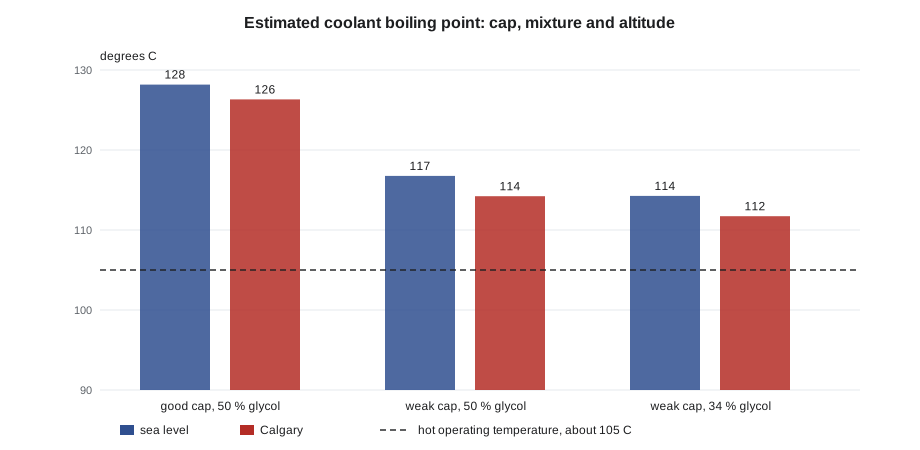
Altitude matters here as well. The cap's rating is above the surrounding atmospheric pressure, so the total pressure in the system is lower at altitude and so is the boiling point. Coolant that would just stay below boiling at sea level can boil in the mountains. And a cap whose spring has weakened lets the pressure out too early, lowering the boiling point by many degrees.
# Boiling point of the coolant for different caps, mixes and places
import math
def boils_at(total_kpa, glycol_rise):
    t = 1 / (1 / 373.15 - (8.314 / 40650) * math.log(total_kpa / 101.325)) - 273.15   # water
    return t + glycol_rise
places = [("sea level", 101.3), ("Calgary", 89.4)]           # name, air pressure (kilopascals, as the formula uses)
caps = [("cap rated 110 kPa", 110), ("van 1's weak cap, 45 kPa", 45), ("no cap (open system)", 0)]
for place, air in places:
    for cap_name, cap_kpa in caps:
        for mix, rise in (("50 % glycol", 6.0), ("34 % glycol", 3.5)):
            t = boils_at(air + cap_kpa, rise)
print(f"{place:<10} {cap_name:<28} {mix:<12} boils at about {t:5.0f} C")sea level cap rated 110 kPa 50 % glycol boils at about 128 C sea level cap rated 110 kPa 34 % glycol boils at about 126 C sea level van 1's weak cap, 45 kPa 50 % glycol boils at about 117 C sea level van 1's weak cap, 45 kPa 34 % glycol boils at about 114 C sea level no cap (open system) 50 % glycol boils at about 106 C sea level no cap (open system) 34 % glycol boils at about 103 C Calgary cap rated 110 kPa 50 % glycol boils at about 126 C Calgary cap rated 110 kPa 34 % glycol boils at about 124 C Calgary van 1's weak cap, 45 kPa 50 % glycol boils at about 114 C Calgary van 1's weak cap, 45 kPa 34 % glycol boils at about 112 C Calgary no cap (open system) 50 % glycol boils at about 102 C Calgary no cap (open system) 34 % glycol boils at about 100 C
The calculation uses a standard formula for water's boiling point, plus a typical rise for each glycol concentration; it is an estimate, but it shows the size of each effect. Van 1 combined all three problems: weak coolant, a cap that leaks pressure early, and the altitude of Calgary, on a hot day with a heavy load. Its boiling margin was a fraction of what the designers intended.
The thermostat
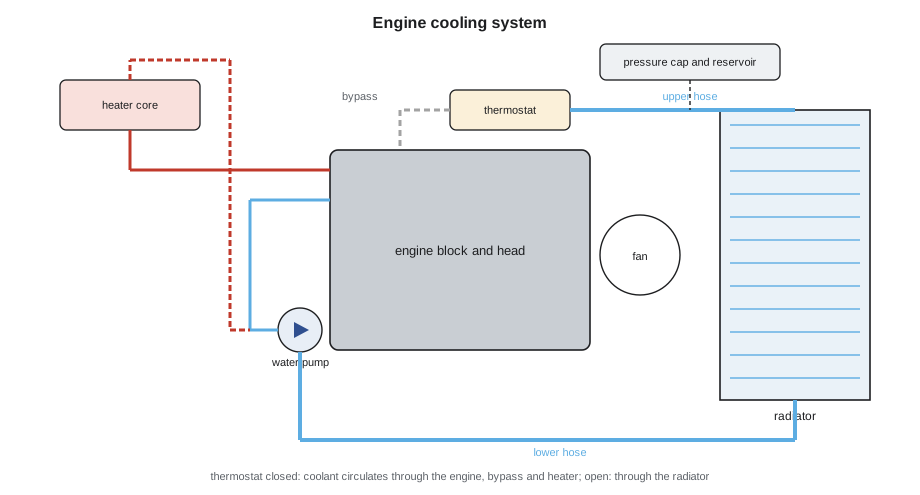
The thermostat controls the engine's temperature by controlling how much coolant goes to the radiator. It is a valve, usually in the coolant outlet from the engine or at the water pump inlet, operated by a wax pellet. When the engine is cold, the valve is closed and coolant circulates only through the engine and heater core, so the engine warms quickly. As the coolant reaches the thermostat's rated temperature, stamped on it, the wax melts and expands, pushing the valve open; it is fully open about 10 to 15 degrees higher. Many thermostats have a small bleed hole or jiggle valve that lets trapped air escape.
Many modern engines use an electronically controlled thermostat, with a heater in the wax pellet that the engine control module can switch on to open it earlier, or a fully electronic coolant control valve. These let the engine run hotter at light load for better economy and cooler at high load to prevent knock. Their faults set trouble codes, such as a thermostat performance code when the engine takes too long to reach its expected temperature.
A thermostat that sticks open makes the engine slow to warm up, especially in winter, with poor heater output and possibly a trouble code. One that sticks closed causes rapid overheating. A thermostat can be tested off the engine in a pan of water with a thermometer, watching for it to start opening at its rated temperature, or on the engine by watching the coolant temperature on a scan tool and feeling or measuring the upper radiator hose: it should stay cool until the thermostat opens and then warm quickly. Thermostats are replaced, not repaired, and never removed to cure overheating; an engine without its thermostat may run cooler at first, but coolant can flow too fast through the radiator to shed heat, and the engine runs cold the rest of the time.
Water pump, radiator, fans and heater
The water pump is a centrifugal pump driven by the accessory belt, the timing belt or chain, or on many newer engines an electric motor. An impeller draws coolant from the radiator and pushes it through the block and head. A water pump fails by leaking at its shaft seal, which shows as a wet or crusted weep hole, by bearing wear, which shows as noise and wobble in the pulley, or by impeller corrosion or breakage, which shows as overheating with no visible leak. Electric pumps, used on Ines Moreau's hybrid, can run with the engine off to keep the heater working, and the control module checks their operation.
The radiator is a heat exchanger: thin tubes carry coolant from one tank to the other, and fins between the tubes pass the heat to air flowing through. Modern radiators are aluminum with plastic tanks. They can be blocked outside by bugs, leaves and road dirt, which reduces airflow, or inside by scale and sludge, which reduces coolant flow; inside blockage shows as cold spots that can be found with an infrared thermometer. The cooling fan pulls air through the radiator when the vehicle is slow or stopped; most are electric and controlled by the engine module, while many trucks and vans use a belt-driven fan with a viscous clutch that locks up as the air from the radiator gets hot.
The heater core is a small radiator under the dashboard that heats the cabin. A leaking heater core shows as a sweet smell, a damp passenger floor or a greasy fog on the windshield. Because the heater core is often the highest point in the system, air trapped there can stop heater output and give false temperature readings.
Diagnosing overheating and coolant loss
Overheating diagnosis starts with the safest, simplest checks, done only when the engine is cold, because a hot system is under pressure and coolant above its normal boiling point will flash into steam the moment the cap is opened. Kiran checks the coolant level and condition, looks for leaks and wet spots, checks the drive belt and fan, and looks at the front of the radiator. Then she uses the pressure tester.
The pressure tester is a hand pump with a gauge that attaches to the filler neck in place of the cap. The system is pumped up to the cap's rated pressure and watched for several minutes; a falling gauge means a leak, which can then be found by looking and listening, or with dye and an ultraviolet light. The cap is tested separately on an adapter: it must hold pressure close to its rating. If no external leak is found but the system loses coolant, the coolant may be going into the engine, through a failed head gasket or a cracked head, which shows as white exhaust smoke with a sweet smell, milky oil, or bubbles in the coolant. A combustion leak tester, or block tester, draws air from the reservoir through a fluid that changes colour if it contains exhaust gas.
# Van 1: cooling system pressure test and cap test (cold engine)
cap_rating = 110                 # kPa
system_test = [(0, 110), (2, 110), (5, 108), (10, 108)]   # minutes, gauge reading with the system pumped to the cap rating
for minutes, p in system_test:
    print(f"system at {minutes:>2} min: {p} kPa")
drop = system_test[0][1] - system_test[-1][1]
print("system holds pressure: no external or internal leak found" if drop <= 5 else f"system lost {drop} kPa: find the leak")
cap_holds = 45
print(f"cap opened at {cap_holds} kPa = {cap_holds / cap_rating * 100:.0f} % of its rating:", "good" if cap_holds >= 0.85 * cap_rating else "replace the cap")system at 0 min: 110 kPa system at 2 min: 110 kPa system at 5 min: 108 kPa system at 10 min: 108 kPa system holds pressure: no external or internal leak found cap opened at 45 kPa = 41 % of its rating: replace the cap
The system holds pressure, so there is no significant leak, and the combustion leak test shows no exhaust gas in the coolant, so the head gasket has survived. The cap fails badly. Kiran also removes the thermostat and tests it in hot water; it opens at its rated temperature. The radiator's front is packed with cottonwood fluff and dirt, which she cleans out with low-pressure water from the engine side. The repair is a new cap, a complete coolant exchange to the correct mixture, and the cleaned radiator. After a road test up the same hill, the temperature stays steady.
Filling and bleeding
After any work that drains coolant, air must be removed from the system, because air pockets stop circulation and can let the head overheat locally even when the gauge looks normal. Some engines have bleed screws at high points; many vehicles are filled with a vacuum filler, which pulls the system into a deep vacuum and then lets coolant flow in, filling every passage without air. Hybrid and electric vehicles often need a scan tool procedure that runs their electric pumps and opens their valves in sequence while the system is filled. Ines Moreau's hybrid has separate cooling loops for the engine and for its inverter, and Dr. Singh's electric car has loops for its battery and drive unit; each has its own coolant specification and filling procedure, and high-voltage safety rules from AUTO-110 apply to any work near them.
Worked problem
Why did van 1 overheat?
Summarize van 1's findings and explain the overheating to Hal Osei.
Show solution
- The coolant was only about a third glycol, so its boiling point was lower than designed and its winter protection was poor.
- The cap opened at well under half of its rated pressure, so the system could not build pressure and the boiling point fell further.
- At the shop's altitude, on a hot day, climbing a long hill with a full load, the coolant boiled, and the steam pushed coolant out of the reservoir.
- The radiator was partly blocked by debris, so it shed less heat; the pump, thermostat and head gasket tested good.
- The repair is a new cap, correct coolant and a clean radiator; Hal's drivers should report any coolant top-ups so they are not hidden by adding water.
Answer: Weak coolant, a failing cap, altitude, heat, load and a dirty radiator together; corrected with a cap, a coolant exchange and cleaning.
Common mistakes
MistakeOpening a hot radiator or reservoir cap.
InsteadLet the system cool fully, and open caps slowly with a cloth.
MistakeTopping up with plain water.
InsteadUse the specified coolant at the correct mixture.
MistakeJudging coolant chemistry by colour.
InsteadUse the coolant the manufacturer specifies.
MistakeRemoving a thermostat to stop overheating.
InsteadFind the cause; an engine needs its thermostat.
MistakeSkipping the bleed procedure.
InsteadRemove air by bleeding, vacuum filling or the scan tool procedure.
Summary and key terms
- The cooling system brings the engine to temperature quickly and holds it there; running too cold is harmful too.
- Coolant is glycol, water and inhibitors; a 50 percent mix protects to about −37 °C; use the specified type.
- The pressure cap raises the boiling point; a weak cap, weak coolant and altitude all lower it.
- The thermostat opens at its rated temperature; stuck open means slow warm-up, stuck closed means overheating.
- Pumps, radiators, fans and heater cores are checked for leaks, flow and airflow.
- Pressure test the system and cap cold; check for combustion gas in the coolant; bleed air after filling.
- Coolant
- A mixture of water, glycol antifreeze and inhibitors.
- Inhibitors
- Additives in coolant that prevent corrosion.
- Thermostat
- A temperature-operated valve that controls coolant flow to the radiator.
- Pressure cap
- A cap with valves that hold system pressure and let coolant return from the reservoir.
- Degas bottle
- A pressurized coolant reservoir that also separates air from the coolant.
- Refractometer
- An instrument that measures coolant concentration from how it bends light.
- Combustion leak test
- A test for exhaust gas in the coolant, which indicates a head gasket or head leak.
Practice problems
Work each problem on paper first, then reveal the answer to check.
Why does a pressure cap raise the coolant's boiling point?
Show answer
Boiling point rises with pressure, and the cap holds the system above atmospheric pressure.
Name two symptoms of a thermostat stuck open.
Show answer
Slow warm-up, poor heater output, low temperature reading, a thermostat performance code.
A cap rated at 110 kPa opens at 60 kPa. Is it good?
Show answer
No; it opens at about 55 percent of its rating and should be replaced.
What does an electrolysis test check?
Show answer
Voltage in the coolant from lost inhibitors or poor grounds, which causes internal corrosion.
Lesson quiz · 5 questions
Score 60% or more to complete this lesson.
Create a free account to save your progress, take quizzes and earn a certificate.