
ARCH-501 · Lesson 9 of 12 · 22 min
Rehearsals
A final review is a performance as well as an examination, and performances are rehearsed. Students who would never submit an unread draft of their thesis document often walk into the final review having never spoken their presentation aloud from start to finish, and they discover in front of the panel that it runs ten minutes long, that the drawings are in the wrong order or that they cannot explain their store without notes. Leclerc schedules three rehearsals in the last two weeks: a timed run alone, a run in front of classmates, and a mock review with a faculty member who has not seen the work. 'The panel should hear your thesis for the fourth time,' she says, 'and you should be the only one who knows it.'
What a final presentation must do
At Elmhurst each student has an hour at the final review: twenty-five minutes of presentation and thirty-five of discussion. The presentation must do three things in twenty-five minutes. It must state the question and the claim so clearly that a visiting critic understands them in the first two minutes. It must walk the panel through the argument, using the drawings and models in the order the representation strategy set. And it must end by saying what the thesis has shown, its limits and what others can use, so that the discussion begins from the findings rather than from the first drawing that catches a critic's eye.
The presentation is not the thesis document read aloud, and it is not a tour of every drawing on the wall. It is an argument with evidence, spoken. Leclerc suggests that students write it as a script first, so that they can time it, and then reduce the script to a card of headings, so that they speak rather than read.
Timing the first run
Ingrid writes her script in nine parts and times it at a speaking pace of about 125 words a minute, slower than conversation, with pauses where the panel needs to look at a drawing or a model.
# Rehearsals: time each part of a 25-minute final presentation from the spoken words
pace = 125                         # words a minute, slower than conversation, with pauses at drawings
parts = [  # (part, spoken words, seconds of silence for looking at a drawing or model)
    ("the question in one minute", 140, 10),
    ("the district at night: the walk with Margaret Flett", 330, 30),
    ("what the research found", 420, 20),
    ("the network: buildings, path and people", 480, 40),
    ("the pavilion and the heat store", 520, 45),
    ("the gym and church hall as warm rooms", 380, 30),
    ("the test: 96 hours in design cold", 300, 20),
    ("limits, and what another district can use", 260, 10),
    ("close: the plain-language report", 120, 10),
]
total = 0
for name, words, pause in parts:
    t = words / pace * 60 + pause
    total += t
    print(f"{name:52s} {t / 60:4.1f} min   running {total / 60:4.1f}")
limit = 25 * 60
print(f"total {total / 60:.1f} min against 25: {'over by ' + str(round((total - limit) / 60, 1)) + ' min' if total > limit else 'within time'}")the question in one minute 1.3 min running 1.3 the district at night: the walk with Margaret Flett 3.1 min running 4.4 what the research found 3.7 min running 8.1 the network: buildings, path and people 4.5 min running 12.6 the pavilion and the heat store 4.9 min running 17.5 the gym and church hall as warm rooms 3.5 min running 21.1 the test: 96 hours in design cold 2.7 min running 23.8 limits, and what another district can use 2.2 min running 26.1 close: the plain-language report 1.1 min running 27.2 total 27.2 min against 25: over by 2.2 min
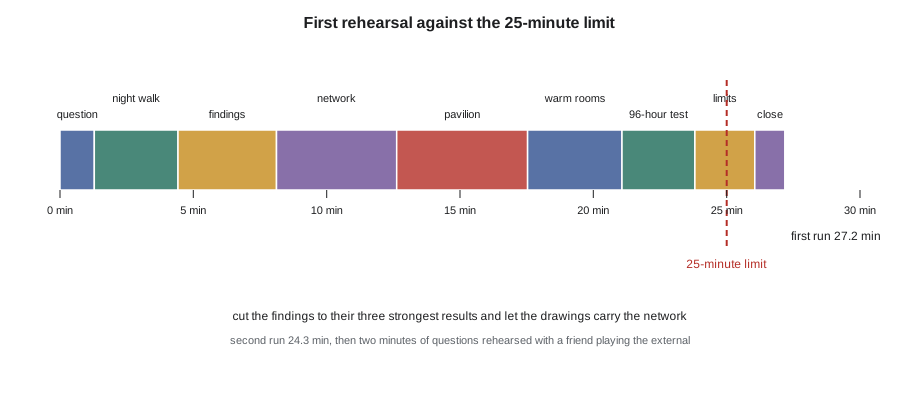
The first run comes to about 27 minutes, two over. The overrun is typical, and so is its cause: Ingrid has tried to tell the panel everything she found, and 'what the research found' takes almost four minutes. She cuts the findings to the three strongest results, each in one sentence with its number: that about 380 households in the district would need a warm place in a long outage; that most of them would go where they already go for help; and that the existing buildings, as they stand, would stay habitable for hours, not days. The rest is in the document and on the board, where the panel can read it. She also stops narrating the network plan and lets the drawing carry it, pointing to the five places in turn. The second run takes 24.3 minutes.
Leclerc warns against cutting the wrong part. Students under time pressure often cut the end, because they reach it last in every rehearsal, and so the findings and limits, which matter most, are rushed or lost. Ingrid protects the last four minutes and cuts from the middle.
Speaking to drawings
A presentation at a wall of boards has a geography: the student moves from board to board, and the panel's eyes follow. Ingrid rehearses where she will stand for each part, which drawing she will point to, and how she will move the panel's attention from the boards to the models. She practises the moment that matters most: standing beside the survivability chart and saying, slowly, 'With only 100 people on the first night, the store runs out almost exactly at the end of the fourth day. That is the limit of this design.' Abernathy, at the second rehearsal, tells her to pause after it. 'Let them see that you know where your design ends.'
She also rehearses without the drawings, in case the projector fails or a board falls, by telling the argument to Callum in five minutes in the studio kitchen. If she can tell it without pictures, she knows it.
The run in front of classmates
The second rehearsal is in front of the other three students and a few classmates from other theses, a week before the review. Each listener is given a job. One times every part. One writes down every word or phrase that a visiting critic might not understand. One writes down the three questions they would ask if they were on the panel. One watches only the speaker's body and voice: where she stands, whether she faces the panel or the wall, whether she rushes.
The list of unclear words is longer than Ingrid expected. 'Survivability' is a term of art that she has used so often she forgot it needed explaining; she adds a sentence defining it as how long a room stays habitable after the power fails. 'Warm porch' needs a picture, so she adds a small sketch to board two. 'Reserve' needs a number. The listener watching her body notes that she faces the wall when she is unsure, and the boards when she is confident, which means the panel can see her doubts. She practises turning to the panel when she is unsure.
Anticipating questions
The discussion that follows the presentation is longer than the presentation itself, and it is where theses are most often won or lost. Students cannot know every question, but most questions at a final review fall into a few kinds: questions about evidence (how do you know?), about method (why did you do it that way?), about alternatives (why not this other design?), about limits (where does it fail?), about meaning (so what, and for whom?), and about the future (what would you do next?). Leclerc asks each student to write two likely questions of each kind and a short answer, with the evidence that supports it and the drawing or page where it can be found.
Ingrid's list includes a question she dreads: 'Why should a city pay for a pavilion when it could buy portable generators?' Her answer, written and rehearsed, is that a generator heats nothing without fuel delivered through the same snowstorm that caused the outage, that it serves one building rather than a network, and that the pavilion is used every day as a laundry, which makes the warm room known and trusted before it is needed, while a generator sits in a shed. She has the numbers for fuel consumption and noise to hand. She also writes an answer she hopes not to need: 'I do not know, but this is how I would find out.' Leclerc considers it the most important answer a student can have ready.
The listeners at the second rehearsal add a question she had not anticipated: 'What happens if the outage is in a heat wave, not a cold snap?' It is a fair question for a network built around warmth, and she writes a short honest answer: the network's buildings, people and protocol would serve a heat emergency too, but the store is a heat store, and cooling would need other means; it is outside her thesis, and she names it as further work.
The mock review
The third rehearsal is a mock review three days before the final. A faculty member who has not seen the work plays the visiting critic, and a classmate plays the external examiner. Ingrid's mock critic is Professor Henrik Solberg, who taught the integrated design studio the year before and has not followed her thesis. He listens to the 24-minute presentation without interrupting and then asks the hardest question of the afternoon: 'Your network depends on volunteers keeping a list up to date every autumn. What is the evidence that they will?' Ingrid answers with the protocol she wrote with the community organization after the mid-term, the organization's existing elder call list that the check-in team builds on, and the yearly practice night. Solberg nods and says the answer belongs in the presentation, not only in the discussion. She adds a sentence to her network section.
Wren's mock review exposes a different problem. Her presentation is beautiful and well timed, but she never says her design flood level aloud, and the mock external has to ask for it. She adds it to the second minute, with the corrected gauge and the ice-jam allowance, because a panel judging a building designed to flood will want to know how high the water comes before anything else.
The day before
Leclerc's advice for the day before is practical. Pin up and check the boards in the review room, with the models in place, and walk the presentation once in the room itself. Print a copy of the abstract and the findings chapter for each panel member. Charge the laptop and bring a printed copy of any projected images. Sleep. And decide in advance what to do if something goes wrong: if a model breaks, say so and carry on; if a question cannot be answered, say so and say how it could be.
Worked problem
Cutting a presentation to time
Joon-ho's first timed run is 28.5 minutes against a 25-minute limit. His three longest parts are the survey of thirty office buildings (5.0 minutes), the Lindell Building's history (3.5 minutes) and the daylight models (4.5 minutes). He must keep at least four minutes for his findings at the end. What should he cut?
Show solution
- He must lose 3.5 minutes, plus a little margin, say 4 minutes.
- The findings are protected, so cuts come from the middle.
- The building's history supports the argument least directly: cut it to 1 minute, saving 2.5.
- The survey can be shown as a single chart of the thirty buildings sorted by plate depth: cut it to 3.5 minutes, saving 1.5.
- Total saved: 4 minutes, giving a run of about 24.5 minutes.
Answer: Cut the history to about a minute and the survey to about three and a half minutes, keeping the daylight models and findings.
Exercise 9: rehearse three times
- Write your presentation as a script in parts, time it at about 125 words a minute with pauses, and cut from the middle until it fits.
- Reduce the script to a card of headings, and rehearse speaking from the card and from the drawings.
- Run it in front of classmates with assigned jobs: timing, unclear words, likely questions, voice and body.
- Write two likely questions of each kind with short answers and where the evidence is.
- Hold a mock review with someone who has not seen the work, and change the presentation in response.
Self-check
- Do your last four minutes state your findings, limits and what others can use?
- Can you tell your argument in five minutes without any drawings?
Common mistakes
MistakeNever speaking the presentation aloud before the review.
InsteadRehearse at least three times, timed, with listeners.
MistakeCutting the end of the presentation to save time.
InsteadProtect the findings and cut from the middle.
MistakeReading the script or the boards aloud.
InsteadSpeak from a card of headings and let the drawings carry detail.
MistakeUsing terms the panel may not know.
InsteadAsk listeners to note unclear words, and define each one briefly.
MistakeHaving no answer ready for a question you cannot answer.
InsteadPrepare to say you do not know and how you would find out.
Summary and key terms
- Final presentations are rehearsed three times: alone and timed, in front of classmates with jobs, and in a mock review.
- In twenty-five minutes a presentation must state the question and claim, walk the argument and end with findings and limits.
- Ingrid's first run was two minutes over; she cut the findings to the three strongest results and protected the end.
- Listeners found unclear terms, such as survivability, and the habit of facing the wall when unsure.
- Most questions concern evidence, method, alternatives, limits, meaning and the future; prepare two of each.
- The mock review moved Ingrid's answer about volunteers into the presentation and Wren's flood level into her second minute.
- Rehearsal
- A practice run of a presentation, timed and heard by others before the review.
- Script
- A written version of a presentation, used for timing before reducing it to headings.
- Mock review
- A practice review with someone who has not seen the work, playing a visiting critic.
- Term of art
- A word with a special meaning in a field, which outsiders may not know.
- Speaking pace
- Words spoken per minute; about 125 suits a presentation with pauses.
- Further work
- Questions a thesis names as beyond its scope but worth pursuing.
Practice problems
Work each problem on paper first, then reveal the answer to check.
How long is each student's final review, and how is it divided?
Show answer
An hour: twenty-five minutes of presentation and thirty-five of discussion.
How long was Ingrid's first run, and how did she fix it?
Show answer
About 27 minutes; she cut the findings to the three strongest results and let the network drawing carry itself.
Why should the end of a presentation be protected?
Show answer
It holds the findings and limits, which matter most and are lost when students cut the end.
What jobs do listeners have at the second rehearsal?
Show answer
Timing, unclear words, likely questions, and watching voice and body.
How did Ingrid answer the question about portable generators?
Show answer
A generator needs fuel delivered through the storm, serves one building, and sits unused; the pavilion is used every day and makes the network known.
What problem did Wren's mock review expose?
Show answer
She never said her design flood level aloud.
Lesson quiz · 5 questions
Score 60% or more to complete this lesson.
Create a free account to save your progress, take quizzes and earn a certificate.