
ARCH-501 · Lesson 10 of 12 · 21 min
Final review
The final reviews run from Wednesday 7 to Friday 9 April in the school's large review hall, with the boards pinned along one wall and the models on low plinths in front of them. Each student has an hour before a panel made up of their committee, the thesis coordinator and two visiting critics who have not seen the work before. The reviews are open: other students, families, friends and, for theses like Ingrid's and Wren's, members of the communities the work is about, sit in rows behind the panel. After each review the panel meets privately and decides the outcome.
This lesson follows the four reviews, what the panels asked and decided, and how a student should conduct themselves in the most important hour of their education so far.
How a final review is judged
Leclerc gives the panel, and the students, the same short list of what the review judges. Is the question clear and worth asking? Is the research sound, with methods suited to the question and ethics respected? Does the design answer the question, and is it resolved where the argument depends on it? Are the claims supported by evidence, with limits stated? Is the thesis communicated clearly in drawings, models, words and speech? And does it contribute something others can use? The outcome at Elmhurst is one of four: pass with distinction, pass, pass with revisions to the document, or not yet passed, with a resubmission later in the year.
A final review is not a contest between the student and the panel. The visiting critics are there to test the work, and the best of them do so by taking it seriously enough to push on it. A student who treats every question as an attack spends the hour defending instead of discussing. Leclerc's advice: 'Answer the question asked, with the evidence you have, and when you do not know, say so and say how you would find out.'
Ingrid's review
Ingrid's review is on Thursday morning. The visiting critics are an architect who designs community buildings in northern and remote places, and a director of emergency management from a city several hours' drive away. Margaret Flett sits in the front row behind the panel with three members of the community organization's board; Ingrid presented the community report at the hub the week before, as her protocol required, so they already know what she found.
Her presentation runs 24 minutes. She opens with the district at night and the question; walks the network on the plan; shows the pavilion, the store and the gym; and stops beside the survivability chart to say where the design ends. She closes with the method another district could use and the plain-language report, and she leaves her final slide up: the network's targets and what she achieved.
# Final review: Ingrid's targets from the proposal, against the results she can defend
results = [  # (target, required, achieved, higher is better)
    ("lowest warm room temperature in a 96 h outage, °C", 12, 13.9, True),
    ("minutes until medical charging is open", 60, 15, False),
    ("high-need zones within a 10-minute walk at 0.8 m/s, %", 100, 91, True),
    ("people supported on the worst night", 380, 335, True),
    ("people supported on night one, before word spreads", 250, 280, True),
    ("pavilion embodied carbon, kg CO2e per m2", 300, 240, False),
    ("loads washed a week in the laundry (everyday use)", 250, 260, True),
]
met = 0
for name, req, got, up in results:
    ok = got >= req if up else got <= req
    met += ok
    print(f"{'met ' if ok else 'not '} {name:58s} target {req:>6}  result {got:>6}")
print(f"{met} of {len(results)} targets met")met lowest warm room temperature in a 96 h outage, °C target 12 result 13.9 met minutes until medical charging is open target 60 result 15 not high-need zones within a 10-minute walk at 0.8 m/s, % target 100 result 91 not people supported on the worst night target 380 result 335 met people supported on night one, before word spreads target 250 result 280 met pavilion embodied carbon, kg CO2e per m2 target 300 result 240 met loads washed a week in the laundry (everyday use) target 250 result 260 5 of 7 targets met
Five of the seven targets are met, and she says so before the panel can. The two she missed are both about reach: 91 of every 100 high-need zones are within a ten-minute walk of a warm place, not all of them, because of the western blocks; and the network supports about 335 people on the worst night, against a high estimate of 380 in need. 'The buildings cannot reach the western blocks,' she says. 'The check-in team and warm porches are meant to, and I cannot yet prove they will.'
The emergency manager's first question is the generator question she had rehearsed, and her answer is short and clear. His second is one she had not expected: 'Have you told the utility?' She has not; her thesis treats the outage as a given. He tells her that in his city the utility restores power first to places like warming centres, if it knows where they are, and that a network listed with the utility might shorten its own outage. Ingrid writes it down and says it belongs in her further work, and that she will add it to the community report. The northern architect asks about maintenance: who replaces the felt when it wears, who services the pump, who pays. Ingrid answers from her operating protocol and admits that the pump's service contract is unresolved.
Okonkwo, her external committee member, asks the question the panel discusses longest: whether the network is a design at all, or a plan for emergency services with some buildings attached. Ingrid answers that the buildings are designed to be used every day, the gym as a gym, the pavilion as a laundry and waiting room, the hall as a hall, and that the design's work is to make each of them able to become a warm room within an hour, with dignity, and to stay one for four days. 'The network is a design because every one of its parts was shaped by what it must do on the worst night,' she says, 'and by what it must be on all the others.' Morningstar, who has said little, says afterward that it was the sentence of the morning.
The panel's decision
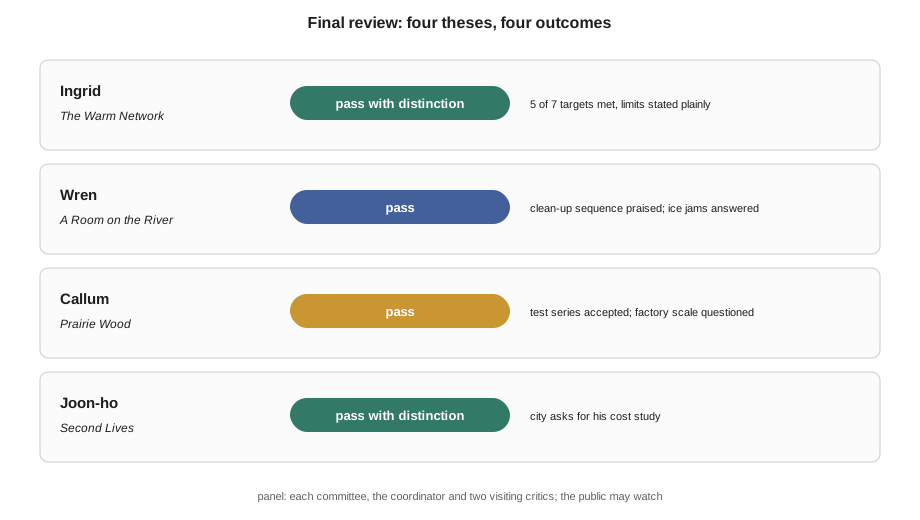
After the hour, the panel meets for twenty minutes. Leclerc summarizes their reasoning to Ingrid afterward. The question is important and clearly asked; the research is careful, calibrated and ethical, and the results-return protocol is exemplary; the design answers the question at the scale where it is asked and is resolved where it matters; the limits are stated honestly, with numbers; and the method is useful beyond the district. Weaknesses: the volunteer side of the network rests on less evidence than the buildings, and the utility question should have been asked. The outcome is a pass with distinction, with two small additions to the deposited document: a paragraph on listing the network with the utility, and a fuller account of the pump's maintenance.
The other reviews
Wren's review, on Wednesday afternoon, is the most beautiful of the four and the one where the panel pushes hardest on a single point. Her six-panel drawing of the spring clean-up, from water on the terrace to the first boat out, is praised by everyone; the city hydrologist, her reader from outside, calls it the first drawing of a flood he has seen that shows what happens after. The push comes from a visiting critic, a landscape architect, who asks why the building is on the river at all, given that the neighbourhood could have a riverside park without a building. Wren answers from her research: the park exists already and is empty most of the year, because there is nowhere warm, dry or staffed on it; the building is what makes the river usable in every season. The panel accepts the answer but asks for more evidence of use, and the outcome is a pass.
Callum's review is the most technical. His full-size bay of aspen floor and his broken specimen, on a plinth in front of the boards, draw the panel in before he begins. The visiting critics, an engineer from a mass timber manufacturer and an architect, accept his test series and his specified strength, with the engineer noting that a commercial product would need several hundred specimens and third-party certification. The push is on the factory: whether a small plant two hours north of the city could make enough to matter, and whether its jobs and wood supply would last. Callum's estimate of the forest area is accepted, but his business case is thin. The outcome is a pass.
Joon-ho's review is the quietest and, to the panel's surprise, the most consequential. His survey of thirty office buildings, sorted by floor-plate depth, gives the city something it does not have: a list of which buildings could become homes cheaply, which only with radical cuts, and which not at all. A planner from the city's housing office, sitting in the public rows at the invitation of a panel member, asks after the review for a copy of the survey and the cost study. The developer on his committee, who doubted him all year, says the slots pay for themselves on his numbers too. The outcome is a pass with distinction.
Conducting yourself at a final review
Leclerc's advice for the hour itself is gathered from many reviews. Listen to the whole question before answering, and if it is unclear, ask for it again. Answer briefly, point to the evidence on the wall, and stop; a short answer invites a follow-up, a long one ends the conversation. Do not defend what cannot be defended; agree that it is a weakness and say how it could be strengthened. Take notes, or ask a friend to, because the comments at a final review are the best advice on the work you will ever get. Thank the panel, and thank the people who took part in your research if they are in the room.
She also reminds the students that a final review is not the end of the thesis. The document is revised after it and deposited, and the panel's comments, the utility question, the pump contract, the evidence of use, the business case, are written into the revision.
Worked problem
Counting the targets met
Ingrid's targets are: warm room above the limit for 96 hours; charging open within 60 minutes; all high-need zones within a ten-minute walk; 380 people supported on the worst night; 250 supported on the first night; pavilion embodied carbon under 300 kg per m²; 250 laundry loads a week. Her results are: above the limit; 15 minutes; 91 of every 100 zones; 335 people; 280 people; 240; 260 loads. Which targets are met?
Show solution
- Temperature: above the limit, met.
- Charging: 15 minutes is under 60, met.
- Walk: 91 of 100 zones is short of all of them, not met.
- Worst night: 335 is short of 380, not met.
- First night: 280 is above 250, met.
- Carbon: 240 is under 300, met.
- Laundry: 260 is above 250, met.
Answer: Five of seven are met; both misses concern the network's reach.
Exercise 10: prepare to be judged
- Read the review criteria and write one sentence on how your thesis meets each.
- Make a final slide or panel of your targets and results, met and not met.
- Say your limits before the panel finds them.
- At the review, listen to each whole question, answer briefly with evidence, and stop.
- Afterward, write every comment into a revision plan for the deposited document.
Self-check
- Is there anything in your thesis you hope the panel will not ask about? Prepare that answer first.
- Have you thanked the people who took part in your research?
Common mistakes
MistakeTreating the panel's questions as attacks.
InsteadTreat them as the panel taking your work seriously, and discuss.
MistakeLong answers that end the conversation.
InsteadAnswer briefly with evidence and stop.
MistakeDefending a weakness that cannot be defended.
InsteadAgree, and say how it could be strengthened.
MistakeHiding missed targets.
InsteadState them, with the reason and what would close the gap.
MistakeTreating the final review as the end.
InsteadWrite the comments into the revision of the document.
Summary and key terms
- The final review judges the question, research, design, evidence, communication and contribution; outcomes range from distinction to not yet passed.
- Ingrid met five of seven targets and stated the two misses, both about reach, before the panel could.
- New questions, such as listing the network with the utility, became further work and additions to the document.
- Her answer that every part of the network is shaped by the worst night and by every other night defended it as a design.
- Wren and Callum passed, with requests for evidence of use and a stronger business case; Joon-ho passed with distinction and the city asked for his study.
- Answer the question asked, briefly and with evidence; say when you do not know and how you would find out.
- Final review
- The examination of a thesis before a panel, with presentation and discussion.
- Pass with distinction
- The highest outcome of a thesis review, for exceptional work.
- Pass with revisions
- An outcome requiring changes to the thesis document before it is deposited.
- Visiting critic
- A reviewer from outside the school who sees the work for the first time at the final review.
- Further work
- Questions a thesis names as beyond its scope but worth pursuing.
- Deposited document
- The final, revised thesis document placed in the archive.
Practice problems
Work each problem on paper first, then reveal the answer to check.
What are the four possible outcomes at Elmhurst?
Show answer
Pass with distinction, pass, pass with revisions to the document, or not yet passed.
Which of Ingrid's targets were missed, and why?
Show answer
The ten-minute walk to all high-need zones and support for 380 people; both because the buildings cannot reach the western blocks.
What did the emergency manager suggest?
Show answer
Listing the network with the utility, which might restore power to it first.
How did Ingrid answer whether the network is a design?
Show answer
Every part was shaped by what it must do on the worst night and what it must be on all the others.
What did the panel ask Callum to strengthen?
Show answer
His business case for the factory.
Why was Joon-ho's review the most consequential?
Show answer
His survey and cost study gave the city a list of offices that could become homes, and a city planner asked for them.
Lesson quiz · 5 questions
Score 60% or more to complete this lesson.
Create a free account to save your progress, take quizzes and earn a certificate.