
ARCH-440 · Lesson 7 of 12 · 21 min
Cultural buildings
Professor Morningstar takes the class to a museum for the seventh week. They spend the first hour in the galleries without her, each asked to find one object and answer three questions: who made it, who chose to display it and who tells its story on the label. When they meet in the lobby, Joon-ho has chosen a beaded bag, and he reports that the label names the nation it came from but not the woman who made it, and that it was collected in 1910 by a missionary. Wren chose a contemporary painting whose label was written by the artist. Ingrid chose a model of a sod house, explained by a curator. 'Every museum is an argument about who gets to tell whose story,' the professor says. 'So is every cultural building. Today we look at how architects shape that argument.'
Cultural buildings include museums, galleries, libraries, theatres, concert halls, archives, community cultural buildings, places of worship and buildings for ceremony and gathering. They hold a special place in a city's architecture: they are often its most ambitious buildings, they represent the identity of a community and they are where people encounter art, history and one another. In ARCH-220 you studied the iconic museum and the Bilbao effect. This lesson looks at cultural buildings from the side of the communities whose cultures they hold, and at the design of smaller cultural buildings that communities build for themselves.
The museum and its history
The public museum grew out of the cabinets of curiosities of European collectors and the royal collections opened to the public after the French Revolution, when the Louvre became a public museum in 1793. In the nineteenth century, museums of natural history and anthropology collected objects, and sometimes human remains, from colonized peoples around the world, often without consent, and displayed them as specimens of supposedly primitive cultures, frequently in the same halls as fossils and animals. Their buildings, often in classical styles, presented the collecting nation as the heir of civilization. Many of the Indigenous objects in North American and European museums today were acquired in this period, some through purchase or gift and many through theft, coercion or the confiscation of ceremonial items when ceremonies were banned.
Since the 1970s, museums have been transformed by demands from the communities whose objects they hold. In Canada, the 1992 report of the Task Force on Museums and First Peoples, created after protests over a 1988 exhibition, called for partnership with First Nations in exhibitions, collections and repatriation, and the United Nations Declaration on the Rights of Indigenous Peoples, now affirmed in Canadian law, recognizes the right to the repatriation of ceremonial objects and human remains. Museums now increasingly invite communities to curate exhibitions, to decide how objects are stored and handled, and to use objects in ceremonies.
These changes have architectural consequences. Collections storage may need rooms where communities can visit and care for objects in private, with spaces for smudging or other ceremonies and ventilation to allow it. Exhibitions may give community voices the first word. Some objects should not be displayed at all. And some communities choose to build their own cultural buildings, holding their own collections and telling their own stories.
Buildings that tell their own stories
Community-led cultural buildings take many forms. The National Museum of the American Indian in Washington (2004), which you met in Lesson 3, was planned through years of consultation with Native nations, and its exhibitions were curated with community curators from many nations. In New Zealand, the national museum Te Papa Tongarewa (1998) was founded on a bicultural partnership between Māori and the Crown, and it includes a working marae, a Māori meeting place, inside the museum. Across Canada, Indigenous communities have built cultural buildings in their own territories, from small museums and language buildings to gathering places, and in cities, Indigenous friendship centres, founded from the 1950s onward, have long served as cultural and social homes for urban Indigenous people.
Cultural buildings for other communities raise similar questions. The Smithsonian's National Museum of African American History and Culture in Washington (2016), designed by a team led by Freelon Adjaye Bond with SmithGroup, wraps its galleries in a bronze-toned screen whose pattern recalls ironwork made by enslaved African Americans in the South, and its visitors begin the history underground and rise toward light. Smaller community museums, such as neighbourhood history museums founded by immigrant communities, often occupy converted buildings and depend on volunteers, but they preserve histories that larger institutions overlooked.
Designing for living culture
Culture is practised, not only displayed. Many community cultural buildings are less about showing objects than about making space for living culture: language classes, ceremonies, feasts, dances, crafts, storytelling, music and the passing of knowledge from Elders to young people. Their programs often include a large gathering space that can hold a whole community for a feast or a dance; a kitchen big enough to cook for hundreds; rooms for Elders, often warm, quiet and close to the entrance; workshops for crafts such as beadwork, carving, drum-making and canoe building, with ventilation and sinks; spaces for children; and outdoor spaces for fires, gardens of traditional plants and ceremonies.
Some of these spaces have specific technical needs. Smudging, the burning of sacred medicines such as sage, sweetgrass, cedar or tobacco, is practised in many First Nations and Native traditions, and buildings that host it need ventilation designed to clear smoke and an agreed procedure with the fire alarm system so that smudging does not trigger alarms, rather than a ban. Kitchens may need to prepare traditional foods such as wild game and fish. Gathering halls may need a floor suitable for dancing, sound systems for drum groups and doors wide enough for large items. Archives and collections need stable temperature and humidity. A good program comes from the community's own description of what it does, not from a generic list.
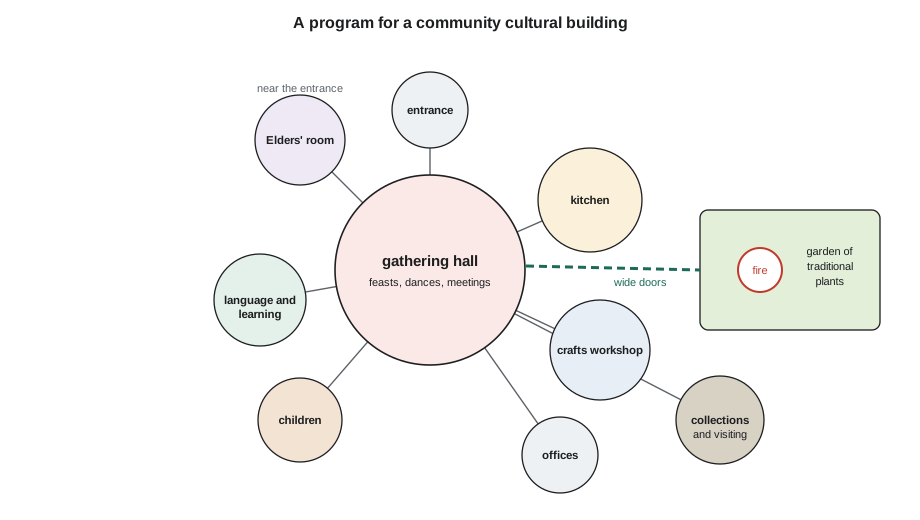
The following script tallies a draft program like the one in the figure, adds circulation and services and estimates the extra exhaust air needed for smudging in the gathering hall and the Elders' room.
# Program area for a small community cultural building, with smudging exhaust
rooms = {                      # net areas (m2)
    "gathering hall": 260, "kitchen": 55, "Elders room": 35, "crafts workshop": 60,
    "language and learning": 45, "children": 40, "collections and visiting": 50,
    "offices": 40, "washrooms and storage": 70,
}
net = sum(rooms.values())
gross = net * 1.30             # walls, corridors, mechanical and entrance
print(f"net area {net} m2, gross area {gross:.0f} m2")
# smudging: extra exhaust to clear smoke quickly, as air changes per hour
height = 6.0                   # hall height (m)
for room, h, ach in [("gathering hall", height, 6), ("Elders room", 2.8, 8)]:
    volume = rooms[room] * h
    flow = volume * ach / 3600   # m3 per second
print(f"{room}: volume {volume:.0f} m3, {ach} air changes per hour = {flow:.2f} m3/s")net area 655 m2, gross area 852 m2 gathering hall: volume 1560 m3, 6 air changes per hour = 2.60 m3/s Elders room: volume 98 m3, 8 air changes per hour = 0.22 m3/s
The gross area, about 850 m², gives the community and the cost consultant a first sense of scale. The exhaust figures tell the mechanical engineer that smudging needs a dedicated, switchable exhaust rather than the normal ventilation rate, and they open the conversation with the fire officials about procedure. Numbers like these are a starting point for discussion with the community, not a substitute for it.
Symbol, form and meaning
Cultural buildings are expected to express identity, and this creates a temptation to rely on symbols: a building shaped like an animal, a canoe, a drum or a feather. Some symbolic forms work powerfully, especially when the community chose them and understands them, as with the eagle roof of Thunderbird House. Others become clichés or, worse, borrow sacred forms that should not be used as architecture. The critic Kenneth Frampton, whose critical regionalism you studied, warned against scenographic regionalism, the use of local images as decoration. A more lasting approach expresses culture through the ways a building is used, its relationship to the land, its materials, its light and its craft, as much as through its outline.
Craft offers a particularly rich route. Many cultural buildings incorporate the work of community artists and makers: carved posts, beadwork patterns translated into metal screens, woven surfaces, murals and handmade objects. Involving artists early, paying them properly and giving them real scope, rather than adding art at the end, produces buildings in which culture is built in rather than applied. It also keeps money and skills in the community.
| Strategy | Example of approach | Risk |
|---|---|---|
| Symbolic form | A roof shaped like an animal chosen by the community | Cliché or misuse of sacred forms |
| Relationship to land | Orientation to the east, views to water, gardens of traditional plants | Generic if not specific to the nation and site |
| Program for living culture | Gathering hall, kitchen, Elders' room, workshops | Underfunded compared with display space |
| Craft and art | Community artists shape screens, posts and surfaces | Art added late as decoration |
| Community control | The community owns and runs the building | Funding for operations, not only construction |
Operating and sustaining cultural buildings
A cultural building that a community cannot afford to run is a burden, not a gift. Iconic buildings often attract capital funding from governments and donors, while the money for staff, programs, heating and maintenance is much harder to find. Architects can help by designing buildings that are durable, efficient and simple to maintain, by sizing spaces to the community's real programs and by allowing the building to earn income through rentals, a café or shared offices. Designing for operations is part of respecting the community.
Worked problem
Programming a cultural building with the community
Joon-ho is helping an urban Indigenous organization program a small cultural building. His first draft, based on museum precedents, gives half the area to galleries. How should he revise it?
Show solution
- Ask the organization to describe what it does in a typical week and year: classes, feasts, ceremonies, programs and visitors.
- Map the activities to spaces and estimate how many people each involves and how often.
- Discover, through the conversation, that the gathering hall, kitchen and workshops are used daily, while display is occasional.
- Rebalance the program: a large gathering hall with display walls, a full kitchen, workshops, an Elders' room and a small collections room for objects cared for by the community.
- Confirm the program with staff, participants and Elders before sketching any form.
Answer: The revised program gives most of the area to living culture and makes display one use of the gathering hall. It fits the organization's work rather than a museum model.
Exercise 7: who tells the story?
This exercise takes about three hours.
- Visit a museum or cultural building in your city and choose five objects or displays.
- For each, record who made it, how it was acquired if stated, and whose voice tells its story.
- Sketch the plan of one gallery and note where community voices appear and where they are absent.
- Deliverable: a table of findings, the sketch and a 500-word proposal for how the building or exhibition could share authority with the communities represented.
Self-critique checklist
- Have I considered who owns and controls the stories and objects?
- Have I given living culture as much attention as display?
- Have I avoided borrowing sacred forms as symbols?
- Have I thought about how the building will be operated and paid for?
Collections care and community access
Collections rooms in community cultural buildings differ from those in conventional museums. A conventional store is designed for preservation and security: stable temperature and humidity, low light, locked doors and limited access. A community store must also allow access by the people to whom the objects belong. Communities may want to handle objects, use them in ceremonies, feed or smudge them, or keep some objects apart from others according to protocols such as separating items used by men and by women. Designs that provide a private visiting room next to the store, with a sink, good light, a large table and ventilation for smudging, and that allow some objects to leave the building for ceremonies and return, support these practices. Conservators and community members increasingly work together to balance preservation with living use, recognizing that for many communities an object kept unused in a box is not being cared for at all.
Common mistakes
MistakeProgramming a cultural building like a generic museum.
InsteadStart from what the community does: gathering, cooking, teaching, ceremony and making.
MistakeBanning smudging because of fire alarms.
InsteadDesign dedicated exhaust and agree procedures with fire officials so that ceremonies can take place.
MistakeAdding community art at the end.
InsteadInvolve artists from the start and give them real scope and fair pay.
MistakeDesigning a building the community cannot afford to run.
InsteadDesign for durability, efficiency, simple maintenance and income where appropriate.
Summary and key terms
- Cultural buildings hold a community's identity and decide who tells whose story.
- Museums collected Indigenous objects and remains under colonialism; repatriation and community curation are transforming them.
- Community-led cultural buildings make space for living culture: gathering, cooking, teaching, ceremony and making.
- Technical needs such as smudging exhaust, kitchens, dance floors and collections climate come from the community's practices.
- Identity is best expressed through use, land, materials, craft and community control, not borrowed symbols alone.
- Repatriation
- The return of objects or human remains to the communities from which they were taken.
- Community curation
- Exhibitions developed and voiced by members of the communities represented.
- Smudging
- The burning of sacred medicines such as sage, sweetgrass, cedar or tobacco for cleansing and prayer.
- Marae
- A Māori meeting place, including a meeting house and the space in front of it.
- Scenographic regionalism
- The use of local images as decoration, criticized by Frampton.
Practice problems
Work each problem on paper first, then reveal the answer to check.
Why do many museums hold Indigenous objects acquired without consent?
Show answer
Under colonialism they collected objects and remains through theft, coercion, confiscation of banned ceremonial items and unequal exchanges.
What did the 1992 Task Force on Museums and First Peoples call for?
Show answer
Partnership with First Nations in exhibitions, collections and repatriation.
Name four spaces commonly needed for living culture in a community cultural building.
Show answer
A gathering hall, a large kitchen, an Elders' room, craft workshops, children's spaces and outdoor fire and garden spaces.
How should a building accommodate smudging?
Show answer
With dedicated, switchable exhaust and an agreed procedure with the fire alarm system.
Why is designing for operations part of respecting a community?
Show answer
Because a building the community cannot afford to staff, heat and maintain becomes a burden.
Lesson quiz · 5 questions
Score 60% or more to complete this lesson.
Create a free account to save your progress, take quizzes and earn a certificate.