
ARCH-440 · Lesson 11 of 12 · 21 min
Ethics of representation
Professor Morningstar starts the eleventh session by projecting four images without comment. The first is a competition rendering of a new community building: bright sun, green trees and a crowd of slim, smiling young people, most of them white, holding coffee cups. The second is a photograph from an architecture magazine of a remote village, beautifully composed, in which the only person visible is a child in ragged clothes looking at the camera. The third is a poster for a cultural event that uses a feather headdress as decoration. The fourth is a page from a studio portfolio, in which a student has drawn a site plan of a First Nation, with the sacred site of the community marked and labelled in detail. 'Each of these images was made by someone who meant well,' she says. 'Each of them is a problem. By the end of today you should be able to say why, and what you would do instead.'
Architects represent constantly. They draw, render, photograph, model, map, name, describe and publish, and their images shape how clients, communities, juries and the public imagine places and people. Representation is never neutral: it decides who appears and who does not, how people are shown, whose names and words are used and who benefits from the images. This lesson examines the ethics of representation in architecture: of people, of places, of cultures and of knowledge.
Who appears in the picture
Architectural renderings are populated by figures, often cut-out people taken from online libraries, and those figures carry messages. For decades, the default rendering showed young, able-bodied, affluent, mostly white people, often in clothes and activities that signalled a lifestyle the project was selling. When a rendering for a public library in a diverse, low-income neighbourhood shows only such figures, it tells existing residents that the building is not for them, and it tells decision-makers a false story about who will use it. Representing people honestly means showing the people who live in the area and who will use the building, including children, Elders, people with disabilities, people of different cultures and people doing the ordinary things they will do there, in every season.
Honest representation also concerns the place itself. Renderings routinely show buildings in summer sunshine with lush trees that will take twenty years to grow, empty streets without cars, and neighbouring buildings faded out. In Winnipeg, a public building will spend almost half the year in cold and snow; a rendering that never shows winter hides how the building will actually be experienced, and whether its entrances, paths and public spaces work when it is cold and dark at five in the afternoon. Showing the building in winter, at night and in use, with its real neighbours, is more honest and often more persuasive.
The following script performs a simple audit of the people shown in a set of renderings, comparing them with the population of the neighbourhood that the building will serve. Such audits are crude, but they make unconscious patterns visible.
# Audit of the people shown in a set of renderings, against the neighbourhood
neighbourhood = {"children": 0.24, "older adults": 0.15, "uses mobility aid": 0.08, "in winter clothing": 0.45}
renderings = [   # counts of figures with each attribute, and the total figures, per image
    {"total": 22, "children": 1, "older adults": 0, "uses mobility aid": 0, "in winter clothing": 0},
    {"total": 18, "children": 2, "older adults": 1, "uses mobility aid": 0, "in winter clothing": 0},
    {"total": 25, "children": 3, "older adults": 1, "uses mobility aid": 1, "in winter clothing": 0},
]
total = sum(r["total"] for r in renderings)
print(f"{'attribute':20s} {'area':>6s} {'shown':>6s}")
for k, share in neighbourhood.items():
    shown = sum(r[k] for r in renderings) / total
    flag = "  under-represented" if shown < share / 2 else ""
print(f"{k:20s} {share:6.0%} {shown:6.0%}{flag}")attribute area shown children 24% 9% under-represented older adults 15% 3% under-represented uses mobility aid 8% 2% under-represented in winter clothing 45% 0% under-represented
In this example, children, older adults, people using mobility aids and anyone in winter clothing are badly under-represented. The fix is not a quota of figures but a habit of asking, for every image, whether it shows the building's real users, in its real climate.
Representing other people's places
When architects and photographers represent places outside their own experience, especially poor, rural or Indigenous communities, they face a particular danger: turning people into a picturesque backdrop or a symbol of need. The literary scholar Edward Said, in Orientalism (1978), showed how European writers and artists represented the peoples of the Middle East and Asia as exotic, timeless and inferior, an image that served colonial power. Rudofsky's Architecture Without Architects, which you met in Lesson 2, has been criticized for a gentler version of the same habit, presenting other people's homes as beautiful forms without their inhabitants or names. Images of poverty used to raise funds or win awards, sometimes called poverty porn, reduce people to their suffering and deny them dignity and agency.
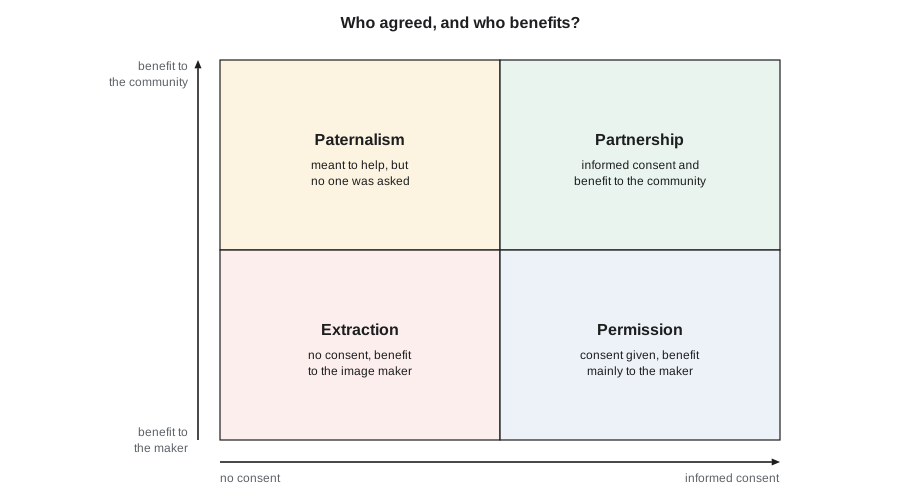
Better practice treats people in images as subjects with names, voices and their own views of their places. It means asking permission before photographing people and their homes, explaining how images will be used and respecting refusals. It means showing people as active, not only as needy. It means naming communities as they name themselves and crediting them. And it means asking whether some places, such as ceremonial sites, should be photographed or published at all.
Culture, symbols and appropriation
Cultural appropriation is the taking of elements of a culture, especially a marginalized one, by members of a dominant culture, without permission, understanding or credit, often for profit or prestige. In architecture it appears when designers borrow forms, patterns and symbols, such as sacred designs, ceremonial structures, clan crests or headdresses, as decoration. The problem is not that cultures influence one another, which they always have, but the imbalance of power: the borrowing culture gains while the source community, which may have been forbidden to practise the same culture, gains nothing and may be harmed. Cultural exchange becomes appreciation rather than appropriation when it is invited, understood, credited and shared.
Indigenous peoples assert rights over their cultural heritage and knowledge. The United Nations Declaration on the Rights of Indigenous Peoples, adopted in 2007, affirms in Article 31 the right of Indigenous peoples to maintain, control, protect and develop their cultural heritage, traditional knowledge and traditional cultural expressions. Copyright and design law protect individual works for limited periods, but they do a poor job of protecting the collective, ancient knowledge of a nation. Canada's laws offer few specific protections for traditional cultural expressions, so communities rely on agreements, protocols and the good faith of designers. For architects, the practical rule is simple: do not use Indigenous designs, patterns or symbols without the authorization of the community and, where appropriate, the individuals who hold rights to them, and credit and compensate the people involved.
| Practice | Appropriation | Appreciation or partnership |
|---|---|---|
| Using a pattern | Copying a pattern from a book onto a façade | Commissioning a community artist to create one, with credit and pay |
| Naming | Choosing an Indigenous word that sounds good | The community chooses the name, its spelling and its meaning |
| Form | A building shaped like a ceremonial structure | A form the community proposes and understands |
| Images | Photographing ceremonies for a portfolio | Photographing only what the community agrees, and sharing the images |
| Credit | The firm takes credit for community knowledge | Community members and Knowledge Keepers are credited by name, with consent |
Knowledge, maps and data
Representation includes knowledge. Architects working with communities gather stories, place names, plant knowledge, oral histories and maps of sensitive places, and they record them in reports, drawings and databases. Some of this knowledge is public; some is restricted to certain people, seasons or ceremonies; some, such as the locations of burial grounds, sacred sites or medicine plants, could be harmed by publication. The student's site plan in the professor's fourth image, marking a sacred site in detail, could expose it to visitors or vandals. As Lesson 6 discussed, principles such as OCAP and CARE give communities authority over information about them. In practice, agree before collecting knowledge how it will be recorded, stored, used and returned, and remove or generalize sensitive information from anything published.
Maps are especially powerful. The colonial survey map, as Lesson 4 showed, represented land as empty parcels. Indigenous communities and their allies have developed counter-mapping, making their own maps with their own names, trails, histories and uses of land, to support land claims, planning and education. Architects can support counter-mapping and use community maps, with permission, in their work, while respecting decisions about what the maps show and who sees them.
Naming and language
Words represent too. Use the names that peoples and communities use for themselves, and spell them as they do; ask when you are not sure. Many style guides now capitalize Indigenous and Elder as signs of respect, and they prefer specific nation names to general terms. Avoid words that describe cultures as primitive, vanished or timeless, and avoid speaking for a community in a project description. When a building or space receives a name in an Indigenous language, the community chooses it, explains its meaning and decides how it is written and pronounced, as Inuit language keepers did for Qaumajuq, which you met in Lesson 3.
New tools, old problems
Image-generating artificial intelligence, which became widely available in architecture from 2022, raises these questions again. Generative tools trained on large collections of existing images tend to reproduce their patterns, including stereotypes: ask for an image of an Indigenous community building and a tool may produce a generic collage of feathers, circles and teepee shapes, drawn from the same clichés this course criticizes. Such tools may also use the work of artists and communities without permission. Designers using these tools should treat their outputs with suspicion, never present them as representing a real community's culture and follow their firm's and their clients' rules on disclosure.
Worked problem
Revising a competition board
Wren's team is preparing competition boards for a community library in a diverse neighbourhood with a large Indigenous population. The draft rendering shows a summer evening with young professionals, and the concept text describes the building as inspired by Indigenous culture. How should they revise it?
Show solution
- Audit the people in the renderings against the neighbourhood and redraw them to show families, children, Elders, people with disabilities and residents of different cultures.
- Add a winter view at dusk, showing the entrance, lighting and paths in snow.
- Remove the vague claim of Indigenous inspiration unless the community has been involved; if it has, describe the specific contributions and credit the people and organizations by name, with consent.
- Check that no sacred or sensitive places or symbols appear without authorization.
- Ask community partners to review the boards before submission.
Answer: The revised boards are more honest about who will use the building and when, and they replace a vague cultural claim with specific, credited contributions. Community partners approve them before they are sent.
Exercise 11: an image audit
This exercise takes about three hours.
- Collect five published renderings or photographs of public buildings in your region.
- Audit each for who appears, the season and time shown, the neighbours and any cultural symbols or claims.
- Redraw or annotate one image to represent its building and users more honestly.
- Deliverable: the audit table, the revised image and a 400-word reflection on the choices you made.
Self-critique checklist
- Have I shown the real users of the building, in its real climate?
- Have I asked permission for images of people and their places?
- Have I avoided using cultural symbols without authorization?
- Have I protected sensitive knowledge and credited the people who shared it?
Credit and authorship
Architecture has a strong culture of individual authorship: buildings are published under the name of a firm or a lead designer, and awards go to the architect. Community-designed buildings challenge this culture, because their best ideas often come from the community. Honest representation credits the community organization, the steering group, Elders, artists, local architects and builders by name, with their consent, in publications, award submissions and on the building itself. It also shares the benefits of recognition, for example by inviting community members to speak at award ceremonies or to co-author articles, so that the community, not only the firm, gains from the project's success.
Common mistakes
MistakePopulating renderings with default stock figures.
InsteadShow the people who live in the area and will use the building, in every season.
MistakePhotographing people and places without consent.
InsteadAsk permission, explain the use and respect refusals.
MistakeUsing Indigenous patterns or symbols as decoration.
InsteadWork only with the authorization of the community and the rights holders, with credit and fair pay.
MistakePublishing maps of sensitive places.
InsteadAgree what may be recorded and published, and remove or generalize sensitive information.
Summary and key terms
- Representation in drawings, images, maps and words is never neutral: it decides who appears, how and to whose benefit.
- Honest renderings show real users, real neighbours and real climate, including winter and night.
- Images of other people's places should respect consent, dignity and the community's own view, avoiding the exotic and poverty as spectacle.
- Cultural appropriation takes without permission or credit; partnership is invited, understood, credited and shared.
- Cultural knowledge and maps belong to communities; agree how they are recorded and published, and treat generative image tools with caution.
- Cultural appropriation
- Taking elements of a marginalized culture without permission, understanding or credit, often for profit or prestige.
- Orientalism
- Said's term for Western representations of other peoples as exotic, timeless and inferior.
- Counter-mapping
- Mapping by communities of their own lands, names and histories, often to challenge official maps.
- Poverty porn
- Images that exploit people's suffering to provoke emotion, raise funds or win attention.
- Informed consent
- Agreement given with full understanding of how an image or information will be used.
Practice problems
Work each problem on paper first, then reveal the answer to check.
Why do default rendering figures cause harm in a public project?
Show answer
They tell residents the building is not for them and give decision-makers a false picture of who will use it.
What did Edward Said argue in Orientalism (1978)?
Show answer
That Western writers and artists represented other peoples as exotic, timeless and inferior, an image that served colonial power.
When does cultural borrowing become appreciation rather than appropriation?
Show answer
When it is invited, understood, credited and shared with the source community.
What does Article 31 of the United Nations Declaration on the Rights of Indigenous Peoples affirm?
Show answer
The right of Indigenous peoples to maintain, control, protect and develop their cultural heritage, traditional knowledge and cultural expressions.
Why should architects be cautious with generative image tools?
Show answer
They reproduce stereotypes from their training images and may use others' work without permission.
Lesson quiz · 5 questions
Score 60% or more to complete this lesson.
Create a free account to save your progress, take quizzes and earn a certificate.