
APT-210 · Lesson 8 of 12 · 23 min
Shrinkage and loss prevention
▶ Video coming soon A video version of this lesson is on the way.
When the year-end count at Linmore Tessaro was reconciled the previous winter, the book value of the inventory had been 640,000 dollars and the counted value 636,100 dollars. Rolf showed Talia the figure on a printout. "Three thousand nine hundred dollars of parts we paid for and can't find," he said. "Some of it is counting error. Some is damage nobody wrote up. And some walked out the door. Our job is to work out which is which, and to make each one smaller."
Shrinkage, or shrink, is the loss of inventory that is recorded in the books but no longer exists. It is one of the costs of carrying inventory (lesson 5), and in a well-run parts department it should be small. This lesson covers where shrink comes from, how to measure it, the controls that prevent it, and how parts technicians should handle suspected theft or fraud.
Measuring shrink
Shrink is usually measured at a physical inventory, as the difference between the book value and the counted value, after counting errors have been corrected. It can be expressed as a share of the inventory value or of the department's sales for the year.
Worked problem
Linmore Tessaro's shrink
The book value of the inventory was 640,000 dollars and the counted value 636,100 dollars. Annual parts sales were 4,944,000 dollars. What is the shrink in dollars, as a share of inventory and as a share of sales?
Show solution
- Shrink:
- \[640{,}000 - 636{,}100 = 3{,}900\]
- Share of inventory:
- \[3{,}900 \div 640{,}000 \approx 0.0061\]
- Share of sales:
- \[3{,}900 \div 4{,}944{,}000 \approx 0.0008\]
Answer: Shrink was 3,900 dollars, about 0.61 in 100 of the inventory and less than 0.1 in 100 of sales. Rolf considered that acceptable but not good; his goal was to halve it. Targets are set by each department.
Where shrink comes from
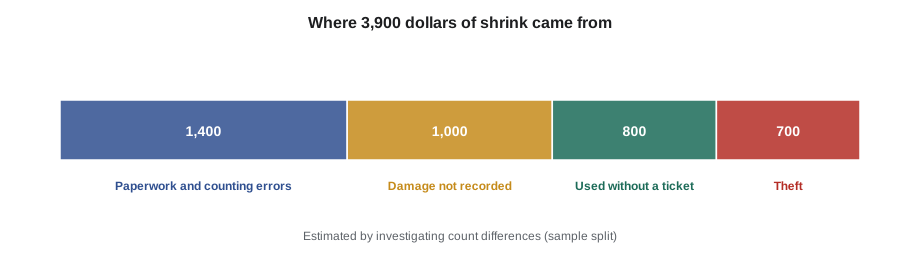
Shrink has four main sources. They need different fixes, so it pays to know which one is causing a loss.
| Source | Examples | Main fix |
|---|---|---|
| Paperwork errors | Wrong number sold, receipts keyed wrong, returns not credited | Scanning, receiving checks, training |
| Unrecorded damage | Dropped parts, crushed boxes, water damage, expired fluids | Damage reports and adjustments |
| Unrecorded use | Shop parts taken without a ticket, parts used in the department | Ticket every part that leaves the shelf |
| Theft and fraud | Parts stolen by customers, staff or others; fake returns; core fraud | Physical security and separation of duties |
Most shrink in parts departments is not theft. Paperwork errors and unrecorded use are usually larger. A technician who grabs a set of clips from the shelf to finish a job and forgets to add them to the repair order creates shrink, even though no one meant any harm. Each case is small, but they add up.
Paperwork and process errors
The controls for paperwork shrink are the same habits that keep the inventory accurate (lesson 7):
- Scan the part, not the bin label or a remembered number, at the counter and at receiving.
- Receive before putting away, so every part on the shelf is in the system.
- Check every receipt against the packing slip and the order, and report shortages and damage to the supplier promptly.
- Credit every return in the system when it is accepted, not when someone has time.
- Close out repair orders with the parts used, and return unused parts to stock in the system.
Receiving errors deserve special attention, because the supplier's invoice is the dealership's cost. If a box arrives with 9 parts and the packing slip says 10, the department pays for 10 unless the shortage is reported within the supplier's time limit. Sasha's receiving team counted every carton against the slip before signing.
Damage
Parts are damaged in storage and handling: a headlamp dropped from a shelf, a bumper cover scuffed by a forklift, fluids that pass their shelf life, or boxes crushed under heavier parts. Damage is unavoidable at some level, but it becomes shrink only when it is not recorded.
Each damaged part should be written up on a damage report, set aside, and either returned to the supplier (if it arrived damaged and the claim is still open), sold at a discount if it is still usable and the customer agrees, or written off and disposed of properly. Good storage (APT-110) reduces damage: heavy parts on low shelves, fragile parts protected, fluids rotated so the oldest is used first.
Theft
Theft from parts departments can come from customers, staff, delivery drivers, contractors or outsiders. Parts that are small, valuable and easy to resell are the most at risk: electronic modules, key fobs, catalytic converters, sensors, wheels and tires, tools, and high-demand accessories. The controls for theft are a mix of physical security and good procedures.
| Control | What it does |
|---|---|
| Limited access to the warehouse | Only parts staff enter storage areas; others are served at the counter |
| Locked or caged storage | High-value and high-risk parts are kept in a locked area |
| Cameras | Record the counter, the warehouse, the receiving door and the shipping area |
| Controlled doors | The receiving door is closed and watched when not in use |
| Tickets for every part | No part leaves the counter without a ticket |
| Regular counts of high-risk parts | Problems are found while they are small |
Key fobs and keys deserve special mention. A blank fob that can be programmed to a vehicle is a security risk to the vehicle's owner, not just a cost to the department. Most manufacturers require dealers to keep key and immobilizer parts secured and to sell them only after checking ownership and identity under the manufacturer's rules.
Fraud
Fraud is theft hidden in the paperwork. In parts departments, the common types are:
- Fake returns: a part is returned that was never bought from the department, or was bought elsewhere at a lower price, and a refund is given.
- Core fraud: a worn core from another supplier, or an empty or wrong core, is returned to claim a core refund.
- Sweetheart deals: a staff member gives a friend unauthorized discounts or free parts.
- False adjustments: stock is taken and the record is adjusted to hide it.
- Ghost suppliers or false invoices: payments for parts that were never received.
Worked problem
A core refund that should not have been paid
Over two weeks, three alternator cores were accepted for refund at 85 dollars each. On inspection by the rebuilder, none of the three matched the reman units that had been sold; they were older cores from another make. What was the loss?
Show solution
- Loss on refunds paid:
- \[3 \times 85 = 255\]
Answer: The department paid 255 dollars in refunds it will not get back from the rebuilder. The fix was to check every core against the original sale and the core return rules before refunding (APT-130 lesson 8).
The best protection against fraud is separation of duties: the person who handles stock should not be the only person who records it, and the person who approves a refund or adjustment should not be the person who asks for it. In a small department, full separation is not always possible, so the manager reviews reports of refunds, adjustments, discounts and voids regularly.
Reports that reveal problems
The dealer system produces reports that show patterns worth checking (lesson 9). Rolf reviewed these every month:
- Inventory adjustments by person, by reason and by part.
- Returns and refunds by person and by customer, including core refunds.
- Discounts and price overrides by person.
- Negative on-hand quantities, which show sales of parts the system thinks are not there.
- Voided invoices, especially voids after the customer has left.
- Count differences on high-risk parts.
A single entry on these reports means little. A pattern, such as one person with many more refunds than others, or the same part adjusted down every month, is a reason to look more closely.
What a parts technician should do
Parts technicians are not investigators, and they should never confront, search or detain anyone. Their role is to follow procedures, record what they see, and tell the right person. Rolf's guidance for the team was:
- Follow the procedures every time, even with people you know and trust.
- Do not accept a return or core that does not meet the rules; refer it to a senior team member.
- Write down what you saw if something seems wrong: the time, the part, the person, what happened.
- Tell the parts manager privately, or use the dealership's reporting process.
- Do not accuse anyone or discuss suspicions with co-workers or customers.
- Never put yourself at risk. If someone is taking parts by force, let them go and report it.
A culture where everyone follows procedures protects honest staff as well as the business. When every part has a ticket and every return is checked, no one is suspected unfairly.
"Most of the 3,900 dollars," Rolf told Talia, "isn't anybody stealing. It's somebody being in a hurry. So the fix isn't cameras. It's making the right way the fast way." The following year, with scanning at the counter, tickets for every shop part and damage written up the same day, shrink at the count fell to 1,850 dollars.
Shop parts and the technicians' shelf
In a dealership, one of the largest sources of unrecorded use is the service department. Technicians need small items all day: clips, fasteners, bulbs, fuses, small hoses, shop supplies. If they help themselves from the parts shelves, or if the parts department hands items across the back counter without a ticket, the parts leave stock without being charged to any repair order.
Most dealers handle this in one of two ways. Some keep a shop supply stock of very cheap, common items such as clips, cable ties and common fasteners, charged to the service department as a monthly expense or as a shop supplies fee on each repair order, so that technicians can take them freely. Everything else is issued only at the back counter, on a repair order (APT-130 lesson 6). Others put every part, however small, on the repair order. Either way works, as long as the rule is clear and every item is either inside the shop supply system or on a ticket.
At Linmore Tessaro, Rolf and Priyanka agreed which items belonged in shop supplies and set a fixed monthly charge for them. Sasha restocked the shop supply cabinet each Monday and recorded the issue in the system. Everything outside the cabinet needed a repair order number. Within two months, the count differences on small parts fell noticeably.
Receiving and delivery controls
The receiving door and the delivery van are two other places where parts can go missing. Parts can be signed for but never arrive, delivered to the wrong customer, or loaded on the van and not delivered. Good controls are simple:
- Count and check every delivery against the packing slip before signing for it.
- Keep the receiving area separate from the shipping area, so incoming and outgoing parts are not mixed.
- Use a delivery manifest listing each invoice on the van, signed by the customer at each stop.
- Check returned parts from customers at the receiving desk, not on the van.
Gideon, the van driver, scanned each invoice as he loaded it and had customers sign on a handheld at each stop. Any part that came back on the van was checked in by Sasha before the end of the day. These steps protected Gideon as much as the dealership: if a customer later said a part never arrived, the signed record showed who had received it.
Damaged on arrival
Parts sometimes arrive damaged from the supplier: a cracked lamp, a bent panel, a crushed box. Freight damage is usually the supplier's or the carrier's problem, but only if it is reported correctly and on time. Sasha's receiving team opened and checked fragile and expensive parts on arrival, noted visible damage on the carrier's delivery record before signing, photographed it, and reported it to the supplier the same day. A damaged part that is put on the shelf unchecked and found weeks later usually becomes the department's loss.
The same care applies to parts that are returned by customers. A returned part is checked for damage and for signs of use before it goes back to stock (APT-130 lesson 8). If it cannot be sold as new, it is set aside and dealt with like any other damaged part, so the shelf holds only parts the department can sell.
Writing up a loss
When a part is found missing, damaged or used without a ticket, the write-up should say what is known, not what is guessed: the part number, the quantity, the value, where and when the difference was found, and what checks were made. "Not found after recount and document check" is a fact. "Probably stolen" is a guess, and guesses written into records can unfairly point at people. Rolf asked for facts on every write-up and kept the judgment for himself and, where needed, the general manager.
Common mistakes
MistakeAssuming all shrink is theft.
InsteadFind the source first; most is usually paperwork, damage or unrecorded use.
MistakeLeaving damaged parts on the shelf.
InsteadWrite them up, set them aside and deal with them.
MistakeAccepting a core or return without checking it against the sale.
InsteadCheck every return against the rules and the original sale.
MistakeLetting the same person approve and request adjustments.
InsteadSeparate duties, or have the manager review.
MistakeConfronting a suspected thief.
InsteadRecord what you saw and report it; never put yourself at risk.
Summary and key terms
- Shrink is inventory in the books that no longer exists, measured at the physical inventory.
- Shrink comes from paperwork errors, unrecorded damage, unrecorded use, and theft or fraud.
- Scanning, receiving checks and tickets for every part reduce paperwork shrink.
- Physical security protects high-risk parts; key and immobilizer parts need extra care.
- Separation of duties and regular review of reports help prevent fraud.
- Parts technicians follow procedures, record what they see and report it; they never confront anyone.
- Shrinkage
- Loss of inventory that is in the books but no longer exists.
- Book value
- The value of inventory according to the system.
- Damage report
- A record of a damaged part and what was done with it.
- Core fraud
- Claiming a core refund with a core that does not qualify.
- Separation of duties
- Dividing tasks so no one person both handles and records the same stock or money.
- Negative on-hand
- A system quantity below zero, a sign of an error.
Practice problems
Work each problem on paper first, then reveal the answer to check.
Book value 500,000 dollars, counted value 497,500 dollars. What is the shrink and its share of inventory?
Show answer
2,500 dollars, or 0.5 in 100.
Which source of shrink is a technician taking clips without a ticket?
Show answer
Unrecorded use.
Four cores were refunded at 120 dollars each but rejected by the rebuilder. What is the loss?
Show answer
480 dollars.
Name two parts that are often kept in locked storage.
Show answer
Key fobs, electronic modules, sensors, catalytic converters.
What should a parts technician do if they suspect a co-worker of theft?
Show answer
Write down what they saw and tell the parts manager privately.
Lesson quiz · 5 questions
Score 60% or more to complete this lesson.
Create a free account to save your progress, take quizzes and earn a certificate.