
APT-210 · Lesson 10 of 12 · 23 min
Seasonal and special-order parts
▶ Video coming soon A video version of this lesson is on the way.
In the first week of October, Sasha moved the wiper blade display from the end of aisle B to the front counter and doubled the stock behind it. Talia asked why the blades needed a new home. "Because in two weeks every customer who drives through the first freezing rain will notice their blades are shot," Sasha said. "Wiper blades, washer fluid, batteries, block heater cords, ice scrapers. The system sees last month's sales. It doesn't see the weather coming."
Most parts sell at a fairly steady rate through the year, and the reorder point methods in lesson 3 work well for them. Two groups do not. Seasonal parts sell much more at some times of year than others. Special-order parts are bought for one customer and should not become stock at all. This lesson covers how to plan for both.
What makes a part seasonal
A part is seasonal when its demand changes in a regular pattern through the year. The causes are usually weather, driving habits or the calendar:
| Season | Parts that sell more |
|---|---|
| Fall and winter | Wiper blades, winter washer fluid, batteries, block heater parts, winter tires and wheels, floor mats, ice scrapers |
| Spring | Summer tires, wheel alignment parts, suspension parts after pothole season, wiper blades again, cabin air filters |
| Summer | Air conditioning parts, cooling system parts, accessories such as roof racks and hitches, detailing products |
| Calendar events | Accessories before holidays, parts for campaigns and recalls, inspection-related parts where inspections are scheduled |
Seasonal demand is predictable in shape but not in exact timing. The first cold snap might come in mid-October one year and in late November the next. Good planning stocks up before the season, watches sales closely as it starts, and runs stock down as it ends.
Why reorder points struggle with seasons
A reorder point based on average sales over the past 12 months will be too low during the season and too high outside it. A system that uses recent months only will react late: it raises the stocking level after the rush has started, when the shelves are already empty, and keeps it high after the season has ended, leaving extra stock for months.
Worked problem
Seasonal wiper blade demand
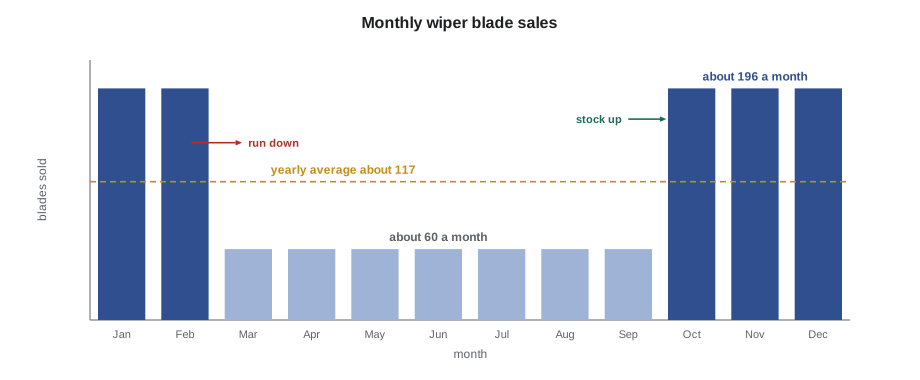
Linmore Tessaro sells about 1,400 wiper blades a year. About 70 in 100 of them sell in the five months from October to February. What are the seasonal and off-season monthly sales, and how do they compare with the yearly average?
Show solution
- Seasonal sales:
- \[1{,}400 \times 0.70 = 980\]
- Seasonal monthly rate:
- \[980 \div 5 = 196\]
- Off-season sales:
- \[1{,}400 - 980 = 420\]
- Off-season monthly rate:
- \[420 \div 7 = 60\]
- Yearly average monthly rate:
- \[1{,}400 \div 12 \approx 117\]
Answer: In season the department sells about 196 blades a month, more than three times the off-season rate of 60. A stocking level based on the yearly average of about 117 would run out in winter and overstock in summer.
Planning for a season
Most dealer systems handle seasonality in one of three ways: a seasonal flag that tells the system to use sales from the same months last year instead of recent months, manual settings where the parts manager raises and lowers the minimum and maximum by date, or pre-season orders placed in bulk before the season. Many departments use a mix. Sasha's seasonal plan had five steps:
- List the seasonal parts and look at the same months last year, as well as the last few months.
- Place a pre-season order for the expected early weeks of the season, often with a supplier promotion or extended payment terms.
- Set seasonal stocking levels in the system for the season's months, and a date to reset them.
- Watch sales weekly once the season starts, and top up quickly if the season is early or strong.
- Run stock down toward the end of the season by lowering maximums, so little is left to carry through the off-season.
Manufacturers and suppliers often offer pre-season programs: discounts or delayed billing for orders placed well before the season, for example winter tires ordered in the summer and billed in the fall. These can be good value, but the same rule applies as with any forward buying (lesson 5). The saving must be greater than the extra carrying cost and the risk of being left with unsold stock if the season is mild.
The end of a season matters as much as the start. A department that is still holding a winter's worth of block heater cords in April will carry them until November. Seasonal parts that are left over should be counted, kept in good condition and checked for shelf life, especially fluids and batteries, before the next season.
Campaigns, recalls and service actions
Some demand jumps are not seasonal but are still predictable. When a manufacturer announces a recall or service campaign, dealers can expect many vehicles to come in for the same repair. The manufacturer usually controls the supply of campaign parts, sometimes allocating them to dealers based on how many affected vehicles are in each dealer's area. The parts department works with service to order campaign parts as vehicles are scheduled, to avoid filling the shelves with parts for vehicles that never arrive. Unused campaign parts may need to be returned under the manufacturer's campaign rules rather than the normal return program.
Special orders
A special order is a part ordered for a specific customer, vehicle or repair, not for stock (lesson 4). Special orders are a normal and important part of business; no department can stock everything. The risk is that a special order is never picked up or installed, and the part ends up in stock with no demand behind it. Many departments find that a large share of their non-moving stock started as special orders.
A good special-order process has six parts:
- Confirm the part with the VIN and the customer's description before ordering (APT-120).
- Explain the terms to the customer: price, expected arrival, the deposit, and the return policy for special orders.
- Take a deposit for retail customers, especially for expensive, unusual or electrical parts.
- Record the order in the system with the customer's contact details, so it is linked to them, not just to stock.
- Notify the customer when the part arrives, and store it in a special-order area, not in a stock bin.
- Follow up on parts that have not been picked up, using the open special orders report (lesson 9).
Worked problem
A special-order deposit
A retail customer orders a rear lamp assembly for 412.80 dollars. The department asks for a deposit of half the price. How much is the deposit, and what is collected on pickup?
Show solution
- Deposit:
- \[412.80 \times 0.50 = 206.40\]
- Balance on pickup:
- \[412.80 - 206.40 = 206.40\]
Answer: The deposit is 206.40 dollars and the same amount is collected on pickup, plus any taxes. The deposit amount is a sample policy; departments set their own.
If the customer cancels, the department's policy decides what happens. A common approach (APT-130 lesson 8) is to return the part to the supplier if possible and charge a restocking fee, such as the sample 20 in 100 used at Linmore Tessaro, to cover the supplier's charges and handling. Some parts, such as electrical parts or parts cut or painted to order, cannot be returned at all, and the department should say so clearly before ordering.
When special orders become stock
Sometimes a part ordered once turns out to be needed again and again. The lost sales and special orders reports help find these parts. If the same part is special-ordered several times in a few months, it may be worth phasing it into stock (lesson 3). The reverse also happens: a part that was phased in because of a few special orders may never sell again and should be phased out early.
A special order that is not picked up has to be dealt with promptly. Rolf's rule at Linmore Tessaro was a phone call at 7 days, a second call and an email at 14 days, and at 30 days a letter explaining that the part would be returned or added to stock and the deposit applied under the policy. Talia's first job after the October reports was to work through three special orders more than 30 days old. One customer had forgotten and picked up the part the same day. One had bought the part elsewhere; the part went back to the supplier with the restocking fee taken from the deposit. The third, a seat trim panel in an unusual colour, could not be returned and was added to stock at cost, with a note to watch it on the aging report.
Working with service
Most special orders in a dealership come from the service department, for repairs where the part is not in stock. These orders are usually not paid for in advance, but the same risks apply: if the customer declines the repair after the part arrives, the part may be left over. Good communication between parts and service reduces this. Rolf and Priyanka agreed that service advisors would confirm that the customer had approved the repair before a special order was placed for an expensive or non-returnable part, and that parts would tell service the same day any special order arrived.
Planning a season with numbers
Sasha's wiper blade plan for the fall started from last year's sales by part number. The ten best-selling blade sizes made up most of the volume, so those were the ones she planned in detail. For each, she looked at last October to February, added a little for growth in the number of vehicles the department served, and set the seasonal maximum to cover about three weeks of seasonal sales, so that the weekly stock order could keep the shelf topped up without holding the whole season's stock at once.
For the best-selling blade, last season's sales were about 140 over five months, or about 28 a month and 7 a week. Three weeks of stock is about 21 blades. With a lead time of two days on the weekly stock order and a little safety stock for a sudden storm, she set a minimum of 9 and a maximum of 24 from the first of October, with a reminder to drop both back to the off-season levels of 2 and 6 at the end of February.
Planning this way keeps the money spent on seasonal stock close to the season's sales. The pre-season order fills the shelves just before demand rises, the weekly order keeps them full, and the reset at the end of the season stops the department from carrying winter stock into summer.
Special orders and the parts-service relationship
Special orders depend on good information from the person asking. A service advisor who gives a clear VIN, a clear description of the repair and the customer's approval makes the special order almost risk-free. One who orders "just in case" before the customer has agreed creates a part that may never be used. The parts department can help by asking the same questions every time and by sharing the open special orders report with service each week, so that advisors see which of their orders are still waiting.
At Linmore Tessaro, the weekly report became part of the Monday parts-service meeting. Each advisor saw their own open special orders, and most old ones were cleared within a few weeks, because the advisor knew whether the customer was coming back.
Accessories and promotions
Accessories such as roof racks, cargo trays, hitches and splash guards often sell in waves tied to new vehicle sales, holidays and manufacturer promotions. When a manufacturer runs a promotion on an accessory, sales can jump for a few weeks and then fall back. The parts department plans for these the same way as a season: order before the promotion starts, watch sales closely, and avoid reordering at the promotion's peak rate once it has ended. Talking with the vehicle sales manager about upcoming deliveries helps too, because many accessories are fitted to new vehicles before delivery.
Seasonal and special-order parts are where good habits show most clearly. A department that plans its seasons, takes deposits and follows up every special order keeps its shelves full of parts customers want. One that does not ends up, a few years later, with shelves of winter stock in summer and parts nobody came back for, the situation lesson 12 explores.
Common mistakes
MistakeUsing yearly average sales for seasonal parts.
InsteadPlan using last year's same months and watch sales weekly.
MistakeKeeping seasonal stocking levels high after the season.
InsteadSet a date to reset them and run stock down.
MistakeOrdering special parts without a deposit or clear terms.
InsteadExplain terms, take a deposit and record the customer.
MistakePutting special-order parts in stock bins.
InsteadKeep them in a special-order area linked to the customer.
MistakeLetting unclaimed special orders sit for months.
InsteadFollow up at set intervals and return or stock them under the policy.
Summary and key terms
- Seasonal parts have regular demand changes through the year; plan before, watch during and run down after.
- Reorder points based on yearly averages run out in season and overstock outside it.
- Pre-season programs can save money if the saving exceeds carrying cost and risk.
- Recalls and campaigns create predictable demand; order parts as vehicles are scheduled.
- Special orders are bought for one customer; confirm the part, explain terms, take a deposit and follow up.
- Unclaimed special orders should be returned or stocked under the policy without delay.
- Seasonal part
- A part whose demand changes in a regular pattern through the year.
- Pre-season order
- A bulk order placed before a season starts, often with a promotion.
- Seasonal flag
- A system setting that bases stocking on the same months last year.
- Recall
- A manufacturer action to repair a safety defect in affected vehicles.
- Special order
- A part ordered for a specific customer or repair, not for stock.
- Deposit
- Part of the price paid in advance when a special order is placed.
Practice problems
Work each problem on paper first, then reveal the answer to check.
A part sells 600 a year, 60 in 100 of it in four summer months. What is the summer monthly rate?
Show answer
600 × 0.60 = 360; 360 ÷ 4 = 90 a month.
What is the off-season monthly rate for the same part?
Show answer
240 ÷ 8 = 30 a month.
A special order costs 280 dollars with a deposit of half. What is the deposit?
Show answer
140 dollars.
Name two steps that reduce the risk of unclaimed special orders.
Show answer
A deposit, clear terms, recording the customer, and follow-up calls.
Why should seasonal stocking levels be reset at the end of a season?
Show answer
To avoid carrying a season's worth of stock through the off-season.
Lesson quiz · 5 questions
Score 60% or more to complete this lesson.
Create a free account to save your progress, take quizzes and earn a certificate.