
APT-210 · Lesson 12 of 12 · 22 min
Fixing a struggling parts department's stock
▶ Video coming soon A video version of this lesson is on the way.
On Monday, November 9, Rolf drove Talia about 40 km to Linmore Tessaro Brantford, a smaller sister store in the Linmore group. Its parts manager, Fergus Amberley, had taken the job in the summer and inherited a department in trouble. Tessaro's district parts manager, Clementine Kesterton, had flagged the store on the quarterly review: low turns, high obsolescence and too many customer complaints about parts not being in stock. Walter had offered Rolf's help. "This is the whole course in one building," Rolf told Talia in the car. "Everything we've talked about, done wrong for a few years. Keep your eyes open."
This lesson follows the visit as a case study. It uses every tool from the earlier lessons: the measures (lesson 11), the reports (lesson 9), aging and returns (lesson 6), counts (lesson 7), stocking settings (lesson 3), ordering (lesson 4), layout (lesson 2) and seasonal and special orders (lesson 10). The goal is to show how a parts professional diagnoses an inventory problem and builds a realistic plan to fix it.
The numbers
Fergus had the store's last 12 months ready. Clementine joined them in the parts office with the manufacturer's targets.
| Figure | Value |
|---|---|
| Parts sales, 12 months | 1,890,000 dollars |
| Cost of parts sold, 12 months | 1,476,000 dollars |
| Gross profit, 12 months | 414,000 dollars |
| Average inventory at cost | 410,000 dollars |
| Non-moving stock, over 12 months | 82,000 dollars |
| Stock requests, sample month | 900 lines; 702 filled from stock |
Talia worked out the measures by hand, as Rolf had taught her, before anyone showed her the system's version.
Worked problem
Diagnosing the department
Using the figures, work out the turns, months of supply, GMROI, obsolescence ratio and fill rate.
Show solution
- Turns:
- \[1{,}476{,}000 \div 410{,}000 = 3.6\]
- Months of supply:
- \[12 \div 3.6 \approx 3.3\]
- GMROI:
- \[414{,}000 \div 410{,}000 \approx 1.01\]
- Obsolescence ratio:
- \[82{,}000 \div 410{,}000 = 0.20\]
- Fill rate:
- \[702 \div 900 = 0.78\]
Answer: Turns of 3.6, about 3.3 months of supply, a GMROI of about 1.01, 20 in 100 of the inventory non-moving, and a fill rate of 78 in 100. Every measure was worse than at Rolf's store, which had 6.0 turns, a GMROI of about 1.73, 6 in 100 non-moving and a 90 fill rate.
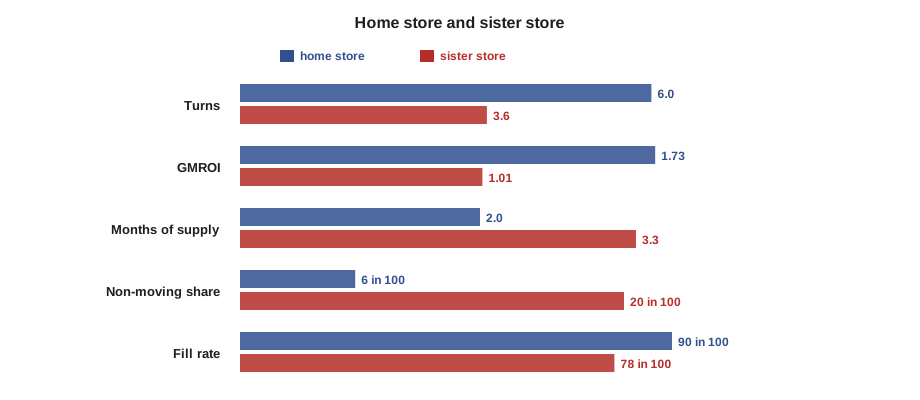
"So the store has too much inventory, and still not enough of the right parts," Clementine said. "That's the usual pattern. More money on the shelves doesn't mean more parts customers want."
Walking the warehouse
Numbers show that something is wrong; the warehouse usually shows why. Rolf, Fergus and Talia walked every aisle with a printout of the aging report. What they found matched the numbers:
- Old stock in the best locations. The bins nearest the counter held parts for models Tessaro had stopped selling years ago. The fast-moving filters and brake pads were at the back.
- Overflow everywhere. Many parts had stock in two or three places, some not recorded in the system.
- A shelf of unclaimed special orders, some more than a year old, with no customer names on them.
- Boxes on the floor from receipts that had not been put away or received in the system.
- Bins with no labels, and several labels with the wrong part numbers.
- Bulk buys: a pallet of a coolant bought on a promotion three years earlier, still half full.
Talia did a quick blind count of 40 bins in one aisle while the others talked. Thirty-one matched the book. "That's 78 in 100," she said. "Same as the fill rate, by coincidence. But if the book is wrong in one bin of every five, the system's suggested orders can't be right either."
Finding the causes
Over coffee, Fergus explained how the department had reached this point. The previous manager had set the phase-in rule to stock any part after a single sale, so that every one-off repair added a part to stock. Phase-out had been turned off. The return program had not been used for two years because no one had time. Special orders were not linked to customers, so unclaimed ones drifted into stock. Receiving was done when someone was free. Cycle counts had stopped in the spring.
Rolf sorted the problems into three groups, because each needed a different kind of fix:
| Group | Problems | Kind of fix |
|---|---|---|
| Settings | Phase-in after one sale, no phase-out, maximums too high, lead times wrong | Change the system settings |
| Stock already on hand | 82,000 dollars non-moving, overstock, unclaimed special orders, bulk buys | Return, transfer, sell or write off |
| Daily processes | Receiving late, no counts, poor labels, special orders not linked to customers | Train and enforce habits |
"If you only clear the old stock," Rolf said, "the settings will fill the shelves up again in two years. If you only fix the settings, the old stock sits there costing you money. And if the processes stay broken, the book will be wrong and nothing else will work. You need all three."
The plan
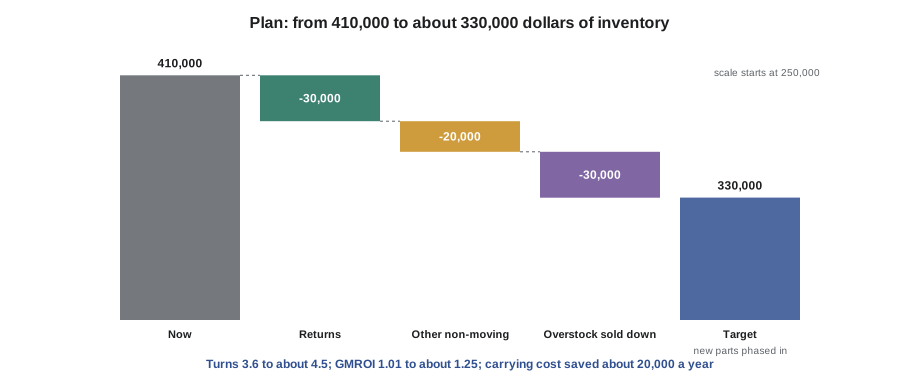
A week after the visit, on Monday, November 16, Rolf sent Fergus and Clementine a written plan. It set a target of bringing the average inventory from 410,000 dollars down to about 330,000 dollars over 12 months, while raising the fill rate toward the store's target of 88 in 100. The main steps were:
- Return eligible stock: about 30,000 dollars of parts through the next two manufacturer return windows.
- Clear other non-moving stock: about 20,000 dollars through transfers to sister stores, the dealer locator, clearance sales and, as a last step, write-off.
- Reduce overstock: about 30,000 dollars by lowering maximums and letting the stock sell down, without reordering.
- Fix the settings: phase-in after three sales in six months, phase-out after 12 months without sales, maximums reviewed, and lead times checked by source.
- Phase in the right parts: use the lost sales and emergency order reports to add the parts customers were asking for.
- Restore the processes: receive and put away the same day, restart ABC cycle counts, relabel every bin, and link every special order to a customer with a deposit and follow-up.
- Re-slot the warehouse: move A parts close to the counter and old stock to the back (lesson 2).
Worked problem
What the plan achieves
If the average inventory falls to 330,000 dollars with the same cost of sales and gross profit, what are the new turns and GMROI? What carrying cost is saved, at 25 in 100 a year?
Show solution
- Inventory reduction:
- \[410{,}000 - 330{,}000 = 80{,}000\]
- New turns:
- \[1{,}476{,}000 \div 330{,}000 \approx 4.47\]
- New GMROI:
- \[414{,}000 \div 330{,}000 \approx 1.25\]
- Carrying cost saved:
- \[80{,}000 \times 0.25 = 20{,}000\]
Answer: Turns would rise to about 4.5 and GMROI to about 1.25, and the store would save about 20,000 dollars a year in carrying cost. If the new parts phased in raise sales, the results will be better still.
Keeping the plan realistic
Clementine pointed out three risks. First, some of the 82,000 dollars of non-moving stock would not return or sell, and writing it off would reduce the store's profit in the year it happened; the general manager and the accountant needed to know and agree. Second, cutting inventory too fast could lower the fill rate further before the new parts were phased in. Third, the plan relied on Fergus's team changing their daily habits, which would take time and training.
Rolf agreed and added a schedule. The settings and processes would change first, in the first month, because everything else depended on them. Returns would follow the manufacturer's windows. Overstock would sell down over the year. Each month, Fergus would report the six measures from lesson 11 to Walter and Clementine, so that progress, or the lack of it, was visible.
| Measure | Now | 12-month target |
|---|---|---|
| Average inventory at cost | 410,000 dollars | About 330,000 dollars |
| Turns | 3.6 | About 4.5 |
| GMROI | 1.01 | About 1.25 |
| Non-moving share | 20 in 100 | Under 10 in 100 |
| Fill rate | 78 in 100 | 88 in 100 |
| Count accuracy | About 78 in 100 (sample aisle) | 95 in 100 |
What Talia learned
On the drive back, Talia went through what she had seen. "Nothing there was complicated," she said. "Every problem was something we do every day at our store. They just stopped doing it."
Rolf nodded. "That's inventory control. It isn't one big decision. It's a hundred small habits: receive it today, count it blind, record the lost sale, link the special order, check the aging report, use the return window. Do them every day and the numbers take care of themselves. Stop, and in two years you're Brantford." He paused. "Don't tell Fergus I said that."
From here, the plan was Fergus's work, and Clementine would check progress at each quarterly review. The first steps, the settings changes and the restart of cycle counts, were planned for the end of November. The first return was planned for the manufacturer's winter window. Whether the store would reach its targets would depend, as Rolf had said, on the hundred small habits.
Talking with the store's team
Before they left, Rolf asked Fergus to bring his team together for twenty minutes. There were four of them: two counter staff, a warehouse person and a driver who also did receiving. Rolf did not show them the numbers first. He asked them what made their days harder. The answers came quickly: parts the system said were there but were not, customers coming back for special orders that could not be found, fast parts at the back of the warehouse, and boxes in the aisles that nobody had time to put away.
Every one of those complaints matched a cause in the analysis. That mattered, Rolf told Talia afterward, because a plan that the team sees as fixing their own problems is much easier to carry out than one that feels like an order from head office. The counter staff wanted accurate on-hand quantities, so they had a reason to scan every part and count blind. The warehouse person wanted the fast parts closer, so he had a reason to help with the re-slot.
Fergus asked the team to choose one thing to fix first. They chose the boxes in the aisles: receive and put away the same day. It was the simplest change and the one they would notice every day. Rolf agreed that it was the right place to start, because accurate receiving would make every later step easier.
Measuring progress
A plan needs a way to tell whether it is working. Rolf suggested that Fergus track a short list each week, in addition to the monthly measures: the number of lines received but not put away at the end of the day, the week's cycle count accuracy, the number of special orders more than 30 days old, and the value of parts returned, transferred or cleared. These weekly numbers would move long before the 12-month turns did, and they would show the team that their effort was making a difference.
Clementine added that Tessaro could help in two ways: by checking whether some of the store's older stock qualified under the manufacturer's rules for superseded parts, and by reviewing the store's suggested stocking settings against the manufacturer's recommended levels for a store of its size. Both offers went into Rolf's written plan with her name beside them.
What happens next
Rolf did not expect to go back to the sister store often; the plan was Fergus's to carry out. The first steps were set for the following weeks: same-day receiving from the start, a short daily cycle count list, and the first changes to the stocking settings. The shelf of unclaimed special orders was to be cleared before the end of the month, with some parts returned, some sold and a few added to stock with notes. Rolf expected little change in the 12-month measures for some time. "Turns move slowly," he said. "Habits move first. If the habits hold, the numbers follow in six months."
The case shows a pattern that repeats across the trade. Departments rarely fail because of one bad decision. They drift, one skipped count, one loose setting and one unclaimed special order at a time. The same tools that diagnose the drift, used every month, stop it from happening again.
On the way home, Talia asked whether Linmore Tessaro had ever looked like the sister store. Rolf laughed. "When I started here, the turns were under four. It took two years of the same habits to fix it. Every department can drift. The difference is whether someone notices early."
Common mistakes
MistakeClearing old stock without fixing the settings that bought it.
InsteadFix settings, stock on hand and processes together.
MistakeCutting inventory without watching the fill rate.
InsteadMove money from slow parts into parts customers ask for.
MistakeWriting off stock without telling management.
InsteadAgree write-offs with the general manager and accountant first.
MistakeMaking a plan with no measures or schedule.
InsteadSet targets, a schedule and monthly reports.
MistakeTrusting the system's numbers when counts are poor.
InsteadCheck accuracy first; the book must match the shelf.
Summary and key terms
- A struggling department often has too much inventory and not enough of the right parts.
- Diagnose with the measures, then walk the warehouse to find the causes.
- Group the causes into settings, stock already on hand and daily processes; all three need fixing.
- A realistic plan sets targets, a schedule and monthly measures, and agrees write-offs with management.
- Reducing inventory from 410,000 to 330,000 dollars at the same sales raises turns from 3.6 to about 4.5 and GMROI from 1.01 to about 1.25.
- Inventory control is a set of daily habits, not a single decision.
- Case study
- A real-world style example used to apply what has been learned.
- Diagnosis
- Finding what is wrong and why, from numbers and observation.
- Sell-down
- Reducing stock by selling it without reordering.
- District parts manager
- A manufacturer representative who supports and reviews dealer parts departments.
- Target
- A planned value for a measure by a set date.
Practice problems
Work each problem on paper first, then reveal the answer to check.
Cost of sales is 1,476,000 dollars. What average inventory would give 5.0 turns?
Show answer
1,476,000 ÷ 5.0 = 295,200 dollars.
An inventory falls by 60,000 dollars. What carrying cost is saved at 25 in 100?
Show answer
15,000 dollars a year.
A store fills 702 of 900 stock requests. How many more must it fill to reach 88 in 100?
Show answer
900 × 0.88 = 792, so 90 more.
Name the three groups of causes Rolf used.
Show answer
Settings, stock already on hand and daily processes.
Why should settings be fixed before clearing old stock?
Show answer
Otherwise the settings will fill the shelves again with the wrong parts.
Lesson quiz · 5 questions
Score 60% or more to complete this lesson.
Create a free account to save your progress, take quizzes and earn a certificate.