
APT-210 · Lesson 4 of 12 · 23 min
Ordering: stock orders and emergency orders
▶ Video coming soon A video version of this lesson is on the way.
On Tuesday, October 20, Rolf asked Talia to sit with him while he prepared the weekly stock order. The inventory software had built a suggested order overnight: 152 lines, from boxes of oil filters to a single door mirror glass. Rolf did not just press send. He scrolled through every line, changed a few quantities, deleted three and added two, then sent 140 lines to Tessaro's regional parts depot before the 4 p.m. cut-off. "The computer suggests," he said. "We decide. If I sent this without looking, we'd have a mirror glass nobody needs and no snow brushes in November."
This lesson covers how a parts department buys its parts. It explains the regular stock order that replaces what sold, the emergency order used when a part is needed quickly, other ways of sourcing parts, and how to choose between them. The goal is to keep the shelves stocked at the lowest total cost, while getting urgent parts fast when a customer needs them.
The stock order
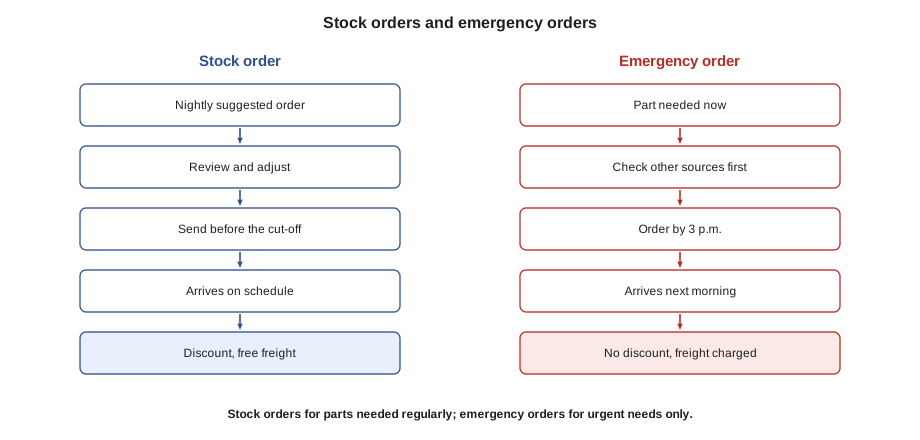
A stock order is the regular, planned order that replenishes the parts the department stocks. Most dealers place stock orders on a fixed schedule with their manufacturer: once a week, a few times a week or, in larger stores, every day. Linmore Tessaro sent its stock order every Tuesday, and the parts arrived on Wednesday.
The stock order is built from the stocking settings covered in lesson 3. Each night, the inventory software compares each stocked part's quantity on hand and on order with its minimum. Parts at or below the minimum are added to the suggested order, with quantities that bring them back up to the maximum, rounded to the package quantity. The parts technician or manager then reviews the suggestion before sending it.
Manufacturers reward dealers for ordering this way, because planned orders are cheaper to fill and ship than urgent ones. A typical arrangement gives a discount or better return terms on stock orders. The exact terms vary by manufacturer and change over time; in this course, Tessaro's sample program gives 5 in 100 off dealer cost on parts bought on the weekly stock order, plus free freight.
Worked problem
The value of the stock order discount
The October 20 stock order was 140 lines with a total dealer cost of 21,860 dollars. At the sample stock order discount of 5 in 100, how much did the discount save?
Show solution
- Discount:
- \[21{,}860 \times 0.05 = 1{,}093\]
- Cost after discount:
- \[21{,}860 - 1{,}093 = 20{,}767\]
Answer: The discount saved 1,093 dollars on one weekly order. Over a year of weekly orders, stock order discounts add up to a large share of a parts department's profit, which is why parts that are needed regularly should come in on the stock order.
Reviewing the suggested order
The software's suggestion is only as good as the settings and the sales history behind it. Rolf's review followed a simple checklist:
- Unusual quantities: a part suggested in a far larger quantity than usual may reflect a one-time sale, such as a fleet customer's big order, rather than steady demand.
- One-time sales: a single sale of an expensive part can trigger a reorder that will never sell again. That was the door mirror glass, sold once for a collision repair.
- Seasonal parts: demand for snow brushes, winter wiper blades and batteries rises in the fall; history from the summer will under-order them (lesson 10).
- Superseded part numbers: the order should use the current part number, and old stock should sell first (APT-120 lesson 6).
- Parts already on back order should not be ordered again.
- Promotions and campaigns: a manufacturer's service campaign or a dealership promotion can raise demand for specific parts.
Reviewing the order takes time, but it is one of the most valuable things a parts manager does each week. An order sent without review can add thousands of dollars of stock that will not sell, and leave out parts that will.
Emergency orders
An emergency order, sometimes called a rush or priority order, is placed when a part is needed before the next stock order will arrive. Common reasons are a car in the service department waiting for a part, a wholesale customer who needs a part today, or a stock part that has run out unexpectedly. Manufacturers usually ship emergency orders the same day or overnight, but at a higher cost: no stock order discount, a freight charge, and sometimes an emergency handling fee.
Many manufacturers also offer a special category for parts needed for a vehicle that cannot be driven or used until the part arrives, often called a vehicle off road (VOR) order. VOR orders get the highest priority, and are often used for customers whose car is in the shop or for fleet vehicles. Because they cost the manufacturer more, they are usually limited to genuine emergencies, and dealers may be audited on how they use them.
Worked problem
The cost of an emergency order
A part has a dealer cost of 186.40 dollars. On the stock order it gets the sample discount of 5 in 100 and free freight. On an emergency order there is no discount and a freight charge of 18 dollars. How much more does the emergency order cost?
Show solution
- Stock order cost:
- \[186.40 \times 0.95 = 177.08\]
- Emergency order cost:
- \[186.40 + 18 = 204.40\]
- Difference:
- \[204.40 - 177.08 = 27.32\]
Answer: The emergency order costs 27.32 dollars more, about 15 in 100 more than the stock order. Worth it when a customer's car is waiting; wasteful when the part could have been on the stock order.
Emergency orders are part of good service, but frequent emergency orders for the same stock part are a warning sign. They usually mean the part's minimum is too low, as with the Vela oil filter in lesson 3. Rolf reviewed the emergency order list every month and asked one question about each repeated part: why wasn't this on the shelf?
Other ways to get a part fast
Before placing an emergency order, the parts technician checks whether the part can be found faster or more cheaply elsewhere:
- Sister stores: other stores in the same dealer group may have the part on the shelf. Linmore Parts Supply and other Linmore stores could often send a part across town the same day.
- Dealer-to-dealer locators: many manufacturers run a system that shows which nearby dealers have a part in stock. Dealers buy and sell parts to each other at agreed prices, often cost plus a small markup.
- Aftermarket suppliers: for many parts, an aftermarket equivalent is available locally the same day (APT-120 lesson 7). The customer and service department need to agree to a non-original part, especially for warranty work.
- The manufacturer's regional depot: sometimes the depot can add a part to a delivery already on its way.
The choice depends on how fast the part is needed, what it costs from each source, whether the job requires an original part, and how the customer is paying. Warranty repairs usually require original manufacturer parts, ordered through the manufacturer's channels (APT-130 lesson 9).
| Source | Speed | Cost | Notes |
|---|---|---|---|
| Stock order | Next scheduled delivery | Lowest, with discount | For parts needed regularly |
| Emergency order | Same day or next morning | Higher, freight charged | For urgent needs |
| VOR order | Highest priority | Highest | Vehicle cannot be used without the part |
| Sister store | Often same day | Usually cost | Within the dealer group |
| Another dealer | Same day or next | Cost plus a markup | Found through a locator |
| Aftermarket supplier | Often within hours | Varies | Customer must accept a non-original part |
Special orders
A special order is a part ordered for a specific customer, not for stock. Special orders are usually placed on the next stock order if the customer can wait, or as an emergency order if not. Because special-order parts are bought for one person, departments often ask for a deposit, and many apply a restocking fee or a no-return policy if the customer changes their mind (APT-130 lesson 8). Lesson 10 covers special orders and seasonal parts in more detail.
Special-order parts should be clearly tagged with the customer's name and the order number when they arrive, and stored in the staging area, not in a regular bin. A special order put away as stock becomes stock: the customer cannot find it, the system shows it as available, and someone else may sell it.
Back orders and order tracking
Not every part ordered arrives on time. When the manufacturer does not have a part, it goes on back order: the order stays open and the part ships when it becomes available. Back orders can last days or, for some parts, weeks. The parts department must track them, keep customers informed and avoid ordering the same part again by mistake.
Most dealer systems show open orders and back orders for each part, with expected dates when the manufacturer provides them. Talia's job each Wednesday after the stock order arrived was to compare what arrived with what was ordered and to update the open order list. Lines that were short, damaged or wrong went to Sasha for a claim (APT-220). Back-ordered special orders meant a phone call to the customer, so they heard the news from the department before they had to ask.
When a back order drags on, the parts technician looks for other sources, as with an emergency. Sometimes the manufacturer offers an alternative part or a kit that includes the back-ordered piece. Sometimes another dealer has one. And sometimes the honest answer to the customer is that the part will take longer than anyone would like, with a date the department believes.
Purchase orders and records
Every order creates a record. Orders to the manufacturer are usually sent electronically from the dealer system, which records the order number, the date, the parts and the expected cost. Orders to other suppliers may need a purchase order, a document or record number that authorizes the purchase and later matches the supplier's invoice.
Good records make the rest of the job possible. They let the department check that invoices match what was ordered and received, claim credits for shortages and damage, and see later why a part was bought. Rolf's rule was that no part came into the building without an order number attached to it, whether it came from Tessaro, a sister store or a supplier down the street.
Receiving what was ordered
Ordering does not end when the order is sent. When the stock order arrives, the receiving team checks every carton against the packing slip and the packing slip against the order. Shortages, extra parts, wrong parts and damage are all recorded and reported to the supplier within the supplier's time limit, which is often only a few days. Parts that arrive but were not ordered are not simply put on the shelf; they are checked, because they may belong to another dealer or may be a supersession that needs a new location.
Once a part is received in the system, it is put away to its location the same day. Special orders are separated and the customer or service advisor is told. Back orders that arrive are matched to the customers waiting for them before any extra stock goes to the shelf. At Linmore Tessaro, Sasha's team aimed to have the Wednesday stock order received and put away by noon, so that the afternoon counter staff could sell from it.
Receiving errors show up later as wrong on-hand quantities, missed reorders and count differences (lesson 7), so careful receiving is one of the most effective ways to keep the whole inventory system accurate. It is also where the department makes sure it pays only for what it actually received. A good receiving clerk is as valuable to inventory control as a good buyer.
Ordering mistakes to avoid
Rolf kept a short list of ordering mistakes on the wall above the buyer's desk. Sending the order without reviewing the largest lines. Ordering a superseded number instead of the current one. Placing an emergency order for a part that was on the stock order arriving the next morning. Forgetting to cancel a back order after the customer bought the part elsewhere. Each one costs money in freight, in extra stock or in lost discounts, and each one is avoided by a minute of checking before the order goes out.
Common mistakes
MistakeSending the suggested order without reviewing it.
InsteadCheck unusual quantities, one-time sales, seasonal parts and superseded numbers.
MistakeUsing emergency orders for parts that sell every week.
InsteadFix the stocking settings so the part comes in on the stock order.
MistakePlacing an emergency order without checking other sources.
InsteadCheck sister stores, dealer locators and suitable aftermarket parts first.
MistakePutting a special order away as stock.
InsteadTag it with the customer's name and order number and stage it.
MistakeReordering a part that is already on back order.
InsteadCheck open orders and back orders before ordering.
Summary and key terms
- The stock order is the regular, planned order built from min/max settings; it usually earns the best pricing.
- Always review the suggested order before sending it.
- Emergency and VOR orders are fast but cost more; repeated emergencies for a stock part mean its settings are too low.
- Sister stores, dealer locators and aftermarket suppliers can be faster or cheaper than an emergency order.
- Special orders are bought for one customer and must be tagged and staged.
- Track back orders, keep customers informed and keep an order record for every part that comes in.
- Stock order
- The regular, planned order that replenishes stocked parts.
- Suggested order
- The order the inventory software builds from stocking settings, for review before sending.
- Emergency order
- An order placed for fast delivery when a part is needed before the next stock order.
- VOR order
- A highest-priority order for a vehicle that cannot be used until the part arrives.
- Back order
- An order the supplier cannot fill yet, kept open until the part is available.
- Purchase order
- A record that authorizes a purchase and later matches the supplier's invoice.
Practice problems
Work each problem on paper first, then reveal the answer to check.
A stock order totals 18,400 dollars. What is the sample discount of 5 in 100 worth?
Show answer
18,400 × 0.05 = 920 dollars.
A part costs 92 dollars. Stock order: 5 in 100 off, free freight. Emergency: no discount, 15 dollars freight. What is the difference?
Show answer
Stock 87.40; emergency 107.00; difference 19.60 dollars.
The same stock part was emergency-ordered six times last month. What does that suggest?
Show answer
Its minimum is too low for its demand and lead time.
What should you check before placing an emergency order?
Show answer
Sister stores, dealer locators, suitable aftermarket parts and whether the part is already on order.
Where does a special-order part go when it arrives?
Show answer
To the staging area, tagged with the customer's name and order number.
Lesson quiz · 5 questions
Score 60% or more to complete this lesson.
Create a free account to save your progress, take quizzes and earn a certificate.