
APT-210 · Lesson 3 of 12 · 25 min
Stock levels, reorder points and lead times
▶ Video coming soon A video version of this lesson is on the way.
Late one afternoon early in October, a technician came to the back counter for an oil filter for a Vela. The bin was empty. The system said there should be two, but both had gone out that morning on repair orders nobody had finished closing. The next stock order would not arrive for several days. Imani borrowed four filters from Linmore Parts Supply across town, and the car went home on time, but Rolf was not pleased. The next morning he sat down with Talia and pulled up the filter's stocking settings. "We sell four of these a day," he said. "We should never run out. Let's find out why we did."
This lesson explains how a parts department decides how many of each part to keep and when to reorder. It covers the ideas behind stock levels: demand, lead time, safety stock, the reorder point and the minimum and maximum quantities that most inventory software uses. The numbers in the examples are sample values for teaching.
Demand: how fast a part sells
Every stocking decision starts with demand: how many of a part are sold or used in a given time. Demand is usually measured from the sales history in the inventory software, often as an average per day, week or month over the last six or twelve months. For Linmore Tessaro's most popular Vela oil filter, the history showed about 21 sold in an average five-day week, or about 4.2 a day.
Demand is never perfectly steady. Some days the filter sold one; some days it sold seven. Demand also changes with the seasons (lesson 10), with the age of the vehicles in the area, and with events such as a service campaign that brings many cars in at once. A good stocking setting is based on the average, with room for the ups and downs.
Demand for a part should include every sale: counter sales, wholesale, repair orders for the service department and, if possible, the lost sales recorded when the part was not in stock (lesson 1). If a part was out of stock for two weeks, its sales history shows two weeks of zero demand, which makes it look less popular than it really is. Some inventory software adjusts for this; when it does not, the parts technician should keep it in mind.
Lead time: how long a part takes to arrive
Lead time is the time between deciding to order a part and having it on the shelf ready to sell. It includes the time until the next order is sent, the supplier's time to fill and ship it, the delivery time, and the time to receive and put the part away. For a dealer, lead time depends on how and when it orders from the manufacturer (lesson 4).
At Linmore Tessaro, the weekly stock order was sent to Tessaro's regional parts depot every Tuesday and arrived on Wednesday, ready on the shelf by Wednesday afternoon. Emergency orders placed by 3 p.m. arrived the next morning, at a higher cost. Lead time for a stock part was therefore up to a week, depending on when in the week the shelf ran low, while the depot's own delivery time was about a day.
This is part of why the Vela filter ran out. Its settings had been calculated for a lead time of about one day, as if the department ordered every day. But the filter was ordered on the weekly stock order, so a shortage that began on Thursday could not be fixed by the stock order until the following Wednesday. The settings did not match the way the department actually ordered.
Safety stock
Safety stock is extra stock held to cover demand that is higher than average, or deliveries that are later than expected. It is the cushion that keeps the shelf from emptying when a busy day comes during a long wait for the next order. Without safety stock, a part would run out on roughly half of all reorder cycles, every time demand during the lead time was above average.
There are several ways to set safety stock. A simple method used by many small departments is to hold a few days' worth of average demand. A method that allows for both busy days and late deliveries compares the worst likely case with the average case:
More advanced software sets safety stock using statistics based on how much demand varies and the fill rate the department wants. The idea is the same: the more uncertain the demand or the delivery, and the more important the part, the more safety stock it needs. A high-value part that sells rarely might have no safety stock at all; a cheap, fast-moving maintenance part usually has plenty.
Worked problem
Safety stock for a less reliable supplier
A part from an aftermarket supplier sells an average of 4.2 a day, but up to 7 on a busy day. Deliveries usually take 3 days but can take 4. Using the worst-case method, how much safety stock should be held?
Show solution
- Worst case during the lead time:
- \[7 \times 4 = 28\]
- Average case:
- \[4.2 \times 3 = 12.6\]
- Safety stock:
- \[28 - 12.6 = 15.4 \approx 15\]
Answer: About 15 parts of safety stock. That is a lot for a single part, which shows why unreliable suppliers are expensive: they force the department to hold more stock. The values are samples.
The reorder point
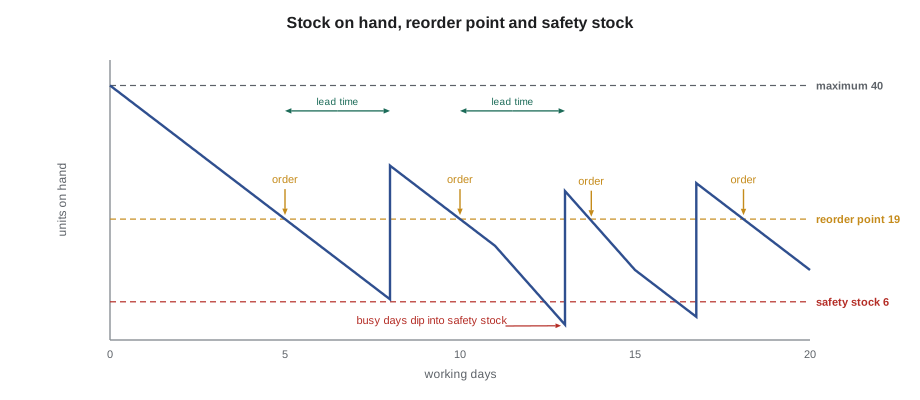
The reorder point is the stock level at which a part should be reordered so that the new stock arrives before the shelf runs out. It equals the expected demand during the lead time, plus the safety stock:
When the quantity on hand, plus anything already on order, falls to the reorder point, the part should be added to the next order. Most inventory software does this automatically by suggesting order quantities from each part's settings (lesson 9). The parts technician still reviews the suggestions, because the software only knows what it has been told.
Worked problem
The reorder point for the Vela oil filter
The Vela oil filter sells an average of 4.2 a day. If the department ordered it daily, the lead time would be 3 days from the moment stock runs low until new stock is on the shelf. Rolf wants 6 filters of safety stock. What is the reorder point?
Show solution
- Demand during the lead time:
- \[4.2 \times 3 = 12.6\]
- Add safety stock:
- \[12.6 + 6 = 18.6\]
- Round up:
- 19
Answer: The reorder point is 19 filters: when stock on hand and on order falls to 19, the filter should be ordered. Round reorder points up, not down, so the cushion is not lost to rounding.
Minimum and maximum: how most software stores the rule
Most dealer inventory software stores stocking rules as a minimum and a maximum, often called min/max. The minimum works like the reorder point: when the quantity on hand and on order falls to the minimum or below, the part is suggested for ordering. The maximum is the highest quantity the department wants on hand, and the suggested order brings stock back up to it.
The difference between the maximum and the minimum is roughly the order quantity: how many are bought at a time. For a part on a weekly stock order, a common starting point is to set the maximum at the minimum plus about one week of demand, so that each weekly order replaces what sold.
Worked problem
Setting min and max for the filter
Using a reorder point of 19 and a weekly order, set the minimum and maximum for the Vela filter, which sells about 21 in a five-day week.
Show solution
- Minimum:
- the reorder point, 19
- One week of demand:
- \[4.2 \times 5 = 21\]
- Maximum:
- \[19 + 21 = 40\]
Answer: A minimum of 19 and a maximum of 40. Each week the order brings stock back up to about 40, and stock should not fall below 19 before the next order arrives except on unusually busy days.
Some parts also have an order multiple or package quantity: they must be ordered in boxes of 6, 10 or 50. If the suggested order is 23 filters and they come in boxes of 12, the order will be 24. Package quantities should be set in the system so suggested orders make sense.
| Setting | What it controls |
|---|---|
| Minimum (reorder point) | When the part is suggested for ordering |
| Maximum | How high stock is brought up by each order |
| Safety stock | The cushion for busy days and late deliveries, built into the minimum |
| Lead time | How long until new stock is on the shelf, used to set the minimum |
| Order multiple | The package quantity the supplier sells in |
Fixing the Vela filter
Rolf and Talia looked at why the filter ran out. Three things had gone wrong together. First, its minimum was set at 6 and its maximum at 12, settings left over from years earlier when Vela sales were small. Second, the settings assumed daily ordering, but the filter was bought on the weekly stock order. Third, two filters had been charged to repair orders that were still open, so the counter thought they were on the shelf when they were already on cars.
The fix had three parts to match. Rolf reset the filter to a minimum of 19 and a maximum of 40, using the weekly ordering pattern and current demand. He asked the service department to close repair orders on time so parts were charged off promptly. And he asked Talia to run a report of every part whose average weekly sales were higher than its maximum, a sure sign of settings that no longer fit (lesson 9). The report found 37 such parts. Most were maintenance items for newer Tessaro models whose sales had grown quickly.
The lesson Talia took from it was that stock settings are not set once and forgotten. Demand changes, models age, suppliers change their schedules, and the department's own habits change. Many departments review the settings for their A parts every few months, and for all parts at least once a year. Some inventory software recalculates minimums and maximums automatically every month from recent sales; even then, a person should check the results, especially for parts with unusual sales.
Phase-in rules: when to start stocking a part
Not every part sold should be stocked. A part that sold once in two years would just sit on the shelf. Most departments use a phase-in rule: a part becomes a stock part only after it has sold, or been requested, a certain number of times in a certain period, such as three times in six months. Lost sales count toward the rule, which is another reason to record them.
Manufacturers often recommend phase-in rules and stocking levels for their dealers, and many dealer systems include the manufacturer's recommended stock for new models. The parts manager adapts these to the store. A dealership in a city with many older Tessaros will stock more parts for older models than a new store in a growing suburb.
The opposite of phase-in is phase-out: removing a part from stock when it has stopped selling. Lesson 6 covers phase-out, obsolete stock and returns.
When to review the settings
Stocking settings are not set once and forgotten. Demand changes as the vehicles in the area age, as new models arrive and as the service department's work changes. Rolf asked for a review of a part's settings whenever one of these happened: the part ran out twice in three months, the on-hand quantity stayed above the maximum for two months, the supplier's lead time changed, or the part was superseded. Most dealer systems recalculate the settings automatically each month, but a person still needs to check the parts where the automatic result looks wrong, such as a part whose sales jumped because of one large fleet order. A good rule is to trust the system for the many ordinary parts and spend human time on the few unusual ones.
Common mistakes
MistakeSetting a reorder point from demand alone.
InsteadAdd demand during the lead time and safety stock.
MistakeUsing the supplier's delivery time as the lead time.
InsteadInclude the time until the next order is sent and put-away time.
MistakeLeaving min/max settings unchanged for years.
InsteadReview settings as demand and ordering patterns change.
MistakeRounding a reorder point down.
InsteadRound up so the safety stock is not lost.
MistakeIgnoring package quantities.
InsteadSet order multiples so suggested orders match how the part is sold.
Summary and key terms
- Demand is how fast a part sells; measure it from all sales and include lost sales where possible.
- Lead time runs from deciding to order until the part is on the shelf, including the wait for the next order.
- Safety stock covers busy days and late deliveries.
- Reorder point = demand during the lead time + safety stock; round up.
- Most software stores the rule as min/max: order at the minimum, bring stock up to the maximum.
- Phase-in rules decide when a part becomes a stock part; settings need regular review.
- Demand
- How many of a part are sold or used in a given time.
- Lead time
- The time from deciding to order a part until it is on the shelf ready to sell.
- Safety stock
- Extra stock held to cover high demand or late deliveries.
- Reorder point
- The stock level at which a part should be ordered: demand during the lead time plus safety stock.
- Min/max
- A pair of stocking settings: order when stock falls to the minimum, and bring it up to the maximum.
- Phase-in rule
- A rule for when a part becomes a stock part, such as three sales in six months.
Practice problems
Work each problem on paper first, then reveal the answer to check.
A part sells 2.5 a day, lead time is 4 days and safety stock is 3. What is the reorder point?
Show answer
2.5 × 4 + 3 = 13.
A part's minimum is 10 and one week's demand is 15. What maximum would a weekly order suggest?
Show answer
10 + 15 = 25.
Why did the Vela filter run out even though it was a stock part?
Show answer
Its settings were too low, assumed daily ordering, and open repair orders hid stock that was already gone.
A part comes in boxes of 12 and the suggested order is 23. How many are ordered?
Show answer
24, two boxes.
Why do lost sales count toward a phase-in rule?
Show answer
They show demand that the sales history would otherwise miss.
Lesson quiz · 5 questions
Score 60% or more to complete this lesson.
Create a free account to save your progress, take quizzes and earn a certificate.