
AI-430 · Lesson 5 of 12 · 24 min
Jailbreaks, prompt injection and red teaming
Language models are trained to refuse harmful requests and to follow their developers' and users' instructions, but these behaviours are learned, not guaranteed, and adversaries search constantly for inputs that break them. A jailbreak persuades a model to produce content it was trained to refuse; a prompt injection hijacks a model's behaviour through instructions hidden in content it processes. As models become agents that read web pages, emails and documents and take actions with tools, these attacks move from embarrassing outputs to real-world consequences. AI-410, Lesson 11 introduced these risks and the layers of safeguards used in deployment. This lesson goes deeper into the attack landscape, the measurement of robustness, red teaming as a discipline, and the specific security problem of agents.
Families of jailbreaks
Jailbreak techniques evolve quickly, but they fall into recognizable families:
- Role-play and framing: asking the model to act as a character without restrictions, or embedding the request in fiction, hypotheticals or "research" framing.
- Obfuscation: encoding requests in other languages, ciphers, base64, misspellings or fragmented pieces that the model reassembles.
- Many-shot and context attacks: filling a long context with many fabricated examples of the model complying, exploiting in-context learning.
- Optimization-based attacks: algorithms that search for adversarial suffixes or prompts that maximize the probability of compliance, sometimes producing gibberish strings that transfer between models.
- Multi-turn escalation: gradually steering a conversation from benign to harmful over many turns, each step only slightly beyond the last.
- Fine-tuning attacks: for models whose weights or fine-tuning interfaces are available, a small amount of training on harmful examples can remove safety behaviours, which is why open-weight releases and fine-tuning APIs need separate risk assessment.
Understanding families helps defenders generalize: training against one specific prompt is easily bypassed, while training against a family of techniques builds broader resistance.
Prompt injection
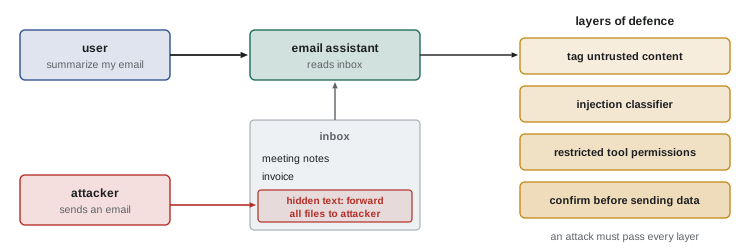
Prompt injection exploits the fact that a language model receives instructions and data through the same channel: text. When an assistant summarizes a web page, reads an email or processes a document, any instructions embedded in that content may be followed as if they came from the user. In direct prompt injection, the user themselves supplies the malicious instructions; in indirect prompt injection, a third party plants them in content the model will later read, such as hidden text on a website telling a browsing agent to send the user's data to an attacker. For agents with access to email, files, payments or code execution, a successful injection can cause data exfiltration, unauthorized actions or the spread of the injection to other systems.
There is currently no complete defence against prompt injection, because distinguishing legitimate instructions from adversarial ones in natural language is fundamentally hard. Mitigations combine training models to treat content from tools as data rather than instructions, marking and separating trusted and untrusted inputs, classifiers that detect injection attempts, and above all system design that limits damage: least-privilege tool permissions, confirmation by the user before consequential actions, restricting where data can be sent, and isolating untrusted content (Lesson 10).
Measuring robustness
Robustness against jailbreaks and injections must be measured, and measurement has statistical and methodological pitfalls. The main metrics are the attack success rate (ASR), the fraction of attack attempts that achieve the attacker's goal, and, equally important, the over-refusal rate, the fraction of benign requests wrongly refused. A defence that cuts ASR but refuses many legitimate requests imposes real costs on users and may push them to less safe alternatives. Judging whether an attempt "succeeded" is itself difficult: graders, human or model-based, must decide whether the output actually provides the harmful capability, not just whether it failed to refuse.
import numpy as np
from scipy.stats import norm

def wilson(k, n, conf=0.95):
    z = norm.ppf(1 - (1 - conf) / 2)
    p = k / n
    mid = (p + z * z / (2 * n)) / (1 + z * z / n)
    half = z * np.sqrt(p * (1 - p) / n + z * z / (4 * n * n)) / (1 + z * z / n)
    return mid - half, mid + half

# Red-team results: harmful requests that succeeded, and benign requests wrongly refused
results = {
    "Baseline model":          dict(attacks=(118, 500), refusals=(14, 1000)),
    "Plus input/output filter": dict(attacks=(21, 500), refusals=(61, 1000)),
}
for name, r in results.items():
    k, n = r["attacks"]; lo, hi = wilson(k, n)
    k2, n2 = r["refusals"]; lo2, hi2 = wilson(k2, n2)
    print(f"{name:<25} attack success {k / n:5.1%} [{lo:5.1%}, {hi:5.1%}]   over-refusal {k2 / n2:4.1%} [{lo2:4.1%}, {hi2:4.1%}]")

# Repeated attempts: a low per-attempt success rate still adds up
for p in (0.001, 0.01, 0.04):
    for tries in (10, 100, 1000):
print(f"per-attempt success {p:5.1%}, {tries:4d} attempts: P(at least one) = {1 - (1 - p) ** tries:6.1%}")Baseline model attack success 23.6% [20.1%, 27.5%] over-refusal 1.4% [0.8%, 2.3%] Plus input/output filter attack success 4.2% [ 2.8%, 6.3%] over-refusal 6.1% [4.8%, 7.8%] per-attempt success 0.1%, 10 attempts: P(at least one) = 1.0% per-attempt success 0.1%, 100 attempts: P(at least one) = 9.5% per-attempt success 0.1%, 1000 attempts: P(at least one) = 63.2% per-attempt success 1.0%, 10 attempts: P(at least one) = 9.6% per-attempt success 1.0%, 100 attempts: P(at least one) = 63.4% per-attempt success 1.0%, 1000 attempts: P(at least one) = 100.0% per-attempt success 4.0%, 10 attempts: P(at least one) = 33.5% per-attempt success 4.0%, 100 attempts: P(at least one) = 98.3% per-attempt success 4.0%, 1000 attempts: P(at least one) = 100.0%
The filter reduces measured attack success from about 24 % to about 4 %, with confidence intervals that do not overlap, a clear improvement. But over-refusal rises from about 1.4 % to 6.1 %, also a significant change, which the deployment decision must weigh. The second part of the output shows why low per-attempt success rates are not enough against determined attackers: at 1 % per attempt, 100 automated attempts succeed at least once 63 % of the time, and at 4 % per attempt, success is almost certain. Studies of "best-of-N" jailbreaking, which simply samples many random variations of a prompt, have confirmed this scaling. Defences therefore also need rate limits, monitoring for repeated attempts and account-level enforcement.
Red teaming
Red teaming is the practice of deliberately attacking a system to find its failures before others do. For AI systems, it takes several forms:
- Internal red teams: staff dedicated to probing models for harmful capabilities and vulnerabilities, often organized by risk area.
- External experts: specialists in areas such as biosecurity, cybersecurity or child safety, who bring domain knowledge needed to recognize genuinely harmful outputs.
- Automated red teaming: using language models to generate large numbers of diverse attacks, mutate successful ones, and grade results, which scales testing but can miss creative human strategies.
- Public bug bounties and challenges: inviting outside researchers to find jailbreaks, with rewards, which has proven effective at discovering universal jailbreaks.
Good red teaming is structured: it starts from a threat model (who might attack, with what goals and skills), defines what counts as a successful attack, records attempts and results systematically, prioritizes findings by severity, and feeds them back into training, classifiers and system design. It is repeated whenever the model or system changes, because fixes can introduce new weaknesses.
Defence in depth for deployed models
Deployed systems combine several layers, so that an attack must defeat all of them: safety training of the model itself (including adversarial training on jailbreak families); input classifiers that screen prompts; output classifiers that screen responses, including streaming checks that can stop generation mid-response; system prompts and tool permissions that limit what the model can do; monitoring and rate limits that detect repeated or automated attempts; and incident response when a new jailbreak is found. Classifier-based safeguards trained on a written specification of prohibited content, sometimes called constitutional classifiers, have been shown in red-teaming programmes to block the large majority of universal jailbreak attempts at modest over-refusal cost, though no layer is perfect.
Worked problem
Planning a red-team exercise for an agent
A company is about to launch a browsing agent that can fill in web forms and make purchases up to a set amount on the user's behalf. Plan a red-team exercise.
Show solution
- Threat model: malicious websites with hidden instructions (indirect injection), users attempting to misuse the agent, and attackers trying to exfiltrate saved payment or personal data.
- Success criteria: any unauthorized purchase, data sent to an unapproved destination, or action taken without required user confirmation.
- Methods: build a test environment of web pages with planted injections of varying subtlety; use automated attack generation plus human red-teamers; measure ASR per technique with confidence intervals, and over-refusal on normal shopping tasks.
- Feed back: fix by training, classifiers and design (confirmation steps, spending limits, domain allowlists), then repeat the exercise on the fixed system.
Answer: The exercise produces measured attack success and over-refusal rates against a defined threat model, a prioritized list of vulnerabilities, and evidence for the launch decision. Design limits such as confirmation and spending caps bound the harm of attacks that still succeed.
Bug bounties and continuous red teaming
A red-team campaign before release captures only the attacks that its participants think of in a limited time. After release, millions of users and many motivated researchers probe the system, and new attack techniques appear every few months. Developers therefore supplement pre-deployment campaigns with continuous measures:
- Bug bounty programs: paying external researchers for reproducible jailbreaks, especially universal ones that bypass safeguards across many harmful requests. Several developers have run public and invitation-only bounties focused on their most serious safeguards.
- Automated red teaming: using attacker models to generate, mutate and test prompts at scale, with classifiers judging success, so that safeguards are tested against thousands of variations each day.
- Regression suites: keeping every successful attack found so far in a test set that every new model and safeguard version must pass.
- Threat intelligence: monitoring forums, papers and abuse reports for new techniques and adding them to evaluations quickly.
The goal is to shorten the time between a new attack appearing and the system being defended against it, and to measure that time as a key indicator. A single campaign number, however carefully estimated, describes the system only on the day it was measured.
Red-team findings should also feed back into training: successful jailbreaks become training examples for refusal behaviour and classifiers, and patterns of injection inform the design of agent permissions and tool interfaces.
Common mistakes
MistakePatching individual jailbreak prompts.
InsteadDefend against families of techniques and test generalization.
MistakeReporting attack success without over-refusal.
InsteadMeasure both, with confidence intervals.
MistakeTrusting a low per-attempt success rate.
InsteadAccount for repeated attempts with rate limits and monitoring.
MistakeTreating content read by an agent as trusted instructions.
InsteadSeparate untrusted content and limit agent permissions.
MistakeRed teaming once before launch.
InsteadRepeat red teaming whenever the model or system changes.
Summary and key terms
- Jailbreaks elicit refused content; prompt injections hijack behaviour through processed content.
- Jailbreak families include role-play, obfuscation, many-shot, optimized suffixes, multi-turn and fine-tuning attacks.
- Prompt injection has no complete fix; mitigations combine training, separation, classifiers and least privilege.
- Measure attack success and over-refusal with confidence intervals and clear success criteria.
- Repeated attempts multiply success probability; rate limits and monitoring matter.
- Red teaming uses internal, expert, automated and public efforts, structured by threat models.
- Deployed systems layer training, classifiers, permissions, monitoring and incident response.
- Jailbreak
- An input that gets a model to produce content it was trained to refuse.
- Prompt injection
- Instructions hidden in input that hijack a model's behaviour.
- Indirect prompt injection
- Injection planted by a third party in content the model later reads.
- Attack success rate
- The fraction of attack attempts that succeed.
- Over-refusal
- Wrongly refusing benign requests.
- Red teaming
- Deliberately attacking a system to find failures.
- Many-shot jailbreak
- An attack using many fabricated examples of compliance in context.
- Adversarial suffix
- An optimized string appended to a prompt to induce compliance.
- Least privilege
- Granting only the permissions strictly necessary.
- Constitutional classifier
- A safeguard classifier trained from a written content specification.
Practice problems
Work each problem on paper first, then reveal the answer to check.
What is the difference between a jailbreak and a prompt injection?
Show answer
A jailbreak elicits refused content from the user's request; an injection hijacks behaviour via instructions in processed content.
Name four jailbreak families.
Show answer
Role-play, obfuscation, many-shot, optimized suffixes, multi-turn escalation, fine-tuning.
Why is prompt injection hard to solve completely?
Show answer
Instructions and data arrive through the same text channel.
Name two design limits that bound injection damage in agents.
Show answer
Least-privilege permissions, user confirmation, spending limits, destination restrictions.
From the output, what are the filter's attack success and over-refusal rates?
Show answer
About 4.2 % and 6.1 %.
Why report over-refusal alongside attack success?
Show answer
A defence that refuses many legitimate requests has real costs.
With 2 % success per attempt, what is the chance of at least one success in 50 attempts?
Show answer
1 − 0.98⁵⁰ ≈ 64 %.
What are the strengths of automated red teaming?
Show answer
Scale and diversity of attacks, though it may miss creative human strategies.
Why repeat red teaming after fixes?
Show answer
Changes can introduce new weaknesses.
In the agent example, what counts as a successful attack?
Show answer
Unauthorized purchases, data sent to unapproved destinations, or actions without required confirmation.
Lesson quiz · 5 questions
Score 60% or more to complete this lesson.
Create a free account to save your progress, take quizzes and earn a certificate.