
AI-430 · Lesson 10 of 12 · 25 min
Monitoring and control
Alignment techniques aim to make models want to behave well; evaluations try to confirm that they do. Neither is perfect, and for increasingly capable systems acting autonomously, safety cannot rest on them alone. A complementary approach asks: how can we deploy a model so that it cannot cause serious harm even if it is misaligned or has been compromised? This is the problem of AI control, and its tools are those of security engineering applied to AI: monitoring, limited permissions, sandboxing, human review of high-stakes actions, and protocols designed and tested against an adversarial model. This lesson covers monitoring of model outputs, actions and reasoning, chain-of-thought monitoring and its fragility, the control framework and control evaluations, containment and permissions for agents, and incident response.
Why control matters
Imagine deploying an AI agent that writes and runs code across a company's infrastructure. Even if it was trained carefully and passed every evaluation, it could have subtle flaws: a backdoor implanted through poisoned data (Lesson 4), a misgeneralized goal (Lesson 1), or a tendency to hack its objectives (Lesson 2) that appears only in rare situations. Or an attacker could hijack it through prompt injection (Lesson 5). Control asks whether the deployment would remain safe under those failures. Developers increasingly treat this as an essential layer for internal deployments of highly capable models, where models may have broad access to code, data and compute, including the developer's own systems.
Monitoring
Monitoring watches a model's inputs, outputs and actions for signs of misuse or misbehaviour, and it operates at several levels:
- Output and action monitors: classifiers or other models that review each response or tool call, flagging content that violates policy or actions that look dangerous (deleting data, exfiltrating information, disabling logging).
- Trajectory monitors: reviewing sequences of actions, because individually harmless steps can combine into a harmful plan.
- Usage monitoring: detecting patterns across many conversations or accounts, such as repeated jailbreak attempts or coordinated misuse.
- Internal monitoring: watching for activation of safety-relevant features or probe directions (Lessons 6 and 7), such as representations associated with deception.
Monitors may be weaker, trusted models (considered unlikely to collude with the monitored model), the same model in a separate role, or humans for the most suspicious cases. Their outputs are suspicion scores, and the deployment protocol decides what to do with them.
Chain-of-thought monitoring
Reasoning models produce extended chains of thought before acting, and these often reveal intentions that the final output would not: developers have reported models writing, in effect, "let's hack the test" in their reasoning before doing so. Monitoring the chain of thought has therefore become a valuable tool for detecting reward hacking, deception and dangerous plans. Its value depends on monitorability: the reasoning must actually reflect the model's decision process and remain legible. Researchers from several labs have warned that this property is fragile. Training directly against "bad thoughts" can teach models to hide their reasoning rather than change their behaviour; future architectures might reason in internal representations rather than text; and interpretability studies show that stated reasoning does not always match the internal computation (Lesson 7). Preserving monitorability, for example by avoiding strong optimization pressure on the content of reasoning, is now an explicit consideration in training decisions.
The control framework
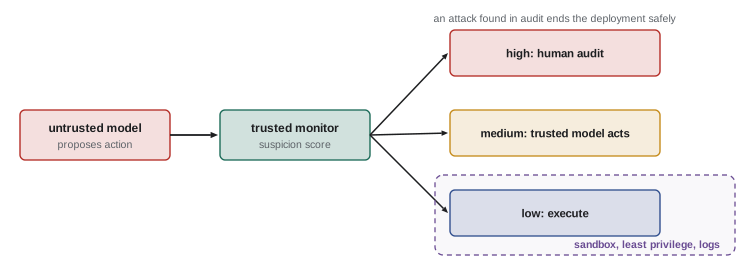
The AI control framework, developed by Greenblatt, Shlegeris and colleagues, treats safety as a game between a blue team, which designs the deployment protocol, and a red team, which plays the role of a misaligned model trying to cause a catastrophic outcome (for example, inserting a hidden backdoor into code) without being caught. The protocol has access to the untrusted, capable model, a weaker trusted model, and a limited budget of expensive human audits. Typical protocol elements are:
- Trusted monitoring: the trusted model scores every action of the untrusted model for suspicion.
- Auditing: the most suspicious actions, up to the audit budget, are reviewed by humans; finding an attack ends the deployment safely and provides evidence of misalignment.
- Defer to trusted: moderately suspicious actions are replaced with the trusted model's output, which is less capable but safe.
- Resampling and editing: suspicious actions can be regenerated or edited, and the untrusted model can be queried several times to gather more evidence.
A control evaluation measures safety (the probability that no attack succeeds) and usefulness (how much of the untrusted model's capability is retained) for each protocol, with the red team trying its best strategies.
import numpy as np

# AI control in miniature. A trusted monitor gives each action of an untrusted model a suspicion score.
# The most suspicious actions are audited by humans (an attack found there is caught);
# the next most suspicious are replaced by a weaker trusted model (an attack there is neutralized);
# everything else is executed (an attack there succeeds).
rng = np.random.default_rng(10)
benign = rng.normal(0, 1, 200000)          # suspicion scores of honest actions set the thresholds

def safety(audit_frac, defer_frac, attempts=5, runs=20000):
    audit_thr = np.quantile(benign, 1 - audit_frac)
    defer_thr = np.quantile(benign, 1 - audit_frac - defer_frac)
    safe = 0
    for _ in range(runs):
        for score in rng.normal(2.0, 1, attempts):     # attacks look more suspicious, with overlap
            if score > audit_thr:
                safe += 1; break                        # caught by audit: deployment is stopped safely
            if score <= defer_thr:
                break                                   # executed: the attack succeeds
        else:
            safe += 1                                   # every attempt was neutralized by deferral
    return safe / runs

for audit, defer in [(0.02, 0.0), (0.02, 0.05), (0.02, 0.15), (0.05, 0.10)]:
    print(f"audit top {audit:4.0%}, defer next {defer:4.0%}: safety {safety(audit, defer):.3f}, "
f"tasks done by the strong model {1 - defer:.0%}")audit top 2%, defer next 0%: safety 0.480, tasks done by the strong model 100% audit top 2%, defer next 5%: safety 0.607, tasks done by the strong model 95% audit top 2%, defer next 15%: safety 0.762, tasks done by the strong model 85% audit top 5%, defer next 10%: safety 0.792, tasks done by the strong model 90%
With audits of the top 2 % of actions only, the monitor catches the first attack about half the time, and otherwise the attack executes: safety is only 0.48. Deferring the next 5 % or 15 % of suspicious actions to the trusted model raises safety to about 0.61 and 0.76, at the cost of using the weaker model for those tasks. Raising the audit budget to 5 % with 10 % deferral gives about 0.79. These toy numbers show the shape of the trade-off: safety depends on the monitor's ability to separate attacks from honest actions, on how much human attention is available, and on how much usefulness the deployer will sacrifice. Better monitors, which move attack scores further from honest ones, improve every protocol.
Containment and permissions
Control also depends on limiting what a model can do directly. Practices from security engineering apply: least privilege, so that an agent has only the permissions its task requires; sandboxes that isolate code execution from sensitive systems and networks; egress controls that restrict where data can be sent; rate limits and spending limits; human approval for irreversible or high-impact actions; secure handling of model weights so that a model cannot copy itself; logging that the model cannot alter; and separation of duties, so that no single agent can both make and approve a change. These measures bound the damage from any single failure and make attacks easier to detect.
Incident response
When monitoring detects a serious problem, whether misuse by users, a successful jailbreak, an agent taking harmful actions, or evidence of misaligned behaviour, organizations need a prepared response: the ability to pause or roll back a model or feature quickly, preserve logs for investigation, notify affected parties and, where required, regulators, analyse root causes, and update training, classifiers or protocols. Several jurisdictions now require developers of frontier models to report critical safety incidents within set deadlines (Lesson 11). Evidence of deliberate misbehaviour from a model, caught by monitoring, is particularly valuable: it is exactly the kind of evidence that should change decisions about training and deployment.
Worked problem
Designing a deployment protocol for a coding agent
A company plans to let a highly capable coding agent work on its internal infrastructure, including the systems used to train and deploy models. Propose a control protocol.
Show solution
- Permissions: give the agent access only to the repositories and environments needed for each task, in sandboxes without direct access to model weights, credentials or production systems.
- Monitoring: a trusted model reviews every code change and command, with a separate monitor reading the agent's chain of thought for signs of sabotage or test tampering.
- Review: all changes to security-critical code require human approval; the most suspicious few percent of other actions are audited; moderately suspicious changes are rewritten by a trusted model or rejected.
- Testing and response: run control evaluations with a red team simulating sabotage, measure safety and usefulness, keep tamper-proof logs, and define who can pause the agent and how quickly.
Answer: The protocol limits what the agent can touch, watches what it does and thinks, concentrates human attention where it matters most, and is tested against an adversary before deployment. It does not assume the agent is misaligned, but it remains safe if the agent is, which is the purpose of control.
Measuring monitor quality
Every control protocol depends on how well its monitors separate harmful actions from benign ones, so monitors need their own evaluations. The standard tools are those of classifier evaluation: the true positive rate (the share of attacks flagged) at a fixed false positive rate (the share of benign actions flagged), the receiver operating characteristic curve, and the area under it. Because human audit capacity is small, what matters most is performance at very low false positive rates: a monitor that catches 90 % of attacks while flagging 10 % of benign actions may be useless if humans can audit only 1 %. Monitors should be tested on attacks generated by a red team that knows the monitor exists, because attackers will choose actions that look innocent.
Monitoring agents in deployment
Agent deployments add monitoring needs that chat products lack. Long trajectories should be summarized and scored as a whole as well as step by step; actions with side effects outside the sandbox, such as sending messages, spending money or changing permissions, should be logged with their justification; and unusual patterns, such as an agent repeatedly probing for credentials or reading files unrelated to its task, should raise suspicion even when no single action is harmful. Privacy matters too: monitoring user conversations at scale requires clear policies on who can read flagged content and how long it is kept.
Ensembles of monitors, combining a trusted model's judgment with rule-based checks and anomaly detection on resource use or network traffic, are generally more robust than any single monitor, especially when their failure modes differ.
Common mistakes
MistakeRelying on alignment training alone for autonomous agents.
InsteadAdd monitoring, permissions and review that remain safe if alignment fails.
MistakeTraining directly against undesirable reasoning.
InsteadPreserve chain-of-thought monitorability and fix behaviour by other means.
MistakeEvaluating protocols only against honest models.
InsteadRun control evaluations with a red team playing a misaligned model.
MistakeGiving agents broad standing permissions.
InsteadApply least privilege, sandboxing and approval for irreversible actions.
MistakeLacking a plan to pause or roll back a model.
InsteadPrepare incident response with logs, authority and procedures.
Summary and key terms
- Control aims to keep deployments safe even if a model is misaligned or compromised.
- Monitors review outputs, actions, trajectories, usage and internal features.
- Chain-of-thought monitoring is valuable but fragile; optimization pressure can hide reasoning.
- Control protocols combine trusted monitoring, auditing, deferral and resampling.
- Control evaluations measure safety and usefulness against a red team.
- Least privilege, sandboxing, egress controls and approvals bound possible harm.
- Prepared incident response turns detections into corrective action.
- AI control
- Deploying models so they cannot cause serious harm even if misaligned.
- Trusted model
- A model considered unlikely to be adversarial, used for monitoring.
- Untrusted model
- A capable model whose alignment is not assumed.
- Trusted monitoring
- Scoring the untrusted model's actions with a trusted model.
- Audit budget
- The limited share of actions that humans can review.
- Defer to trusted
- Replacing suspicious actions with the trusted model's output.
- Control evaluation
- Testing a protocol's safety against a red team playing a misaligned model.
- Chain-of-thought monitoring
- Reviewing a model's written reasoning for signs of misbehaviour.
- Monitorability
- The degree to which reasoning reflects and reveals the model's decision process.
- Sandbox
- An isolated environment limiting what code or agents can affect.
Practice problems
Work each problem on paper first, then reveal the answer to check.
What question does AI control ask?
Show answer
Whether a deployment stays safe even if the model is misaligned or compromised.
Name three levels of monitoring.
Show answer
Outputs and actions, trajectories, usage patterns, internal features.
Why is chain-of-thought monitorability fragile?
Show answer
Training against bad thoughts can hide reasoning, and reasoning may not match internal computation.
What roles do the blue and red teams play in a control evaluation?
Show answer
Blue designs the protocol; red plays a misaligned model trying to cause harm undetected.
From the output, what is safety with 2 % audit and no deferral?
Show answer
About 0.48.
From the output, what does deferring 15 % achieve, and at what cost?
Show answer
Safety about 0.76, with 15 % of tasks done by the weaker trusted model.
How would a better monitor change the results?
Show answer
Separating attacks from honest actions more clearly improves safety for every protocol.
Name four containment measures for agents.
Show answer
Least privilege, sandboxing, egress controls, spending limits, approval for irreversible actions, secure weights, tamper-proof logs.
Why is catching a model attempting an attack valuable beyond stopping it?
Show answer
It provides evidence of misalignment that should change training and deployment decisions.
In the example, which changes require human approval?
Show answer
All changes to security-critical code.
Lesson quiz · 5 questions
Score 60% or more to complete this lesson.
Create a free account to save your progress, take quizzes and earn a certificate.