
AI-430 · Lesson 11 of 12 · 25 min
Safety frameworks, policy and governance
Technical safety methods matter only if organizations use them consistently and decide well about when to train, deploy, restrict or pause models. Governance is the set of commitments, processes, laws and institutions that shape those decisions. For frontier AI it operates at several levels: internal safety frameworks adopted by developers, voluntary commitments and industry codes, national laws and regulators, government safety institutes, and international cooperation. This lesson surveys each level, explains how capability thresholds link evaluations (Lessons 8 and 9) to required safeguards, compares the main legal regimes that apply to frontier developers, and discusses the open questions that make AI governance a fast-moving field. Laws and institutions in this area change frequently; the details below reflect the situation in late 2026, and practitioners should always check current sources.
Frontier safety frameworks
Most leading developers have published frontier safety frameworks: documents that describe which dangerous capabilities they track, how they evaluate them, and which safeguards they commit to apply as capabilities grow. Examples include Anthropic's Responsible Scaling Policy, OpenAI's Preparedness Framework and Google DeepMind's Frontier Safety Framework, and at the 2024 Seoul AI summit, sixteen companies committed to publish frameworks of this kind. Despite differences in terminology, the frameworks share a common structure:
- Risk domains: typically chemical, biological, radiological and nuclear (CBRN) weapons, offensive cyber operations, autonomous AI research and development, and sometimes persuasion or loss of control.
- Capability thresholds: defined levels of dangerous capability in each domain, such as the ability to provide meaningful uplift to a novice attempting to produce a biological weapon, or to automate the work of an entry-level AI researcher.
- Evaluations: tests run before and during training and before deployment to determine whether a model is near or above each threshold, with safety margins to account for elicitation gaps.
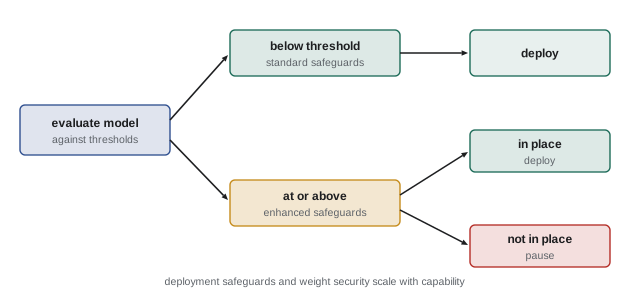
- Required safeguards: deployment protections (classifiers, monitoring, access restrictions) and security protections (protecting model weights against theft) that must be in place before a model above a threshold is deployed or further trained.
- Governance: who makes decisions, how they are documented, how the framework is updated, and what external review or reporting takes place.
The core idea is if-then commitments: if evaluations show a capability above a threshold, then specific safeguards are required, and if those safeguards cannot be implemented, deployment or training is paused. Frameworks have been criticized for vague thresholds, discretion in interpretation and the absence of external enforcement, and several have been revised as experience accumulated; newer laws now require some of their elements to be published and followed.
Thresholds based on compute
Laws often need a simple, objective trigger for which models they cover. Training compute, measured in floating-point operations (FLOPs), is widely used because it correlates with capability, is known to the developer before deployment, and is hard to game without also limiting capability. For dense transformers, training compute is approximately six times the number of parameters times the number of training tokens:
# Training compute thresholds used in AI rules. Compute is estimated as about 6 x parameters x tokens.
models = [
    ("Small open model", 8e9, 15e12),
    ("Mid-size model", 70e9, 15e12),
    ("Large model", 400e9, 30e12),
    ("Frontier run", 2e12, 40e12),
]
thresholds = [("EU AI Act systemic-risk presumption", 1e25), ("California SB 53 and New York RAISE", 1e26)]
for name, params, tokens in models:
    flops = 6 * params * tokens
    hits = [label for label, t in thresholds if flops > t]
    print(f"{name:17s} {params:8.1e} parameters {tokens:8.1e} tokens  compute {flops:8.1e}")
print(" above:", ", ".join(hits) if hits else "no threshold")Small open model 8.0e+09 parameters 1.5e+13 tokens compute 7.2e+23
above: no threshold
Mid-size model 7.0e+10 parameters 1.5e+13 tokens compute 6.3e+24
above: no threshold
Large model 4.0e+11 parameters 3.0e+13 tokens compute 7.2e+25
above: EU AI Act systemic-risk presumption
Frontier run 2.0e+12 parameters 4.0e+13 tokens compute 4.8e+26
above: EU AI Act systemic-risk presumption, California SB 53 and New York RAISEThe small and mid-size models fall below all thresholds. A 400-billion-parameter model trained on 30 trillion tokens uses about 7 × 10^25 FLOPs, above the EU's presumption threshold for systemic risk but below the 10^26 threshold used in the California and New York laws. Only the largest run crosses both. Compute thresholds are crude: algorithmic progress means that a fixed threshold captures increasingly capable models less well over time, fine-tuning and inference-time compute are not always counted, and small specialized models can be dangerous in narrow domains. For these reasons, compute thresholds are usually combined with capability evaluations and with criteria based on the developer's size or revenue.
Laws and regulators
The European Union's AI Act, which entered into force in August 2024, is the most comprehensive horizontal AI law. It regulates high-risk applications (such as AI in hiring, credit and critical infrastructure) and imposes obligations on providers of general-purpose AI (GPAI) models that have applied since August 2025: technical documentation, information for downstream providers, a copyright policy and a summary of training content. Models with systemic risk, presumed above 10^25 FLOPs of training compute or designated by the Commission, face additional duties: model evaluation including adversarial testing, assessment and mitigation of systemic risks, serious incident reporting and adequate cybersecurity. A General-Purpose AI Code of Practice, published in 2025 and signed by most major developers, describes how these obligations can be met; the AI Office oversees compliance.
In Canada, there is no federal law specifically regulating frontier AI. The proposed Artificial Intelligence and Data Act, part of Bill C-27, died when Parliament was prorogued in January 2025. Governance relies instead on existing law (privacy legislation such as PIPEDA and Quebec's Law 25, human rights and competition law), the federal Voluntary Code of Conduct on the Responsible Development and Management of Advanced Generative AI Systems, which many companies have signed, and the Directive on Automated Decision-Making for government systems. Developers serving Canadians who also operate in the United States or the European Union must comply with those jurisdictions' frontier rules, which in practice shape the safety processes applied to models used in Canada.
Across these regimes, recurring elements are transparency (publishing frameworks, model cards and system cards), testing before deployment, incident reporting, cybersecurity for model weights, and whistleblower protections, rather than detailed technical rules, which would quickly become outdated.
| Element | EU AI Act (GPAI with systemic risk) | California SB 53 | New York RAISE Act |
|---|---|---|---|
| Applies from | August 2025 (enforcement from August 2026) | January 1, 2026 | January 1, 2027 |
| Main trigger | Above 10^25 FLOPs or designation | Above 10^26 FLOPs; large developers by revenue | Above 10^26 FLOPs; large developers by revenue |
| Safety framework | Risk assessment and mitigation; Code of Practice | Publish a frontier AI framework | Publish safety and security protocols |
| Incident reporting | Serious incidents to the AI Office | Within 15 days; 24 hours if imminent risk | Within 72 hours |
| Penalties | Up to 3 % of global turnover or EUR 15 million | Up to $1 million per violation | Up to $1 million, $3 million for repeat violations |
Safety institutes and international cooperation
Several governments have created AI safety institutes, technical bodies that evaluate frontier models, conduct research and advise policymakers. The United Kingdom created the first in 2023 (renamed the AI Security Institute in 2025). The US institute, created at NIST in 2023, was reorganized in 2025 as the Center for AI Standards and Innovation (CAISI), focused on standards, voluntary testing agreements with developers and national security risks. Canada launched the Canadian AI Safety Institute (also abbreviated CAISI) in November 2024 within Innovation, Science and Economic Development Canada, funding research through partners including the CIFAR and the National Research Council. These bodies form an international network that shares evaluation methods and, in some cases, jointly tests models before release.
International cooperation also runs through summits (Bletchley Park 2023, Seoul 2024, Paris 2025 and India 2026), the OECD AI Principles and its reporting framework for the Hiroshima AI Process code of conduct, the Council of Europe's Framework Convention on AI (the first binding international treaty on AI, opened for signature in 2024 and signed by Canada, the United States and others), and the International AI Safety Report, a scientific assessment of general-purpose AI risks led by Yoshua Bengio with experts nominated by over thirty countries, first published in January 2025.
Inside organizations
Effective governance inside a developer depends on more than a written framework. Good practice includes a clear decision-making process for training and deployment with documented rationales; independent internal review, for example by a safety or risk committee with authority to delay launches; board-level oversight of catastrophic risk; external evaluation by safety institutes and third-party assessors before major releases; secure channels for employees to raise concerns, protected by law in some jurisdictions; publication of system cards that report evaluation results, safeguards and known limitations; and post-deployment monitoring with incident response (Lesson 10). Security of model weights deserves particular attention, because a stolen model escapes every deployment safeguard; frameworks increasingly specify security levels matched to capability, up to protection against well-resourced state actors.
Open questions
AI governance is unsettled. Key debates include:
- Open-weight models: releasing weights enables research, competition and local control, but safeguards can be removed by fine-tuning and releases cannot be recalled. Many frameworks set capability thresholds above which open release would not be appropriate.
- Federal versus state rules: in the United States, whether a national standard should preempt state frontier AI laws remains contested.
- Verification: how outsiders can confirm that developers follow their own frameworks, and whether audits and third-party evaluation should be mandatory.
- Competition and coordination: unilateral safety commitments may be costly if competitors do not make them, which motivates industry codes, legal minimums and international agreements.
- Compute governance: tracking advanced chips and large training runs as a basis for oversight, including export controls on advanced semiconductors.
- Pace: rules written for today's systems may not fit future ones, which favours flexible, process-based requirements and regular review.
Worked problem
Mapping obligations for a new model
A developer based in Canada with annual revenue above $1 billion (USD) plans to release, in the European Union, California and New York, a general-purpose model trained with 2 × 10^26 FLOPs. Which frontier obligations apply, and what must the developer prepare?
Show solution
- Compute: 2 × 10^26 FLOPs exceeds both the EU 10^25 presumption and the 10^26 threshold in SB 53 and the RAISE Act, and revenue exceeds the large-developer criteria.
- EU: as a GPAI model with systemic risk, the developer must perform evaluations including adversarial testing, assess and mitigate systemic risks, report serious incidents and ensure cybersecurity; signing the Code of Practice is the expected route.
- California and New York: publish a frontier AI framework and safety protocols, publish transparency reports at release, set up incident reporting within the required deadlines, and protect whistleblowers.
- Canada: no frontier-specific law applies, but the voluntary code and privacy law do; the developer can engage the Canadian AI Safety Institute and partner institutes for evaluation.
Answer: The developer needs one well-documented safety framework, an evaluation program covering dangerous capabilities, a system card, an incident response process able to meet the shortest deadline (24 hours for imminent risk in California) and clear whistleblower channels. Building one process that satisfies the strictest requirements is simpler than maintaining separate ones for each jurisdiction.
Reading a frontier safety framework critically
When evaluating a developer's published framework, useful questions include: Are the capability thresholds specific enough that an outsider could tell whether they had been crossed? Are the required safeguards concrete, with standards for testing them? Who decides, and can the decision be overridden for commercial reasons? Is there external review or reporting of results? What happens if the safeguards cannot be achieved? Frameworks that answer these questions clearly provide much stronger assurance than those that describe intentions in general terms.
Common mistakes
MistakeTreating a published framework as proof of safe practice.
InsteadLook for clear thresholds, evidence of compliance and external review.
MistakeRelying on compute thresholds alone.
InsteadCombine them with capability evaluations and other criteria.
MistakeAssuming obligations depend only on where the developer is based.
InsteadCheck every jurisdiction where the model is offered.
MistakeNeglecting weight security.
InsteadProtect weights in proportion to capability; theft bypasses all deployment safeguards.
MistakeQuoting rules from memory.
InsteadCheck current sources; AI laws and institutions change frequently.
Summary and key terms
- Frontier safety frameworks define risk domains, capability thresholds, evaluations and required safeguards.
- If-then commitments link evaluation results to safeguards or a pause.
- Training compute, about 6ND, is a common legal trigger, but it is crude.
- The EU AI Act imposes GPAI and systemic-risk obligations, supported by a Code of Practice.
- California SB 53 and New York's RAISE Act require frameworks, transparency and incident reporting.
- Safety institutes in Canada, the United States, the United Kingdom and elsewhere evaluate models and share methods.
- Internal governance, weight security and external review make frameworks effective.
- Frontier safety framework
- A developer's policy linking dangerous capabilities to required safeguards.
- Capability threshold
- A defined level of dangerous capability that triggers stronger safeguards.
- If-then commitment
- A pledge to apply specific safeguards if a threshold is reached.
- FLOP
- A floating-point operation, the unit used to measure training compute.
- GPAI
- General-purpose AI model, a category regulated under the EU AI Act.
- Systemic risk
- In the EU AI Act, risk from the most capable general-purpose models.
- Code of Practice
- Guidance on meeting EU GPAI obligations, signed by developers.
- AI safety institute
- A government technical body that evaluates and researches AI risks.
- System card
- A published report of a model's evaluations, safeguards and limitations.
- Weight security
- Protection of model parameters from theft or leakage.
Practice problems
Work each problem on paper first, then reveal the answer to check.
Name the five common elements of frontier safety frameworks.
Show answer
Risk domains, capability thresholds, evaluations, required safeguards, governance.
What is an if-then commitment?
Show answer
A pledge that reaching a capability threshold triggers specific safeguards or a pause.
Estimate the training compute of a 70-billion-parameter model trained on 2 trillion tokens.
Show answer
6 × 7 × 10^10 × 2 × 10^12 ≈ 8.4 × 10^23 FLOPs.
From the output, which model crosses only the EU threshold?
Show answer
The large 400-billion-parameter model, at about 7.2 × 10^25 FLOPs.
Why are compute thresholds crude?
Show answer
Algorithmic progress, uncounted fine-tuning and inference compute, and dangerous small models.
Since when have EU GPAI obligations applied?
Show answer
August 2025.
Which body oversees GPAI compliance in the EU?
Show answer
The AI Office of the European Commission.
What does the International AI Safety Report provide?
Show answer
A scientific assessment of general-purpose AI risks by experts from over thirty countries.
Why is weight security important?
Show answer
A stolen model escapes all deployment safeguards.
Name two open questions in AI governance.
Show answer
Open-weight release, preemption, verification, competition, compute governance, pace.
Lesson quiz · 5 questions
Score 60% or more to complete this lesson.
Create a free account to save your progress, take quizzes and earn a certificate.