
AERO-499 · Lesson 3 of 12 · 21 min
Concept generation
With the requirements signed, the team spends weeks 5 and 6 doing something that feels uncomfortable to engineers trained to find the right answer: generating many answers, most of which will be wrong. Professor Lindqvist calls this the divergent phase. Its purpose is to make sure the concept the team eventually chooses was chosen from a wide field, not simply the first idea that came to mind. The convergent phase, selecting among the concepts, is the subject of the next lesson. Mixing the two, judging ideas while they are still being generated, is the most common way to end up with a timid design.
Start from functions, not from aircraft
Every student on the team has a picture of a light trainer in their head, and it is usually a high-wing piston aeroplane with a tricycle undercarriage, because that is what most North American flight schools fly. Starting from that picture would make the Plover E2 a battery-powered copy of an aircraft designed around a piston engine and a fuel tank. To avoid it, the team breaks the aircraft down into the functions it must perform, independent of any solution: carry and protect two occupants, generate lift, produce thrust, store energy, convert stored energy to shaft power, control the aircraft in three axes, move on the ground and absorb landing loads, and give the instructor and student a good view. Each function can then be met in several ways, and the combinations form the space of possible concepts.
The electric drive changes some functions fundamentally. Energy is stored in a battery whose mass does not change during the flight, so the centre of gravity does not move and the aircraft lands at its take-off mass. The motor is small, light and efficient at any size, so the designer can place it, or several of them, almost anywhere, which is impossible with a piston engine that needs cooling air, an exhaust and a mechanical connection to the propeller. And the battery is the heaviest single item in the aircraft, so where it goes dominates both the balance and the crash safety of the design.
Learning from what exists
Before generating new ideas the team studies existing aircraft, a step called benchmarking. The point is not to copy them but to learn what problems they solved and how, and to calibrate the team's estimates.
| Aircraft | Type | What the team took from it |
|---|---|---|
| Pipistrel Velis Electro | Two-seat electric trainer, EASA type certificate 2020 | Circuit-training mission; two battery packs, one ahead of and one behind the cabin; liquid-cooled drive; maximum take-off mass of 600 kg |
| Diamond eDA40 | Four-seat electric conversion of a piston type, in development | The difficulty of fitting a battery into an airframe designed around fuel tanks; fast DC charging |
| Bye Aerospace eFlyer 2 | Two-seat electric trainer, in flight test | Low-wing, clean composite airframe built for low drag |
| Cessna 152 | Two-seat piston trainer, out of production | The handling and cabin the school's instructors know; maximum take-off mass of about 760 kg |
| Diamond DA20 | Two-seat piston trainer | Low-wing composite trainer with good visibility and benign stall behaviour |
| School fleet | Four-seat piston aeroplanes | Real operating costs, maintenance records and lesson lengths |
Two lessons stand out. The Velis Electro, the first electric aeroplane to receive a full type certificate, flies short circuit lessons, and Transport Canada validated its type certificate in November 2025, so a certified path for the class exists in Canada. And it is small: its maximum take-off mass is little more than half that of a four-seat piston trainer, which hints at how hard it is to carry the energy for a longer lesson. Arjun, who did the Petrel 19 sizing, adds a third observation from experience: electric conversions of existing piston aircraft tend to end up heavier than aircraft designed around the battery from the start, because the airframe was laid out for fuel in the wings and an engine in the nose.
Generating ideas
The team uses three techniques. In brainstorming, everyone suggests ideas for one function at a time, quantity is encouraged, building on others' ideas is encouraged, and criticism is forbidden until the session ends. In brainwriting, each person writes three ideas on a sheet in five minutes and passes it on; the next person adds three more, building on what is there. This gives quieter members as much voice as louder ones, and the team finds it produces more unusual ideas than talking. Finally, for each function, the team asks how nature, other industries or other aircraft solve it: the motor could sit at the wingtips, as in some research aircraft, to recover energy from the tip vortex; the battery could be part of the structure, as in some electric cars; the aircraft could have no tail, like a glider of the flying-wing type.
Some ideas are deliberately unusual. Fatima suggests a structural battery in which the cells form part of the wing box. Lucas suggests swappable battery packs, so a charged pack could be fitted between lessons instead of waiting for a recharge. Grace suggests a parallel hybrid with a small engine for the reserve only, so the battery could be sized for the lesson and the 30-minute reserve carried as fuel. Owen suggests that the school buy a simulator and fly fewer hours in real aircraft. All of these go on the board. Two of them, the swappable packs and the hybrid reserve, survive into the concept review as variants; the simulator idea is recorded as a competing option that the school should weigh, because it is the honest alternative to building a new aircraft at all.
The morphological chart
A morphological chart lists the functions in rows and the ways of meeting each one in columns. Picking one option from each row gives one concept. The chart turns a few dozen ideas into a very large number of combinations, and the next step is to remove the combinations that cannot work.
# Morphological chart for the Plover E2: count the combinations, then remove the ones that cannot work
from itertools import product
chart = {
    'wing':      ['low wing', 'high wing'],
    'propulsor': ['tractor nose motor', 'pusher behind cabin', 'two wing-mounted motors'],
    'battery':   ['nose and aft fuselage', 'wing roots', 'under the cabin floor'],
    'tail':      ['conventional', 'T-tail', 'V-tail'],
    'gear':      ['fixed tricycle', 'fixed tailwheel'],
    'seating':   ['side by side', 'tandem'],
}
def ok(c):
    w, p, b, t, gr, s = c
    if p == 'pusher behind cabin' and gr == 'fixed tailwheel': return False   # propeller strike on rotation
    if p == 'pusher behind cabin' and t == 'conventional': return False        # propeller wash and tail boom clash
    if b == 'wing roots' and w == 'high wing': return False                      # heavy mass high above the occupants, crash loads
    if p == 'two wing-mounted motors' and gr == 'fixed tailwheel': return False # poor ground clearance and loop risk
    if s == 'tandem' and w == 'low wing' and gr == 'fixed tailwheel': return False  # instructor view over the nose
    return True
allc = list(product(*chart.values()))
good = [c for c in allc if ok(c)]
print(f'combinations: {len(allc)}; after compatibility rules: {len(good)}')
trainer = [c for c in good if c[5] == 'side by side' and c[4] == 'fixed tricycle']
print(f'side by side with tricycle gear (flight school preference): {len(trainer)}')
picks = {'A': ('low wing', 'tractor nose motor', 'nose and aft fuselage', 'conventional', 'fixed tricycle', 'side by side'),
         'B': ('high wing', 'pusher behind cabin', 'under the cabin floor', 'T-tail', 'fixed tricycle', 'side by side'),
         'C': ('low wing', 'two wing-mounted motors', 'wing roots', 'V-tail', 'fixed tricycle', 'side by side')}
for k, c in picks.items():
print(f'concept {k}: {" / ".join(c)} valid={ok(c)}')combinations: 216; after compatibility rules: 101 side by side with tricycle gear (flight school preference): 40 concept A: low wing / tractor nose motor / nose and aft fuselage / conventional / fixed tricycle / side by side valid=True concept B: high wing / pusher behind cabin / under the cabin floor / T-tail / fixed tricycle / side by side valid=True concept C: low wing / two wing-mounted motors / wing roots / V-tail / fixed tricycle / side by side valid=True
The chart has 216 combinations. Five compatibility rules, each with a physical reason, remove more than half of them. A pusher propeller behind the cabin will strike the ground on rotation with a tailwheel undercarriage, and its slipstream clashes with a conventional tail mounted on the same fuselage. Heavy batteries in the wing roots of a high-wing aircraft sit above the occupants, where their mass loads the cabin structure in a crash. Wing-mounted motors on a tailwheel aircraft lose ground clearance and make the aircraft prone to ground loops. A tandem low-wing tailwheel trainer gives the instructor in the back seat a poor view over the nose. That leaves 101 combinations, and the school's preferences for side-by-side seating, so that instructor and student can see each other's hands and faces, and a tricycle undercarriage, which forgives a poor landing, reduce it to 40.
The team does not try to evaluate 40 concepts. Instead it chooses three that differ as much as possible, so that the selection in the next lesson compares genuinely different ideas rather than small variations on one.
Three concepts
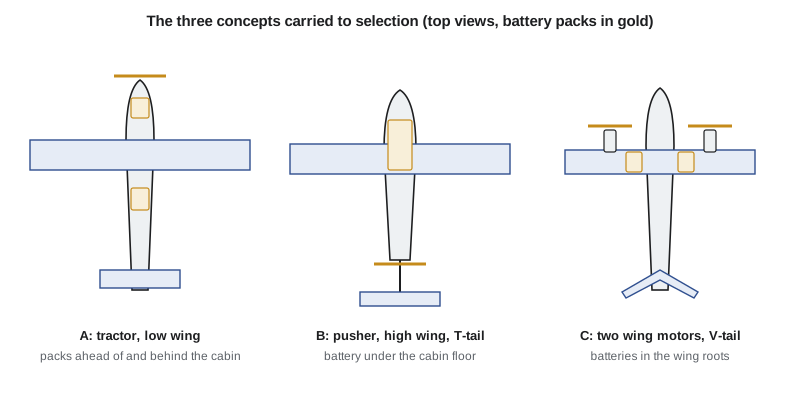
Concept A is the conventional answer, deliberately included as a reference: a low wing, a single tractor motor in the nose, one battery pack ahead of the cabin and one behind it, a conventional tail and fixed tricycle gear. Its strength is that everything about it is understood, from handling to certification. The two packs balance each other about the wing, and the front pack sits behind a firewall that protects the occupants from a fire in it.
Concept B puts the propeller behind the cabin as a pusher, with a T-tail above the slipstream, a high wing and the whole battery under the cabin floor. Its strengths are a quiet cabin, a clear view forward with no propeller arc, and a wing that does not block the view downward in the circuit. Its weaknesses are a heavy, long drive shaft or a motor in the tail cone where cooling is hard, a propeller exposed to stones thrown up by the nose wheel, and a battery directly under the occupants, where it is closest to them in a fire or a hard landing.
Concept C is the most ambitious. Two motors on the wing leading edges blow the wing, raising its maximum lift so that the wing can be smaller and the aircraft more efficient in cruise. The batteries go in the wing roots, close to the motors and away from the cabin. A V-tail saves wetted area. Its weaknesses are its novelty, two motors to maintain, the asymmetric thrust if one fails, which a trainer flown by students must handle gracefully, and a V-tail whose mixed control inputs make the handling harder to certify and less like the aircraft students will fly next.
The hybrid reserve and the swappable packs are kept as variants that could apply to any concept. The hybrid variant is assessed in the next lesson and rejected, mainly because it brings back the fuel system, engine maintenance and emissions the school wants to escape, and because the engine would need to start reliably in the air after sitting cold for an hour, which Sam says is exactly when engines do not start. The swappable packs survive as an option for the detailed design.
Sketch before you calculate
For each concept the team draws a three-view sketch to approximate scale on squared paper before any calculation. Hélène, who spent years building aircraft before moving into engineering, insists on it. A sketch shows problems that a list hides: in concept B's first sketch the battery under the floor raised the seats so much that the occupants' heads touched the wing; in concept C's, the motors sat so close to the cabin that the propellers would have passed within a few centimetres of the door. Neither problem kills the concept, but both had to be solved before the concepts could be compared fairly.
Worked problem
Counting a morphological chart
A chart has rows with 2, 3, 3, 3, 2 and 2 options. How many combinations are there, and how many remain if one rule removes every combination that has both option 2 of row 2 and option 2 of row 5?
Show solution
- Total combinations: \(2 \times 3 \times 3 \times 3 \times 2 \times 2 = 216\).
- Combinations with both named options: fix those two rows, so \(2 \times 1 \times 3 \times 3 \times 1 \times 2 = 36\).
- Remaining: \(216 - 36 = 180\).
Answer: 216 combinations, of which 180 remain. Rules interact, so with several rules the count must be found by enumeration, as the code does.
Common mistakes
MistakeJudging ideas while generating them.
InsteadSeparate the divergent phase from the convergent phase; record every idea first.
MistakeStarting from a familiar aircraft.
InsteadStart from functions, so that the electric drive's freedoms are not lost.
MistakeCarrying several near-identical concepts.
InsteadChoose concepts that differ as much as possible, with a conventional reference among them.
MistakeIgnoring alternatives to building an aircraft.
InsteadRecord competing options, such as more simulator training, so the sponsor sees the full picture.
Summary and key terms
- Concept generation is divergent: the aim is a wide field of ideas, judged later.
- The team starts from functions rather than an existing aircraft, because the electric drive changes where thrust and energy storage can go.
- Benchmarking existing electric and piston trainers calibrates estimates and shows that a certified path for small electric trainers exists.
- Brainstorming, brainwriting and analogy produce ideas; a morphological chart combines them; compatibility rules remove unworkable combinations.
- Three deliberately different concepts go to selection: a conventional tractor (A), a high-wing pusher (B) and a twin wing-motor V-tail (C), with a hybrid reserve and swappable packs as variants.
- Divergent phase
- Generating many options without judging them.
- Functional decomposition
- Breaking the system into the functions it must perform.
- Benchmarking
- Studying existing systems to learn and calibrate.
- Morphological chart
- Table of functions and options whose paths define concepts.
- Brainwriting
- Written idea generation passed between members.
- Reference concept
- A conventional concept included to compare others against.
Practice problems
Work each problem on paper first, then reveal the answer to check.
Why does the battery's constant mass matter to the configuration?
Show answer
The centre of gravity does not move in flight and the aircraft lands at take-off mass, and the battery's location dominates balance and crash safety.
How many combinations did the compatibility rules leave?
Show answer
101 of 216, and 40 with side-by-side seating and tricycle gear.
What is concept C's main aerodynamic advantage?
Show answer
Wing-mounted propellers blow the wing, raising maximum lift so the wing can be smaller.
Why was the hybrid reserve variant rejected?
Show answer
It brings back fuel, engine maintenance and emissions, and needs a cold engine to start reliably in flight.
Why does Hélène insist on sketches?
Show answer
Sketches reveal geometric problems, such as head clearance or propeller clearance, that lists hide.
Lesson quiz · 5 questions
Score 60% or more to complete this lesson.
Create a free account to save your progress, take quizzes and earn a certificate.