
AERO-499 · Lesson 12 of 12 · 22 min
Final presentation
In week 26 the team presents the Plover E2 to a board in the main boardroom at Borealis Aerospace in Winnipeg. Dr. Nakamura chairs it. With her are Élise, Kenji, Rachel Oduya, the owner and chief flight instructor of Lockport Flight Centre, Professor Lindqvist and two faculty assessors. The team has 18 minutes to present and 10 minutes for questions. At the end of the meeting the sponsor will decide whether to fund a next phase, and the assessors will grade the project. Eight months of work comes down to 28 minutes, and the team has learned from earlier reviews that what decides the outcome is less the slides than whether the board trusts the people presenting them.
The purpose of the presentation
The presentation is not a spoken version of the report. The board has had the report for a week; some have read it closely and others only the executive summary. The presentation has three jobs: to make the answer and the recommendation unmistakable, to give the board enough evidence to trust them, and to let the board probe the parts it doubts. Everything on the slides should serve one of those jobs. Detail that the report covers well, the full drag build-up, the derivation of the gust formula, the whole certification plan, belongs in backup slides that are ready if someone asks.
The storyline
Priya builds the storyline before any slide exists, on a single page, as a sequence of sentences that together tell the story. Each sentence will become the headline of one slide. Read in order, the headlines alone should give the board the whole argument.
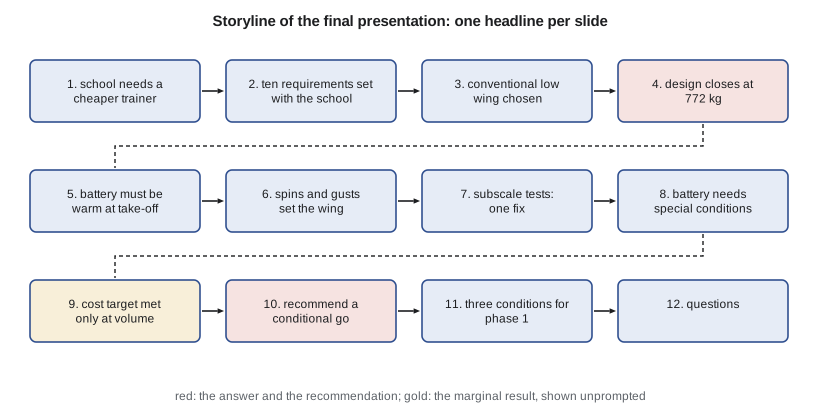
The storyline follows the pattern the report used: situation, answer, evidence, limitations, recommendation. It starts with the school's problem in its own words, because the school's owner is in the room and the problem is real to him. It gives the answer early, on the fourth slide: the design closes. Then it gives the evidence in the order of the questions the board is likely to ask: will the battery really do the lesson, will the structure carry the loads, does it fly properly, can it be certified, and what will it cost. The limitations come with the evidence, not after it. The recommendation is the last content slide, followed by its conditions.
Designing the slides
Each slide carries one message, stated as a full sentence in the headline: not “Battery results” but “The battery completes the lesson with reserve only when it starts at 20 °C or warmer.” The body of the slide is the evidence for that sentence, usually one figure simplified from the report: fewer lines, larger labels, and the one point that matters highlighted. The constraint diagram on the sizing slide shows only the three boundaries and the design point; the report's version, with intermediate wing loadings and annotations, would be unreadable from the back of the room. Text on slides is limited to what the audience must read; anything the speaker says does not also need to be written.
Hélène, who has sat through more design reviews than anyone in the room, gives the team three rules she says most presenters break. Use a font that the person at the far end of the table can read, which in practice means nothing smaller than about 24 points. Never show a table of numbers that the audience must study to find the point; put the point in the headline and highlight the numbers that support it. And number every slide, so that a board member can say “go back to slide 7” instead of “the one with the blue curve”.
Timing and rehearsal
Eighteen minutes for twelve slides is less than a minute and a half each, and the team has much more to say than that. Priya allocates time by importance: two minutes each for the sizing and the battery slides, which carry the main technical argument, and less for the slides that set up the problem or summarize. The plan leaves two minutes spare, because talks always run long. Then the team rehearses, three times, with a timer and an audience: Arjun, Sam and two students from another team.
# Final presentation plan: time budget per slide, rehearsal check and the requirement scorecard
slides = [('Title and team', 0.5), ('The flight school problem', 1.5), ('Requirements and mission', 1.5),
          ('Concepts and selection', 1.5), ('Sizing: closing the loop', 2.0), ('Battery and cold weather', 2.0),
          ('Structure and loads', 1.5), ('Subscale tests', 1.5), ('Certification and safety', 1.5),
          ('Cost per hour', 1.5), ('What we recommend', 1.0), ('Questions', 0.0)]
limit = 18.0                                       # minutes for the talk; 10 more for questions
total = sum(t for _, t in slides)
print(f'{len(slides)} slides, planned {total:.1f} min of {limit:.0f} min, {limit-total:.1f} min spare')
rehearsal = [0.6, 1.9, 1.7, 1.8, 2.6, 2.4, 1.4, 1.3, 1.6, 1.9, 1.2, 0.0]     # first timed run
for (name, plan), real in zip(slides, rehearsal):
    if real > 1.2 * plan and plan: print(f'  over by {(real-plan)*60:3.0f} s: {name}')
print(f'rehearsal total {sum(rehearsal):.1f} min -> cut {max(0, sum(rehearsal)-limit)*60:.0f} s or more')

score = {'R1 payload': 'met', 'R2 lesson + reserve': 'met with the pack at 20 C or warmer', 'R3 take-off': 'met', 'R4 climb': 'met',
         'R5 stall': 'met', 'R6 cruise': 'met', 'R7 recharge': 'met with an 80 kW charger', 'R8 certification': 'plan agreed',
         'R9 cost per hour': 'met in Canada at 200 aircraft; needs about 400 in the US',
         'R10 cold soak': 'met by pre-conditioning procedure'}
met = sum(1 for v in score.values() if v.startswith('met'))
print(f'\nrequirements met: {met} of {len(score)}')
for k, v in score.items(): print(f' {k:20s} {v}')12 slides, planned 16.0 min of 18 min, 2.0 min spare over by 24 s: The flight school problem over by 18 s: Concepts and selection over by 36 s: Sizing: closing the loop over by 24 s: Cost per hour rehearsal total 18.4 min -> cut 24 s or more requirements met: 9 of 10 R1 payload met R2 lesson + reserve met with the pack at 20 C or warmer R3 take-off met R4 climb met R5 stall met R6 cruise met R7 recharge met with an 80 kW charger R8 certification plan agreed R9 cost per hour met in Canada at 200 aircraft; needs about 400 in the US R10 cold soak met by pre-conditioning procedure
The first rehearsal runs 18.4 minutes, 24 seconds over even with the spare time used, and four slides overrun by more than 20 per cent. The sizing slide is the worst: Owen explains the whole sizing loop, iteration by iteration, when the board needs only the converged result and the sensitivity to battery specific energy. He cuts it to the result and one sentence on method, and puts the iteration table in a backup slide. The cost slide overran because Priya explained the DAPCA model; she replaces the explanation with one sentence and the calibration factor, and keeps the model in backup. By the third rehearsal the talk runs 16 minutes 40 seconds.
Each speaker presents their own area, which shows the board who did the work and lets the specialists question the person who knows most. The cost of five speakers is the handovers, which waste time and break the thread if they are clumsy. The team scripts them: each speaker ends with a sentence that leads to the next slide and names the next speaker. Priya opens and closes, so the board hears the problem and the recommendation from the same person.
Preparing for questions
The ten minutes of questions are where the board decides whether to trust the team. The team prepares for them as seriously as for the talk. Each member writes down the five hardest questions they could be asked in their area, and the team answers all of them in a mock session, with Arjun and Sam asking. Backup slides are made for the answers that need a figure. The list includes questions the team would rather not be asked: why should the sponsor believe a 200 Wh/kg pack will exist; what happens if the school flies more air work and fewer circuits; why the subscale model's glide ratio was so low; and whether the team simply chose the concept it liked.
Professor Lindqvist gives them advice on answering. Listen to the whole question before answering it. Answer it directly in the first sentence, then give the reason. If you do not know, say so, say what you would need to find out, and offer to follow up. Never guess a number in front of a board; a wrong number given confidently costs more trust than an honest “I don't know”. And if a question exposes a real weakness, agree that it is one, and say what the team did or would do about it.
Presenting a marginal result
The hardest part of the presentation is the cost slide, because the result is marginal: the target is met in one market at 200 aircraft and missed in the other. There is a strong temptation to present the favourable case and mention the other in passing. The team does the opposite. The slide shows both markets and the sensitivity to production quantity on one chart, with the 60 per cent target as a line across it, and the headline says what the chart shows: “Cost per hour meets the target only above about 200 aircraft where fuel is expensive and about 400 where it is cheap.” Kenji had told them earlier that a sponsor's executives have seen a hundred optimistic business cases and can recognize one instantly; a team that shows the unfavourable case unprompted is believed on everything else.
The same honesty applies to the recommendation. The team does not recommend that the sponsor develop the Plover E2. It recommends a conditional go: a funded first phase, about a year long, to remove the three uncertainties that could make the design fail, before any commitment to full development.
| Condition | What the next phase must show | Why |
|---|---|---|
| Battery | A qualified pack at 200 Wh/kg or better with a demonstrated cycle life of at least 2,000 cycles to 85 per cent | The mass, mission and cost all depend on it |
| Certification | An agreed certification basis with the regulator, including draft special conditions for the battery and propulsion unit | Novel features carry the largest schedule and cost risk |
| Market | Letters of intent from flight schools for enough aircraft to meet the cost target in the target market | The cost target is met only above about 200 to 400 aircraft |
The recommendation slide also shows the requirement scorecard from the code: nine of ten driving requirements met, with the certification basis planned but not yet shown, and with the conditions attached to R2 and R9 stated on the slide, not left for the questions.
The review
The questions come quickly. Rachel asks how the team would show that a misleading energy indication is hazardous rather than catastrophic; Grace walks through the functional hazard assessment and the two independent estimates. The chief flight instructor asks what happens on a winter morning when the hangar heater fails; Lucas explains that the take-off inhibit would stop the flight, and admits that the school would lose the lesson. Kenji asks whether a dual-winding motor would fix the drive train result in the fault tree; Grace says it probably would, at a mass the team estimates at 4 kg, and that it is the first change she would study. Dr. Nakamura asks the last question: “If this were your money, would you spend it?” Priya answers that she would spend the first-phase money, because it is small compared with full development and it answers the questions that decide everything else, and that she would not commit to full development today.
After the team leaves the room the board deliberates for twenty minutes. It funds a six-month study of the battery and certification conditions, smaller than the team proposed, with two of the students offered summer positions to work on it. The school's owner says that he will write a letter of intent conditional on the cost result. The assessors' comments praise the honesty of the cost slide and the way the team handled the cold-weather finding, and criticize the thin treatment of flutter, which the report identified but did not analyse.
Closing the project
A project is not finished when the presentation ends. The team holds a retrospective: what went well, what did not, and what each member would do differently. The early sizing loop, the charter's rule on reporting slips, and taking bad news to the sponsor early are on everyone's list of things that went well. The late start on the battery test rig, and the weeks lost to waiting for the final layout, are on the list of things that did not. The team then assembles a handover package for the sponsor: the report, the configuration sheet, the scripts with instructions, the test data, the risk register and the decision records, so that the engineers who continue the work start where the team stopped.
Professor Lindqvist ends the course with the same point she made in week 1. The Plover E2 may never be built. The team's grade, and more importantly the trust the sponsor now has in its members, comes from having found out honestly whether it should be, and from being able to show why.
Worked problem
Writing a slide headline
The battery slide shows the state of charge through the mission for three cases. Its draft headline is “Battery simulation results”. Write a better one.
Show solution
- Identify the one message the board must take from the slide: the battery meets the mission at end of life only if it starts warm.
- Include the condition and the number that matter: a pack temperature of 20 °C.
- Write it as a full sentence in plain language.
Answer: “At end of life the battery completes the lesson and reserve only if it starts at 20 °C or warmer.”
Common mistakes
MistakeTurning the report into slides.
InsteadChoose the few messages the board needs, one per slide, and keep the detail in backup slides.
MistakeUsing topic headlines such as “Results”.
InsteadWrite each headline as the sentence the slide proves.
MistakeRehearsing without a timer or audience.
InsteadRehearse at least three times, timed, with people who will ask questions.
MistakeHiding a marginal result.
InsteadShow the unfavourable case unprompted; it earns trust for everything else.
Summary and key terms
- The final presentation makes the answer and recommendation unmistakable, gives enough evidence to trust them, and lets the board probe.
- A storyline of sentence headlines carries the argument: problem, answer, evidence with limitations, recommendation.
- Each slide has one message and one simplified figure; detail goes to backup slides.
- Time is allocated by importance and tested in timed rehearsals; the first ran 18.4 minutes for an 18-minute slot and was cut to under 17.
- The team prepared answers to the hardest questions and presented the marginal cost result unprompted.
- It recommended a conditional go with three conditions on the battery, the certification basis and the market.
- The sponsor funded a smaller first phase, and the team closed the project with a retrospective and a handover package.
- Storyline
- Sequence of slide headlines that together carry the argument.
- Headline
- Full sentence at the top of a slide stating its message.
- Backup slide
- Slide prepared for an expected question, not shown in the talk.
- Conditional go
- Recommendation to proceed only if stated conditions are met.
- Retrospective
- Team review of what went well and what to change.
- Handover package
- Records that let others continue the work.
Practice problems
Work each problem on paper first, then reveal the answer to check.
What are the three jobs of the final presentation?
Show answer
Make the answer and recommendation unmistakable, give enough evidence to trust them, and let the board probe.
How long did the first rehearsal run, and what was cut?
Show answer
18.4 minutes; the sizing iterations and the cost model explanation moved to backup slides.
Why does each speaker present their own area?
Show answer
It shows who did the work and lets specialists question the person who knows most.
What are the three conditions of the recommendation?
Show answer
A qualified battery pack, an agreed certification basis and enough letters of intent.
How should a presenter answer a question they cannot answer?
Show answer
Say so, say what is needed to find out, and offer to follow up, rather than guess.
Lesson quiz · 5 questions
Score 60% or more to complete this lesson.
Create a free account to save your progress, take quizzes and earn a certificate.