
AERO-420 · Lesson 7 of 12 · 27 min
Launch vehicles and ascent
Every mission begins with the most violent and expensive part of its life: the climb from the ground to orbit. Crocus-1 will spend a few minutes on a launch vehicle and five years in orbit, yet the launch accounts for a large share of the mission cost and much of its risk. The spacecraft team does not design the launcher, but it must understand launch performance well enough to choose a ride, negotiate an orbit and design a satellite that survives the trip. This lesson builds the delta-v budget to orbit, explains why rockets have stages, and describes the loads and interfaces that the launcher imposes on the spacecraft.
Dr. Watanabe has two options on the table. The first is a rideshare on a large launcher flying from the United States, the option assumed in Lessons 4 and 5. The second is a dedicated small launcher flying from a commercial launch site proposed for Nova Scotia, which would put Crocus-1 exactly into its target orbit on a date of the team's choosing, at a higher price. Arjun's task is to check whether a small launcher of the class on offer can actually reach a 550 km sun-synchronous orbit with a payload of 150 kg, which covers Crocus-1 and its separation system.
The delta-v to orbit
Lesson 1 gave the circular speed at 550 km: 7.59 km/s. A launcher must deliver more than that, because it loses velocity on the way up to three effects. Gravity loss is the velocity lost while the rocket is climbing against gravity: every second the thrust is partly spent holding the vehicle up rather than accelerating it along the path. It amounts to roughly 1 to 1.5 km/s for typical launchers, more for vehicles with low thrust-to-weight ratios that climb slowly. Drag loss is the velocity lost to air resistance in the lower atmosphere, usually 0.05 to 0.2 km/s, small because the rocket leaves the dense air quickly. Steering loss comes from the thrust not pointing exactly along the velocity during the turn toward horizontal flight, about 0.1 to 0.2 km/s.
The rotation of the Earth then helps or hurts. A site at latitude \(\phi\) moves eastward at \(0.4651\cos\phi\) km/s. Launching eastward into a prograde orbit gains most of this speed; launching westward costs it. A sun-synchronous orbit is slightly retrograde, at 97.6 degrees, so the launch heads slightly west of south, or west of north, and the rotation works mildly against the vehicle. The launch azimuth \(\beta\) satisfies
and the component of the site's eastward speed along the launch direction is \(0.4651\cos\phi\sin\beta = 0.4651\cos i\) km/s. The latitude cancels. Whatever the launch site, the rotation penalty for a sun-synchronous orbit at 97.6 degrees is about 62 m/s. Latitude matters for prograde orbits, where a site near the equator gains up to 465 m/s, and it limits which inclinations can be reached directly, since a launch cannot reach an inclination lower than the site latitude without a plane change. For polar and sun-synchronous missions it matters mainly through range safety: the vehicle must be able to fly south or north over water or empty land, which is why the Nova Scotia site suits these orbits.
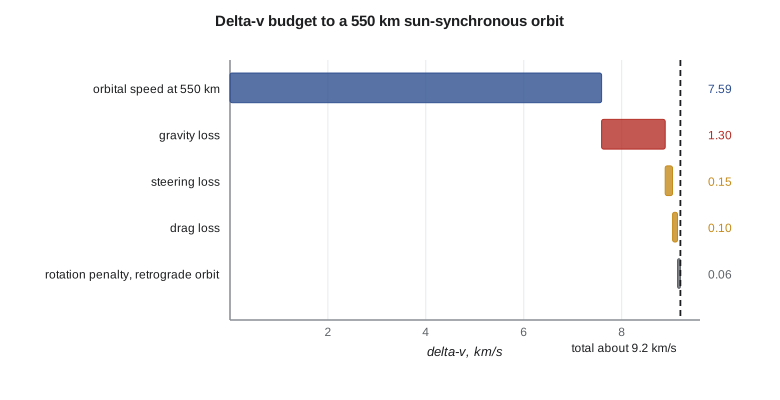
# Launch vehicle performance: delta-v budget to a 550 km sun-synchronous orbit and a two-stage small launcher.
import math
MU = 398600.4418; RE = 6378.137; G0 = 9.80665
v_orbit = math.sqrt(MU/(RE + 550))
lat = math.radians(45.1)
v_rot_east = 0.4651*math.cos(lat)            # km/s, eastward speed of the launch site
# A sun-synchronous orbit is retrograde (i = 97.6 deg), so the launch azimuth points slightly west of south
# and Earth's rotation works against the vehicle: sin(azimuth) = cos(i)/cos(latitude).
sin_az = math.cos(math.radians(97.6))/math.cos(lat)
rot_penalty = -v_rot_east*sin_az               # positive number = extra delta-v needed
losses = {"gravity loss": 1.30, "drag loss": 0.10, "steering loss": 0.15}
budget = v_orbit + sum(losses.values()) + rot_penalty
print(f"circular speed at 550 km {v_orbit:.3f} km/s; site at latitude {math.degrees(lat):.1f} deg moves east at {v_rot_east:.3f} km/s")
for k, x in losses.items(): print(f"  {k}: {x:.2f} km/s")
print(f"rotation penalty for the retrograde orbit {rot_penalty*1000:.0f} m/s; total budget about {budget:.2f} km/s")
def stage(m0, mp, isp):
    return isp*G0*math.log(m0/(m0 - mp))/1000
payload = 150.0
s2_dry, s2_prop, s2_isp = 550.0, 3300.0, 330.0
s1_dry, s1_prop, s1_isp = 2400.0, 21000.0, 295.0
m_s2 = payload + s2_dry + s2_prop
m_total = m_s2 + s1_dry + s1_prop
dv1 = stage(m_total, s1_prop, s1_isp); dv2 = stage(m_s2, s2_prop, s2_isp)
print(f"lift-off mass {m_total/1000:.2f} t: stage 1 {dv1:.3f} km/s, stage 2 {dv2:.3f} km/s, total {dv1+dv2:.3f} km/s")
print(f"payload fraction {payload/m_total*100:.2f} percent; margin against budget {dv1+dv2-budget:+.3f} km/s")
single = stage(m_total, s1_prop + s2_prop, 320.0)
print(f"same propellant in one stage (Isp 320 s, dry mass of both stages carried): {single:.3f} km/s")circular speed at 550 km 7.585 km/s; site at latitude 45.1 deg moves east at 0.328 km/s gravity loss: 1.30 km/s drag loss: 0.10 km/s steering loss: 0.15 km/s rotation penalty for the retrograde orbit 62 m/s; total budget about 9.20 km/s lift-off mass 27.40 t: stage 1 4.207 km/s, stage 2 5.641 km/s, total 9.848 km/s payload fraction 0.55 percent; margin against budget +0.651 km/s same propellant in one stage (Isp 320 s, dry mass of both stages carried): 6.838 km/s
The budget comes to about 9.2 km/s, a typical figure for low Earth orbit. The two-stage launcher in the code has a lift-off mass of 27.4 tonnes. Its first stage carries 21 tonnes of propellant with a specific impulse of 295 s, averaged over sea level and vacuum, and delivers 4.21 km/s; its second stage carries 3.3 tonnes at a vacuum specific impulse of 330 s and delivers 5.64 km/s. The total, 9.85 km/s, beats the budget by 0.65 km/s. That margin is not wasted. It covers propellant reserves held back for dispersions, the extra energy to reach 550 km rather than a lower insertion, and the plane steering a real trajectory needs. Launchers advertise their performance to sun-synchronous orbit for exactly this reason: the published figure already includes these margins.
The payload is only 0.55 percent of the lift-off mass. This tiny fraction is normal. Even large launchers place only 2 to 4 percent of their lift-off mass in low Earth orbit, and the rest is propellant and structure that falls back or burns up. The rocket equation is responsible: the delta-v depends on the logarithm of the mass ratio, so each additional kilometre per second requires multiplying the mass ratio, not adding to it.
Why stages
The last line of the code shows the power of staging. The same total propellant, carried in a single stage with a better average specific impulse of 320 s, delivers only 6.84 km/s, far short of orbit. The single stage must accelerate its empty tanks and engines all the way to orbital speed. A two-stage vehicle drops the first stage's 2.4 tonnes of dry mass once its propellant is gone, so the second stage only pushes its own structure and the payload. The improvement is so large that every orbital launcher in service uses two or more stages, or a core with strap-on boosters, which is staging in parallel.
Staging has a second benefit. The first stage works in the dense lower atmosphere and needs engines with nozzles sized for sea-level pressure, while the upper stage works in near vacuum and can use a much larger nozzle expansion for a higher specific impulse. Each stage is optimized for its part of the flight. Reusable first stages, which fly back for landing, give up some performance to carry landing propellant, but the saving in hardware cost has transformed the price of launch over the last decade.
The ascent trajectory
A launcher rises vertically for the first few seconds to clear the tower, then begins a gentle pitch-over toward the launch azimuth. Through the lower atmosphere it flies a gravity turn, in which the thrust is kept along the velocity and gravity slowly bends the path toward the horizontal. This keeps the angle between the vehicle axis and the airflow near zero, which limits aerodynamic loads during the period of maximum dynamic pressure, usually around a minute after lift-off at an altitude of 10 to 15 km. Above the atmosphere the guidance switches to an optimal steering law that shapes the trajectory to reach the target orbit with the least propellant. The fairing that protects the payload is jettisoned once aerodynamic heating has fallen to a low level, typically above 100 km.
Many upper stages reach a low, elliptical orbit first and coast to the apogee, where a second burn circularizes. This is a Hohmann transfer from Lesson 4 built into the launch, and it lets the vehicle reach higher orbits efficiently. Rideshare missions often add several further burns to drop payloads at different altitudes or to deorbit the upper stage after the last separation, which reduces debris.
Launch time matters as well as launch site. For a sun-synchronous orbit the right ascension of the node, and so the local time of the equator crossing, is fixed by the moment of launch: the orbit plane is set where the Earth's rotation has carried the site when the vehicle lifts off. A 10:30 descending node from a high-latitude site corresponds to a particular time of day, and a launch that slips by an hour gives a crossing time an hour different, unless the vehicle steers to compensate. A dedicated launcher can therefore offer Crocus-1 the exact local time it needs, with a window of a few minutes each day. A rideshare offers the local time the primary customer wants, which is why the team asked for a manifest whose primary also wanted a mid-morning orbit. A mismatch of half an hour would be acceptable to Dr. Benali; a mismatch of three hours would not, and it cannot be fixed later with propellant, as the node-change costs of Lesson 5 showed.
Launch loads and the spacecraft
Marcus Webb's structure must survive the launch environment. The launcher's user guide specifies quasi-static accelerations, typically up to 6 to 8 g along the axis near burnout and 1 to 2 g laterally; sine vibration at low frequency; random vibration up to 2000 Hz; acoustic noise of about 140 decibels inside the fairing; and shock at separation events, the most severe when pyrotechnic devices fire. The spacecraft must also have its fundamental frequencies above minimum values, often around 40 Hz axially and 20 Hz laterally for a small satellite, so that it does not couple dynamically with the launcher. The team proves all of this by analysis and then by test: Crocus-1's structural model goes through vibration and shock testing before any flight hardware is built.
Other interface requirements are just as important. The fairing sets a maximum envelope, the separation system sets the mounting interface, and the launch provider limits outgassing, electromagnetic emissions and the energy stored in batteries and pressure vessels. For a rideshare, the satellite must usually be switched off during launch and must wait a set time after separation before deploying solar arrays or antennas, to protect the other payloads.
Choosing a ride
The comparison between the two options comes down to cost, schedule and orbit. The rideshare is cheaper per kilogram and well proven, but the orbit and date are set by others, which is why Crocus-1 carries propellant for orbit raising and an inclination trim. The dedicated launcher costs more but delivers the exact orbit and allows the team to launch when the satellite is ready. Regulation also differs. A launch from Canadian soil is authorized by Transport Canada, which authorizes launches from Canadian soil under its interim commercial space launch program while Parliament considers Bill C-28, the proposed Canadian Space Launch Act introduced in April 2026, while a launch from the United States is licensed under the US system and the licence is held by the launch provider. Either way the satellite operator remains responsible for its own spacecraft licences, covered in Lesson 12. The team chooses the rideshare for the first satellite and keeps the dedicated launcher as an option for a second.
| Item | Value | Comment |
|---|---|---|
| Circular speed at 550 km | 7.59 km/s | Lesson 1 |
| Gravity loss | about 1.3 km/s | depends on thrust-to-weight |
| Drag and steering losses | about 0.25 km/s | small for a well-shaped ascent |
| Rotation penalty, sun-synchronous | about 0.06 km/s | independent of site latitude |
| Total budget | about 9.2 km/s | before reserves |
| Two-stage launcher capability | 9.85 km/s | margin 0.65 km/s |
Worked problem
Rotation penalty
Show that the Earth-rotation penalty for a 97.6 degree orbit is about 62 m/s.
Show solution
- The eastward speed along the launch direction is \(0.4651\cos i\).
- \(\cos 97.6^\circ = -0.1323\), so the component is \(-0.0615\) km/s.
- The negative sign means rotation opposes the launch.
Answer: About 62 m/s of extra delta-v.
Worked problem
Stage delta-v
A second stage starts at 4000 kg with 3300 kg of propellant and \(I_{sp} = 330\) s. Find its delta-v.
Show solution
- Mass ratio \(= 4000/700 = 5.714\).
- \(\Delta v = 330(9.80665)\ln 5.714 = 3236(1.743)\).
Answer: 5.64 km/s, as in the code.
Worked problem
Equatorial advantage
How much eastward speed does a site at 5 degrees latitude provide for a due-east launch?
Show solution
- \(0.4651\cos 5^\circ = 0.463\) km/s.
Answer: About 463 m/s, a large help for prograde orbits.
Common mistakes
MistakeTaking the circular speed as the launch delta-v.
InsteadAdd gravity, drag and steering losses, about 1.5 km/s.
MistakeAssuming a southern or equatorial site helps a sun-synchronous launch.
InsteadThe rotation penalty depends only on inclination for these orbits.
MistakeAdding stage delta-v without the masses that each stage carries.
InsteadEach stage pushes all the stages above it and the payload.
MistakeIgnoring the fundamental frequency requirement.
InsteadA satellite that is too flexible can couple with the launcher.
MistakeAssuming the launch provider's licence covers the satellite.
InsteadThe operator holds separate spacecraft licences.
Summary and key terms
- Reaching low Earth orbit needs about 9.2 km/s: the orbital speed plus gravity, drag and steering losses, adjusted for the Earth's rotation, which for a sun-synchronous orbit costs about 62 m/s from any site.
- Staging makes this possible by discarding dry mass, and the payload is still only about 0.5 to 4 percent of lift-off mass.
- The ascent follows a gravity turn and an optimal upper stage trajectory.
- The spacecraft must survive quasi-static, vibration, acoustic and shock loads and meet frequency and interface limits.
- Crocus-1 flies on a rideshare first.
- Gravity loss
- Velocity lost while thrust holds the vehicle up against gravity.
- Drag loss
- Velocity lost to air resistance during ascent.
- Launch azimuth
- The compass direction of the launch.
- Staging
- Discarding empty stages to reduce the mass to be accelerated.
- Gravity turn
- An ascent in which gravity bends the trajectory while thrust follows the velocity.
- Maximum dynamic pressure
- The point of highest aerodynamic load during ascent.
- Fairing
- The nose shroud that protects the payload through the atmosphere.
- Rideshare
- A launch that carries many payloads to a shared orbit.
Practice problems
Work each problem on paper first, then reveal the answer to check.
What is the total delta-v budget to Crocus-1's orbit?
Show answer
About 9.2 km/s.
Why does staging help?
Show answer
Empty tanks and engines are discarded instead of being accelerated to orbit.
What delta-v would the single-stage version deliver?
Show answer
About 6.84 km/s, not enough for orbit.
Why is the payload fraction so small?
Show answer
The rocket equation makes delta-v depend on the logarithm of mass ratio.
When is the fairing jettisoned?
Show answer
Once aerodynamic heating is low, typically above 100 km.
Why must a rideshare payload wait after separation before deploying?
Show answer
To protect the other payloads and the upper stage.
Lesson quiz · 5 questions
Score 60% or more to complete this lesson.
Create a free account to save your progress, take quizzes and earn a certificate.